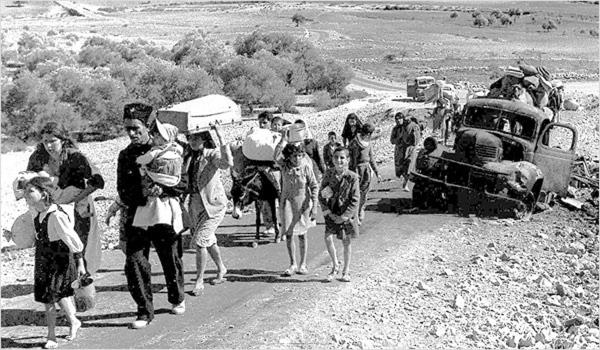
Palestinian refugees: Some of the 750,000 driven from Palestine, 1948. Photo: Wikipedia
Contents (new entries and updated information will be added to this page—look for those labeled as “NEW” and "UPDATED")
- 1940 - 1949: The Nakba; Deir Yassin massacre; Murders of Palestinian fedayeen “infiltrators”
- 1950 - 1959: Raids into Jordan-controlled West Bank; Raid on Qibya; Attacks in Egypt and in Gaza during Suez Canal crisis; Support for Iran’s brutal Shah regime
- 1960 - 1969: Six-Day War; Israeli settler and military attacks on Palestinians, West Bank; Battle of Karameh, Jordan; Israeli nuclear weapons
- 1970 - 1979: The October War (Yom Kippur War)
- 1980 - 1999: Lebanon War, and the Sabra and Shatila Massacre, Lebanon; Attack on PLO headquarters in Tunisia; Crackdown on first Palestinian Intifada (uprising)
- 2000 - 2009: Attacks during the Second Palestinian Intifada; Blockade of Gaza; Operation Cast Lead (First Gaza War)
- 2010 - 2019: The Great March of Return, Gaza
- 2020 - Present: May 2021 Gaza War; Genocide in Gaza; Bombings in Yemen; Assassinations with booby-trap pagers as part of war against Hezbollah, Lebanon; Attacks on Syria during the civil war; Bombing of Iranian consulate in Damascus, Syria, killing high-ranking Iranian officers; Seizing Syrian territory after overthrow of Assad regime; 12-Day War against Iran; U.S.-Israeli War on Iran; Unleashing the “Gaza model” in Lebanon
Israel is a racist apartheid state which was imposed on the Middle East with the backing of U.S. and other imperialist powers—at the cost of great suffering for the Palestinian people, and the people of the region more broadly, from Israel’s beginning up to today.
Now, as the U.S. and Israel carry out massive war crimes in Iran, bourgeois (capitalist-imperialist) politicians and media keep repeating how terrible the regime in Iran is. But as pointed out in “Three Dividing Lines: From the Revcoms, on the U.S.-Israeli War on Iran”:
Yes, this Iranian regime of brutally oppressive Islamic fundamentalist tyrants is truly terrible. But—contrary to what is voiced, in rote repetition, by bourgeois politicians, of both ruling class political parties (Democrat as well as Republican), and other representatives of U.S. imperialism—this Iranian regime is not the most terrible terrorist force in the Middle East (or the whole world, as Trump has claimed). That “distinction,” with regard to the Middle East, clearly belongs to Israel—which is a genocidal terrorist state that has carried out, and continues to carry out, atrocities on a scale well beyond that of the Iranian regime. (And, in terms of the world as a whole, the most destructive, and yes, terroristic, force clearly is the USA—not only in the form of the current fascist regime but overall and for some time.)
The chart we have compiled here includes many of the atrocities and terrorist attacks carried out by Israel, starting with the Nakba (Arabic for “catastrophe”)—the massacre of 15,000 Palestinians and the ethnic cleaning of 750,000 from their land at Israel’s 1948 founding, and up to the present—including the wars Israel has waged against Lebanon, Iran, Egypt, Syria, Iraq, Jordan and elsewhere in the region. For decades, the U.S. has backed up this terrorist state of Israel—with billions of dollars in military and other aid every year, as well as diplomatic and political support. This is because, as revolutionary leader Bob Avakian points out, “Israel plays a ‘special role’ as a heavily armed bastion of support for U.S. imperialism in a strategically important part of the world (the ‘Middle East’).”
1940s
Nakba (the “catastrophe” in Arabic)—violent ethnic cleansing of Palestinian Arabs from their homeland
1947-1949
Israeli military forces and Zionist terrorist groups attacked Palestinian cities and destroyed more than 531 villages. About 15,000 Palestinians were killed in a series of atrocities, including dozens of massacres. At least 750,000— about half of Palestine's predominantly Arab population—were forced out of their homes and became refugees in Gaza and the West Bank, Lebanon, Jordan, Syria, Egypt and Iraq. To ensure that there would be nothing for the Palestinians to return to, Israel thoroughly destroyed their villages and even many olive and orange trees. Israel has built “calm and idyllic” forests over swaths of land on what were demolished Palestinian villages.
There were at least 31 documented massacres. And Israel had taken 78 percent of Palestinian territory.
This terrorist ethnic cleansing was foundational and essential in the establishment of the state of Israel.1
Deir Yassin massacre
1948

This is a mass grave used to bury 104 victims of the Deir Yassin massacre, April 1948. The round stone ring is a mass grave filled with female victims, and the square is a common grave for the men. Photo: AP
One of the most terrible massacres during the Nakba was in the village of Deir Yassin near Jerusalem, where Israeli forces killed more than 100 people. Some of the victims were mutilated and raped before being murdered. Entire families were killed. Dozens of men were paraded through Jerusalem on trucks and then executed in a nearby quarry. As news of the massacre spread, tens of thousands more fled their villages, making the massacre a decisive moment in Palestinian history.2
Murders of Palestinian fedayeen “infiltrators”
1949-1966
Israeli forces treated many Palestinians crossing the border as fedayeen (guerilla fighters) “infiltrators,” including Palestinians crossing into Israel for work, and killed them indiscriminately. Israelis killed between 2,700-5,000 mostly unarmed Arab “infiltrators” and expelled more than 10,000 Palestinians.3
1950s
Raids into Jordan-controlled West Bank
1953
IDF forces, fully armed and with heavy equipment, routinely crossed into the Jordanian-controlled West Bank and carried out raids against Palestinian villages, including Falameh, Rantis, Idna, Surif, and Wadi Fukin.4
Raid on Qibya
1953
Israeli military (Israeli “Defense” Force, IDF) troops, led by future Israeli prime minister Ariel Sharon, used mortars to bombard the West Bank village of Qibya, which at the time was under Jordanian control. More than 69 Palestinian civilians were massacred, two-thirds of whom were women and children. Thirty to forty buildings were destroyed. According to UN observers, ”bullet-riddled bodies near the doorways and multiple bullet hits on the doors of the demolished houses indicated that the inhabitants had been forced to remain inside until their homes were blown up over them.” Sharon wrote in his diary that “Qibya was to be an example for everyone.”5
Attacks in Egypt during Suez Canal crisis
1956
When Egypt nationalized the Suez Canal, Israel, along with French and British forces, attacked Egypt, with Israeli forces moving to occupy the Sinai Peninsula. Israel was responsible for an estimated 2,000-3,000 Egyptian deaths and the capture of more than 6,000 Egyptians as prisoners of war.6
Attacks in Gaza during Suez Canal crisis
1956
As France, Britain and Israel were moving toward war against Egypt over the Suez Canal crisis, Israel launched attacks against Palestinians in the Gaza Strip. Israeli police and military killed 275 Palestinians in Khan Yunis, 110 in Rafah, and 48 in the village of Kafr Qasim.7
Support for Iran’s brutal Shah regime
Late 1950s to 1979
The Shah of Iran was installed in power by a U.S.-engineered coup in 1953. The Shah turned Iran—oil rich and strategically situated—into a client of U.S. imperialism. Mossad, the Israeli spy agency, played a major role in training the Shah's notoriously brutal secret police, Savak, which tortured and killed thousands of Iranians. As mass opposition to the Shah's regime pulsed through Iran in 1977, Israel's "Project Flower" sent Iran up to $500 million worth of military and police equipment.8
1960s
Israeli nuclear weapons
1960s to present
Israel developed nuclear weapons in the 1960s, with help from French and British imperialists—and it is the only country in the Middle East that has this weapon of mass destruction. Israel refuses to openly admit they are nuclear-armed, but it is widely acknowledged by experts that Israel has about 90 nuclear warheads. This nuclear weapons arsenal serves as a thinly veiled terroristic threat of massive destruction against those Israel considers enemies in the region. At the same time, along with the U.S., Israel has accused Iran of trying to develop nuclear weapons and used that justification to bomb Iran in June 2025 and launch all-out war eight months later.9
Six-Day War
1967
Israel launched a war against Egypt that quickly spread to other Arab countries: Syria, Jordan, and Iraq. Israel captured the Sinai Peninsula from Egypt, and took over the remaining 23 percent of historic Palestine—the Gaza Strip (from Egypt), East Jerusalem and the West Bank (from Jordan), and the Golan Heights (from Syria).
Total non-civilian deaths included 11,000-15,000 Egyptians, 1,000 Syrians, and 6,000 Jordanians. The Israelis took some 6,000 prisoners. In 2022, an Israeli journalist revealed that Israeli soldiers burnt alive at least 20 Egyptian soldiers and the next day used a bulldozer to dig and bury their bodies in an unmarked mass grave, which is now an Israeli tourist attraction.
In the aftermath, hundreds of thousands more Palestinians became refugees, and more than one million Palestinians came under Israeli rule in the occupied territories.10
Israeli settler and military attacks on Palestinians, West Bank
1967-present
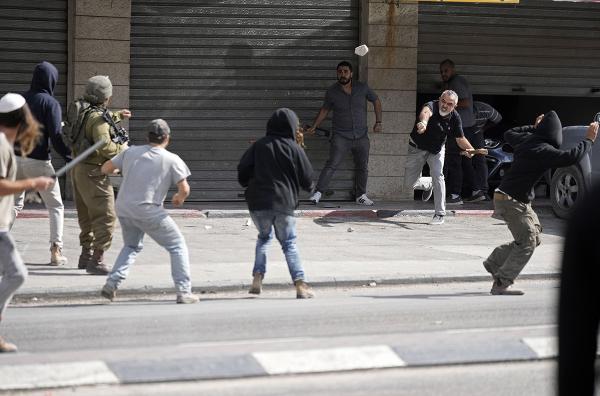
A Palestinian man throws a stone to defend himself from an earlier attack by a mob of settlers on Palestinians in Huwara in 2022. Photo: AP
The West Bank (land between Israel and the Jordan River, where three million Palestinians live), along with Gaza and the Golan Heights, has been under Israeli military occupation since 1967—the longest military occupation in modern history. For decades, increasing numbers of Israeli “settlers” have been seizing land in the West Bank to build illegal housing units—with the backing and protection of the Israeli government and military.
Between January 1, 2008 and March 15, 2026, 2,074 Palestinians were killed in the West Bank by the IDF and armed settlers. Israel has detained more than 21,000 Palestinians—including 1,655 children—since 2023. In 2025 alone, Israeli forces and settlers killed 671 Palestinians in the West Bank, including 129 children. More than 40,000 Palestinians have been forcibly displaced from their homes through Israeli military violence. Entire neighborhoods, roads, and other critical infrastructure have been destroyed. In 2024, the International Court of Justice (ICJ) ruled in an advisory opinion that Israel's occupation was illegal and called for Israel to end its "unlawful presence ... as rapidly as possible" and to make reparations to the people of the occupied territories.11
Battle of Karameh, Jordan
1968
An Israeli force of 15,000 soldiers, supported by tanks and fighter jets, attacked the combined forces of Jordan and the Palestine Liberation Organization (PLO) in the Jordanian border town of Karameh. After 15 hours of combat in which Israel suffered major losses, the Israelis were repulsed.12
1970s
The October War (Yom Kippur War)
1973
Egypt and Syria initiated a war against Israel with the aim of winning back territory previously lost to Israel. Backing each side were two nuclear-armed imperialist superpower rivals, the U.S. for Israel and Soviet Union for Egypt and Syria. More than 8,500 Egyptians and Syrians were killed, with 2,600 killed on the Israeli side.13
1980s
1982 Lebanon War, and the Sabra and Shatila Massacre, Lebanon
1982

Israel invaded Lebanon to destroy and expel the PLO. On September 16 and 18, Phalangist (pro-Israel fascist militia), accompanied by Israeli soldiers, attacked the Palestinian refugee camps of Sabra and Shatila in Beirut, murdering up to 3,500. Women were raped, people were decapitated, and pregnant women were stabbed so they and their fetuses were killed. Israeli soldiers fired flares to light the night sky for the Phalangists.
In February 1983, a UN commission found that “Israeli authorities or forces were involved, directly or indirectly” in these massacres.14
Attack on PLO headquarters in Tunisia
1985
In a long-range airstrike, Israel bombed the PLO headquarters in Tunisia. The strike, using 1,000-pound bombs, killed 68 people, including 50 Palestinians and 18 Tunisians, and wounded over 100 people. According to the Associated Press, “Neighbors and families rushed into the streets, digging through rubble with their bare hands, searching for survivors.” One man told the AP, “On that tree, I found half the body of a martyr, still hanging and his blood still flowing.”15
Crackdown on first Palestinian Intifada (uprising)
1987-1993
Gaza and the West Bank erupted in mass upheaval against Israeli occupation and control. Palestinians, primarily youth, set up roadblocks, and confronted Israeli soldiers by throwing stones. Israel launched a brutal crackdown, clubbing and breaking bones of protesters, and shooting them with live ammunition. By the end of the Intifada in 1992, more than 1,100 Palestinians were killed, including 250 children. Israel imprisoned about 120,000 Palestinians who were subjected to torture.16
2000s
Attacks during the Second Palestinian Intifada
2000-2005
In September 2000, Ariel Sharon—head of the Likud Party and soon to be prime minister—led hundreds of Israeli soldiers in a march to Haram al-Sharif, a site considered the third holiest in Islam after Mecca and Medina. Protests erupted with stone-throwing Palestinians who were met with rubber bullets. As the intifada fully erupted, battles raged between Palestinian guerillas and the Israeli military.
The Israeli military attacked Palestinians with deadly force, including warplanes, and political assassinations. Between September 2000-February 2005, about 3,200 Palestinians and about 1,000 Israelis were killed.17
Blockade of Gaza
Starting in 2007

Israeli naval commandos on stormed a flotilla of ships carrying aid and hundreds of pro-Palestinian activists to the blockaded Gaza Strip, killing at least 10 passengers in a deadly predawn raid, May 31, 2010. Photo: AP
Israel imposed a near-total blockade against the 1.5 million inhabitants of Gaza, making it the world’s biggest “open-air prison.” The Israeli blockade slashed food, medical, and fuel deliveries into Gaza. Living conditions became even more unbearable, and the UN warned of a humanitarian crisis.18
Operation Cast Lead (First Gaza War)
2008-2009
In what Israeli generals called “mowing the lawn,” Israel bombarded Gaza from air, land, and sea for 22 days. The assault, by F-16s, Apache helicopters, and unmanned drones murdered at least 1,417, including 313 children, and wounded more than 5,000. White phosphorus (a chemical weapon that burns people’s skin) rained down on the severely crowded population.
Human Rights Watch reported that “some 3,540 homes, 268 factories and warehouses, as well as schools, vehicles, water wells, public infrastructure, greenhouses and large swathes of agricultural land, were destroyed, and 2,870 houses were severely damaged.”19
2010s
Attacks on Syria during the civil war
2013-2025
During the civil war in Syria between the Assad regime and various forces backed by different powers, Armed Conflict Location and Event Data (ACLED) recorded that Israel had launched more than 600 air, drone or artillery attacks across Syria during the year 2025 alone.20
Operation Protective Edge, Gaza
2014
Lasting 50 days, an Israeli offensive with F-16 warplanes, tanks, and soldiers killed more than 2,200 Palestinians, including 551 children, and more than 11,000 were injured. Gaza was left in rubble and ruin.21
The Great March of Return, Gaza
2018-2019

Great March of Return protesters throwing rocks at IDF soldiers at Gaza border, May 5, 2018. Photo: IDF Spokesperson's Unit / CC BY-SA 3.0
The Palestinian Great March of Return demonstrations began on Land Day in 2018 to demand the end of the Israeli blockade of Gaza and the right of refugees to return to the homes they were expelled from. The nonviolent marches of tens of thousands were met with a horrific response by Israel, using tear gas, rubber bullets, and live ammunition. Medical workers and journalists were targeted. Snipers aimed at protesters’ legs in order to leave them disabled for life. The shootings overwhelmed the already strained Gazan healthcare system. From March 2018 to December 2019, close to 200 Palestinian protesters were killed and 8,000 wounded.22
2020s
May 2021 Gaza War
2021
Israeli settlers and IDF forces tried to evict Palestinians from East Jerusalem. Israeli police stormed the Al-Aqsa mosque and injured 300 worshippers, which ignited massive protests in Gaza. When the Islamic fundamentalist group Hamas fired missiles into Israel, the IDF began bombing Gaza. In 11 days of bombing, the Israeli air force destroyed more than 1,000 homes. More than 261 Palestinians were killed, including 67 children, and 2,000 wounded. Israel deliberately targeted water-treatment plants. By mid 2021, UNICEF estimated that half of the water network in Gaza—wells and reservoirs, desalination and waste water plants, water delivery systems, pumping stations—was damaged and nearly 800,000 people had no access to piped water.23
Genocide in Gaza
October 7, 2023-present

Palestinians killed while trying to get food at a Gaza Humanitarian Foundation site, July 19, 2025. Photo: AP
After the Hamas attack in Israel on October 7, 2023, Israel began a genocidal war against the entire Palestinian population of Gaza, with full U.S. backing (beginning with Biden and continuing with Trump). Israel has dropped more than 200,000 tons of explosives on Gaza—equivalent to 13 Hiroshima atomic bombs. Most of Gaza has been leveled by Israel, with 92 percent of homes damaged or destroyed. The Lancet reports there were 75,200 violent deaths, plus an additional 16,300 nonviolent deaths during the genocide, which does not include the perhaps 10,000 Palestinians buried in the rubble. As of October 2025, nearly 470,000 people—22 percent of Gaza’s population—were facing the imminent threat of starvation due to Israel’s blockade of food coming in, the consequences of which will affect the people of Gaza for generations to come. It’s estimated that Gaza’s population has declined by 254,000 or 10.6 percent since the start of the genocide.24
Bombings in Yemen
2024
In July and September, Israel bombed Yemen’s civilian infrastructure, which is a war crime under international law. This was at a time when Saudi Arabia, with U.S. backing, was carrying out large-scale attacks in Yemen. Israel carried out airstrikes on critical civilian installations in the city of Al-Hudaydah, including oil facilities, fuel tanks, docks and cranes at the port, as well as the central power station, knocking out power to the city. Israeli airstrikes resulted in dozens of casualties. The head of the Yemeni group Mwatana for Human Rights said that “This could lead to a humanitarian catastrophe, pushing Yemen into further starvation and suffering.”25
Assassinations with booby-trap pagers as part of war against Hezbollah, Lebanon
2024
On the afternoon of September 17, thousands of digital pagers across Lebanon suddenly exploded—in markets, homes, cars and hospitals. The explosions reportedly killed at least 39 people and maimed or injured 3,400, including 200 critically. The next day, booby-trapped walkie-talkies exploded. This was a terrorist attack by Israel, supposedly aimed at the Iranian-backed Israeli fundamentalist group Hezbollah. But most of those killed and severely injured were ordinary people going about their daily business. This was part of Israel’s war against Hezbollah in Lebanon, which left whole regions of Lebanon in ruins.26
Bombing of Iranian consulate in Damascus, Syria, killing high-ranking Iranian officers
April 1, 2024
Using U.S.-supplied “stealth” jets, Israel attacked the Iranian consulate residential building, killing or wounding everyone inside, including high-ranking Iranian military officers.27
Seizing Syrian territory after overthrow of Assad regime
December 2024-present
Just days after the fall of the reactionary Assad regime, Israel announced it had achieved total air superiority by destroying more than 80 percent of Syria's air defense systems. It attacked Syria at least 900 times in the year after the Assad regime's fall. Israel has also sent troops into the Syrian side of the Golan Heights, violating the 1974 ceasefire agreement with Syria. And it has established military outposts in areas of the UN-monitored demilitarized zone, and is carrying out air and ground attacks from there—all in violation of Syria’s sovereignty and international law.28
12-Day War against Iran
June 12-24, 2025
In an illegal, unprovoked war of aggression, Israel carried out nearly 360 attacks across Iran over 12 days. The attacks started as the U.S. was supposedly carrying out “negotiations” with Iran. At least 1,190 Iranians were killed and 4,475 injured across Iran. Health care facilities and services were among those hit, including 9 hospitals, 6 ambulances, and 1 Red Crescent helicopter. Over 200 locations in the Tehran area were bombed in the first 10 days of the attacks. Nine days after the start of the Israeli bombings, the U.S. sent seven B-2 stealth planes that dropped 14 30,000-pound “bunker-buster” bombs on Iran’s nuclear facilities and fired 30 submarine-launched Tomahawk cruise missiles.29
U.S.-Israeli War on Iran
February 2026-present

On February 28, Israel joined the U.S. in a surprise attack on Iran—launching an unprovoked, unjust and criminal war that is involving many other countries in the region and could spiral to even more dangerous and horrific levels. Human Rights Activists-Iran (HRA-Iran) reported that as of March 29, 3,461 Iranians had been killed by the joint U.S.-Israel attacks. Of those, 1,551 were civilians, 236 of them children (including more than 160 schoolgirls massacred when a U.S. missile hit in Minab). Top government and military officials have been targeted and assassinated. Historic sites important to the culture of the people of Iran have been damaged or destroyed.30
Unleashing the “Gaza model” in Lebanon
March 2026-present
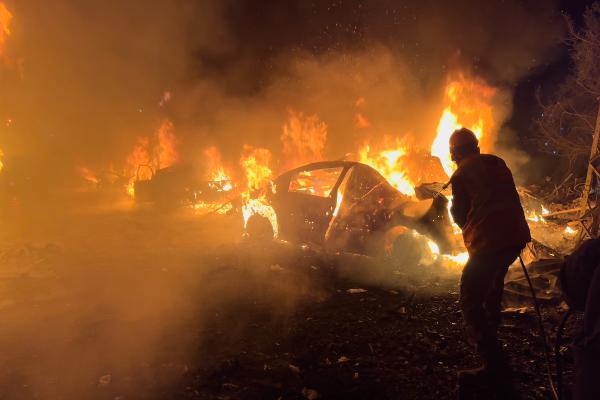
The site of one of the Israeli airstrikes, in Beirut, Lebanon, April 1, 2026. Photo: AP/Huyssein Malla
Shortly after the U.S.-Israel war on Iran began, Israel launched a pre-planned assault to implement what it called the “Gaza model”—in other words, genocide—in Lebanon aimed at eliminating Hezbollah. That includes massive devastation and occupation of Lebanese towns and territory south of the Litani River—some 8-10 percent of Lebanon’s territory. And it means large-scale death and devastation for people across all Lebanon, including the densely populated capital, Beirut. In the first three weeks of this war, Israel dropped over 2,200 bombs and killed over 1,000 Lebanese, and wounded over 2,500. The IDF ordered the blanket evacuation of over a million people from their homes. On March 16, Israel launched a ground invasion.31
FOOTNOTES:
1. Quick Facts: The Palestinian Nakba (Catastrophe). Institute for Middle East Understanding, April 5, 2023
Explainer: The Deir Yassin Massacre. Institute for Middle East Understanding, April 5, 2023
Five things the United States knew about the Nakba as it unfolded, Middle East Institute, May 13, 2022.
From one generation to the next, Palestinians aim to keep the history of al-Nakba alive, CNN, May 24, 2024
Pappe, Ilan, A Very Short History of the Israel-Palestine Conflict, Oneworld Publishers, 2024.
Factsheets: Refugees, The Palestinian Academic Society for the Study of International Affairs.
Palestinian Villages, Israeli Parks: How the Past Echoes in the Present, Institute of Palestine Studies, December 23, 2015. [back]
2. Explainer: The Deir Yassin Massacre. Institute for Middle East Understanding, April 5, 2023. [back]
3. A Brief History of the Arab-Israeli Conflict. Jeremy Pressman, University of Connecticut, May 19, 2005.
Israeli Military: A 100% Failure Rate Eradicating Palestinian Militant Resistance, Evergreen Review. [back]
4. Attacks on West Bank village Qibya, Gaza Bureij camp—UNTSO report (Bennike), SecCo debate, SecGen statement—Verbatim record, United Nations. [back]
5. Benny Morris, Israel's Border Wars, pp. 257-276. esp. pp. 249, 262.
The Question of Palestine, United Nations, October 27, 1953. [back]
6. 1956—Sinai Campaign. History Central.
“Casualties of Mideast Wars,” Los Angeles Times, March 8, 1991. [back]
7. Special report of the Director of the United Nations Relief and Works Agency for Palestine Refugees in the Near East covering the period 1 November 1955 to mid-December 1956, UNRWA, 1957. [back]
8. The Rise and Fall of the Shah, Amin Saikal.
"Documents Detail Israeli Missile Deal With The Shah". [back]
9. The Samson Option, Seymour Hersh, Random House New York, 1991.
Iran threatens strike on Dimona, the heart of Israel’s long-ambiguous nuclear program, Interesting Engineering, March 5, 2026.
Israel’s Nuclear Program, Nuclear Age Peace Foundation, October 1, 2019.
Unraveling the Myth of Opacity: How Israel’s undeclared Nuclear Arsenal Destabilizes the Middle East, The International Affairs Review, October 16, 2012. [back]
10. Six-Day War. EBSCO.
Six-Day War | Definition, Causes, History, Summary, Outcomes, & Facts | Britannica.
Israel’s burning alive of Egyptian soldiers proves its immorality, Middle East Monitor, May 13, 2022. [back]
11. 6 things you need to know about Israeli violence in the West Bank, American Friends Service Committee, 1/6/26. Confronting violent settlers in the occupied West Bank, together, BBC, 8/9/24.
Northern West Bank Humanitarian Response Update | 21 January—30 April 2025. United Nations Office for the Coordination of Humanitarian Affairs.
Data on casualties, United Nations Office for the Coordination of Humanitarian Affairs.
Israel and Palestine: Events of 2023. Human Rights Watch.
The Question of Palestine. United Nations.
Israel’s continued occupation of Palestinian territory ‘unlawful’: UN world court. UN News, 7/19/24.
For Palestinians, the Local is the National, Diana Greenwald, Assistant Professor of Political Science at the City College of New York, Jadaliyya, May 1, 2023.
Summary of the Advisory Opinion of 19 July 2024. [back]
12. Battle of Karameh Establishes Claim of Palestinian Statehood, Donald Neff, Washington Report on Middle East Affairs, March 1998, pp. 87–88. [back]
13. Yom Kippur War. EBSCO. [back]
14. Sabra and Shatila massacre survivors: 'It can’t be unseen', Middle East Eye, September 16, 2022.
Sabra and Shatila: Jewish nurse recounts horrors of Palestinian massacres, Middle East Eye, September 16, 2022. [back]
15. Tunisians remember the Israeli strike that bound their fate with Palestinians 40 years ago. Associated Press, October 2, 2025. [back]
16. Explainer: The First Intifada, Institute for Middle East Understanding, December 16, 2012. [back]
17. Second Intifada (Al-Aqsa Intifada, 2000–2005?), Economic Cooperation Foundation, September 28, 2000.
Israeli-Palestinian fatalities since 2000–OCHA Special Focus, UN, August 2007.
Al-Aqsa Intifada, EBSCO. [back]
18. THE GAZA STRIP: The Humanitarian Impact of the Blockade. UN Office for the Coordination of Humanitarian Affairs, July 2015. [back]
19. Israel/Gaza: Operation ‘Cast Lead’ - 22 Days of Death and Destruction, Amnesty International, July 2, 2009.
Fact Sheet: Israel’s “Operation Cast Lead” (2008-09), Institute for Middle East Understanding, January 4, 2012.
Human Rights In Palestine and Other Occupied Territories, UN Human Rights Council, September 24, 2009.
“I Lost Everything” Israel’s Unlawful Destruction of Property during Operation Cast Lead, Human Rights Watch, 2010. [back]
20. Israel attacked Syria more than 600 times over the past year. https://www.aljazeera.com/news/2025/12/9/israel-attacked-syria-more-than-600-times-over-the-past-year. [back]
21. 2014 Gaza conflict, UNRWA. [back]
22. Great March of Return One Year On, UNRWA.
Report of the detailed findings of the independent international Commission of inquiry on the protests in the Occupied Palestinian Territory, Human Rights Council, February-March 2019. [back]
23. The May 2021 Gaza War, Interactive Encyclopedia of the Palestine Question.
Children bear brunt of violence in Gaza, UNICEF, May 21, 2021.
Overview | November 2021, UN Office for the Coordination of Humanitarian Affairs, November 3, 2021. [back]
24. Gaza population fell by 254,000 since Israel genocidal war began: Study, ahramonline, February 2, 2026.
Gaza death toll exceeds 75,000 as independent data verify loss, Al Jazeera, February 18, 2026.
Malnutrition crisis reaches catastrophic levels as famine declared in parts of Gaza, British Red Cross, October 10, 2025.
What is happening in Gaza? The ceasefire agreement offers a crucial moment of hope, British Red Cross, December 2, 2025.
The ruin of Gaza: how Israel’s two-year assault has devastated the territory, The Guardian, October 7, 2025.
10,000 people feared buried under the rubble in Gaza, United Nations, May 2, 2024.
From enumeration to inference: what the Gaza Mortality Survey reveals—and misses—about counting deaths in the Gaza Strip, The Lancet, April 2026.
"Health Is Political": Dr. Tanya Haj Hassan On the "Health Is Political": Dr. Tanya Haj Hassan On the Targeting of Infrastructure Sustaining Children's Health in Gaza, Institute of Palestine Studies, March 3, 2026. [back]
25. For the second time: Israel’s war machine targets Yemen’s power infrastructure, Reliefweb, October 2, 2024.
Conflict in Yemen and the Red Sea, Center for Preventive Action, February 28, 2026. [back]
26. A year on, Lebanese maimed in Israel's pager attacks on long road to recovery. Reuters, September 17, 2025. [back]
27. Iran accuses Israel of killing generals in Syria strike, BBC, April 1, 2024. [back]
28. Middle East Overview: December 2025, ACLED, December 8, 2025.
UN sounds alarm at Israel’s ‘severe violations’ at key buffer zone with Syria, CNN, November 14, 2024.
UN experts say Israel airstrikes on Syria violate international law, JURIST, December 12, 2024. [back]
29. Twelve Days Under Fire: A Comprehensive Report on the Iran-Israel War. Human Rights Activists News Agency, June 13, 2025.
In Twist, U.S. Diplomacy Served as Cover for Israeli Surprise Attack, Wall Street Journal, June 13, 2025. [back]
30. Day 29 of U.S. and Israeli Attacks on Iran: Strikes on Hundreds of Targets in Residential Areas, HRANA, March 28, 2026. [back]
31. As Israel prepares to implement the ‘Gaza model’ in Lebanon, where is the international reaction?, The Guardian, March 18, 2026.
War by the numbers: How many strikes, targets, and missions has Israel carried out? — explainer, The Jerusalem Post, March 19, 2026.
Iran hits Gulf oil facilities with retaliatory strikes; Global energy markets shaken; Lebanon death toll tops 1,000, Drop Site News, March 19, 2026.
Israeli Defense Minister Katz says Israel will take control of Southern Lebanon, BBC, March 31, 2026. [back]