“Don’t be Afraid! Don’t be Afraid! We Are All Together!” – Popular protest chant in Iran
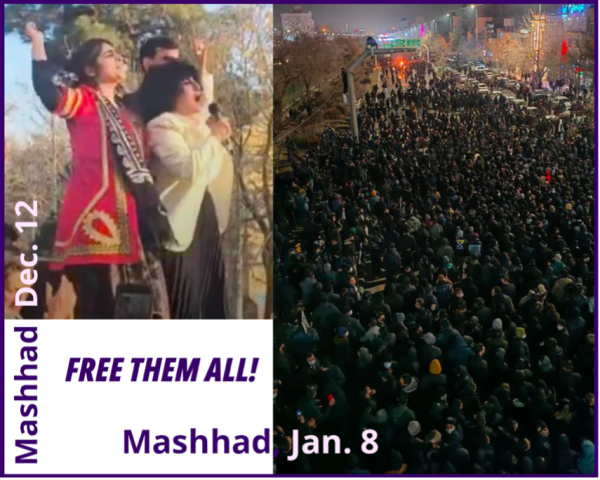
Left: Sepideh Gholian and Narges Mohammadi lead chants outside memorial for rights lawyer in Mashhad, before the attack which detained 50 mourners on December 12, 2025. Right: Huge protests fill Mashhad streets for hours, January 8, 2026. Composite: IEC
Facing live bullets, mass detentions, and torture chambers, people have taken to the streets in small and large cities in Iran day after day and night after night for the past 12 days and counting. “Don’t be afraid! Don’t be afraid! We are all together!”, and “Down with the Dictator!” are chanted from hard streets, affluent apartments and university dorms.
Lives of Detainees from Mashhad Memorial-Protest in Grave Danger
In this rapidly intensifying situation, several key activists, including Narges Mohammadi and Sepideh Gholian, remain cut off from almost all contact after they were brutally arrested on December 12 during a memorial in Mashhad for Khosrow Alikordi, a civil rights lawyer who had died under suspicious circumstances. About 560 miles from Iran’s capital and largest city Tehran, Mashhad is the country’s second largest city, a religious hub for fundamentalist theocratic forces, with a total of 75 Islamic seminaries/schools. The lives of these and newly arrested political prisoners are in imminent danger and should be defended and their bravery emulated.
Ali Rahmani, son of political prisoner and 2023 Nobel Peace laureate, Narges Mohammadi, posted a video on January 7 that included clips from the current protests in Iran, reminding everyone that his mother and 38 other activists have been disappeared with no location, charges, or contact with family and denied access to their lawyers. In her absence, he said, “I respectfully call on lawyers, activists, journalists and media outlets to be the voice of the Iranian people.” Ali, his twin sister Kiana, and their father, Taghi Rahmani, are in exile in France, and have not seen Narges for 9 years.
Iran’s political prisoners are the voices of conscience who have taken great personal risks and made big sacrifices to fight for justice, some speaking out against the regime as well as against Israeli-US aggression. In the swirl of complex and contradictory forces in Iran today, there is important potential for the political prisoners to help sharpen and lead the question of what way forward and how to avoid political pitfalls and defeats. It’s why, as an important part of supporting the people’s struggles raging in Iran, political prisoners must be defended, their voices must be heard, and they must be freed immediately!
With dozens killed and thousands of people (protesters, activists and bystanders) now being swept up into detention centers, where they face solitary confinement (such as all the women arrested at Mashhad on December 12), with forced confessions, beatings, torture and rape, the demand to identify, defend, and free the prisoners and to stop executions becomes all the more urgent.
The New and Continuing Round of Mass Rebellion
The current uprising in Iran began on December 28, 2025, with a strike and protests by merchants in the famed Grand Bazaar of Tehran, who were unable to set prices because of the disastrous rapid deflation of Iran’s currency (trading at 1.46 million rials to one U.S. dollar). University students in Tehran quickly called for students nationwide to join the protests, bringing demands for political freedoms, chanting “Down with the Dictator”, “Down with [Ayatollah] Khamenei”, “Freedom, freedom, freedom.”
Some videos show students chanting “Death to the Oppressor, whether Shah or Supreme Leader,” or women students waving their headscarves in defiance of compulsory headscarf laws in an echo of the Woman, Life, Freedom uprising of 2022-2023. The political significance of their chant is their rejection not only of the Islamic ruling mullah regime, but also of the U.S.-backed wannabe Shah or king (Reza Pahlavi), son of the brutal dictator Shah (Mohammad Reza Pahlavi), installed by a CIA coup in 1953 and overthrown by a mass uprising in 1979.
Initial Crackdown Sparks Broader and More Intense Resistance
The regime’s initial repressive actions quickly sparked further protests, fairly small at first, in smaller towns concentrated in Iran’s western regions, which are home to several oppressed or ethnic minority nationalities such as Kurds, Arabs and Lurs. The police, the elite Islamic (counter) Revolutionary Guard Corps (IRGC) and its paramilitary wing Basij, have moved to disperse protesters with live fire, mass arrests, tear gas and water cannons, and vicious assaults on the wounded at hospitals.
There were multiple vicious police attacks on a hospital. On January 3, in the small town of Malekshahi in Ilam province, protesters had marched on a government building, chanting, “Don’t be afraid! We are all together!” Police fired directly at the crowd from rooftops, injuring dozens and killing several. After the injured were rushed to the hospital, police surrounded the hospital and forced their way in, shattering doors and spraying tear gas, in an attempt to arrest the injured and remove the dead to prevent public funerals. Staff defended their patients even as they were themselves being beaten, while others chanted “Death to Khamenei”. By January 6, it is reported that the furious populace took control of the entire town of Malekshahi and drove out the IRGC and Basiji.
By the second week, protests also spread to small and large cities in the east, including Mashhad and Zahedan (a hub of the brutally oppressed Baluchi minority).
Kurdish Prisoners Join General Strike
Several Kurdish organizations issued a call for a general strike in several Kurdish majority provinces on January 8 in support of the nationwide uprising, which succeeded in shutting down commerce in many towns. At least 14 Kurdish political prisoners in Evin, Yazd and Sanandaj prisons joined them by going on hunger strike.
One of them, Varisheh Moradi, wrote a powerful statement supporting the current round of uprising, reposted in full by Burn The Cage and excerpted below:
This path is the continuation of the historical rupture of “Woman, Life, Freedom”; a rupture that has taken society through both reactionary poles: both religious tyranny and monarchy. Women are the vanguards of this struggle; not as symbols, but as a force that challenges the patriarchal and authoritarian order of both forms of power…. The leadership of this path lies in the hands of the people, not the kings of yesterday nor the rulers of today…[our emphasis]
—Varisheh Moradi, January 2026, Evin Women's Ward
As of January 9, Human Rights Activists News Agency (HRANA) reported that more than 512 protests had taken place across all of Iran’s 31 provinces in the first 13 days of the uprising. At least 50 protesters had been killed in gunfire, among them at least seven children under 18, a conservative figure since identities are still being verified. At least 2,300 had been arbitrarily arrested, among them at least 167 of children under 18, in many cases their whereabouts are still unknown. Student protests have erupted at 35 universities.
U.S./Israel and Their Toadies Salivate for Bloodlust in Iran
The U.S. and its genocidal partner Israel aim to fish in Iran’s troubled waters and seize it, threaten bloodletting in order to shore up their national interests. On January 2, Donald Trump posted on Truth Social that the U.S. is “locked and loaded” to intervene in Iran if the government kills protesters. Trump has repeatedly issued such bellicose threats on Iran in recent weeks “to knock the hell out of them,” as U.S. military hardware, its troops, warships and F-15 warplanes are poised in the region. The Persian language X account of the U.S. State Department posted their own obscenity on January 9 that Iran’s “…judiciary has again threatened protesters… Instead of addressing the roots of the unrest, the Islamic Republic’s regime relies on threats and intimidation. The world is watching.” Are all their mirrors broken?
Just don’t look at the blood of Iranian civilians dripping from Netanyahu and Trump’s jaws from the mid-June bombings, including of Evin prison, where many political prisoners are held. Don’t look at the fresh blood in the genocide in Gaza at U.S.-backed Israeli hands. Don’t look at the bloody history of the U.S.-CIA-backed Shah of Iran whose secret police SAVAK tortured political prisoners and children in front of their parents. There is now hyper online promotion of Reza Pahlavi to manufacture consent inside and outside Iran in case he is needed to ride a red, WHITE and blue horse into Tehran.
NO! DO LOOK, THEN ACT. Look at Venezuela, at Nigeria, at Gaza and inside the U.S. The threats are not empty rhetoric. Take these threats seriously; as people living in the U.S., we have the responsibility to politically respond against any U.S.-Israeli attack on Iran that “will bring more unbearable suffering to the people of Iran.” As the IEC co-posted (with Quemar La Jaula) a quote from our founding Emergency Appeal, now more relevant than ever, and called on people everywhere to amplify this understanding, and these demands:
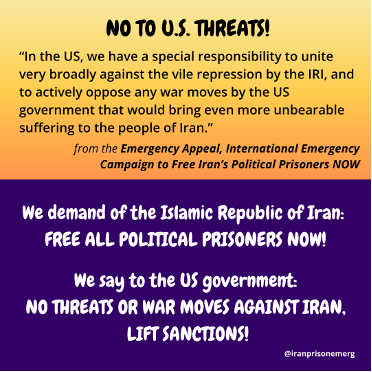
Graphic: IEC