400 Years of Crimes Against the Native Peoples in the U.S.
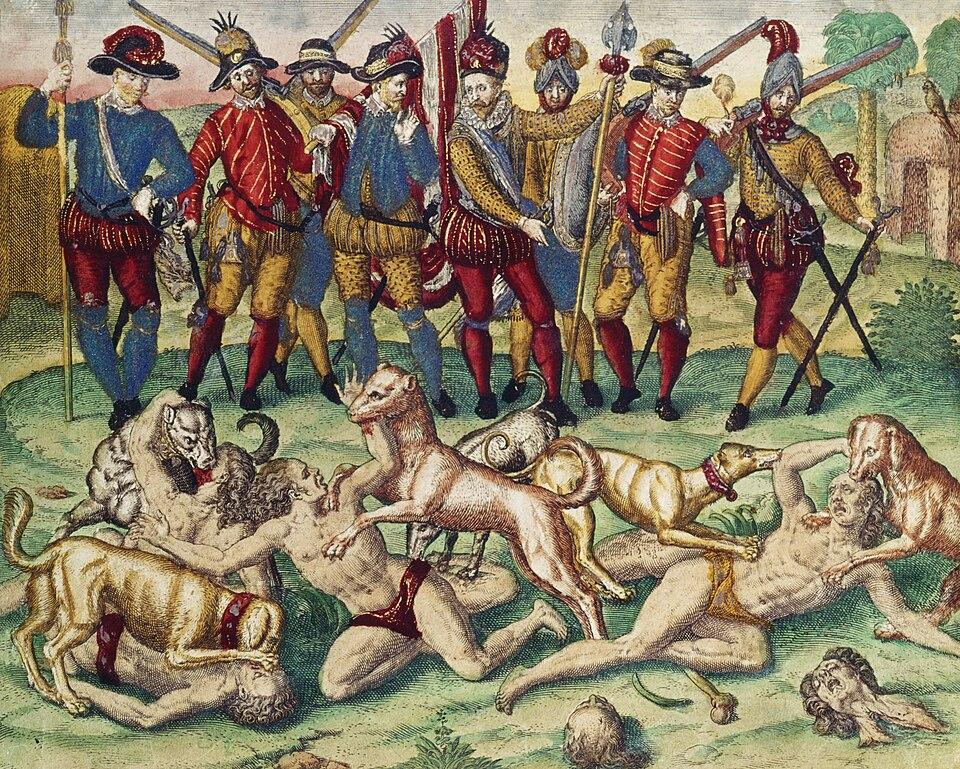
Spanish conquistadors like Columbus set war dogs on indigenous Americans. (Theodor de Bry, c. 1596) Illustration by Theodor de Brys, 1596 (public domain)
Christopher Columbus and his crew were met by the friendly indigenous Arawaks. They immediately took several Arawaks captive and demanded that they take them to the source of the gold they wore. (American Crime Case #77)
So began the conquest of the Americas.
“When Christopher Columbus reached the Americas in 1492, ten million indigenous people lived in what is now the United States. By 1900, there were less than 300,000.” (“Forced Removal of Native Americans,” Equal Justice Initiative.)
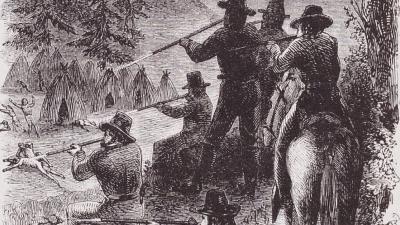
This was the beginning of a 400-year history of genocide achieved through the theft of the Native peoples’ lands and “forced removal,” through war and massacre after massacre, through the spread of disease, and the destruction of Native cultures. It is a history of brutal and deadly oppression with Native peoples enslaved and deemed inferior and sub-human.
Witness this:
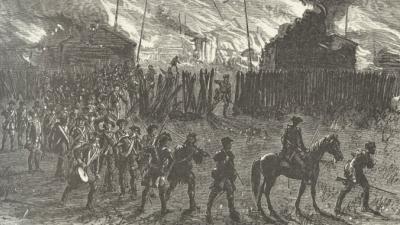
** “In June 1779, heavily armed caravans of more than 6,200 American soldiers headed north from Pennsylvania and west from a town near Albany, New York. These forces, under the command of General John Sullivan, of the Continental Army ordered by Washington himself then in a war for independence from England. ” Only 5,000 Native people were left alive and able to flee to Canada. In what became known as the “Winter of Hunger” whole families froze to death on their trek to Canada. (American Crime Case #90) This mass murder was only the beginning.
** “It is estimated that 95 percent of the indigenous populations in the Americas (meaning all of the Americas, North and South) were killed by infectious diseases during the years following European colonization, amounting to an estimated 20 million people.” These diseases included smallpox, bubonic plague, and measles. (“A Historical Perspective of Healthcare Disparity and Infectious Disease in the Native American Population,” Jamie E. Ehrenpreis, National Library of Medicine.)
** As the U.S was established, and then when the Civil War broke out in 1860 and continuing in its aftermath, the theft of the Native lands and accompanying ethnic cleansing continued. Native peoples were driven out of their lands to make room for the expansion of slavery, capitalism, the mining of gold in California, and the coming of the railroad and the white settlers frantically going west. A case in point: “In 1830 Andrew Jackson informed Congress of the progress of the Indian Removal east of the Mississippi River… By the end of Jackson’s Presidency, his administration had negotiated almost 70 removal treaties. These led to the relocation of nearly 50,000 eastern Indians to the Indian Territory—what later became eastern Oklahoma. It opened up 25 million acres of eastern land to white settlement and, since the bulk of the land was in the American south, to the expansion of slavery.” (“President Andrew Jackson’s Message to Congress ‘On Indian Removal’ (1830),” Milestone Documents, National Archives.)
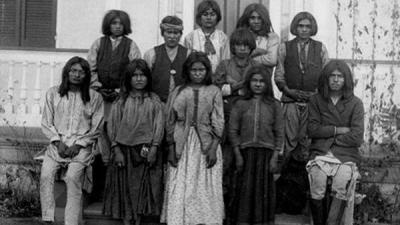
** Kill the Indian, save the man--the slogan raised by the rulers as thousands of children were kidnapped and forced into boarding schools. From the moment of their arrival at boarding school the children were stripped of their indigenous identity, and simultaneously indoctrinated to view their own heritage—and themselves— as something to be despised, and eradicated. The boys’ heads were shaved; all the children’s clothes were taken, replaced with uniforms. Their real names were changed to European names to both “civilize” and “Christianize” them. They were taught English and forbidden to speak their Native languages—even to each other—and they were forced to abandon their Native beliefs and take up Christianity. All of this contributed to a sense that they had lost themselves. (American Crime Case #40)
A word on the treaties the U.S. signed with the Native American peoples
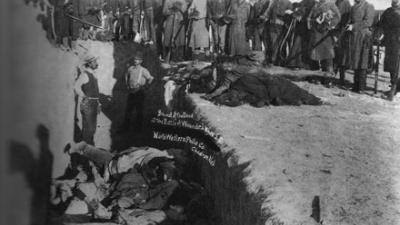
Throughout the history of the U.S., the government continually signed treaties with different peoples, but once signed they were quickly broken, ignored, or altered when new resources were discovered, such as gold in the Black Hills in South Dakota (held as sacred to the Native Americans) and California. Native American peoples were massacred again, raped and mutilated by the American Cavalry, settlers and “American heroes” like Daniel Boon, Kit Carson, and others who led the way along with the U.S Cavalry. The rest of the people were pushed further and further and further west than Jackson’s “Indian Territory” of Oklahoma.” (See “Broken Treaties” below.)
On this page:
On this page are only a few of the crimes committed by the rulers of the U.S. in this 400 year history, but they viscerally testify to the conclusion that “America was never great.” It was established to enrich and empower both the slave masters and the growing capitalist class in their insatiable drive to dominate and take all the land, resources and dehumanize human beings as slaves and producers of wealth, only to continue their plunder beyond the Continental U.S. and become the most powerful super-power that has replayed this shameful history in Latin America, Africa, and now in Gaza and the Middle East today, bringing us closer to world war and ecological existential threats to humanity which should not be celebrated on the 4th of July or any other day.
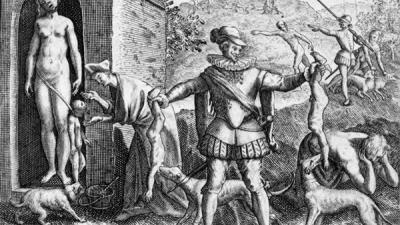
Infectious Diseases
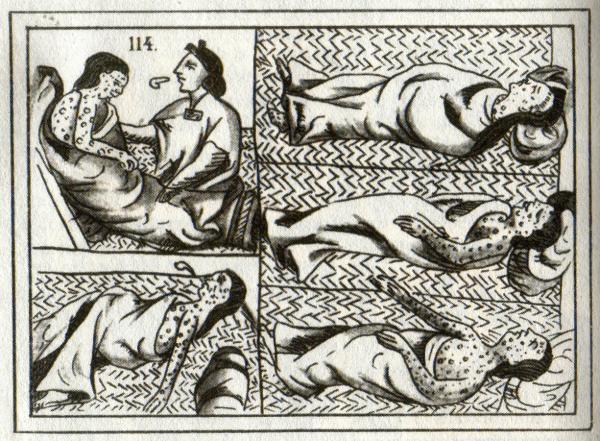
16th century Aztec drawing of smallpox victims. Public domain
“Infectious diseases had a profound historical impact on Native American populations beginning with the arrival of European settlers who introduced new diseases to previously naive populations. During the initial phase of European colonization, infectious diseases were the primary killer among Native American communities. Infections ranging from smallpox, bubonic plague, chickenpox, cholera, the common cold, diphtheria, influenza, malaria, measles, scarlet fever, some sexually transmitted diseases, typhoid, typhus, tuberculosis, leptospirosis, and pertussis produced illness and extensive deaths. It is estimated that 95 percent of the indigenous populations in the Americas were killed by infectious diseases during the years following European colonization, amounting to an estimated 20 million people. While Europeans coming to the New World had herd immunity or were asymptomatic carriers of many of these diseases, Native American populations, who were being exposed to pathogens for the first time, experienced deadly epidemics. This has been termed the “Virgin Soil Effect.” Although some of these infections were already present in the New World (including tuberculosis and leptospirosis) when settlers arrived, lack of food, violent conflict and changing environment enhanced the virulence of these organisms. The spread of these diseases was intensified by the practice of capturing and selling of Native American slaves along trade routes and the forced concentration of Native Americans into specific areas. For example, it is believed that Dengue fever became endemic in the U.S. after introduction from the slave trade. Social conditions experienced by the Native American population including starvation (due to loss of land and lack of access to hunting and trading routes), lack of clean water, and the destruction caused by warfare are hypothesized to have perpetuated the severity of infectious epidemics among Native American populations. This view is contrary to previous suggestions that genetic predisposition to lowered immunity, rather than social factors, was the major contributing force resulting in heavy losses during these epidemics. Further studies have identified the possibility of higher daily airborne particle exposure as a risk factor for infectious disease exposure in Native populations.”
(National Library of Medicine, “A Historical Perspective of Healthcare Disparity and Infectious Disease in the Native American Population,” by Jamie E Ehrenpreis 1, Eli D Ehrenpreis 2)
References
- American Crimes
- “Forced Removal of Native Americans,” Equal Justice Initiative
- The National Library of Medicine, “A Historical Perspective of Healthcare Disparity and Infectious Disease in the Native American Population” by Jamie E Ehrenpreis 1, Eli D Ehrenpreis 2
- “President Andrew Jackson’s Message to Congress ‘On Indian Removal’ (1830),” Milestone Documents, National Archives
- The term “Manifest Destiny” was coined by journalist John O’Sullivan and appeared for the first time in an editorial in the July-August 1845 issue of The Democratic Review. Britannica defines the term as “the belief that the United States had the divine right to expand westward—and that all such exploration and expansion was God-ordained.” See “Manifest Destiny.”
- Bob Avakian social media message #2: “When has the USA been a “great country,”
- “Broken Treaties with Native American Tribes,” Sarah Pruitt, History.com.
- Native American Treaties, National Archives
Broken Treaties
Below you will find the list of treaties by year, many signed in blood by the leaders of the Native Nations and the representatives of the U.S. government. A signed treaty is a legally binding document and “Law of the Land” but by historical analysis, all if not most are a list of broken treaties that were discarded, ignored or abrogated at the will of U.S. government ”progress,” the gold rush, the railroad, or white settlers because the Native peoples living there stood in the way and these other forces wanted the land according to Sarah Pruitt, a frequent contributor to History.com.
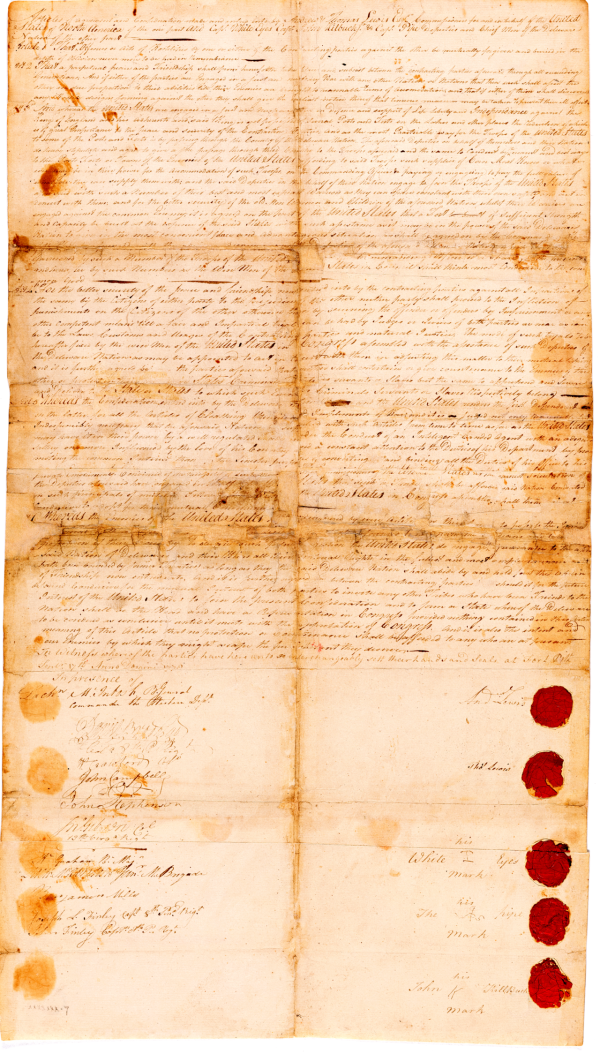
The Treaty of Fort Pitt signed September 17, 1778. Public domain
Partial List: Broken Treaties
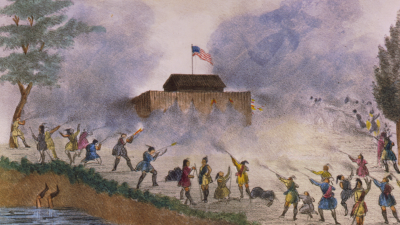
Treaty With the Delawares/Treaty of Fort Pitt – 1778: Pennsylvania militiamen killed nearly 100 Lenape (most of them women and children) at the village of Gnadenhutten in March 1782, mistakenly believing they were responsible for attacks against white settlers.
Treaty of Greenville– 1795: As more white settlers moved west into the Great Lakes region, a Native American confederacy including the Shawnee and Delaware, who had already been driven westward by U.S. expansion, as well as the Miami, Ottawa, Ojibwa and Potawatomi, mounted an armed resistance beginning in the late 1780s. After U.S. troops under General “Mad” Anthony Wayne defeated them in the Battle of Fallen Timbers, Miami chief Little Turtle and other Native leaders ceded large parts of what would become Ohio, Michigan, Indiana, Illinois, and Wisconsin in the Greenville Treaty.
Treaty of Fort Wayne – 1809: In this treaty, negotiated by William Henry Harrison, then governor of Indiana Territory, with Native peoples including the Delaware, Potawatomi, Miami and Eel River tribes, the United States acquired 2.5 million acres of land in what is now Michigan, Indiana, Illinois and Ohio, for the equivalent of about two cents per acre. Shawnee chief Tecumseh and others argued that the treaty’s signers had no authority to sell the land and warned Americans not to settle there.
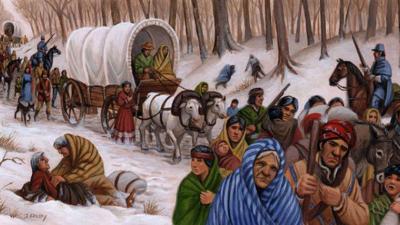
Treaty of New Echota – 1835: Many Cherokee resisted removal from their ancestral lands in the Southeast, bringing their struggle all the way to the U.S. Supreme Court. But despite the Court’s ruling in Worcester v. Georgia (1832) that the Cherokee and other tribes were “sovereign nations,” the removal continued. In 1835, U.S. government representatives met with a group of Cherokee representatives at New Echota, Georgia, to sign a treaty that traded all 7 million acres of Cherokee land for $5 million and land in Indian Territory.
This was followed by the Trail of Tears and Death (1838–1839), during which approximately 4,000 Cherokee died during forced removal. The treaty also promised the Cherokee a seat in Congress, a provision that remains unfulfilled to this day.
Treaty of Medicine Lodge (1867): Signed with the Kiowa, Comanche, and Apache tribes, this treaty promised protection, supplies, and reservation lands in exchange for tribes moving onto reservations. The U.S. government almost immediately failed to deliver promised supplies and allowed settlers to encroach on reservation lands. These violations led to further displacement and violent conflicts, including the Red River War. In 1903, the Supreme Court ruled in Lone Wolf v. Hitchcock that Congress had the power to unilaterally abrogate treaty provisions, effectively rendering treaties powerless.
Treaty of Dancing Rabbit Creek (1830): This treaty forced the Choctaw to cede their lands in Mississippi under the Indian Removal Act. The U.S. government failed to provide adequate resources during the forced migration to present-day Oklahoma, resulting in significant death and suffering. This tragedy foreshadowed the removal of other tribes under the Removal Act.
Treaty of Point Elliott (1855): Signed in the Pacific Northwest, this treaty guaranteed fishing rights and lands for tribes including the Duwamish and Suquamish. However, the U.S. government continually restricted access to traditional fishing grounds, causing ongoing economic hardships. Legal battles over these rights continue, though rulings like the Boldt Decision (1974) have reaffirmed Native fishing rights.