As a teenager in the mid-1960s I treasured a painting by the artist Ben Shahn of Sacco and Vanzetti. These were two Italian anarchists who were unjustly executed in 1927, framed for the death of a security guard and a paymaster at a shoe factory. So when I saw that the Jewish Museum in New York City had an exhibit of Ben Shahn's work, I decided to make time to go and see it.
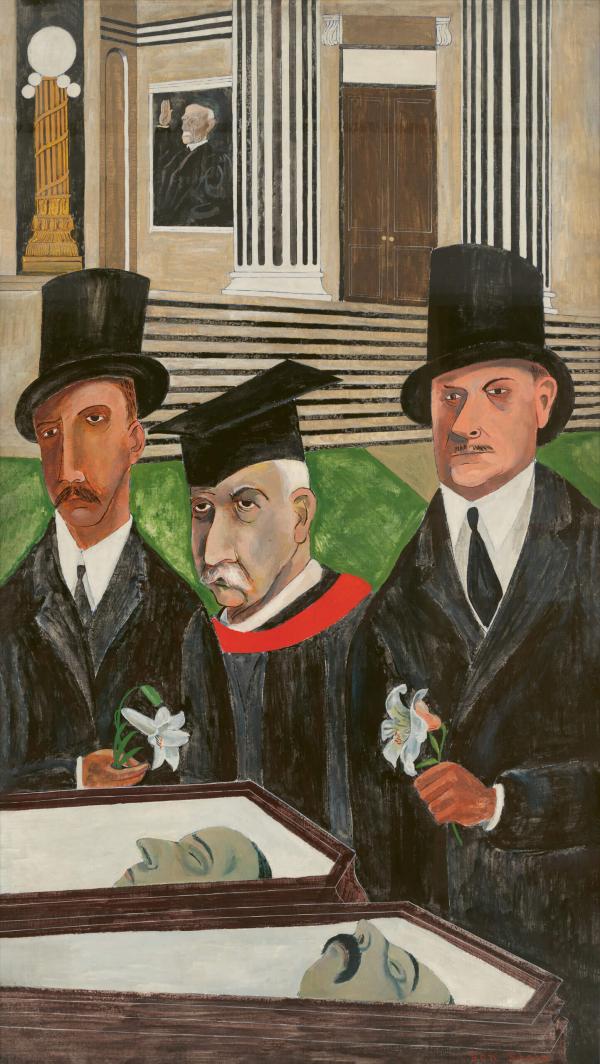
The Passion of Sacco and Vanzetti, 1931-32, by Ben Shahn Photo: Whitney Museum of American Art
The first painting you see is one I had on my wall. It is from a whole series of 23 paintings Shahn did about Sacco and Vanzetti and their families. Several of them are in this exhibit but this one is particularly moving. Hovering over the coffins of the two executed anarchists are the judge who sentenced them to death and two of the commissioners who upheld that sentence, all very stone-faced and unmoved, in spite of the lilies in their hands. It was very powerful and affecting to me. A cry for justice and a scathing exposure of immorality of those in power.
Then next one is this declaration, written in 1957, which resonates resoundingly today:
Nonconformity is the basic pre-condition of art, as it is the pre-condition of good thinking and therefore of growth and greatness in a people. The degree of nonconformity present—and tolerated—in a society might be looked upon as a symptom of its state of health.
Ben Shahn “On Nonconformity” The Shape of Content 1957
The next drawing is Warsaw 1943. The plaque says:
Following World War II Shahn searched for a way to grapple with incomprehensible acts of evil. In Warsaw, 1943 he commemorated the twentieth anniversary of the uprising of the Warsaw Ghetto Jews against their Nazi occupiers. [The Warsaw Ghetto uprising was a powerful armed rebellion among hundreds of Jews against Nazi efforts to deport the remaining ghetto population to death camps.]
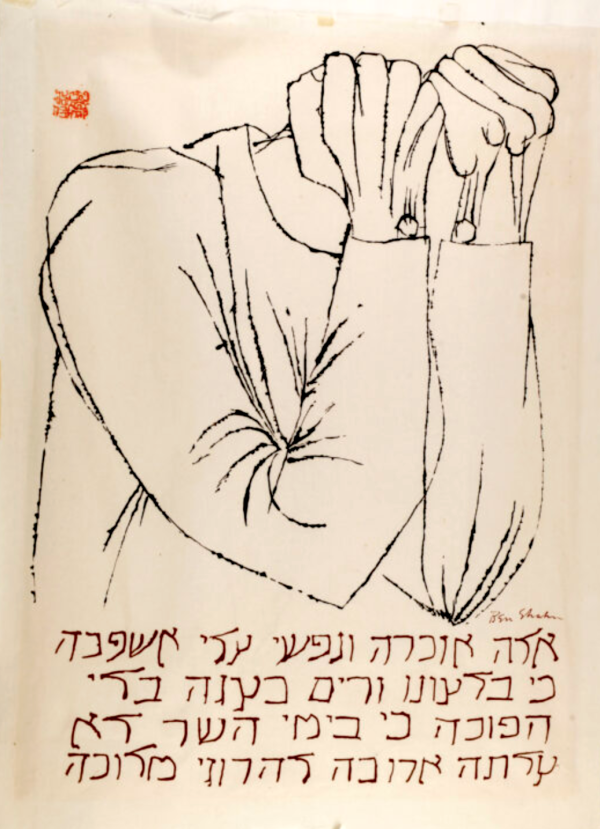
Warsaw, 1943, by Ben Shahn
Next to it is this plaque:
Translation from the Hebrew
These I will remember and my soul overflows with sorrow.
For evil people have swallowed us, like a cake, unturned, for
during the days of Caesar there was no reprieve for the ten martyrs,
put to death by the [Roman] government.
- Prayer said on Yom Kippur (Jewish Day of Atonement)
The image of scores of people, who have been starved, imprisoned behind walls with no way out, deliberately murdered because they dared to express their humanity—Warsaw—and now in Gaza!! How could those who were slaughtered in Warsaw—and beyond—how could they now be visiting the exact same inhumane, ghastly, unthinkable genocide on another people!?!? The parallels screamed out and yet the gallery was silent.
Shahn’s life and work were part of many of the battles for civil rights and social justice from the 1930s through the 1960s and there is much in this exhibit that provokes deeper reflection. His art reflects the respect he had for the oppressed and disdain for the oppressor. Today cries out for more artists to step out and speak out as Ben Shahn did during his life.
But the poison of the reality of what Israel is doing in Gaza, and to the Palestinian people throughout Palestine, haunted me for the rest of the exhibit. It is as Bob Avakian has said: "After the Holocaust, the worst thing that has happened to Jewish people is the state of Israel." He went on to say: “And Israel has done something truly incredible—Israel has managed to turn Jews into Nazis!”
The horror of this irony weighed on me for the rest of the day and returns every time I think of that picture, head in hands at the unthinkable acts committed against humanity.