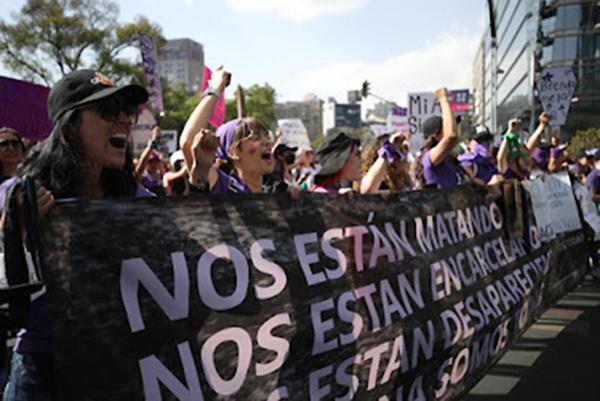
In Mexico, women took to the streets in many cities to protest attacks on abortion rights. Photo: Aurora Roja blog/Yazmín Ortega Cortés, La Jornada
Around the world, hundreds of thousands of women took to the streets to fight against the patriarchy that oppresses them in every corner of the planet. From Guatemala to Afghanistan, from Japan to Pakistan, from Turkey to the United States, and throughout Latin America, a growing rebellion has expressed that it may become a powerful force for revolution. A revolution that can and needs to end patriarchy and all forms of oppression and exploitation.
In Mexico, women took to the streets again, from Tijuana to Tapachula, from Guadalajara to Xalapa, from Juárez to Oaxaca, in Puebla, Tlaxcala, Chiapas, Hidalgo, Sonora and many more places. They expressed their fury and indignation at the intensifying oppression against women that is taking on more brutal forms, such as the murder of, on average, 10 women every day, in many cases for the simple fact of being women. In several states the protests were really massive, with the participation mainly of young people. They demanded an end to feminicides, rapes, and sexual harassment; and justice for the victims, and punishment for the guilty, as well as legal and safe abortions.
In Mexico City (CDMX), from the day before March 8, some women stood in front of the metal wall that the government erected to protect the National Palace [executive branch headquarters]. On that wall, in large letters, they painted “MÉXICO FEMINICIDA” [“FEMICIDAL MEXICO”], in addition to other phrases such as “Nosotras somos la resistencia” [“We women are the resistance”] and “Conservadora su impunidad que protege asesinos” [“You conservatives, your impunity protects murderers”]. Also, a large airship flew through the sky of the city with huge signs that said, on one side, “10 feminicidios diarios” [“10 femicides a day”] and on the other, “Ninguna en el olvido" [“No women should be forgotten.”] Again the walls, again the creativity of women. Because they also walled in the Cathedral, and on another of those walls with full-color artistic graffiti, demonstrators wrote: “¡Aborto legal en todo el país!” [“Legal abortion throughout the country!”]. In the roundabout where the monument to Christopher Columbus used to be, and which people have renamed the Roundabout of Women in Struggle, demonstrators changed the wooden monument—of the woman with her fist in the air—for a metal one. The atmosphere of combativeness began with these actions.
From the federal and capital city governments, in addition to their walls, they did everything possible to intimidate and criminalize the women who went out to march. They announced and promoted that it was going to be the most violent march, thus trying to sow fear among women and in society in general. They tried to create this atmosphere of fear so that fewer people would go to the march and to try to isolate the protesters, criminalize them and paint them in the worst way.
From the pulpit of the National Palace, President Andrés Manuel López Obrador declared in his morning press conference, justifying and joining the declaration of the CDMX government, that the march would be dangerous: “Yes, yes, because there is a lot of infiltration by right-wing conservatism.” In this way, he tries again to disqualify the righteous and radical opposition as if it were part of the bourgeois “circus” of the electoral parties of Morena, PRI, PAN, MC, etc. The fury over the murder and abuse of women is righteous and necessary. These crimes are intolerable, and are more than enough reason to bring down and dismantle the patriarchal capitalist system with an actual revolution. As the demonstrators rightly stated: “Conservadora su impunidad que protege asesinos” [“You conservatives, your impunity protects murderers.”]
The demonization did not work for them: The rejection of the attempts to intimidate was palpable. Mexico City—right on March 8—was flooded with tens of thousands of women. The day was painted purple and green, because thousands of young people covered themselves with T-shirts, scarves, handkerchiefs, and flags that they carried with these colors. Tens of thousands marched through the streets from various rally points to reach the Zócalo (main downtown plaza). From past noon it was announced that contingents of women began to arrive at the Zócalo and continued to arrive beyond six in the afternoon.
The contingents radiantly expressed their anger, their hartazgo [“We are totally fed up”], and at the same time their emotion and joy at meeting up again and walking, shouting and dancing together. They shouted out: “Ni una más, ni una asesinada más” [“Not one more, not one more woman murdered,”] “Porque vivas se las llevaron vivas las queremos” [“Because they took them alive, we want them back alive,”] “Hay que abortar, hay que abortar, hay que abortar este sistema patriarcal” [“We have to abort, we have to abort, we have to abort this patriarchal system,”] “La policía no me cuida, me cuidan mis amigas” [“The police do not protect me; my women friends protect me,”] “El Estado opresor, es un macho violador” [“The oppressive state is a macho rapist,”] “Si tocan a una, respondemos todas” [“If they touch one of us women, we will all respond,”] and many more chants, accompanied by the rhythms of drum corps. They carried posters where they expressed their sisterhood and indignation: “Estoy aquí por las que ya no están” [“I am here for those women who are no longer here,”] “Abuela vine a gritar lo que te hicieron callar” [“Grandma, I came to shout out what they made you keep quiet.”] From the flagpole in front of the National Palace, there was a rope stretched out with complaints against harassers. Also mothers of victims of femicides, or who are looking for their disappeared daughters, were part of the contingents.
Contingents were entering and leaving the Zócalo, with estimates of around 75 thousand protesters. Groups of women beat on the walls protecting the National Palace and the Metropolitan Cathedral; they tried to tear them down, but from inside the fences the [police] threw fire extinguisher powder and gas.
The Revolution Movement distributed the flyer “A Call to Rebellious Women and All Those who Hate the Violence, Abuse and Disrespect Plaguing Women: Organize Now for an Actual Revolution that Wipes Out the Oppression of Women and Emancipates Humanity,” from the Revolutionary Communist Organization, Mexico (OCR, M), which is available on the Aurora Roja blog in Spanish [and here in English]. A compañera and a compañero agitated that this women’s movement is very positive and inspiring, and that to end oppression, it is necessary to end patriarchy. That part of the flyer was read: “Are we going to be content with some cosmetic reforms on the patriarchal system, or should we fight to end patriarchy and all forms of oppression? If we want to end the oppression of women, we have to ask ourselves, what does it take to achieve that? The current state must be shattered, because it leaves in absolute impunity the overwhelming majority of misogynistic crimes and whose own armed forces and police grope, rape and kill women. It is necessary to end both ‘legal’ and organized-crime capitalism which dehumanizes and enslaves women and makes huge profits from pornography, prostitution, human trafficking, demeaning commercials, as well as the super-exploitation of female labor. The patriarchal family which is so oppressive for women and children must be ended and transformed throughout society. It is necessary to open up every sphere of society to the full participation of women on an equal footing. It is necessary to fully unleash the fury of women and launch an enormous struggle in the family, at work, at school, in culture and the arts, throughout society to criticize and transform all kinds of oppressive relationships and ideas of machismo and male supremacy.” And this is only possible by means of an actual revolution. At the same time, other compañeras and compañeros handed out the leaflet to the men and women who passed by, as well as offering them revolutionary literature.
This was a day of massive and combative participation of women, an explosive atmosphere of fury, “creating more favorable conditions for revolution,” as the flyer puts it.
Under this capitalist and patriarchal system, the crimes are not going to stop, nor the repression by the government. As seen again. In Michoacán, Guanajuato and Tlaxcala, the pigs attacked the women who were participating in the march, subdued them and beat them and took them away under arrest. On March 6, an 18-year-old young woman was beaten and kicked by the police in San Miguel de Allende, Guanajuato. On March 8, at the end of the march in Morelia, 25 young people, women and men, were arrested, and in Tlaxcala three women were arrested at the end of the protest.
As the OCR, M leaflet says: “Enough with so much oppression, with so many injustices, with so many murders, rapes, outrages, and disrespect against so many women! If you want to end patriarchy and all forms of oppression, join the Revolution Movement, to work collectively for the liberating revolution that is needed. That means getting into why an actual revolution is needed, what this means and what the new society that is proposed will be like, debating the new communism that is the essential guide to open a new stage of revolutions in the world. And also to take this liberating revolution to the people so as to spread the movement for revolution while we unite with all the people willing to fight against the crimes, injustices, destruction, and attacks committed by this heartless system.”
Break the Chains!
Unleash the Fury of Women As a Mighty Force for Revolution!
Aurora Roja
Voice of the Revolutionary Communist Organization, Mexico
Download the pdf of this article in Spanish: 8M-reportaje.pdf