In trying to justify the Trump fascist regime's murders of Venezuelans on the high seas, its blockade of Venezuela, and the threats aimed at Venezuela’s President, Nicolás Maduro, Stephen Miller, one of Trump's chief fascist advisors, said this:
American sweat, ingenuity and toil created the oil industry in Venezuela. Its tyrannical expropriation was the largest recorded theft of American wealth and property. These pillaged assets were then used to fund terrorism and flood our streets with killers, mercenaries and drugs.
As usual, Stephen Miller has succeeded in both turning reality exactly upside down and unwittingly revealing how needless, destructive and mendacious (lying through its teeth) this system is.
Let’s start with the “pillaged assets.” If you want to talk about “pillaged assets,” you have to start with the European colonial powers who landed in the Americas in 1492. They confronted two continents with a combined population of somewhere between 50 and 100 million people. With the sword and with diseases for which the people of the Americas had no immunity, the invaders conquered. Some groups lost 90 percent of their people to disease; others were wiped out totally. Those who survived were enslaved and put to work mining silver. In addition, 25 million Africans were kidnapped to bring as slaves to this “new world” to grow the crops of sugar cane, tobacco, coffee and cotton that amassed massive profits.
With those profits, and standing on the bones of tens of millions, the capitalist class—and the capitalist system—rose to supremacy worldwide.
“Ingenuity”? Try inhumanity—and a system that grew to power on the basis of slavery, genocide and bitter exploitation.
Whose “Tyrannical Expropriation”?
We could stop there, and Miller’s version of what the author Mark Twain is said to have called the peculiar American combination of arrogance and ignorance would stand exposed. But because people get trained by the media, schools, and politicians in so much narrowness and ignorance about what this country has done, AND because the stakes are so high right now, it’s worth it to answer Miller in more detail.
In referring to the nationalization of Venezuelan oil reserves, Miller has the nerve to talk about “tyrannical expropriation.” Let’s look at what really happened.

A political prisoner in "La Rotunda" prison in Venezuela wearing 75 pound leg irons, 1930s. Photo: Nerio Valarino (Public Domain)
With the discovery of oil in Venezuela, the U.S. quickly moved in. Venezuelan puppet General Juan Vicente Gómez seized power in a 1908 coup with the help of the U.S. Navy. Gómez ruled the country either directly or through puppet presidents until his death in 1935. His state security forces carried out widespread torture and forced disappearances. "His enforcers were fond of shackling political prisoners in grillos, leg irons that rendered many victims permanently disabled—and those were the “lucky” ones. Others were hanged to death by meathooks through their throats or testicles."1
In reality, Miller’s talk of “tyranny” applies first and foremost to the U.S. puppet regime and its enforcers.
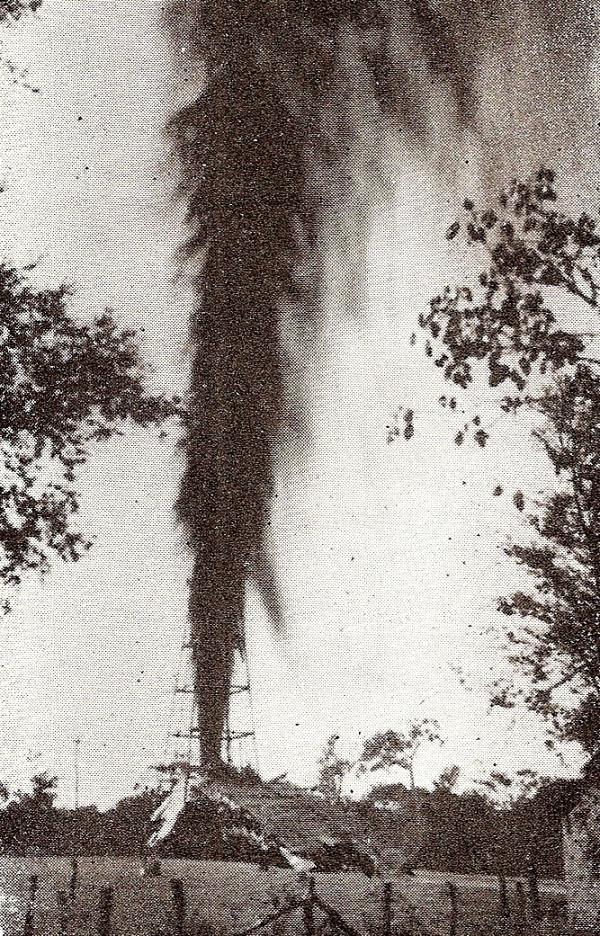
The 1922 oil blowout at the Barrosos No. 2 well in Cabimas that kicked off Venezuela's massive oil boom. Photo: Public Domain
“Expropriation”? The puppet Gómez enabled foreign oil companies to directly plunder Venezuelan resources. He granted highly profitable concessions (giving exclusive rights to explore and drill in specific locations and profit from the oil produced) to foreign oil companies, including American giants like Standard Oil. Those U.S. companies came to control 98 percent of the Venezuelan domestic oil market and extracted enormous profits from the Venezuelan economy. But that wasn’t all. The whole Venezuelan economy became geared around oil. Oil set the priorities for development inside Venezuela. Peasants were driven from the countryside into the slums of the cities.
As for the “sweat” that Miller claims came from the U.S.? The U.S. supplied the managers and some of the technicians—but almost all of the labor came from Venezuelans or migrants from the surrounding countries. To the extent that people did the same kinds of work, Venezuelans were paid less. The manual workers lived in squalid company dorms.
Plundering another country’s resources, installing a puppet government, distorting their economy, and exploiting its people? That, Miller, is expropriation.
Major Changes in the World Lead to Imperial Adjustments
A Radically Different—and Far Better—World IS Possible
In a 2017 talk, The Problem, The Solution and The Challenges Before Us, Bob Avakian turned the reality so often distorted by the likes of Steven Miller right-side up. Read—or listen—to this and think about both the history that is recounted in the accompanying article and the lies of Steven Miller:
If you step away and out of the confines of the self-contained logic of the capitalist system, think about it: The raw materials are there, the people are there—that’s what you need to develop an economy. The question is, on what terms and through which means are you developing that economy with those people and those raw materials?
Once again we’re back to the question that I focused on centrally in THE NEW COMMUNISM: through which mode of production are things done? Capitalism is not the only way, and is certainly far from the best way, to “create jobs” and for people to have meaningful employment. It is possible to have a radically different economic system, the system of socialism, in which people’s work is not exploited for the benefit of cut-throat competing capitalists who are now cut-throat competing capitalists on a world scale, who immediately, as soon as they find it not profitable enough, stop creating those jobs in this country and go to another country where they create jobs, until they find another country where they can go and more ruthlessly exploit people. The people are there. That is the most important thing. And with the people it is possible now to have a radically different economic and social system which is not built on exploitation and oppression—which, in fact, moves to do away with every form of exploitation and oppression—the socialist system moving toward communism on a world scale, at which point all exploitation and oppression will have been eliminated.
But something big was changing worldwide. A powerful wave of national liberation and anti-colonial struggles swept through Asia, Africa and Latin America in the years during and after World War 2. In China, the masses of this formerly oppressed nation were led by the great revolutionary communist Mao Zedong to win liberation and to move on to socialism. Revolutionary China provided a beacon to the oppressed masses and a challenge to the imperialist system, for over 25 years.2
In the face of this global upsurge, and in competition with what was, at that point, an imperialist Soviet Union, U.S. imperialism was forced to change its tactics. Domestic forces—even some from what had been liberation struggles—found their place within the imperialist political and economic system. These bourgeois forces were, or became, tied to imperialism and got “a cut of the action,” as the economies were maintained within the imperialist system. (See The New Communism, by Bob Avakian, Part IV, page 284, section on Angola for more on this phenomenon.)
As part of this wave, in 1976, the Venezuelan legislature nationalized the oil industry. Yet the imperialists found “work-arounds” for direct ownership and continued their domination. As economist Francisco Rodriguez notes (quoted in the Washington Post): “Nobody was going to resist Venezuela carrying this nationalization to its end, and the U.S. was much more interested in having Venezuela be a provider of oil—relatively cheap oil—than to have a production collapse in Venezuela.”
Hugo Chávez: Further Nationalization and Vicious American Retribution
History did not stop there. In 1998, Hugo Chávez Frías was elected president, winning with 56 percent of the vote. His “Bolivarian revolution” included a host of economic and social measures, including further nationalizations of the oil industry. (“Hugo Chavez Has an Oil Strategy... But Can This Lead to Liberation?”, by Raymond Lotta gets into the limitations of Chávez’s strategy and why it could not break the chains of the imperialist system.)
The U.S. imperialists concluded that the Chávez regime had to be removed—by force if needed. On April 11, 2002, Chávez was overthrown in a military coup d’etat, done in close coordination with the U.S. imperialists and applauded by the likes of the New York Times. But two days after the coup, masses surged into the streets of Venezuela and Chávez returned to power. Ever since then, the imperialists have been imposing more and more extreme sanctions aimed at strangling Venezuela's oil income and devastating Venezuela's fragile, oil-dominated economy—first under Chávez and then, after his death, under his successor Nicolás Maduro.3
America Poses as Victim While Acting as Executioner
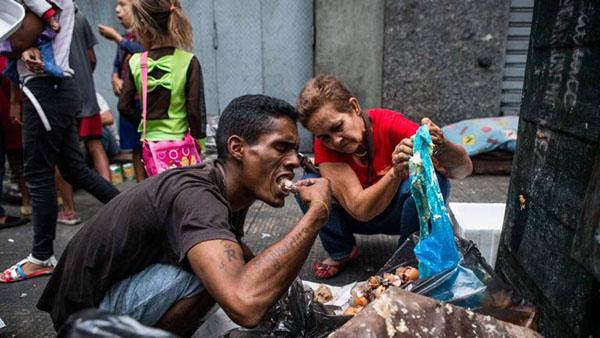
People scrounging for food in the trash during economic crisis caused by U.S. sanctions, Caracas, Venezuela, 2016.
The consequences of the U.S. economic warfare for the Venezuelan people have been catastrophic. The online journal World Politics Review reported that people in Venezuela are “…living in the most dire conditions outside of a warzone in recent memory.” Disastrous economic conditions in Venezuela mean that millions of people are unable to meet life’s most basic needs like water, food, fuel, and shelter. The country’s health system has collapsed. In 2019, 14 percent of all children under five suffered from acute malnutrition, and 57 percent of pregnant women were malnourished. These figures have almost certainly risen since.
As of 2022, more than seven million people had been forced to leave Venezuela over the previous seven years. The Brookings Institution, a U.S. think tank, reported that “the Venezuelan refugee crisis is one of the largest in modern history.” Think about it: seven million people, each of them so desperate that they risked everything for a journey that for most was fraught with danger.4
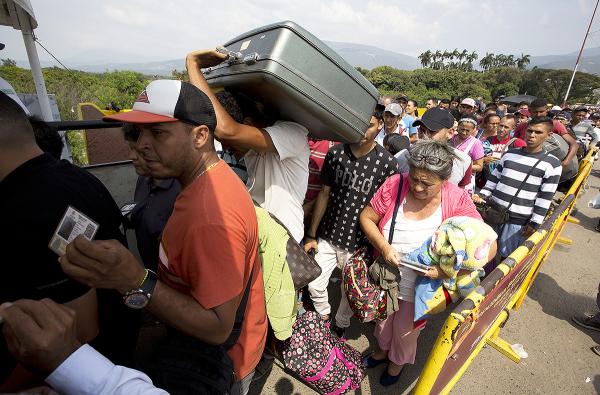
This is what has been inflicted on the Venezuelan people both by the “routine” predatory functioning of the capitalist-imperialist system, and by coldblooded decisions made and policies carried out by the rulers of that system, especially by U.S. rulers from Obama to Trump to Biden.
And yet Stephen Miller howls that the U.S. is being “tyrannized,” “expropriated,” “pillaged” and “terrorized.”
Trump and the Fascist Agenda
Now, with Trump II, this horror has taken a further leap. Beyond the outright starvation, Trump and Miller first sought to demonize the very Venezuelan immigrants who were forced to flee their country by U.S.-imposed starvation as gangsters. They paid their junior partner Nayib Bukele in El Salvador $3 million to imprison and torture over 200 immigrants that Trump illegally deported there, most of whom had nothing whatsoever to do with gangs or drugs. Then they began murdering Venezuelans on the high seas for supposedly running drugs, killing at least 105 so far—with no approval from Congress and no proof whatsoever of their accusations. (See coverage of this at revcom.us here and here.)

There are three aims underneath this leap in the offensive against Venezuela that Stephen Miller tries to cover over with his cries of victimhood. First, Trump aims to intensify U.S. domination of Latin America as a source of strength in the U.S.'s contention with now-imperialist China over the division of the world. China is a major partner of Venezuela, and driving China out, or even seriously cutting into its influence, would be a major advance for the U.S. It’s not so much that the U.S. wants the oil for the money (though with Trump that enters into it), but they want control of the spigot. Second, the gross illegality of the war crimes that the U.S. is committing on the high seas—including its refusal to seek congressional approval—is a big part of the further fascist transformation of the U.S.5 Third, this is part of the fascist tearing up of any semblance of the rule of law in international relations.
People Must Act
With these as the stakes—and with this as the history—it is frankly inexcusable for the American people to have remained so silent in the face of these outrages. As THE REVCOM CORPS For The Emancipation Of Humanity have put it in a call to action:
All this is criminal. It is escalating. And it could very well be a prelude to all-out war. People in this country have a huge responsibility to oppose any such aggression, nonviolently in the streets and in the arenas of public opinion, as an imperialist predatory war waged by a fascist regime.
And they have added:
To organizations and individuals: endorse this call, or put out your own complementary call to action. Spread this call. And message us @therevcoms to talk with us about your ideas about what needs to be done.
Answer their call.
In the name of humanity, we refuse to accept a fascist America!
This whole system is rotten and illegitimate! We Need and We Demand, a Whole New Way to Live, a Fundamentally Different System!
