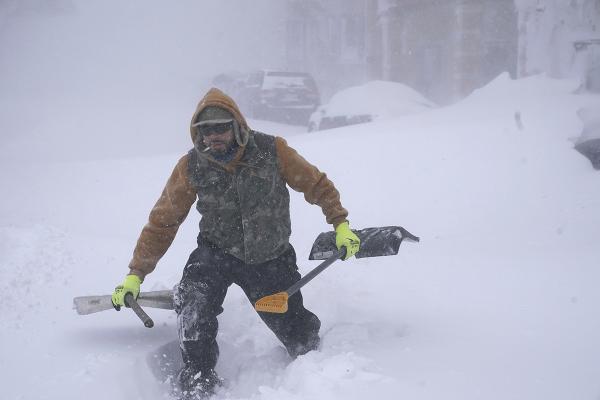
A devastating snowstorm hit Erie County, New York—which includes the city of Buffalo—on Friday, December 23. The storm continued at high intensity until early on Saturday, leading to the deaths of at least 39 people. More than half of those who died were Black people—in a county where only one out of seven people is Black.
Think about it: this means that if you took 42 random people in the county that includes Buffalo, six of them would be Black. But if you just looked at the same number of blizzard victims, over 21 would be!
The blizzard was a powerful natural weather phenomenon. But the disproportionate way that the deadly effects of the storm hit Black people has everything to do with the nature and workings of the system we live under, capitalism-imperialism.
The Needless Deaths of Anndel Taylor and Others

Anndel Taylor
Early Friday afternoon, 22-year-old Anndel Taylor finished her shift as a certified nurse assistant in a facility in East Aurora, where she was known for her dedication to her patients. East Aurora is a white suburb 20 miles outside Buffalo. But Black unemployment in Buffalo is 17 percent (almost five times the unemployment rate nationally!), so it was worth the drive. The storm was already raging, but what choice did she have? She got in her car and headed for home in Buffalo.
By 4 pm Anndel had gotten within six minutes of her home. That meant that she was back in a community where the city doesn’t exactly rush to plow the streets. Her car got stuck in the snow. She started calling emergency responders, periodically running her car to keep from freezing. She texted her sisters in North Carolina to tell them she was “trapped”—and as time went on, “scared.” She sent them video of the snow burying her car. The sisters frantically called for emergency help.
This went on for eight hours. Then around midnight, Anndel stopped answering her sisters’ texts. Help never came. On Saturday night—more than a full day after her first call for help, Anndel’s family was notified that she had been found dead in her car.
Other Black people died under different circumstances but for similar reasons. Abdul Sharifu, a 26-year-old Congolese immigrant awaiting the birth of his first child, went out on Saturday morning to get milk for his pregnant wife. He left his home on Buffalo’s East Side at noon. He was found dead on the ground almost 12 hours later. Lederise Curry, a 46-year-old mother known for her kindness, made it through the storm itself. But early Monday morning she had an asthma attack. Emergency responders took hours to get to her. The streets in her neighborhood had not been cleared. By the time they arrived, Lederise had died.
A System That Values Property and Lets People Die
It’s true that this was a historically bad storm that stretched resources of local governments. But it’s also true that Buffalo city officials found the “resources” to set up an “anti-looting task force” to stop desperate people from taking food and supplies from stores. According to a report in the Washington Post,1 “Buffalo police said that they had to take resources away from recovery efforts to go after thieves while residents are still missing” [emphasis added].
The police chief acknowledged that it took until Wednesday for cops to finish responding to 911 calls from Saturday. But they did succeed in arresting 10 people for “looting”! Buffalo’s Mayor Byron Brown bragged about this, calling the people arrested “the lowest of the low”! The mayor is Black, which only goes to show (once again) that the problem in America is not the “color” of the people in charge; the problem is the system that they are in charge of!
What kind of system is it that “cherishes” private property over the lives of completely innocent people, and in particular, Black and other oppressed people? Ask yourself: who—or, more to the point, what system—really is the “lowest of the low”?
Getting to the Roots of Oppression
Buffalo (like most U.S. cities) is heavily segregated, with the great majority of Black people living on the East Side. The East Side is a severely oppressed ghetto, where people are penned in, denied jobs and decent housing and education, and constantly brutalized and locked up by the pigs.
These conditions of outrageous oppression are not unique to Buffalo. More than 150 years after the end of slavery, the masses of Black people in the U.S. face continuing systematic discrimination in every part of society—from jobs and education to housing, health care, and so on—with millions of youth, in particular, robbed of any hope for a decent future and forced into conditions of desperate poverty.
To get into how things got this way, and what it is going to take to end this oppression, we need to get to the roots.
In “Racial Oppression Can Be Ended, But Not Under This System,”2 Bob Avakian, BA, goes deeply into the roots of the oppression of Black people, as well as Native Americans and Mexicans, in the early history of this country and continuing through the 19th century. We urge readers to return to this. After laying this out, BA gets into how when World War 2 broke out, capitalist industry in the North suddenly needed a supply of cheap labor to replace workers who were sent off to war. In this situation, large numbers of Black people were able to migrate to the North and get jobs—and this continued after the war because of the continued expansion of the economy, due in big part to the fact that the U.S. was on the winning side of that war and at the same time experienced almost no damage to the industrial facilities and infrastructure on its territory. Significant numbers of Black people were able to get some better-paying jobs in industries like steel and auto.
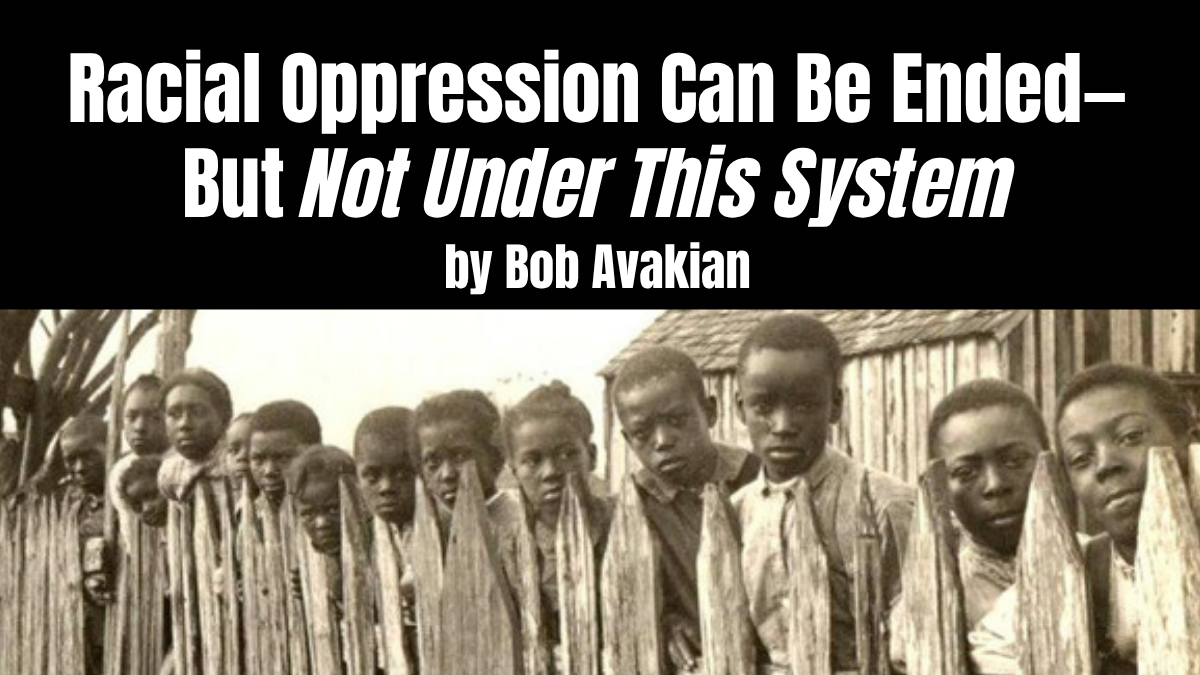
All this meant big changes in the situation for masses of Black people, but—once again—not an end to their oppression. As BA wrote in “Racial Oppression Can Be Ended—But Not Under This System”:
But, at the same time, because of the white supremacy built into the system over centuries—and the fact that really moving to overcome this would tear apart the fabric of the system and crack its very foundation—Black people continued to be subjected to systematic discrimination, including in employment (with “last hired and first fired” an accurate description of the situation of Black people with regard to employment). To cite another ugly example, government policy with regard to housing involved conscious, deliberate discrimination: after World War 2, loans were given to white people to enable them to buy their own homes, and increasingly move to the suburbs, while this was denied to Black veterans (and others) and instead Black people were piled into segregated housing projects in the inner cities. And this was part of the continuing systematic segregation and discrimination to which Black people were subjected.
In Buffalo, the East Side was an integrated area before the 1940s. Black people at that time were a small portion of the city’s population. As noted above, with World War 2 and the needs of the U.S. rulers, large numbers of Black people moved north. This included to cities like Buffalo, where they faced continuing brutal discrimination. In Buffalo, as in most other cities, this meant confining Black people in segregated areas that were heavily patrolled by racist police. And when Black people went outside these areas, they were watched, harassed and sometimes brutalized or killed. These neighborhoods got the worst of basic public services like trash pickup, fire protection, hospitals and schools.
The 1960s saw an unprecedented upsurge of anticolonial and anti-imperialist movements and revolutionary struggles worldwide that deeply shook the U.S. and other imperialist powers. Within the U.S., there was also the rise of the Civil Rights movement and then the development of the more radical Black liberation movements. As one result, the rulers of this country made some concessions, including an increase in Black officials and a growth of the Black middle class. But the position of Black middle class people has been far more precarious than that of the white middle class (as shown, for example, in the disproportionate effects of the 2008 housing crisis on Black people). And in recent decades, factories and other sources of jobs for people in the inner cities have been moved in large numbers to other areas of the world—particularly the oppressed countries of the Third World where the desperate conditions of the people, including millions of children, leave them vulnerable to being super-exploited under life-threatening conditions.
As BA notes:
All this, together with increased automation and “cybernation” of production, when combined with the ongoing segregation and discrimination built into this system, has led to a situation where huge numbers of Black people, and especially youth, have, for generations now, not only been unemployed but are left with no prospect of meaningful employment in the regular (“formal”) economy.
BA points to how the continuing oppression of Black people and the working of the overall capitalist-imperialist system are tied together:
Here we see the “toxic combination” of systematic, historically-evolved segregation and discrimination, enforced with brutal violence by the powers-that-be, together with the basic functioning and requirements of the capitalist economy—which involves the greater and greater concentration not just of wealth, but of the means of production (technology, factories and other physical structures, sources of raw materials, and so on) in the possession and under the control of large-scale capitalist enterprises and financial institutions, which are locked in cut-throat competition with each other, not just within a particular country but increasingly on a global scale, and are therefore driven to ruthlessly exploit people and constantly search for ways to even more viciously super-exploit large numbers of desperate people, including children, in a worldwide network of sweatshops. (For example, cell phones and computers depend on the mineral coltan which is mined under horrific conditions by people, including large numbers of children, in the Congo in Africa; and a large part of the clothes that are bought in the U.S. are produced by huge numbers of women working in horrific conditions in the Asian country of Bangladesh.)
Buffalo and the Crime of Segregation
Focusing back on Buffalo—on top of the discriminatory housing policies described above that pushed Black people into poor, segregated areas, Buffalo city politicians had a policy of demolishing the East Side residences that white people had moved out of. This left the neighborhood with thousands of vacant lots, which led to further deterioration of the area overall.3
The “normal” capitalist compulsion to maximize profit also played a big role. For instance, the real estate industry carried out “blockbusting,” where brokers would sell a few homes to Black families in previously white areas, then play on the racism of white residents to convince them to sell their homes quickly and cheaply “before Black people ‘ruined’ the neighborhood.” Then they would turn around and re-sell those homes to Black families at higher prices.
The transformation of the East Side into a segregated, oppressed ghetto is basic to understanding the increased vulnerability of Black people during the recent storm. Media reports, including two pieces in the Washington Post,4, 5 written in the days after the storm, give numerous examples of the obvious discrimination in how Black areas and white areas were treated before, during, and in the wake of the storm.
For instance, before the storm local authorities set up “warming centers” for people whose power went out. The whole city of Buffalo—275,000 people, one-third Black—had exactly two warming centers. Even those were only open during daytime hours, and both had power failures. But the nearby suburb of Tonawanda, with about 73,000 people, 86 percent white, had four shelters.6
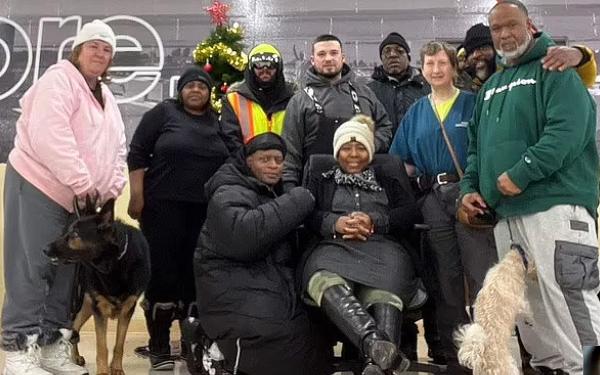
Jay Withey slept in his truck after the vehicle became stuck as Western New York was pummeled with 50-plus inches of snow. But the situation was untenable. Withey realized he wasn't alone, and he organized at least 24 people, including seven senior citizens, to break into the Pine Hill Primary Center and camped out in the cafeteria until they could get out. They left a note apologizing for breaking a window, and eating some of the food. Photo: Office of Governor Kathy Hochul
The largest numbers of people who died in the blizzard were found outside (not in cars, homes, businesses). How many were trying to get to the few shelters but never made it?
Street plowing is another example—according to accounts in the Post, in many white areas, plows were moving up and down the main streets as soon as the storm ended. In mainly Black areas, people in subsidized housing were still trapped in their homes as late as Thursday night—five days after the storm.
The blizzard made the “normal” conditions people on the East Side confront even worse. For starters, much of the housing on the East Side is old and dilapidated—a lot of it built in the 1800s (in Buffalo as a whole, close to two-thirds of housing is over 80 years old). This means poor heating systems, poor insulation, and more power outages—things that make these homes potential death traps in a severe winter storm. At the same time, many Buffalo residents spend more than half their income on rent.
The city claimed that it had advised people before the storm to “stock up” on food and medicine, and blamed people who didn’t do that. But as a local pastor told the Post, people in the area “live paycheck to paycheck. To say that they should get two weeks of groceries is an impossible request for many.” More than half of Buffalo residents are on food stamps. And even if people had the money to do a big shopping, the entire East Side—90,000-plus people—has exactly one full-service supermarket.
And what is that supermarket? The Tops Supermarket—the scene of the May 20, 2022 racist massacre in which the gunman, whose aim was to kill as many Black people as he could and inspire other similar acts, murdered 10 people. The lack of large stores in Black communities is another reflection of systemic racism: the fact that under capitalism, decisions about where to make healthy food available are based on where profits will be highest, not on where people actually need those facilities.
Finally, the Post reports that nearly 30 percent of people in Buffalo have some kind of disability, and rates of asthma, diabetes and other chronic ailments that require daily medication are dramatically higher than in the mainly white suburbs of Erie County.
All of this set the stage for the Christmas Eve disaster in Buffalo. The daily conditions of oppression that tens of millions are forced to live with every day are also the conditions that drive and create life-threatening risk in crisis situations.
Putting an End to the Centuries-Long Oppression
In an opinion piece in the Post, Pete Saunders, an urban planner, attributed much of the death and suffering of Black people in the Buffalo blizzard to “structural racism—some call it ‘racism without racists.’” He wrote, “[P]atterns established during the bygone days of virulent, interpersonal racism remain embedded in the infrastructure, and these become most evident in times of crisis.”
Although Saunders makes a few good points, the view that the deadly conditions confronting Black people are a remnant of “bygone days” characterized by “virulent, interpersonal racism” is flat-out wrong. The “virulent, interpersonal racism”—in its most extreme form, the lynchings carried out by huge crowds of white people who gleefully took pictures of their victims—was grounded in, and served to reinforce, the economic system of sharecropping and the political/social system of segregation. And as to those being bygone days, Saunders is writing about a city in which barely six months before someone massacred 10 people simply for being Black and a country in which two years ago nearly half the population voted for Trump, a clearly racist and fascist candidate.
And Saunders’s “solution”—"individual acknowledgement of its [structural racism’s] effects, a deep and society-wide shift in thinking about urban planning, and leaders who can steer their cities toward equity and inclusion”—leads people away from what is actually needed to put an end to oppression: a real revolution, with a totally different economic system, and a new state power that backs up the masses in transforming all oppressive relations and institutions.
In his article, BA gets at the reality of how you can’t reform away racist oppression under this system:
…imagine what would happen if, under this system and with the way its economy functions, the government tried to adopt policies that would deal with the long-term unemployment of Black people in the inner cities, who have not only been denied jobs but also the training for the jobs that do exist—imagine what the reaction would be of many white people who would in fact lose their better-off positions as a result of these policies. Imagine what would happen if these kinds of policies were applied not just to employment, but to education, and on down the line. (We have already seen the “backlash” that was fostered in response to even minimal efforts to implement “affirmative action” programs in employment and education.)
Again, this is not simply a matter that “white people are racist.” Many are racist, although many do not want to be. But the deeper problem is that given the basic way the capitalist economy works, and how everyone is encouraged to be “out for yourself”—and, more fundamentally, the fact that people are actually driven and compelled to compete with each other in every significant part of life, including employment and education—it would actually create destructive chaos and conflict among the people, and tear apart the “cohesion” of the society, to try to really and fully undo and overcome the reality and effects of centuries of racist oppression—under this system….
All this is why there will not be any real and meaningful move by the powers-that-be (and any of its politicians and political parties) to overcome the centuries-long experience and legacy of brutal racist oppression and the situation it has led to today, where millions and millions of Black youth and other youth of color have no prospect of a decent future—under this system.
As BA emphasizes, all this is NOT an argument for holding back from struggling against racist oppression and other injustices. And, “The fact that this oppression cannot be abolished under this system is not a reason for giving up in despair—it is a compelling reason why this system must be and can be abolished—and it is the fundamental basis for why people can be won to wage the revolutionary struggle to finally bring it down!”
From the Constitution for the New Socialist Republic in North America, authored by Bob Avakian
In light of the egregious crimes, oppression and injustice perpetrated by the former ruling class and government of the United States of America against various minority nationalities, to give expression to the voluntary union and growing unity of the various peoples within the New Socialist Republic in North America, and to give the most powerful effect to the principles and objectives set forth in this Constitution, discrimination against minority nationalities, in every sphere of society, including segregation in housing, education and other areas, shall be outlawed and prohibited, and concrete measures and steps shall be adopted and carried out, by the government at the central and other levels, to overcome the effects of discrimination and segregation, and the whole legacy of oppression, to which these peoples have been subjected. (From Article II, Section 3: Minority and Formerly Oppressed Nationalities)