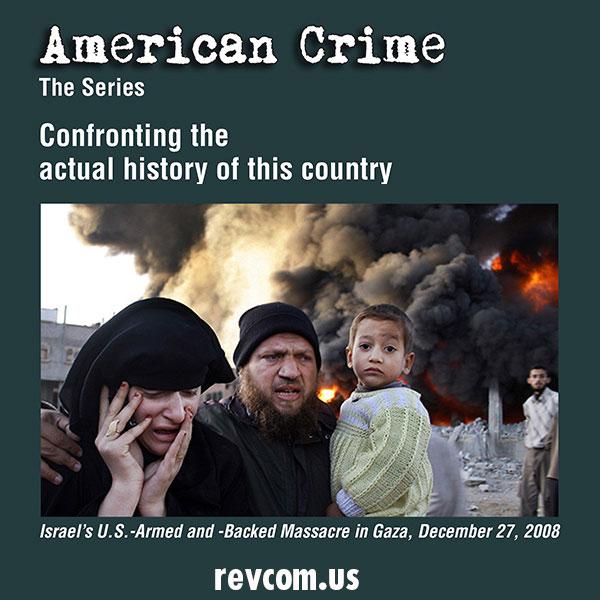
Bob Avakian has written that one of three things that has “to happen in order for there to be real and lasting change for the better: People have to fully confront the actual history of this country and its role in the world up to today, and the terrible consequences of this.”
3 Things that have to happen in order for there to be real and lasting change for the better:
1) People have to fully confront the actual history of this country and its role in the world up to today, and the terrible consequences of this.
2) People have to dig seriously and scientifically into how this system of capitalism-imperialism actually works, and what this actually causes in the world.
3) People have to look deeply into the solution to all this.
Bob Avakian
May 1st, 2016
In that light, and in that spirit, “American Crime” is a regular feature of revcom.us. Each installment focuses on one of the 100+ worst crimes committed by the U.S. rulers—out of countless bloody crimes they have carried out against people around the world, from the founding of the U.S. to the present day.

See all the articles in this series.
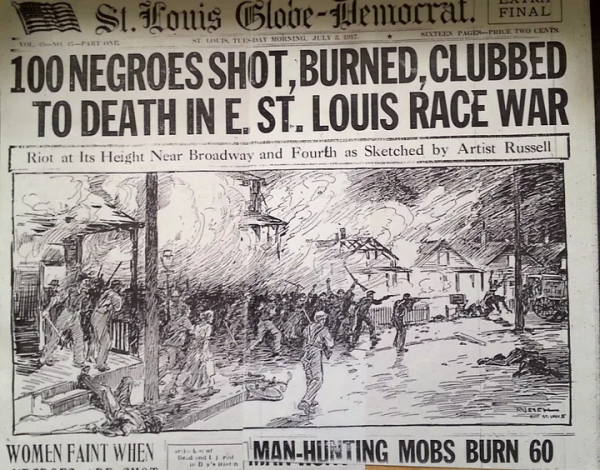
July 3, 1917, Front page of St. Louis Globe-Democrat
The Crime
On July 2, 1917, a violent and vicious mob of white people burned, lynched and stoned the Black citizens of East St Louis, Illinois. The known death toll was close to 50 with the bodies that had been discovered (39 Black people and 8 white people)1, but later reports by a grand jury and the press estimated that 100-200 were killed.2 3 4 (No one knows the exact number of fatalities. Beyond the reported deaths, the racist mobs threw dozens more both dead and alive into the Mississippi River, and many others died in burning buildings. Also, at the time there was an uncounted number of Black migrants present in the city.)5 312 houses and buildings, along with 44 rail cars were burned and destroyed.6 Six thousand Black people were displaced and fled from the city when their homes were destroyed and their lives were threatened.7 A significantly larger number of Black people were convicted compared to whites for their roles in what happened on July 2.8 This horrible, racist attack is now known as the East St. Louis Massacre of 1917.
In early 1917 tensions between Blacks and whites led to street fights between them. In February the Majestic Theater in downtown East St. Louis played a three-day run D.W. Griffith’s racist film The Birth of a Nation, further inflaming the white population. On May 28 at a Council meeting the white population was stirred into frenzy by Alexander Flannigan, a former city treasurer, who told the crowd, “As far as I know, there is no law against mob violence.” A white mob stormed out of the meeting and began accosting and beating Black people. Rumors were spread that Black people were planning an uprising to begin on July 4.
Ida B. Wells-Barnett reported that on the evening of July 1, “These colored men said that an automobile had gone through the neighborhood firing right and left into the windows of the houses and of the church…When a second automobile came on the scene very soon after, they thought it were the same parties, and fired into after a parley, wounding two officers who afterwards died.”9
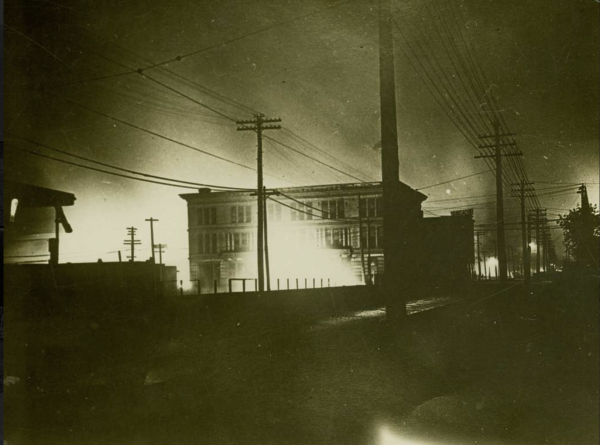
East St. Louis massacre, library in flames, July 1917. Photo: PD
Starting early the next morning a white mob of 500-1,000 people moved on any Black person they could find. “Robert Boylan, a St. Louis Globe-Democrat reporter, stated that whites were pursing blacks ‘like boys chasing rabbits.’”10 As the killings continued into the afternoon, the mob started setting the homes of Black people on fire. People in the community fled for their lives. They fled across the Mississippi River into the State of Missouri towards St. Louis. By 8 p.m., the killings were over, but the fires continued to burn.
In a long eyewitness report from the St. Louis Post-Dispatch, July 3rd, 1917, by Carlos F. Hurd, Staff Reporter, Hurd recounts the horrors he saw:11 12
“For an hour and a half last evening I saw the massacre of helpless Negroes at Broadway and Fourth Street, in downtown East St. Louis, where a black skin was a death warrant.”
…“I saw man after man, with hands raised, pleading for his life, surrounded by groups of men—men who had never seen him before and knew nothing about him except that he was black—and saw them administer the ahistoric sentence of intolerance, death by stoning. I saw one of these men, almost dead from a savage shower of stones, hanged with a clothesline. Within a few paces of the pole from which he was suspended, four other Negroes lay dead or dying, another having been removed, dead, a short time before. I saw the pockets of two of these Negroes searched, without the finding of any weapon.”…
“The butchering of the fire-trapped negroes went on so rapidly that, when I walked back to the alley a few minutes later, one was lying dead in the alley on the west side of Fourth Street and another on the east side....”
“Right here I saw the most sickening sight of the evening. To put the rope around the Negro’s neck, one of the lynchers stuck his fingers inside the gaping scalp and lifted the Negro’s head by it, literally bathing his hand in the man’s blood. ‘Get hold and pull for East St. Louis,’ called a man with a black coat and a new straw hat on as he seized the other end of the rope , and helped lift the body seven feet from the ground, and left hanging there.”
The Criminals
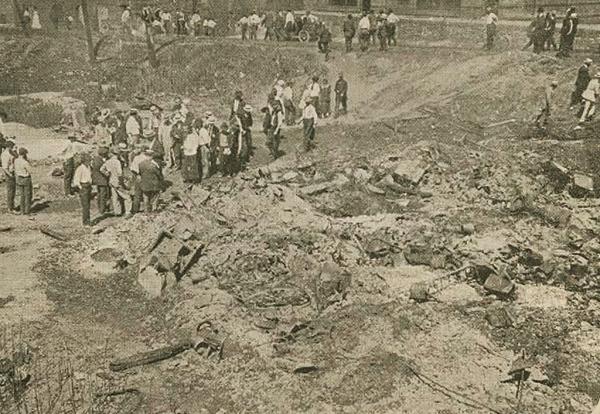
After East St. Louis massacre, residents search for victims. Six were found. Photo: Abraham Lincoln Presidential Library & Museum
White racist mob: The white racist mob was directly responsible for the massacre that brutalized the Black people of East St. Louis, Ill on July 2.
Police and National Guard: “Most National Guardsmen are simply bystanders, merely watching what is unfolding before their eyes. They are making no effort to stop the rampaging mob and protect the embattled African-American passengers. Some guardsmen in East St. Louis eventually threw in with the rioters and joined them in killing African-Americans."13
“…the state militia was given orders not to shoot white men and women, and they stood by and saw the most brutal savagery perpetrated without lifting a finger for protection or punishment for those who did murder, committed arson, or burned up little children and old people.”14
Woodrow Wilson: Woodrow Wilson, a Democrat, was elected to the presidency in 1912. He fired a number of high-ranking Black federal officials who had served under the preceding Republican administration and replaced them with white appointees. He also allowed his cabinet members to segregate their departments. The nation’s capital, which had been relatively integrated under the Republicans, became segregated under Wilson’s administration.15
During the 1916 presidential race, Wilson ran his campaign strategy where he depended on minimizing the Black electorate and arousing white voters.16 Wilson’s campaign managers decided to try to win swing states such as Illinois by playing to the fears of many whites that the Republicans would use the large number of Black people who had so recently migrated north to steal the election for the Republicans.
In 1915, a special showing of the racist film, The Birth of a Nation was organized for Wilson’s viewing at the White House. This film favorably depicted the Ku Klux Klan lynching of a Black man and was by far the most popular film of its time.17 Wilson praised this, saying that it was “Like writing history with lightning. My only regret is that it is all so terribly true.”18
Wilson refused to allow a government investigation into the massacre. However, the House of Representatives held one anyway.
Press: The East St. Louis Daily Journal continuously ran stories about Black crime and Blacks attacking whites.19 These sensationalist and often untrue articles were intended to inflame the white population against the Black residents of East St. Louis. The paper ran articles stating that “Black colonizers” were in East St. Louis without jobs. The paper wrote, “Negroes (who) come into East St. Louis, are not known, shoot or rob someone, and get out before we know who they are.” These articles inflamed the white population that their city was under siege by thousands of Blacks who were up to no good.
The Judicial System: The courts unjustly went after the Black people arrested during the massacre. An all-white jury found the 10 defendants guilty and they were all sentenced to a minimum of fourteen years in prison.20
Six police officers were indicted by the Grand Jury for murder and conspiracy. The court allowed three to plead guilty and allowed the other three to go free. The cops drew straws to determine who would plead. Those three were fined a total of $150, which prompted the St. Louis Argus to suggest that the “lottery” had effectively set the price for a license to kill or maim Blacks in East St. Louis at $50.21
The Alibi
Ida B. Wells-Barnett reported: “The cause (of the massacre) was alleged to be the killing of two white police officers who had been shot by colored men when they went into the Negro district on the Denver side to quell a supposed riot.”22
“In a deliberately-provocative action, authorities allowed the bullet-riddled car to be left parked just across the street from the police station. Angry whites, some drinking, gathered to look at the vehicle. They began talking about taking revenge on the city’s blacks.”23
With that bullet-riddled car and the shooting of the two cops as the excuse, the massacre was on.
The Real Motive
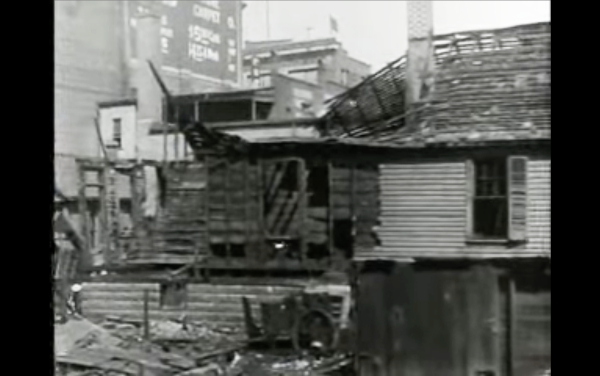
Charred remains of homes in a Black neighborhood of East St. Louis, Illinois, July 3, 1917. Photo: Screengrab of YouTube video
From 1915-1920, Black people migrated north in great numbers. Around 1915, it was estimated that 15,000 Black people lived in East St. Louis, with another 8,000 arriving during 1916-1917. At that time the Black population was one-third of the population of the city.24 This was during the Jim Crow period where state and local laws were being introduced in the South to enforce racial segregation and Black people were fleeing the South to escape the brutalities they faced and those Jim Crow laws, and, at the same time, there was a need for more factory workers in the north as the U.S. was ramping up to go into World War 1, as well as supporting the current war in Europe, all of which increased the demand for war material.25
Steel mills and other industries wanted a larger labor force (a surplus of labor) in order to drive down wages and undermine the unions. This huge influx of Black workers ensured the capitalists that they would have a ready supply of strike-breakers and people who would work for lower wages at their disposal, creating what was required to reap enormous profits.
This great migration north of Black people from the South did not end the oppression rooted in white supremacy from which they sought to escape. The Black workers who came north could only find the worst, most dangerous jobs at the lowest pay—last hired and first fired. They were segregated, and the police—along with armed white mobs—were mobilized to confine and terrorize them. Black people were forced into the worst living conditions, with many unable to even find jobs. The surplus of desperate Black workers was used to break the strikes of the higher paid white workers. And this was done throughout the north (also see American Crime Case #12: The 1921 Tulsa Massacre and the Destruction of Black Wall Street and American Crime Case #15: Chicago 1919: The Racist Riot and the Righteous Resistance)
East St. Louis was overall a horrible place to live. Industries were given huge tax breaks to build their factories in the area. Graft and corruption were rampant in the local government. Booze flowed freely. Gambling and prostitution ran wild. The cops were on the take. The industries “created soot, dirt, odors and noises…Workers were crowded together in neighborhoods close to the factories, and a substantial portion of the population lived in small wooden shacks.”26 Racial segregation existed in the community and in the workplace. East St. Louis was known as “a wide open, wild, and wooly gambling town.”27
As tensions between the white and Black population increased in early 1917, whites started attacking Blacks, beating and shooting them. At that time Black people began to arm themselves as a defensive measure against the white armed attacks on them. It became the word among the Black population that “As long as the state or the United States did not disarm us, we are able to take care of ourselves.”28 The specter of Black people organizing to repel the white attacks upon them with guns, further inflamed the white community. However the fact that a section of the Black community was able to defend themselves with guns, saved part of their community from total destruction.29 The stage was set for the massacre that was to come.