Bob Avakian has written that one of three things that has “to happen in order for there to be real and lasting change for the better: People have to fully confront the actual history of this country and its role in the world up to today, and the terrible consequences of this.”
3 Things that have to happen in order for there to be real and lasting change for the better:
1) People have to fully confront the actual history of this country and its role in the world up to today, and the terrible consequences of this.
2) People have to dig seriously and scientifically into how this system of capitalism-imperialism actually works, and what this actually causes in the world.
3) People have to look deeply into the solution to all this.
Bob Avakian
May 1st, 2016
In that light, and in that spirit, “American Crime” is a regular feature of revcom.us. Each installment focuses on one of the 100+ worst crimes committed by the U.S. rulers—out of countless bloody crimes they have carried out against people around the world, from the founding of the U.S. to the present day.

See all the articles in this series.
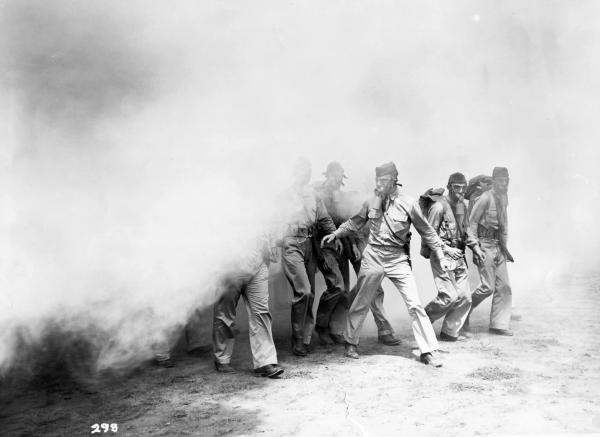
U.S. troops in Panama in a chemical warfare training exercise during World War 2. Photo: Howard R. Wilson/Courtesy of Gregory A. Wilson
THE CRIME
During World War 2, the U.S. military conducted experiments with chemical weapons—e.g., lewisite1 and mustard gas2—on over 60,000 soldiers and sailors. The military did separate race-based testing on Black, Japanese-American and Puerto Rican soldiers to see how non-white people would react to being mustard gassed.
These studies were conducted at Cornell University Medical College in New York, University of Chicago Toxicity Laboratory, Institute for Medical Research in Cincinnati, Rockefeller Institute for Medical Research in New York, and on San Jose Island off the coast of Panama.
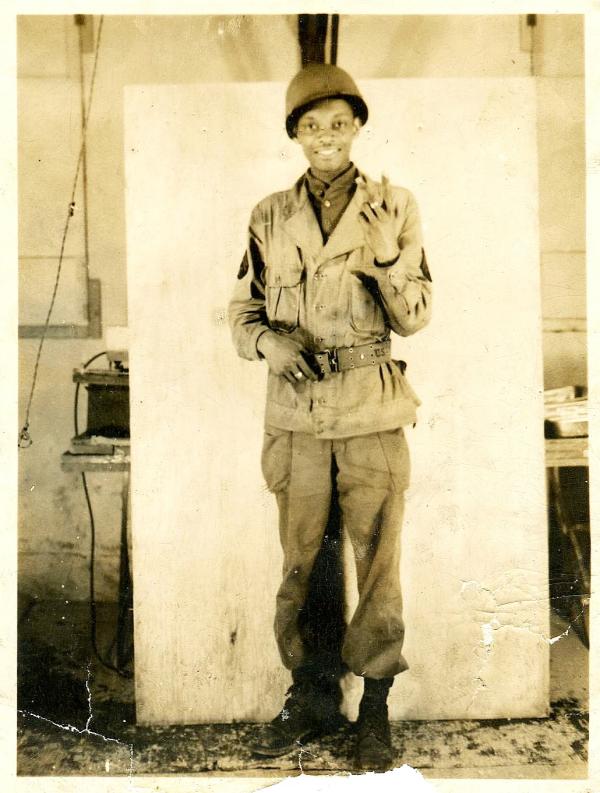
Rollins Edwards, one of the Black soldiers subjected to chemical weapon tests, at Clark Air Base in the Philippines, 1945. Photo: Courtesy of Rollins Edwards
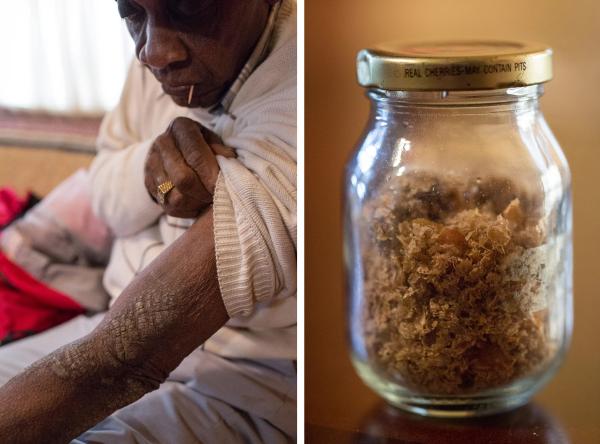
Rollins Edwards showing how 70 years after exposure to chemical weapon tests, his skin still falls off in flakes. At right, a jar full of the skin flakes that he carried around to show what happened to him. Photo: Amelia Phillips Hale for NPR
The soldiers were locked in gas chambers and exposed to mustard gas and other agents. In a National Public Radio (NPR) investigation that exposed the mustard gas experiments on Black soldiers, Rollins Edwards, a Black veteran said, "It felt like you were on fire. Guys started screaming and hollering and trying to break out. And then some of the guys fainted. And finally they opened the door and let us out, and the guys were just, they were in bad shape.”3 Edwards stated that “They said we were being tested to see what effect these gases would have on Black skins …You had no choice. You did not know where you were going. They didn’t tell you anything.” Edwards says his “skin still falls off in flakes as a result of the testing.”4 For years, the World War 2 veteran carried around a jar full of the flakes to convince people that something had happened to him.
In her book, Toxic Exposures: Mustard Gas and the Health Consequences of World War II in the United States, Susan Smith indicates that many soldiers who took part in the experiment were considered as “volunteers.” However, Smith states that in one experiment, “There is no indication that [the researcher] sought consent from individual research subjects. Instead the consent for human experimentation came from military authorities.”5
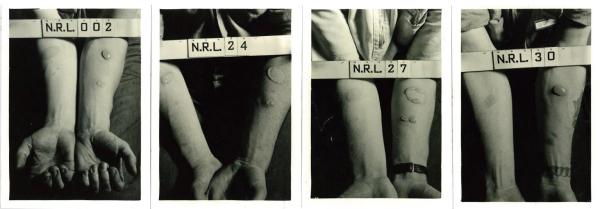
These historical photographs depict the forearms of human test subjects after being exposed to nitrogen mustard and lewisite agents in World War II experiments conducted at the Naval Research Laboratory. Photo: Courtesy of the Naval Research Laboratory
Smith suggests that Black and Puerto Rican troops were tested in a search of an "ideal chemical soldier." If these troops were more resistant to chemical weapons, they could be used on the front lines while white soldiers stayed back, protected from the gas.6 This racist notion that the skin of Black and other non-white soldiers could withstand mustard gas better than the skin of white soldiers indicated that the military intended to use Black and Puerto Rican troops on the front lines during chemical warfare.
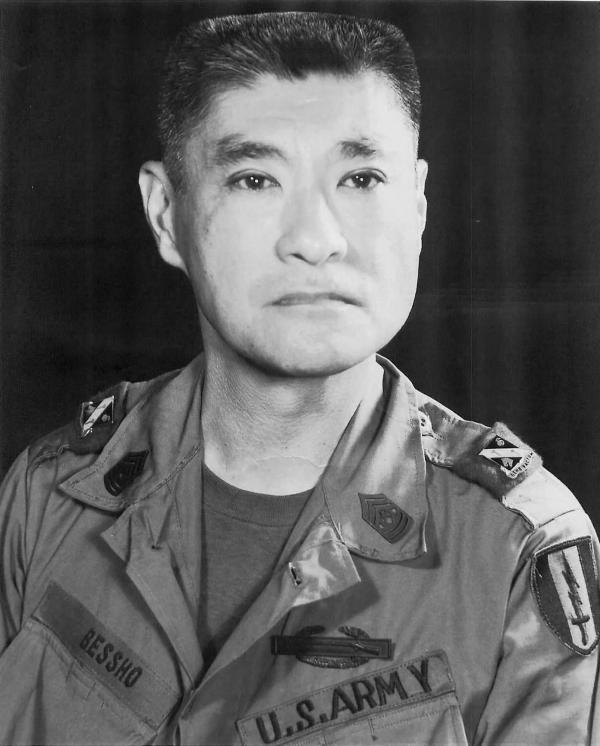
Louis Bessho, one of the Japanese-American soldiers who were forced to undergo the U.S. military's mustard gas testing. Photo: Courtesy of David Bessho
David Bessho, whose father was a participant in the chemical gas experiments, said, “They were interested in seeing if chemical weapons would have the same effect on Japanese as they did on white people.” Bessho says his father told him, "I guess they were contemplating having to use them on the Japanese."7
In the NPR investigation, June Dickenson reported that “All of the World War II experiments with mustard gas were done in secret and weren't recorded on the subjects' official military records. Most do not have proof of what they went through. They received no follow-up health care or monitoring of any kind. And they were sworn to secrecy about the tests under threat of dishonorable discharge and military prison time, leaving some unable to receive adequate medical treatment for their injuries, because they couldn't tell doctors what happened to them.”8
THE CRIMINALS
President Franklin D. Roosevelt: Roosevelt supported the Chemical Warfare Service (CWS) that was established in 1918. Roosevelt stated: “I am doing everything in my power to discourage the use of gases and other chemicals in any war between nations. While, unfortunately, the defensive necessities of the United States call for study of the use of chemicals in warfare…”9 [emphasis added] In 1941, Roosevelt established the Office of Scientific Research and Development (OSRD). A branch of OSRD, the National Defense Research Committee (NDRC), provided “federal funds for thousands of chemical warfare research projects.”10
United States Congress: “Congress made the Chemical Warfare Service a permanent part of the Army in 1920, with duties to continue ‘the investigation, development, manufacture or procurement and supply of all smoke and incendiary materials, all toxic gases, and all gas defense appliances…’”11 “By 1942, the U.S, government had allocated $1 billion to the CWS.”12
U.S. Army: Key military leaders supported the use of chemical weapons and the experiments. One of them was CWS chief Major General William N. Porter. Porter “pushed superiors to approve the use of poison gas against Japan. ‘The initiative in gas warfare is of the greatest importance. We have an overwhelming advantage [over the Japanese] in the use of gas. Properly used gas could shorten the war in the Pacific and prevent loss of many American lives,’ Porter said.”13
Mass media: The New York Daily News proclaimed in 1943, “We Should Gas Japan,” and the Washington Times Herald wrote in 1944, “We Should Have Used Gas at Tarawa” because "You Can Cook 'Em Better with Gas.”14
Scientists who took part in the mustard gas experiments on soldiers: The key scientists who experimented on the soldiers were Max Bergmann, Cornelius Rhoades, Homer Smith, and Marion Sulzberger. Bergmann, who worked for the Rockefeller Institute for Medical Research, experimented on soldiers from CWS and on sailors from the naval prison on Hart Island.15 Rhoades participated in the experiments done on Puerto Ricans. In a letter he wrote about his experiments, Rhoades stated that “extermination” was a solution to local health problems.16 Smith “believed that mustard gas should be used in the Pacific against Japan, and he hoped that field studies … would demonstrate its effectiveness.”17 Sulzberger was one of the strongest proponents of race-based studies, and his studies erroneously concluded that there were differences in how races reacted to mustard gas, in particular that Black soldiers were more resistant to mustard gas than white soldiers. His bad science contributed to the notion that Black soldiers should precede white soldiers into a chemical warfare battle.18
THE ALIBI
During World War 2, the Army Chemical Corps was established, focusing on research and development of chemical agents for use in war. The U.S. claimed that it was stockpiling chemical weapons, including mustard gas and various nerve agents, as a deterrent against use by enemies of the U.S.19
President Roosevelt claimed that the U.S. would only use chemical weapons as a defensive measure. In June 1943, he stated the U.S. policy toward gas in warfare: “This country has not used them, and I hope we never will be compelled to use them. I state categorically that we shall under no circumstances resort to the use of such weapons unless they are first used by our enemies.”20
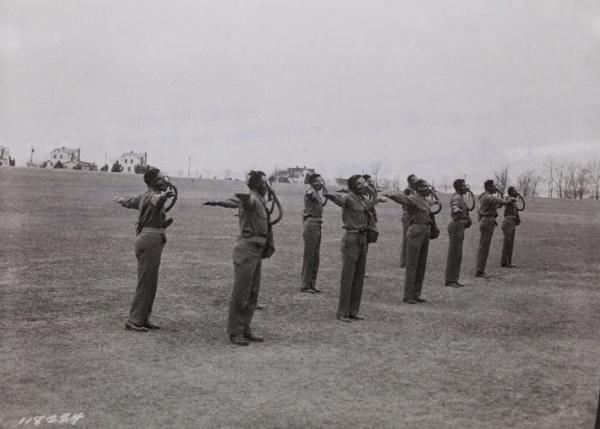
Black soldiers in a segregated unit practice movement in gas masks and protective gear at a base in Maryland during World War 2. Photo: Army Signal Corps via National Archives
The U.S. military claimed that chemical weapon testing on soldiers and sailors was only to determine how to protect them from mustard gas. In a 1991 form the Department of the Navy presented during a congressional hearing, the reason they gave for the experiments was “to test and evaluate protective clothing and applications (ointments, powders, etc.) for use against war gases. This program which was formerly classified was established by the Navy in anticipation of the potential use of war gases by the enemy.”21
THE REAL MOTIVE
Various powers fighting World War 1 used chemical weapons. After WW 1 and before WW 2, the U.S. stockpiled 87,000 tons of mustard gas to be used in warfare.
Despite claims by the U.S. that they would not use chemical weapons during the war, they were not only stockpiling mustard gas but had intentions to use it. This became clear in 1943 with an incident in Bari, Italy, where a U.S. ship containing mustard gas was destroyed during a German attack on several U.S. vessels. The bombing of the ship unleashed the mustard gas from two thousand 100-pound mustard gas bombs, injuring and killing many sailors. Those on the ship were never told that their cargo contained mustard gas bombs. The U.S. and Britain kept this attack secret as they did not want the Germans to know that the U.S. and its allies were intending to unleash mustard gas during the war.22
The U.S. made plans to unleash massive chemical attacks on Japan and Germany.23 As early as April 1944, a detailed study titled “Selected Aerial Objectives for Retaliatory Gas Attacks on Japan” had been completed, “assessing the vulnerability of cities such as Tokyo, Nagoya and Osaka to gas attack. The analysts believed that their densely populated residential areas, with narrow streets and few open spaces, were particularly susceptible to chemical warfare. Moreover, mustard gas is readily absorbed by wood, and Japanese wooden houses would have been very difficult to decontaminate…The intention was to maximize casualties, mostly civilian, and the study stated: ‘The Gas Attack Program is aimed primarily at causing the maximum number of casualties, crippling transportation and public services, complicating and delaying the repair of high explosive bomb damage and making targets more vulnerable to incendiary attack.’”24
By June 1945, the full gas attack plan was submitted to Major General William N. Porter, head of the Chemical Warfare Service, detailing 50 urban and industrial targets, including 25 cities that were particularly susceptible to gas attack. According to the report, “Gas attacks of the size and intensity recommended on these 250 square miles of urban population might easily kill 5,000,000 people and injure that many more.”25
During that time, the U.S. had discovered and begun to build a weapon to use on Japan that was more powerful than chemical weapons—the atomic bomb. However, had the Manhattan Project to build that bomb failed, the U.S. had Plan B in store for Japan—a massive chemical weapons attack.
Despite the outrage over the development and use of chemical weapons after World War 2, the U.S. continued to use them in war. During the Vietnam War, the Chemical Corps continued its support of combat operations through the employment of incendiary munitions, herbicides, riot control agents, and other efforts, with the use of napalm26 and Agent Orange27 being the main chemical weapons of choice.