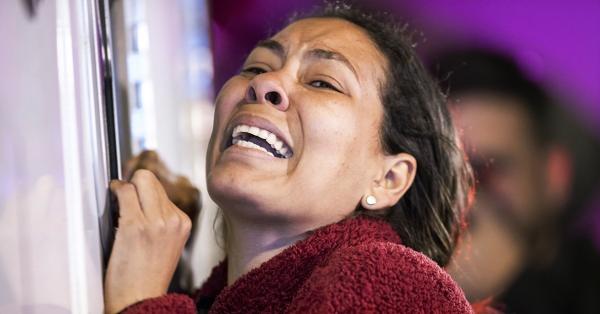
A migrant cries for someone she knows who was injured in the deadly fire inside a Ciudad Juárez, Mexico, detention center, March 27, 2023. AP
Last week, the day after a fire in a Ciudad Juárez, Mexico, detention center killed 39 migrants from six Latin American countries, families of three young men—Dikson Aron Cordova, Edin Josue Umaña, and Jesús Adony Alvarado—gathered in Proteccion, an impoverished village in western Honduras. The three had set out together, trying to get to the U.S. Each hoped to find a job and send money back to their families. Their names were on a list of victims—but there was no telling whether the three were dead or alive. Jose Cordova Ramos, father of one of the men, said of the ordeal he and others were experiencing, “You want to be strong, but these are hard blows. They’re unbearable.”
In Juárez on March 28, a Venezuelan woman, who herself had recently been released from a women’s detention center, said at a protest demanding justice for the victims of the fire, “We were there not long ago. It could have been us dying in there like animals, like pigs being slaughtered in a fire. Does it matter? Do our names matter to anyone?”
The Choices People Confront
Why would someone pack everything they have into a backpack and head out on a 2,000-mile journey, by foot? Why would they choose to leave everyone they love, and set off to a place they’ve never been; a place where people speak a language they don’t know, where many people hate them without knowing anything about them except the color of their skin? Why would they go, knowing they will be terrorized, perhaps robbed, beaten and raped, by police, military and criminal gangs, on the the thousand-to-one shot that they’ll make it all the way to the U.S. and land a job bussing tables, or processing chickens, or cleaning other people’s homes?
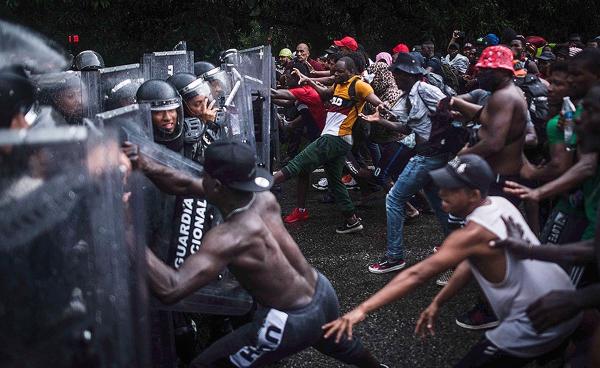
The Mexican National Guard violently attacks a caravan of immigrants heading for the U.S.
People make choices, but they don’t get to choose what choices they can make. The migrants who died in Juárez faced dreadful choices. But who set up those choices? What determined that THOSE were the choices? As Bob Avakian wrote in More On Choices… And Radical Changes, “[P]eople don’t make choices in a vacuum. They do it in the context of the social relations they’re enmeshed in and the options they have within those relations—which are not of their own choosing. They confront those relations, they don’t choose them.”
The three Honduran youths confronted the relations of the imperialist system. Imperialism isn’t just an intellectual word. It has real meaning, and real consequences in the lives of millions. It crushes lives and spirits. It poisons the planet. It shapes every choice people make, whether they know that or not.
Look through the many entries in Revolution’s “American Crime” series for exposures of what U.S. imperialism has done in Mexico and Central America—decades of relentless exploitation, genocidal wars, destruction of subsistence agriculture; rampant contamination of the land, water, and air; acute, accelerating, and devastating climate change; mass impoverishment in the countryside, millions of people forced into squalid urban slums. Read how the U.S. has created a catastrophe of human suffering in Venezuela. All this is imperialism in action.

Bob Avakian has written that one of three things that has "to happen in order for there to be real and lasting change for the better: People have to fully confront the actual history of this country and its role in the world up to today, and the terrible consequences of this."
Read the American Crime Series
The imperialist system forces countless people to lead lives that are unbearable, and unlivable, while it enriches a handful, who control not only enormous wealth, but the means of producing that wealth—the ruling class of the system. Imperialism constrains and confines the choices people face, so that a woman, facing the possibility of starvation for her young daughter, “decides” to carry her child on a trek that lasts months, through freezing cold and broiling heat, knowing that if she makes it all the way she will have to cross through razor-wire tunnels patrolled by heavily-armed robo cops. She will be told to “show her papers” before she can go any further. And she very likely will be thrown back onto the streets of a city prowled by soldiers and police with automatic weapons and looking for migrants; a city infamous throughout the world for violence against women.
These are the kinds of choices imperialism gives masses of people. Think of the lives of Dikson Aron Cordova, Edin Josue Umaña, and Jesús Adony Alvarado. Think of the tens of millions like them; penniless and stateless, vilified by Amerikkkan fascists and racists; kicked around like footballs to serve the needs of different sections of the ruling class in this country. Their choices were made before they were born. Think of the system that caused their suffering.
And then think of what Bob Avakian has said about the choice that confronts us:
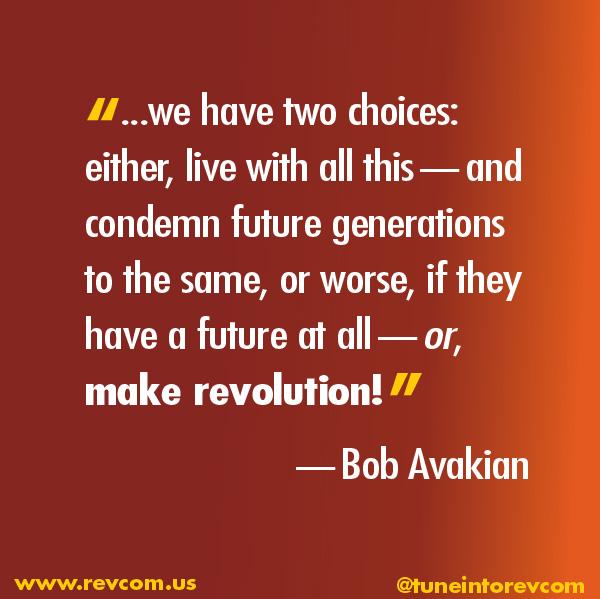
...we have two choices: either, live with all this—and condemn future generations to the same, or worse, if they have a future at all—or, make revolution!
—Bob Avakian, from his speech Why We Need an Actual Revolution and How We Can Really Make Revolution