Question: Well, I think it would be worthwhile going further at this point of class outlooks, and the class outlook of the middle strata in particular. And just to highlight a distinction you drew before, I know this is something people often get confused about: As you were saying, the point is not that everybody individually who comes from a middle class background is going to think that way, or think the same way; but, to pick up on a point you were making earlier, the middle class is caught between the proletariat and the bourgeoisie, between the most oppressed and exploited class and the capitalist class, and people in this middle class don’t want either class ruling over them—that’s the class outlook of the middle class. And what goes along with that is the idea: Let’s just make everyone equal. In terms of what you were saying about remaking the world in the image of the middle class, that outlook is “let’s just make everyone equal.” I think that comes into play in a lot of this. Along these lines, here are some types of things people with this middle class outlook often say. I’ll put out a few of them, and then maybe you could respond. “Why do you make such a big deal out of this one person, BA? Shouldn’t everyone be equal? Shouldn’t the goal be democracy? Aren’t we all leaders, shouldn’t everyone’s ideas be given equal consideration?” These are the kinds of things that often get said by people coming from this outlook. How would you respond to that?
AS: Why do we make such a big deal about this one person, BA? Well, it’s not a very complicated answer. You have a person who’s the most advanced theoretician of radical change, of revolutionary transformation of society, alive on this planet today. It’s really that simple. He’s not a god, he’s not some kind of mystical cult leader, or anything like that. He just happens to be the most consistently scientific and advanced person in terms of learning the lessons of the past, both positive and negative, and drawing from many broad sources, to forge a whole new synthesis, and provide leadership, theoretically as well as practically, to get us out of the situation we’re in, in terms of the major problems that plague society and the world today. He’s got the analysis of the problems and the analysis of the solution, and he has the ability to lead people in applying the science to concretely transforming things in the direction of revolution, the kind of revolution that actually serves the emancipation of humanity and is not just promoting one group of people over another, or creating a new class of oppressors to oppress people.
And this question basically has a lot to do with, do you think this world, as it is, is a horror? Do you think this system creates an unbelievable amount of unnecessary suffering for people, both in this society and around the world? If you do, what are you going to do about it? And what do you think is involved with that? Do you think it’s just a simple thing of giving a thumbs up or a thumbs down, or doing a “mic check” or something? [laughs]
I mean, it’s ridiculous. It’s ridiculous, it’s frankly childish, when people don’t understand the need for leadership. This question, why do you make such a big deal about this one person, BA, actually has another question hidden inside it: Why do we need to have any leaders at all? It has to do with the notion that a lot of these people have, that they don’t want anybody leading them. That is a kind of a childish protest, that corresponds to the middle class outlook of people who are filled with illusions, imagining that somehow they are some kind of free agents in society who manage to escape being led by anyone. That’s so absurd.
What do you think a society is? A society, any kind of society, involves leadership. In a capitalist-imperialist society—of course, there’s leadership! You’re being led on a daily basis. How do you think things happen, like the production of things, in a society like this one, or on a global plane? How does agriculture, and industry, and transportation, and health care, education, all the various institutions...how do you think they get built up, and on what basis, with what values, with what objectives? Do you think they just kind of emerge spontaneously, like mushrooms after a rain, and that they require no leadership? That people just bop around day to day, running things, in a random and disorganized manner? Obviously not. So, of course, they’re led. They’re led with certain objectives. They’re led with certain principles. They’re led with certain values. The basic institutions of society under capitalism-imperialism are led primarily on the basis of generating and expanding profits, and out-competing rival capitalists. The way this kind of society is organized and led has nothing to do with actually being geared to meeting the needs of the people. That’s not the basic objective of capitalists and it’s certainly not their priority. From their standpoint, if they sometimes meet some of the needs of the people in the course of doing what they’ve got to do, then fine—but again, that’s not what they’re primarily geared to doing.
Does anybody really think that any major institutions, in any kind of society, can exist without some kind of leadership? And what do you mean if you say, “I don’t wanna be led, I don’t wanna be told what to do?” What are you thinking? That you’re just going to get together with five or six friends and you’re going to make all the major decisions of life? Think about what you are actually going to encounter in society: You’re not going to be isolated on some kind of mountaintop. What about when you relate to other people and those other people have different ideas of what they want, or what’s needed? Who’s going to sort all that out and figure out what’s actually the most correct thing to go for or the most important things to prioritize? On what basis, and with what kinds of methods and orientation, are such things going to be decided? You know, even in socialist society there will still be contradictions among the people. One example that has been given is this: What if you think we should build a park, and other people think we should build a health clinic? Maybe both ideas are good and both things are needed, but we just don’t have the resources to build both at a particular time. Who’s going to sort that out? Who’s going to figure out what to prioritize? Who’s going to make the decisions about what contributes to the direction that society needs to go in overall? Now think about how these kinds of questions will be multiplied many, many times over, and on a daily basis, if you’re talking about the society as a whole. So how can all this be figured out and handled in the best possible ways? It will take leadership.
Earlier, I mentioned the “4 Alls.” This is something from Marx that was popularized by the Chinese revolutionaries who followed the leadership of Mao. It is a concentrated way of describing the strategic goal of communism. It refers to the fact that, in order to get to communism, we need to move towards a world where we can get rid of all the class divisions among people, on a worldwide level; and, in order to do that, we have to move beyond all the economic-production relations that are the underpinning of those class differences. Because those class differences don’t appear like mushrooms after a rain either. They have something underneath them, they come out of particular economic-production relations that foster those class divisions. And the idea of moving towards communism is, if you want to get rid of class divisions among the people, you’ve got to get beyond the existing economic-production relations that are the material underpinning of those divisions. And you have to get beyond the social relations that flow out of, or correspond to, those underlying production relations, the oppressive social relations like the contradictions between men and women, and between different nationalities, and between different parts of the world. And the fourth of the “4 Alls” is revolutionizing all of the old ideas and the ways of thinking that go along with relations of oppression and exploitation.
All this is a completely, a radically and fundamentally, different vision of how the world could and should be. It’s a completely different framework. And when we talk about how “BA is the architect of a completely different framework”—of revolution, of the revolutionary process, and of the new society to bring into being—that’s exactly what he is. You can like it or not like it, agree or don’t agree, but objectively that’s what he actually is. And he’s been developing this framework very systematically, on the basis of scientific methods. And that is why we make such a big deal about this one person, BA. There is no one else in the world today who is on the same level in terms of developing the science of revolution and its application to the struggle to transform this society and the world on a radical, a truly radical basis, that deals with fundamental problems. Nobody’s taken it as far, and on such a consistently scientific basis, and has as worked out a sense of not only why it needs to be done, but how to do it, and what to bring into being to replace this system. That’s why we make such a big deal about him.
The way some people make a principle of opposing any and all leadership, insisting that they are “against the very idea of leadership” is truly absurd, especially when anyone who thinks about it for two minutes should be able to recognize that all the major components, of any large and complex society, obviously have to be led in order to be functional.
And then there’s this other idea that some people put out: “Isn’t everyone equal?” Or shouldn’t our goal be to “make everyone equal”? Why do people say such stupid stuff?! [laughs] Look, it’s one thing to say that all human beings are “equal,” in the sense that every human being is a full human being and should be recognized as such. There’s no such thing as an “illegal” human being, there’s no such thing as a human being that’s only “one-half, or three-fifths,” of a human being, there’s no such thing as some kind of inherently “inferior” human being. All human beings are full human beings. That’s one thing. But when somebody poses the question, shouldn’t everyone be equal, what they’re really asking is shouldn’t everyone be able to throw their weight around to the very same degree, shouldn’t everybody be able to have the very same influence on things? Well, that’s not reality. I don’t know what kind of dream world you live in, but the reality is that different people in human societies have different degrees of influence, for good or bad reasons. You know, there are some bad reasons why some people have disproportionate weight and influence. For instance, the people who run the government, who run this society, who run the police and the military, you’re not equal to them. OK? [laughs] The bosses where you work, who have the ability to throw you out on the sidewalk, you’re not equal to them either. Not because you’re a less valuable human being, but because you’re objectively not equal to them in terms of the social position you occupy and the influence you are able to wield. So these are examples where you can see that everybody’s not “equal,” since some people clearly wield disproportionate weight and influence of a negative nature.
The other side of this is that there are also people who wield disproportionate weight and influence of a positive nature, including in ways that can contribute positively to society, that can “serve the people” in various ways. Think of people who are “tops” in their fields, like a “top” doctor or lawyer or a “top” auto mechanic or a “top” athlete or musician. I don’t think of them somehow being “better” human beings than me, but I have no problem acknowledging that I don’t have their skills and experience in those fields and therefore that we are not all “equal” in that sense and therefore I wouldn’t expect to be wielding the same degree of authority or influence as those “top” experts in an operating room, on a basketball court, or on a concert stage, just to use those examples. But I’m not worried about that. I don’t feel threatened by that. We don’t need to be “equal” in every dimension of life. And the reality is we’re not all “equal” in terms of experience, skills and abilities. And in relation to positive things, it’s OK, it’s more than OK, if some people can wield more weight and influence. Which gets me back to BA. It’s not only OK, it’s more than fine, if BA is able to wield disproportionate weight and influence inside the Party he leads, in the larger movement for revolution, in the broader society at large. If he has the experience, skills and abilities that put him at the “top of the field” with regard to the analysis of the biggest social problems of this era and what to do about it, if he is objectively at the “top of the field” with regard to the development of the science of revolution and communism, then I, for one, want him to be able to wield as much disproportionate influence as possible! [laughs]
Nobody else has done this kind of work. Look at the work he’s done. Be scientific and look at the evidence. Show me anybody else who’s done this type of work, at this level, with this degree of depth and substance and innovation, anywhere in the world, anywhere in this society, or even in his own party. As I said earlier, he is clearly miles ahead of even the best of the rest. That’s just a fact right now. So here, too, we’re certainly not all “equal,” we don’t all have the same expertise and abilities. But why pretend otherwise, or act as if that’s some kind of big problem? It’s not! In particular, to everyone who sees the need to radically transform society and work for the emancipation of all humanity, I would simply say the following: 1) we all have the ability to make important contributions to the overall collective process of revolution, so let’s get on with doing that; 2) we should all be trying to learn as much as we can, in particular about BA’s overall method and approach, to work on “catching up” with BA as best we can, so that we can keep improving how well we function as a “team”; and 3) if we’re serious about wanting to make a better world, we should recognize how lucky and privileged we are to have the opportunity to learn from such a “top expert,” to have the benefit of such advanced leadership. And we should take full advantage of this.
So again, the fact that there are differences in people’s abilities is just a matter of reality. And, I’ll tell you, this idea of not wanting to recognize that some people have more influence than others, and that in some cases it is a very good thing that some people can have more influence, is a classic middle class kind of complaint. The people who are more at the bottom of society don’t generally have this problem. They know damn well that people have different abilities, different experiences, different levels of expertise. They already know that some have had the privilege to have higher levels of education and advantages in life, and that some have had very big disadvantages in life. And they know that all this makes a difference to what people can do. Again, “equality” is one thing, if you’re talking about how lives matter, and how all people are full human beings. But people occupy different material positions in society, concentrate different levels of expertise, wield different degrees of influence.
At the same time, when we talk about some of those misconceptions and wrong views commonly found among middle class people, let’s not fall into being narrow or mechanical about this. There is not just one single outlook that “automatically” and inevitably comes along with your position in society. I don’t want to encourage the development of “revenge thought” towards middle class people. Just because a lot of middle class people frankly have their heads up their asses these days doesn’t mean that people at the bottom should want to chop their heads off! [laughs] Because many of these people can turn out to be very generous-minded, and very inspired by the developing movements of resistance, and by the growth of the revolutionary movement and its communist leadership, and many will contribute in some very good and very significant ways to the transformation of society in the interests of the majority of people. So, let’s make sure we deal with things scientifically, by looking at how different people actually are, how they actually think and act, and not go around imposing generalities on people.
But, without falling into mechanical thinking, it is a fact that people do occupy different material positions in society, and that does tend to affect, it does tend to strongly influence, the outlook and the views and analyses of people. So, in a society like the United States, with its large middle class, you end up having people saying things like, “Well, I don’t wanna have leadership.” Again, as I was saying earlier, this sounds childish and stupid, frankly, if you think for two minutes about what’s actually involved in running any part of even the existing society. And then, what about running and directing, providing guidance to, an actual revolutionary process, with all its complexity, with all its diversity, a process which ultimately needs to involve thousands and millions of people...many different kinds of people who come from many different backgrounds, who have many different ideas about how to go forward. If you’re leading a revolution, you’re gonna be trying to shepherd all that, and in a certain direction. You’re gonna be trying to direct it toward strategic goals, that will benefit the majority of humanity. But, of course, not everybody involved is going to understand all of this in exactly the same way and all at the same time. In fact, they won’t. This gets back to the example we were talking about earlier, about how, when you get to the point where there can actually be a revolution in a country like the United States, the majority of people involved in making the revolution will still hold on to religious ideas. They won’t have all broken with religion. But, at the same time, they’ll still be part of the revolutionary process. This contradiction is something Bob Avakian spoke to in the Dialogue with Cornel West. It’s a good example, but just one example, of the complicated contradictoriness and diversity of views, and so on, that will come together in the revolutionary process, and that you can already see coming together in beginning ways.
But, if you want any process to go in a certain direction, and to accomplish certain goals, then you definitely need leadership. If you are trying to solve a problem in the natural sciences...let’s say that you want to investigate the surface of Mars, and you get a bunch of scientists together...if they can’t agree on the strategic objectives of their project, if they can’t agree on the methods and approach, if they’re all going in different directions with all this, you’re just going to have a mess! [laughs] The different people involved might all contribute some important ideas and insights, but if there’s no way of coordinating it, if there’s no way of channeling it, or directing it, towards a specific goal—in short, if there’s no leadership—you’re not going to get very far. You need leadership to enable you to sort out what’s right and what’s wrong, and to actually make sure that, even if there are inevitably going to be some false starts and some dead ends, most of the efforts are at least attempting to go in a certain direction, towards a certain goal. So, of course, you need leadership. And who’s providing that kind of leadership for the revolutionary transformation of society? Show me anyone else who has done the kind of extensive work and deep analyses and produced the kind of materials, the whole body of work, that Bob Avakian has produced. Show me anyone who even comes close.
Illusions of Freedom and Equality, the Reality of Dictatorship—And Moving Beyond Oppressive Divisions
AS continues: And the same goes for the stupid question—frankly, it is stupid: “Aren’t we all leaders?” Well, it depends. What do you mean by leadership? And to what degree? We’re certainly not all “equal” leaders. There may be a lot of people trying to provide leadership to a given process, in accordance with their different abilities and experience, but that’s certainly not going to be all on the same footing, for all the reasons I just outlined. So when some people start saying things like “but, but...aren’t we all leaders?” what they’re really saying, once again, is “we don’t want leadership, we don’t acknowledge the value of leadership.” It’s just that typical pipe-dream of middle strata people who labor under the illusion that nobody’s telling them what to do and nobody’s leading them. Because one of the features of this kind of system, the capitalist-imperialist system, is that it has this surface facade, it wraps itself in a cloak of bourgeois democracy, which gives many people the impression that they are just existing and living in the society without being led. This system cloaks things, it hides behind a veil. Its core essence is one of exploitation and oppression for the many, both here and all around the world; but it tries to hide this behind a surface appearance that proclaims “certain rights and liberties,” which are typically only extended to the few, but which can help them mask the true crushing nature of what lies at the heart of their system. The reality is that we already live under a dictatorship—it’s the dictatorship of the bourgeoisie. But, the people who run this society don’t tell you this, they don’t want you to think about this. By contrast, the revolutionary communists are completely open and honest in explaining to people why we would all benefit from living under a dictatorship of the proletariat, organized and led in the right manner, a form and mechanism making it possible to lead things in the direction of abolishing those “4 Alls” we talked about earlier, getting beyond class divisions and class dictatorships altogether—all of which would benefit the vast majority of people. That kind of dictatorship would actually be in the interests of the vast majority of people, and its goal of getting to communism is a goal of emancipation for all of humanity. So communists don’t need to hide this—they can be open and above-board about the need, and the positive character, of that dictatorship of the proletariat. But in current capitalist-imperialist society, in which we live under a bourgeois dictatorship, the people running things have no interest in telling everybody in school, and so on: “By the way, kiddies, we thought you should know that you live under the dictatorship of the bourgeoisie, and we want you to learn all about how we’re leading you in accordance with our interests and objectives.” [laughs] No, I don’t think they want to do that. They’d rather give people this false sense of autonomy and freedom, and fill their heads with the idea that you can do whatever you want to do, that you can be whatever you want to be—and if you don’t succeed, it’s your own damn fault! As if they had nothing whatsoever to do with leading and enforcing the structuring of society in ways that continually restrict and distort people’s lives, when they’re not outright crushing them. So that’s ridiculous as well.
As for the question of different ideas: Should everyone’s ideas be given equal consideration? I don’t know, do you really think so? Do you actually think all ideas are equal? How about somebody who says they ran into little green men from Mars the other day? That’s an idea. Should it be given equal weight? What about the people who won’t vaccinate their children, and who are creating a social problem because they are afraid of vaccinations, and they don’t realize the value of vaccines? What about the idea that Caucasians are somehow superior to other races? Should that be given equal weight? I mean, there are all sorts of ideas, and many of them are wrong! Any individual will have tons of ideas. Do you really think they’re all equal? Should we give equal weight and equal time in the schools and so forth to the people who, despite all the evidence, still don’t believe in evolution, who believe the creation stories in the Bible, or the creation stories of any other religion, who imagine that some supernatural forces one day decided to...poof!...create life on earth, and, in particular, gave special place to human life...who believe that it was all done in just six days, and only a few thousand years ago, or any of the other ridiculous nonsense that is spoken to and taken apart in the Evolution book?
As a sidepoint here, I would like to once again encourage people to get into this book, The Science of Evolution and the Myth of Creationism: Knowing What’s Real and Why It Matters, because I think it can really help people to learn not only the basic facts of evolution—to learn about the tremendous amount of concrete scientific evidence that shows how life on this planet came to be and how it changed, how it evolved, over billions of years, and how it continues to evolve—but to also learn about a lot of important points of philosophy and scientific method, which I think people would actually get a lot out of, and be able to apply more generally to all aspects of life, including to revolutionary processes. Forgive me for plugging that book here for a second, but I think it’s actually worth doing.
But getting back to the argument that some people make that “all ideas are equal,” should we really be giving equal time and equal weight to religious ideas of supernatural creation vs. the scientifically established theory of evolution, a set of ideas that has been repeatedly tested and verified in the actual world since the late 1800s, which is backed up by tons of concrete scientific evidence, and which has been proven to be true over and over and over again? I mean, come on!
Look, people can hold whatever idea they want to, they can have the idea in mind that they can fly off a roof by flapping their arms, as far as I’m concerned. Have whatever idea you want to, but don’t try to tell me we should give all ideas equal weight! It gets back to the question of science. Ideas are not all equal, all ideas are not equally valid. And that’s the point: Say whatever you want to say, have whatever idea you want to have, but don’t tell me that they’re equally valid, because all ideas are not equally backed up by concrete evidence, by scientific proof. Once again, science is an evidence-based process. And I can tell you, on the basis of science, that if you go on the roof and just flap your arms, you are not going to be able to fly, OK? [laughs] And that the outcome will not be very good. There is concrete evidence to back up that idea. Ideas should be evaluated not on the basis of what you happen to believe, or what some other people happen to believe, but on the basis of having been tested up against material reality, and found to be true, or false, on the basis of actual concrete material evidence. So if you have the idea that if you just flap your arms you’ll be able to fly, that is a false idea that is not backed up by evidence. I’m obviously using a ridiculous example, but it’s to make a serious point.
Question: That some of the ideas about why society is the way it is, and how you can transform it, are the equivalent of thinking you can jump off a building and fly?
AS: Yeah, pretty much!
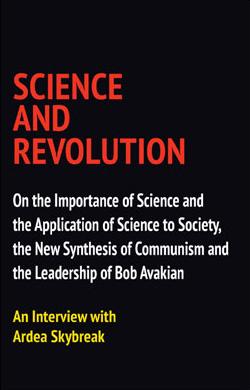
SCIENCE AND REVOLUTION On the Importance of Science and the Application of Science to Society, the New Synthesis of Communism and the Leadership of Bob Avakian An Interview with Ardea Skybreak
Available in PDF format on revcom.us.
Print Paperback available for purchase at Insight Press and at Amazon.