
For several weeks, the genocidal racist Trump has been orchestrating a hate-filled, racist-coded campaign against Lisa Cook. She is the first Black woman appointed to the seven-person Board of Governors of the Federal Reserve Bank. Trump has accused Cook of “mortgage fraud,” even though no charges have been filed against her. He has demanded her firing, even though he has no authority to do so. But all this is standard operating procedure in the new fascist order.
The Federal Reserve Bank (“the Fed”) is a crucial ruling-class institution. It supervises banks, sets key interest rates and influences the money supply, and acts as a “lender of last resort” (providing support to failing banks and acting to inject credit during financial emergencies and crises). The Federal Reserve is often referred to as the “most powerful central bank in the world.” The Fed has never been “independent” of imperialist ruling-class interests. And the U.S. Federal Reserve is a key instrument of U.S. imperialist domination and hegemony in the world economy. (See accompanying article for more on this.)
In this article, I am not going to explicitly address Trump's designs on the Federal Reserve Bank to serve the fascist restructuring of the economy. Rather, I want to share with readers some of what I have learned about Lisa Cook's pioneering economic research. In this, I have drawn from a major and in some ways career-defining research paper that she wrote: Violence and Economic Activity: Evidence from African-American Patents, 1870-1940. I have also benefited from several valuable profiles of this work featured on the podcast Planet Money and other interviews with and presentations by Cook.
One biographical fact to be noted: Lisa Cook was part of a cohort of Black children who desegregated local Georgia public schools. She was beaten by racist mobs and her body still bears scars. And a professional fact: in 2020, when Lisa Cook became a full professor of economics at Michigan State University, there were 9,000 full professors of economics in the U.S., and only 90 were Black.
Challenging the Orthodoxy of “Pure Economic” Models
Lisa Cook studied under the Nobel Prize-winning economist Paul Romer. He analyzed the important role of innovation in spurring growth in modern economies. He held that with investment in science, the adoption of strong patent laws, and competition—robust innovation would result. Which in turn would have a potent effect on growth. All that was needed was this kind of institutional framework.
Cook, a doctoral candidate at the time, had doubts about this notion that with science schools and patent laws, the table was set for innovation. Did this really apply to Black people? She posited that there might be “extra-economic” factors at work accounting for disparities between white and Black patent applications. She was posing whether laws on the books are actually enforced equally and whether the prevailing level of violence against Black people in society would impact innovation originating from Black inventors.
In other words, she was bringing the dimensions of unequal legal and social relations and institutional and “extra-judicial” violence—violence not officially sanctioned by law but not prevented by the law either, like lynchings—into the discussion of innovation. The prevailing discourse of mainstream economics is one that sees things in terms of sophisticated economic models backed up by mathematics... a “pure economics” that need not concern itself with history, or with power and social relations.
Proving Her Case
Cook had to put her hunch—that became a working hypothesis—to empirical test. She set out to compile two sets of data. One was to compile a database of patents for inventions going back more than 150 years—and to ascertain the race of the inventors, a formidable task, given that the patent record did not enter that information. The other set of data that she needed turned on measures of violence and the unequal rule of law. Here she developed various benchmarks, from spikes in segregation laws to the rise in violence, with lynchings at the far end of that spectrum. She would see how Black innovation grew or fell in different times and places around the country.
How she searched out and brought data together into usable measures is a fascinating story that takes in more than 10 years of painstaking work. Her final paper submitted to professional journals covered the years 1870-1940.
Some of Lisa Cook's Critical Findings
Using the methodology she developed and examining the rise and fall of patent filings in connection with spikes in segregation laws and lynchings, she discovered these trends:
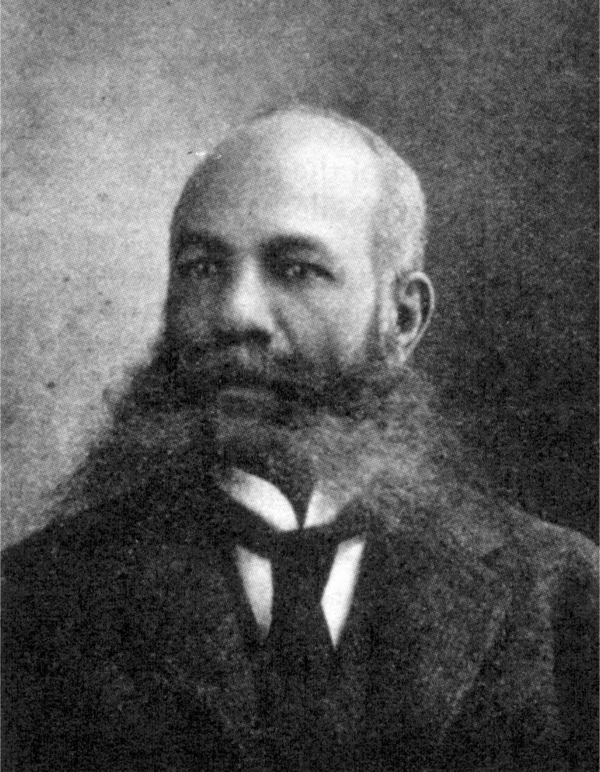
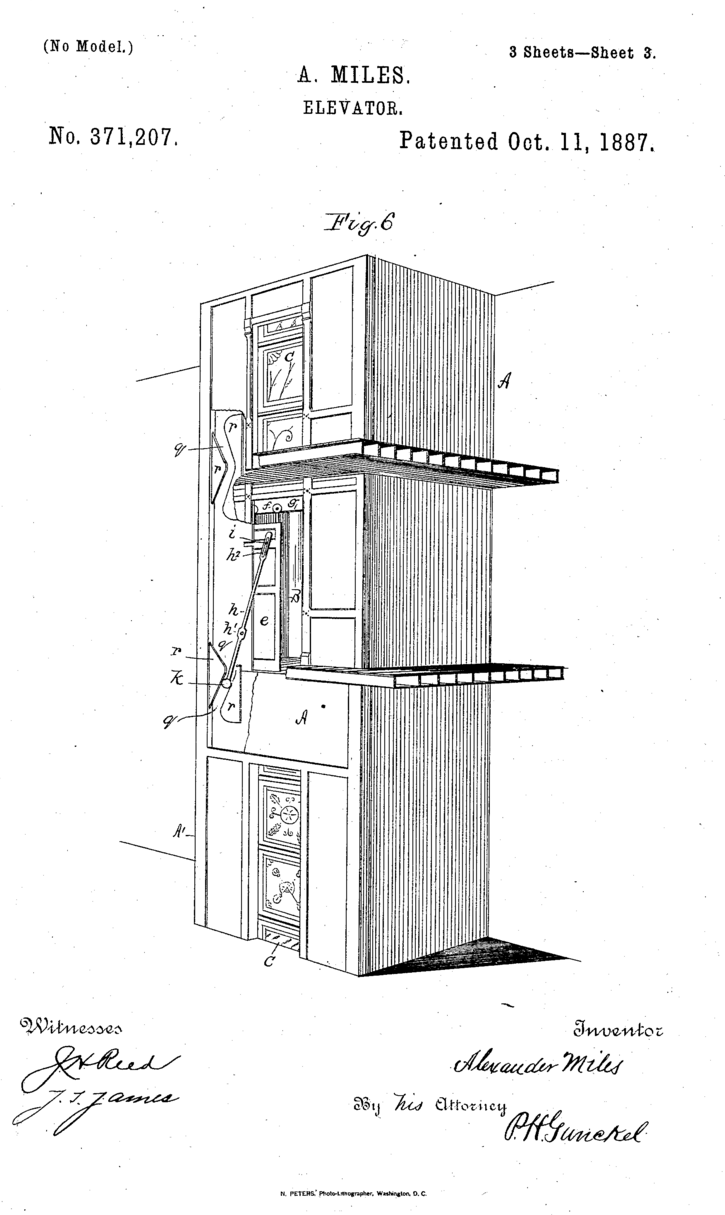
Alexander Miles. Photo: circa 1885.
At the time of Alexander Miles' (above) invention, doors of the elevators had to be closed manually. If the shaft was not closed, people could fall through it leading to some horrific accidents. Miles designed a flexible belt attachment to the elevator cage which allowed for automatic opening and closing when the elevator reached the the respective floors (drawing below). Photo and drawing: public domain
*A high point of innovation for Black inventors was in the period 1870-1900. By 1870, the Civil War had produced great gains for Black people. The 14th Amendment had been enacted, promising equal protection (rights of citizenship) for all men born or naturalized in the U.S. With Reconstruction—the dramatic measures taken by the federal government from 1865 to 1877—new avenues opened up for Black people to hold political office, own property, obtain education. And in this period, Black people were filing patents at basically the same rate (patents per person in the Black population) as white inventors. Even as fierce white supremacist backlash and violence quickly emerged, the positive changes that did take place, along with the struggle of Black people, enabled this trend to continue through 1900.
Black inventors gave us elevators, rotary engines, a telephone system, mechanisms to knead dough, and many other kinds of innovations in this period. Again, they were inventing at the same rate as white inventors.
*In 1900, there begins a sharp decline in the rate of Black patents. Why? The Supreme Court in 1896 had sanctioned and institutionalized segregation with its Plessy v. Ferguson ruling—this coming on top of the savage KKK/white supremacist violence that was part of the reversal of Reconstruction.
*How would segregation inhibit innovation and the filing of patent applications? Cook explained in an interview with Planet Money: “They've been locked out of libraries, where they used to go check the patent registries. They are locked out of the commercial districts, where their patent attorneys are. They were cut off from talking to other inventors, I think that was one of the biggest casualties.” Cook has pointed out that it wasn't until the 1970s that there were Black patent attorneys.
*Lisa Cook finds a further and very sharp drop in patent applications from Black people in 1921. What was going on? Cook: “You have to test when you're looking at something that is that stark... and I just couldn't get the effect to go away no matter what I threw at it.” She checked and re-checked to see if it was a calculation error. And then it dawned on her: the Tulsa race massacre of 1921!
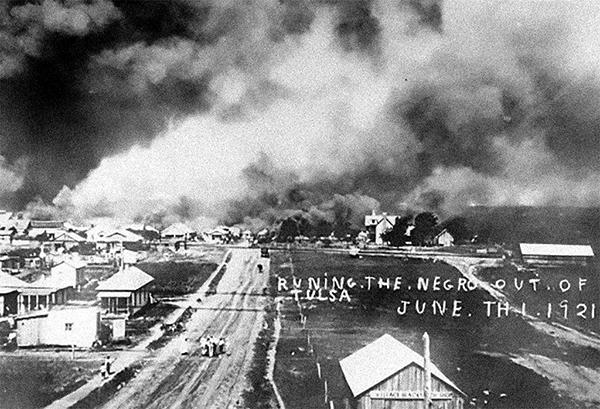
Black neighborhood of Greenwood burned down by white racist mobs during Tulsa Massacre, 1921.
Tulsa contained one of the most prosperous and thriving Black communities in the country. It was literally destroyed by marauding racist mobs: shooting on sight, with authorities firebombing from the sky, residents massacred and chased out of town. For Black people, Cook observed, “Tulsa demonstrated that no one would help them... the local government failed, the state government failed, the US government failed. At every single level, nobody had their backs. They were all afraid.”
American Crime Case #12: The 1921 Tulsa Massacre and the Destruction of Black Wall Street
This lack of the rule of law for Black people, the fact that a Black person didn't feel safe anywhere, that your scientific-intellectual breakthroughs would not be recognized and defended... this contributed to major disparities between white and Black patenting that persisted to the 1940 end date of Cook's study. But many Black inventors defied the odds and threats, including her cousin Percy Julian. In 1940, he invented an improved way to make cortisone (the anti-inflammatory steroid). It may not have gone that way, as the house he grew up in had been firebombed twice!
An Overview and Extension of the Research
Looking at the 1870-1940 period as a whole, Lisa Cook calculates in her paper that the United States had lost out on more than 1,100 inventions from Black inventors. What might have happened if these inventions had come forth instead of being stymied and suppressed by segregation and racial violence... if these inventions held back had been incorporated into the economy? Cook says that the loss was the equivalent of patents generated in a middle-sized European country, like the Netherlands.
So her hypothesis and specific challenge to Paul Romer's model of innovation was confirmed: strong patent laws (or what is often referred to as “intellectual property rights”) did not, and do not, in and of themselves beget innovation. Not when these laws are applied unequally (segregation and discrimination), and not when you introduce the historically defining “variable” of racist violence into the mathematics.
Lisa Cook's research paper had to fight its way to publication. She received the backing of three Nobel Prize-winning economists, including from Paul Romer whose work she was critically interrogating.
Cook's study covers the years 1870 to 1940. In that period, the peak year for African-American patents per person in the Black population was 1899. More recently, she extended her datasets to 2010. It turns out, and this is a terrible indictment, that 1899 still is the peak year.
A Bitter Irony and a Lesson Going Forward
Lisa Cook is a Black woman appointed to the Federal Reserve Bank by the Biden administration. For Trump, that's grounds enough to demand her removal... never mind due process. But more is in play. If you become familiar with many of the topics of Lisa Cook's writings—which prominently include papers on racial and gender disparities in the labor force and wealth acquisition—you can see why the Trump fascist-racist operatives are sharpening their knives of character assassination as part of the overall fascist juggernaut to silence the truth about racism as an historical and pervasive fact of life in this country.
Lisa Cook is refusing to step down. She has not only hired legal counsel to stand down these charges but is also suing Trump. This is a sharp and sharpening contradiction, as Trump aims to establish fascist-dictatorial control over the Federal Reserve and escalates the blatant and ever-more aggressive white supremacy of fascist rule.
There is a bitter irony in all this. Lisa Cook came up in a generation that worked to change the system “from within,” with the idea that racial oppression could be ended—or at least seriously lessened—by fighting to make that system more equitable. Ironically, her research on patents is just one indicator of the persistence of the oppression of Black people in U.S. capitalist-imperialist society.
But, as Bob Avakian has written in the profound essay “Racial Oppression Can Be Ended, But Not Under This System”:
…as important as these mass struggles are, if they are not built toward, and do not finally get to the point of, taking on the whole system, with the aim of bringing it down, and bringing something much better into being, then, as I have emphasized before, even where concessions are won, “so long as this system remains in power, there will be powerful forces who will move to attack and undermine, and seek to reverse, even these partial gains,” and people will remain oppressed and once more weighed down with a feeling of demoralization, as they are once again divided and pitted against each other.
The story of Lisa Cook points to the urgent need both to drive this fascist juggernaut from power and to bring to people the understanding that this capitalist-imperialist system itself is the source of not only the fascism but the virulent racism, the toxic misogyny, the xenophobia and ignorance and all the rest that this system has never been able to eliminate and that, to quote Bob Avakian, “only the radical emancipating revolution represented by the new communism can bring an end to these horrors and bring into being a truly emancipating society and ultimately a world where human beings can truly thrive together and give full expression to their humanity.”