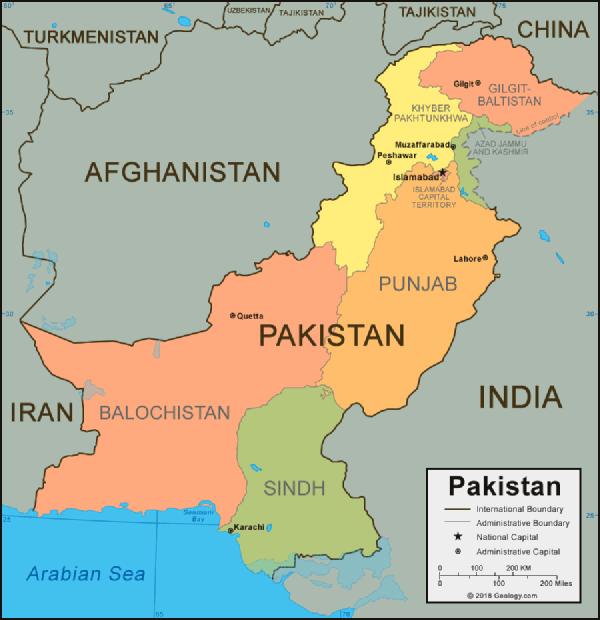
Since June 14, Pakistan—an impoverished South Asian country of over 200 million people—has been increasingly devastated by torrential rains, floods and landslides that have killed over 1,200 people as of September 3, including at least 440 children.1
The Pakistani government reports that 33 million people have been directly affected by the flooding. Satellite images show that as much as one-third of Pakistan is now underwater!
A Staggering Level of Human Suffering
While the rains have stopped—for now—there is already a scale of human suffering that is hard to wrap our minds around:
- Over one million homes have been damaged, including 260,000 on a single day.
- At least 500,000 people are living in refugee camps. Three million have been displaced from their homes, often losing all their possessions.
- The World Health Organization reports that 6.4 million people are in dire need of humanitarian aid.
- As stagnant warm water sits for days, and wells and water systems are contaminated by flood waters, water-borne epidemic diseases can spread quickly, causing more death and misery.
- The UN reports that “More than 3 million children are in need of humanitarian assistance and at increased risk of waterborne diseases, drowning and malnutrition.”
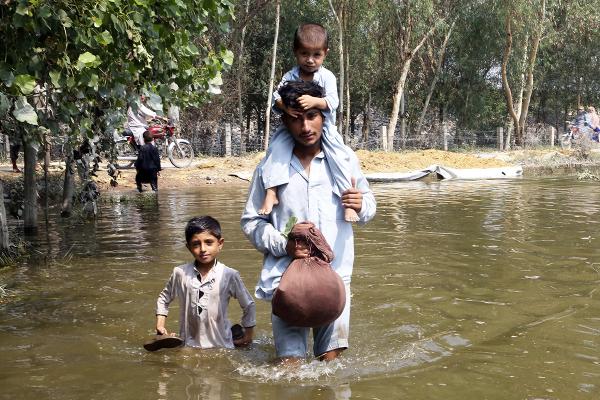
One-third of Pakistan has been flooded by historic monsoon rains June-September 2022. This photo taken September 1, 2022. Photo: AP
Journalists traveling through the flood areas are confronting the human reality behind these statistics:
- Sadia, a young woman from Balochistan province, described to BBC the situation there: “You can’t find a single home that is safe now. They are under the sky with no help. Right now, we are in need of first aid relief like tents, some shelter and some basic food, they can’t cook anything. And they need clean water to drink.”
- A Sky News journalist reporting from Sindh province heard from Lal Khatoon, “village matriarch” and “a forceful, passionate presence in a group of weary-looking people” who lost their homes from the flooding. She said, “No one came here to help. Thank goodness my children got here. But they now have fevers and stomach problems.” She tried to show reporters her house—but it was completely underwater.
- SBS News (from Australia) reported on the situation in another Sindh province village: “Villagers rushed to meet a Reuters news team … begging for food or other help. ... ‘We lost our house to the rain and floods, we’re going to Karachi [province capital city] to our relatives. No one has come to help us,’ said Allah Bakash, 50, leaving with his family and belongings loaded on a truck.”
Beyond the immediate life-and-death emergencies facing millions, there has been profound economic damage with long-term consequences on a country in which 76 million people live on less than $3.20 a day:
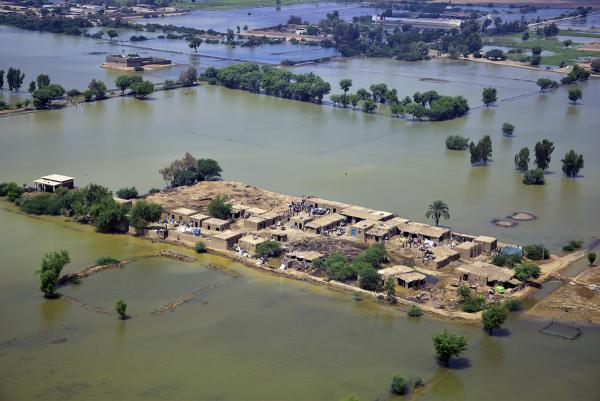
Homes are surrounded by floodwaters in Jaffarabad, Pakistan. More than one million homes have been damaged. Photo: AP
- Vast swathes of farmland have been submerged, destroying crops, wiping out months of labor and investment overnight. On top of instantly ruining millions of poor farmers, the loss of crops aggravates Pakistan’s existing food shortages and inflation; it will likely put food out of reach for millions, for months to come.
- The industrial economy will also be damaged, especially the textile sector, which depends on supplies of cotton from now-flooded farmland.
- And there is massive damage to infrastructure, which the debt-wracked Pakistani government is in no position to repair or replace. 2,000 miles of road were washed away, and 162 bridges had been damaged as of August 29.
And yet, almost three months into the disaster, international aid is trickling in. The UN is trying to raise $160 million, a pitiful fraction of what is needed. And so far the “great powers” are offering token amounts. Great Britain—whose wealth and power was in large part built on almost two centuries in which it colonized and plundered South Asia, including what is now Pakistan—gave or pledged roughly 20 million pounds sterling (about $23 million.) The U.S. is offering $30 million… in the same week it approved more than 30 times that amount—$1.1 billion—to Taiwan for advanced weaponry to prepare for a possible war with China.
“This Is Very Far from Normal”
Monsoons are powerful seasonal wind systems that normally bring heavy rains to Pakistan in August and dry cooler air in the winter. Monsoons are part of the natural ecosystem of many tropical and sub-tropical countries, and agriculture and other aspects of human activity are built around these more or less predictable rhythms.
But what has been happening in Pakistan (and South Asia overall) this year is not “normal.” As Sherry Rehman (Pakistan’s minister for climate change) put it, “Pakistan has never seen unrelenting torrential rains like this. This is very far from a normal monsoon. It is a climate dystopia at our doorstep.”
Several different dynamics—all linked to global warming—are contributing to this catastrophic situation.
Three Ways That Climate-Change Is Implicated in the Flooding
First, even in May, before the summer rains, runoff from over 7,000 glaciers (dense masses of compressed ice) in Pakistan’s mountainous north was causing flooding. It is normal for glaciers to grow in size in the winter and shrink in the summer heat. But as the planet grows warmer, this normal cycle has become unbalanced. Glaciers in Pakistan, like those around the world, are shrinking much faster than the average rate of past centuries—some studies say ten times faster.
Some melted ice runs off into existing streams and rivers, turning them into raging torrents and flooding surrounding areas. Some runoff accumulates in glacial lakes that are formed by “glacial dams” of packed ice at one end of a valley. But these “dams” are also melting and can suddenly burst, unleashing millions of gallons of water all at once, wiping out roads, bridges, dams and whole villages. (This is known as “Glacial Lake Outburst Flooding,” or “GLOF.”)
This year was exceptionally hot in some parts of Pakistan, with temperatures in one city reaching 120 degrees F. This likely contributed to greatly increased glacial melting, floods and GLOF. Pakistan’s prime minister was shocked by what he saw from a helicopter flying over a northwestern region: “Village after village has been wiped out. Millions of houses have been destroyed.”
Second, an even bigger problem is that heavy rainstorms barraged Pakistan starting on June 14, seven weeks before monsoon season. While not brought by monsoon winds and so technically “pre-monsoonal,” these storms combined heavy thunderstorms typical of early summer rain with long cycles of continuous rain characteristic of monsoons. This had much the same effect as if the monsoons came early and never stopped! These “pre-monsoonal” rain events are linked to the global pattern of more disastrous heavy rains, because as the atmosphere grows warmer it draws and holds much more moisture, and then unleashes more intense and sustained rainstorms.
Third, when the powerful monsoons of August came, the land was already saturated with water. So the monsoonal downpours added massive amounts of water to existing floodwater.
The end result may well turn out to be the worst flooding in Pakistan’s history. Pakistan’s National Disaster Management Authority (NDMA) reported that nationally, rainfall this year was already three times heavier than average. And in Sindh—one of the worst-hit provinces—the rainfall has been 466 percent greater than normal levels.
The unprecedented nature of the floods is illustrated in a video of a bridge in Khyber Pakhtunkhwa province. A previous bridge at the same place was destroyed in floods in 2010, which at that time were called “the worst ever.” The new bridge was rebuilt 16 feet higher over the river… yet it was still inundated in this year’s floods.
This is where we are, not just in Pakistan, but globally: each new “unprecedented disaster” is soon surpassed by an even worse one.
The Pakistan crisis is far from “over.” Fields that are under 20 feet of water have to drain before hopefully new crops can be planted. In the meantime, people who depended on that land, and all the people displaced by the flooding have to find some way to live.
But on top of that, the NDMA is predicting that in September, some of the worst-affected areas will experience above-normal rainfall and thunderstorms that can trigger flashfloods. Even more ominous, NDMA says that it “is on a high-water alert” due to worsening glacial runoff, which has swollen the Indus River—one of longest in Asia, and running through the key grain-producing areas of Pakistan. The NDMA worries that the Indus could overwhelm flood control systems, potentially further devastating the agricultural heartland.
The Escalating and International Dynamics of Global Warming
One thing we see in Pakistan is that different aspects of the climate catastrophe feed into and feed off of each other, as when glacial melting in the mountainous north feeds into devastating rain and floods further south. And this dynamic of escalating crisis is not confined within national or regional borders; it is worldwide—for instance, the melting of the permafrost in Siberia due to global warming is releasing hundreds of billions of tons of greenhouse gases like methane… which in turn accelerates global warming.
So what we are seeing in Pakistan today is not some “exception”—it is a harbinger of what is coming to the planet. Things are going to extremes—glacial and polar ice is melting, seas are rising, heat and raging storms are intensifying all over the planet. Even as and when the capitalist system at the root of this is uprooted through revolution around the world, repairing, restoring and nurturing the damage will have to be a major focus for revolutionary societies and will still take many decades. But that process cannot even begin until the grip of this system on our planet is broken.
Global Warming: Created by Capitalism-Imperialism, Paid for by the Oppressed
A bitter irony in all this is that while this global warming was and is overwhelmingly driven by the actions of the wealthy capitalist-imperialist countries, the devastating impacts are falling most heavily on poor and oppressed countries. Pakistan is a sharp example of this. According to the UN Environmental Program, “Pakistan contributes less than 1% of global greenhouse gas emissions2 but ... ranks consistently in the top 10 countries most vulnerable to the effects of climate change.” Countries like Pakistan are being devastated by floods, droughts and heat waves. Some island nations even face the prospect of disappearing under the sea as polar ice caps melt and ocean levels rise.
But it is the capitalist-imperialist countries—U.S., Europe, Russia, Japan and China3—that have competed with each other to extract, produce, sell, and burn every possible drop of oil and other fossil fuels—and search out new sources—in pursuit of profit and global power, even though the use of these fuels is a major driver of climate change. It is these capitalist-imperialist countries that build industry under the mantra of “profit before all else,” pouring pollutants into the air, dumping them in the rivers and oceans. It is their system which organizes “global supply chains” using huge amounts of fossil fuel to ship products and their components across the world, primarily so they can take advantage of the cheapest labor in the furthest corners of the earth.
Climate change and global warming affect the whole world, including significant impacts on capitalist-imperialist countries. But these capitalist-imperialist countries have much greater economic and social reserves (acquired by plundering the planet) to deal with disasters. Whereas countries of the global South that have been colonized, invaded, plundered and looted for centuries have vastly less capacity to rebuild damaged lives or devastated infrastructure. Instead, millions are left to sink deeper into poverty, illness and misery.4
***
The flood disaster in Pakistan is yet another sign of the existential danger to humanity from global warming. In this light, it is all the more urgent for everyone deeply concerned about the state of the world and the planet to grapple seriously with fundamental questions: What is driving the plunder of the planet and global warming? Can this be resolved under the system of capitalism-imperialism, and if not, why not? What is the solution? Why and how can a socialist system take a fundamentally different approach than capitalism and put taking care of the environment of the planet as a foundation of its economy? There are real answers, and we urge everyone to go the revcom.us resource page on the climate emergency: Capitalism-Imperialism Is Destroying the Planet… Only Revolution Gives Humanity a Real Chance to Save It.