by Jila Anousheh
In an article titled “War has casualties?!” we wrote: “[Pro-U.S.-Israel monarchist] Reza Pahlavi's war with the Islamic Republic is a war of the security organizations of [Israeli secret police] Mossad, the U.S., and other countries in the region against the security apparatus of the Islamic Republic that has been going on for years.” [That article in Farsi is in Atash/Fire #171, and in English is at revcom.us/en/war-has-casualties>.]
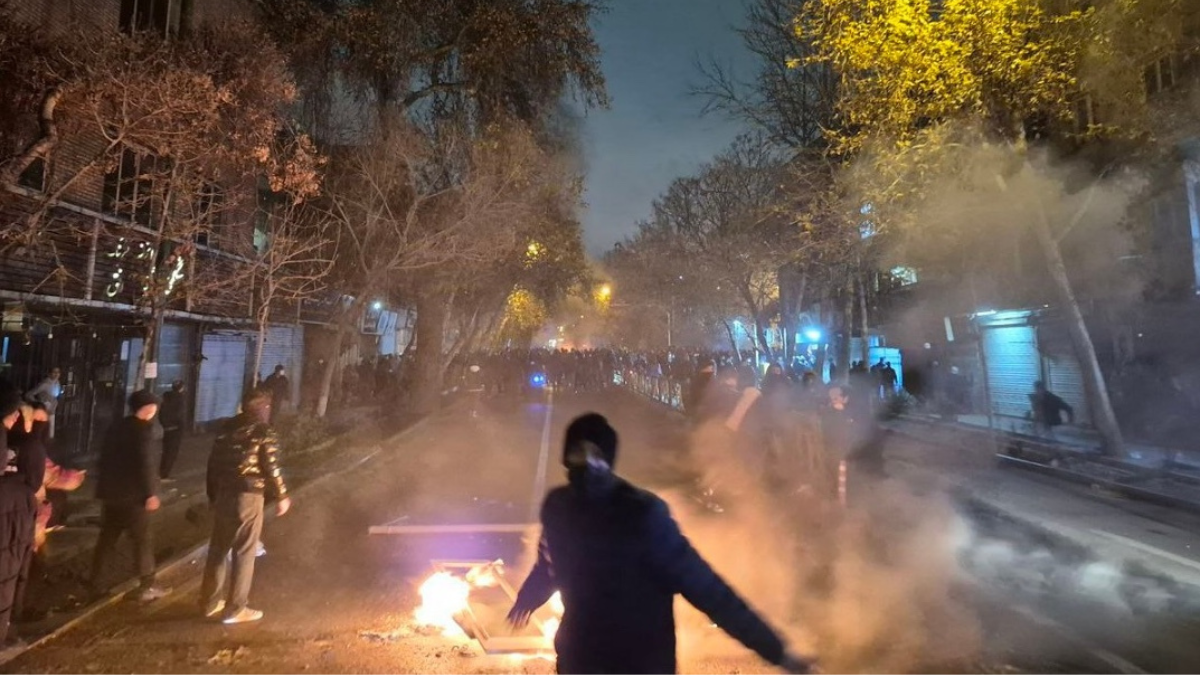
We now know that the presence of Mossad-led forces in the midst of the popular uprising 1 was not merely a fabrication of the Israeli media. Instead, it was true. It was not a figment of the imagination of the Israeli media. It was real. It was unprecedented. Numerous eyewitnesses report that [the Mossad-led forces] acted in an organized way and threatened anyone who did not chant “Pahlavi will be back.” The IRI's [Islamic Republic of Iran’s] repressive apparatus was aware of this breach and used it as a “golden” opportunity to indiscriminately kill people. Shame on these religious fascists who have drenched their hands in the blood of the people, time and again. This time, it was to an extent without parallel in the history of contemporary Iran. Shame and hatred on that genocidal regime [Israel] and their Iranian servant, Reza Pahlavi.
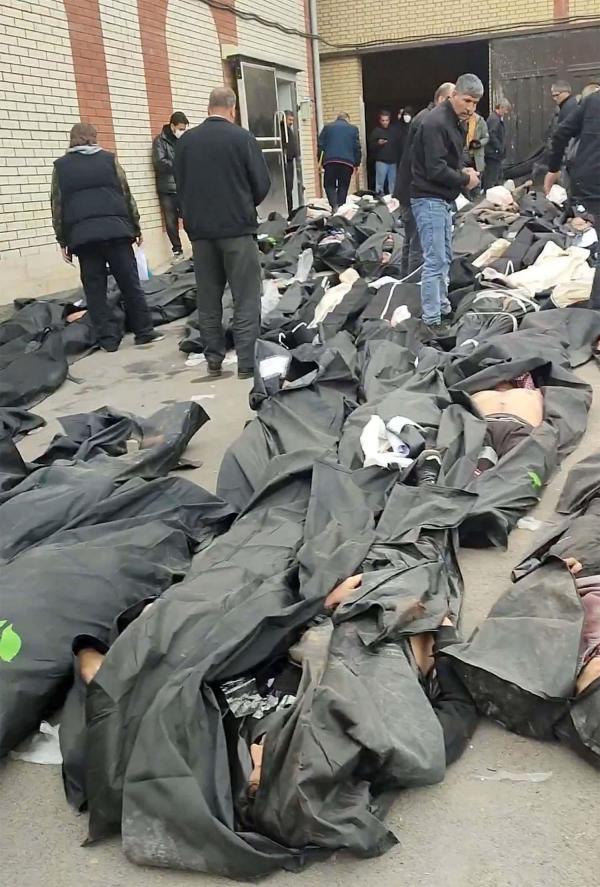
Bodies lie in body bags on the ground outside Kahrizak Forensic Medical Centre in Tehran, Iran, January 11, 2026. Photo: Middle East Online
But the slaughter of our people had other international partners as well. In this massacre, the security services of the Islamic Republic of Iran benefited from the obvious and unprecedented cooperation of the Russian and Chinese security services. These facts must be highlighted when preparing an indictment for the massacre of people during the January 2026 uprising by the armed forces of the IRI (including the Islamic Revolutionary Guards [IRGC], the Basij [its civilian militia], and its international branch, the Quds Force). The participation of Israel, China, and Russia in this massacre should be exposed and protested on a worldwide scale.
With this introduction, we will discuss the suppression of the January 2026 uprising. What we know so far is this: thousands of people were killed across the country, more than 100,000 people were injured, people's neighborhoods were destroyed, the wounded were kidnapped from hospitals and killed, and medical centers were turned into centers of murder.
After the June 2025 military attack on Iran by U.S. and Israeli forces, the Fars News Agency (which is close to the IRGC) wrote: “Why shouldn't we repeat the experience and the executions of 1988? Don't you think the time has now come to repeat that successful experience… which helped us to run the country for years without any problems and not have to deal with the problem of terrorism.... If we rid ourselves of our enemies in just the same way that we got rid our enemies in 1988, we can feel secure.”2
This shows that the IRI had been preparing to commit this crime. The arrests and executions that followed [the June military attack], and the October 2025 “Enhanced Punishment for Espionage” law, promulgated by [Iran’s President Masoud] Pezeshkian, indicate that they were preparing to commit a major crime.
The Doctrine and the Structure of Repression, in Generic Terms
Now let's turn to the doctrine and structure of repression in the IRI. Everyone knows that in the IRI, the security and survival of this regime determine its policies. From the IRI's perspective, protest is an on-going feature of Iranian society, not an occasional occurrence. Therefore, they have adopted a model of continuous repression. The model of continuous repression is built into the identity of the IRI. This is the general characteristic of the IRI's security doctrine. However, it is specifically designed to suppress urban youth. Statistics on the victims of the January 2017 and November 2019 uprisings, the [2022] Mahsa “Jina” Amini uprising, and the January 2026 uprising, clearly demonstrate this reality.
The model of repression in Iran is a hybrid of Chinese and Russian [imperialists] methods combined with local structures and practices. Of course, because the repressive apparatus of the IRI is heir to the organized repression apparatus of the [Mohammad Pahlavi] Shah's regime, it is not without the influence of certain Western [imperialists] methods of repression. But the hard core of the IRI’s current suppression doctrine is indebted to the Chinese and Russian methods of suppression.
The IRI has adopted China’s so-called “Strike Hard” doctrine. “Strike Hard” is a structural policy to exert tight control over society. It operates on the basis of fear, speed and intensity of the action, and control over the narrative. The key principle of “Strike Hard” in relation to large protests is to stop the protesters by administering a severe shock. Implementation of “Strike Hard” includes mass executions and, in street operations, the use of military-grade weapons, indiscriminate and coordinated killings in multiple cities, attacks on hospitals, and mass arrests.
The IRI's model of repression borrows from Russia its use of asymmetric violence, and shadow-operations, and terror-inducing tactics. Russia's pattern of repression in Africa (especially by the private Wagner forces controlled by the Russian government) is recognized as among the most violent and brutal models of “population control and political suppression.” Asymmetric violence reacts to any instance of “violence” or self-defense by the people with exponentially greater violence and terror-producing operations. [The late IRGC Commander] Qasem Soleimani3 both learned from the “Wagner model” and used it in his suppression of the people of Syria.
This model includes severe repression and mass killings, targeted shootings of civilians, “cleansing” operations in protest areas, the use of heavy weapons of war, disappearances, executions at close range, and the dissemination of fabricated narratives to justify the crackdown. The goal is: “deterrence through fear.”
The IRI retained some of the methods of repression used by SAVAK [Shah’s secret police] and in 1979-1980, combined them with [Aytollah] Khomeini's idea of forming a “20-million-strong army,” which resulted in the creation of a vast network of Basij forces in the neighborhoods, schools, factories, and offices. It is a local, cheap, and decentralized security force network that enforces theocratic control throughout the country. The Basij has a huge budget, and is constantly recruiting from both cities and rural villages.
Conclusion
Our Party has always grappled with the issue of the IRI “model of survival,” and has grappled with how to develop a systematic method of confronting it, based on a precise knowledge of the repressive apparatus, its doctrine and methods of operation, and to transfer this understanding to the youth who step into the arena of struggle against the regime. In the face of repression, the question is always: what can we do to turn the repression used on us back against itself—and to mobilize the people to wage the struggle on an even larger scale. At its core, the answer to this question is political and ideological line. Attention to technical and tactical principles is subordinate to that. In this regard, the document titled “Accumulating Forces and Organizing for Revolution” (an excerpt from the documents of the 11th Plenum of the Central Committee of the Communist Party of Iran, MLM) says:
So far we have encountered great obstacles along our way, and will do so again. … On this path, we must maintain our strategic nerve. During storms, heavy blows, and setbacks, we must keep our heads above water, not lose our sense of direction, and not give in to “it cannot be done,” “we’ll be isolated,” and “why didn’t we take such and such a step earlier.”
We can maintain this basic orientation, not through sheer willpower, but by using the scientific method of seeking to understand the problems and search for solutions. In other words, political struggle with a correct orientation is the decisive factor in confronting the repressive apparatus and transforming each act of repression into a broader and more enduring struggle against the IRI. Even now, in light of the repression of the January 2026 uprising, we must once again examine the structure of the power that we are going up against, and the factors that strengthen it or lend it resilience.
Since the U.S.-Israeli military aggression in June 2025, the IRI has increasingly tied its fate to the intense rivalry between the Chinese and Russian imperialists and U.S. imperialism. In exchange for this loyalty, China and Russia helped rebuild the IRI's military and security apparatus. At the same time, in response to public unrest and uprisings, the IRI adopted the approach that “public dissatisfaction equals continuation of the 12-day war,” and began preparing for the massacre. The infiltration of Israel's proxy forces into the people's uprising gave the IRI an opportunity to declare war on the uprising of the unarmed people, and with the pretext of “we are at war, and the enemy has infiltrated,” was able to unite internal factions of the government and even to bring along a number of religious intellectuals, reformists, and national-religious figures.
This analysis tells us that we must strongly oppose any policy that seeks to drag the popular uprisings into imperialist contention. When the many women and men fighters grasp the complexities of the political scene, and the character and objectives of the various forces involved in it, then they can prevent others from following the worthless orders of the fascist Trump, the Mossad security apparatus, and their hired broker, Reza Pahlavi.
The significance of having the theory and policies to confront repression is as significant as having a theory and policy to confront the regime's theocratic religiosity, its attempt to squash freedom, its mandatory hijab and its enforcement of national oppression, its reactionary regional wars, and so on.
Now, a major and decisive battleground with the Islamic Republic of Iran is to turn the regime’s repression from a tool of its survival into a driving force for its overthrow.
Success in this difficult arena requires creating and strengthening a powerful movement with two simultaneous characteristics: it must have the ability to actively and effectively resist severe suffocation by the widely deployed domestic repression machine, and at the same time it must keep the tentacles of scavengers dependent on Israel and the U.S. away from the people and prevent the toxic polarization of “the enemy of my enemy is my friend.”
Success in this struggle depends on thousands of young people—who rose up and put their lives on the line in these uprisings—developing a revolutionary method and approach. They must have a clear understanding of who are the friends and the enemies of the revolution. They should not only be against the IRI but they must also stand against U.S. imperialism and the imperialists of China and Russia who support the IRI—and support the struggle of people in those countries to overthrow their governments.
The prerequisite for turning repression back against itself requires that a broader movement grasp these political lessons, and that they become widespread among the people. This political factor is crucial to further isolate the IRI both domestically and internationally. Without this revolutionary orientation, we will not succeed in creating the broadest popular alliance within the country, nor in gaining the support of the people around the world. This policy must be reflected in the people’s slogans. The slogan that must resonate and appear on doors and walls everywhere is: Down with the Islamic Republic of Iran—Long Live the New Socialist Republic in Iran.