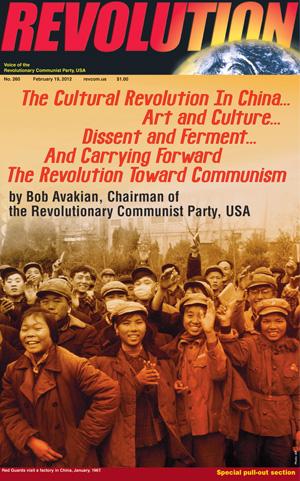
The recent revcom article about Tuberculosis (TB), "How the System Lets a Curable Disease Kill More than a Million People Every Year," jogged my memory about my childhood years in China and the public health campaigns during the early years of the communist revolution.
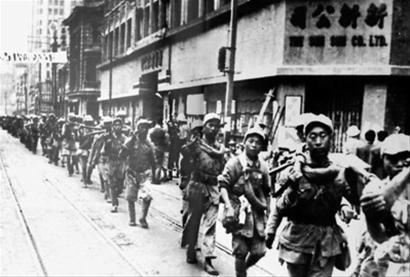
People's Liberation Army troops enter Shanghai, May 25, 1949. Public domain
When I was a year old, the Red Army marched into the major port city of Shanghai in May 1949, at a time when nearly 22 million people (about 4 percent of China's population of around 540 million at the time) was infected by TB, one of many airborne diseases.
On a warm summer eve in 1954 or 1955, I recall being at a film showing in a large park in Shanghai, maybe even the one that had “no Chinese or dogs allowed” signs before the revolution. The film aimed to enlist us kids into a mass movement to kill flies and to remind adults not to spit as these were sources of spreading diseases in society.
For context, after the revolution, millions of peasants poured into cities like Shanghai from the impoverished villages of China, and along with urban dwellers, had certain habits like spitting on the street. And even in 1955, the part of Shanghai where I lived had no indoor plumbing. People with horse drawn carts came through our neighborhood regularly to call out for people to bring their “night soil” that they collected and took out to areas for fertilizers. So pests like flies, mosquitoes, rats (and public spitting) were real public health issues. Unfortunately sparrows were included as one of the pests.
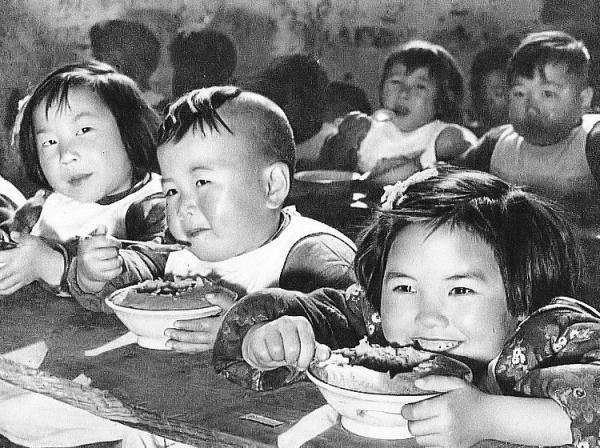
People's commune nursery school, 1959. Public domain
After the film, I recall we got little fly swatters for our voluntary task to contribute to improving society, maybe an early version of Mao’s “serve the people” mass ethos popularized during the Cultural Revolution later. It not only helped save lives but helped bring about a social norm of thinking about other people and society from an early age. And it was fun, especially the authority to admonish adults when you are a little kid.
As another aspect of this, I recall signs in the park in front of flower gardens that said “don’t pick the flowers so others can enjoy them too.” It wasn’t “don’t pick the flowers or you may be arrested for destroying state property.” That is, for all the claims of repression in socialist China, one social change was to get people to think about others. Of course I did not understand all this as a child, but had to look back through studying and learning the bigger picture and broader implications, to appreciate what the socialist system was about.
There is actually a small book, “No Flies in China: A Report on a Recent Visit to Red China” by a British journalist George Stafford Gale, published in early 1955. I don’t know his perspective on socialism but the title indicates the broad interest in China’s repeated public health efforts of "doing away with all pests.” This was part of the Great Leap Forward launched in 1958, shortly after our leaving China. China had been plagued by famines and droughts for centuries. We grew up with stories of corpses being collected on pre-revolution Shanghai streets, many who had died of hunger.
A crucial lesson on the scientific method was the error of including sparrows as one of the pests because they were known to eat up grain, seeds and fruit. However by the mid 1950s, there was already scientific data and scientists that opposed the official policy because sparrows were a known natural predator of insects such as locusts. But Mao and the Party leadership mistakenly favored other scientists and reports from the peasantry on eradicating sparrows to save grain, likely due to a reification of the peasants and the need of feeding the growing population, which was real. But this unscientific error led to an ecological imbalance and contributed to the famine in China in 1959-1961. In the absence of sparrows, swarms of locusts consumed grain fields, along with a severe drought during that time. This error was corrected by 1960 and China subsequently imported millions of sparrows from the Soviet Union to repair the damage.
All this highlights the importance of science and a thorough scientific/objective method to solve real world problems of the revolution. But it is clear that Mao was NOT just out to grab power and kill people. Public health campaigns involving the masses of people were a key part of how socialist China went from a life expectancy of 32 years in 1949 to 65 years in 1976 when Mao died—not by state repression as happened in now capitalist-imperialist China during the recent COVID pandemic, but by mass education and mobilization.
The above comes from my limited personal recollections. For a dialectical and historical materialist comprehensive view of the first stage of communist revolutions—lessons of its overwhelming strengths but also secondary but real weaknesses—it is imperative to go to the great resources at revcom.us—to study the extensive and expansive body of work of Bob Avakian, Raymond Lotta and others.