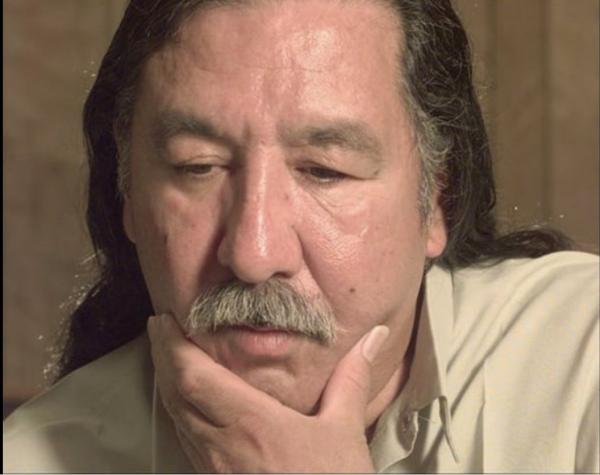
AIM leader Leonard Peltier was framed for the killing of two FBI agents and was railroaded into prison in 1977. The photo is from 1999. Photo: Joe Ledford/The Kansas City Star/AP
On July 2, the U.S. Parole Commission denied Native American political prisoner Leonard Peltier his bid for parole. Peltier, now 79, has been in U.S. maximum-security prisons for 47 years since 1977, when he was framed and unjustly convicted for killing two FBI agents.
This denial comes despite that fact that Peltier has had serious and painful health problems for many years. In recent years, he has suffered from increasingly declining health—he has had a stroke, he is blind in one eye, and he must use a walker to get around the maximum-security prison. He also has diabetes, an aortic aneurysm, effects of COVID-19, and other serious health problems. But throughout the decades of brutal imprisonment, Peltier has remained unrepentant.
His supporters say this year’s hearing was probably his last chance for parole. His lawyer plans to appeal the parole denial. Peltier was previously denied parole in in 2009. Very powerful forces, including Biden’s FBI Director Christopher Wray, have publicly opposed Peltier's release.
Leonard Peltier was railroaded by the U.S. government for the murder of two undercover FBI agents who attacked an American Indian Movement (AIM) camp on the Pine Ridge Reservation in South Dakota in 1975. Peltier and others were in the camp helping to protect people on the reservation from what became known as the "Reign of Terror." Sixty-four AIM members and supporters were murdered during this campaign, which was led by the FBI.
The “Reign of Terror” was launched as retaliation for the 1973 uprising at Wounded Knee, when hundreds of Native American people and supporters stood up against the U.S. government-backed murder and intimidation of AIM members and their supporters.
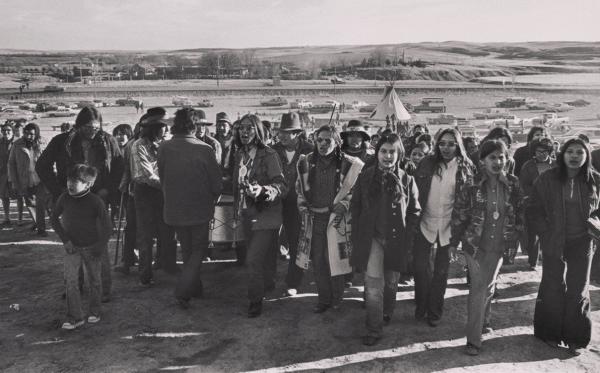
Occupation by Oglala Lakota Indians, American Indian Movement, and their allies of Wounded Knee on the Pine Ridge reservation, South Dakota, 1973. Photo: Owen Luck/Beinecke Library, Yale University
Two other activists, Darrelle "Dino" Butler and Robert Robideau, were also tried for the murder of the FBI agents, but they were acquitted. As Peter Matthiessen wrote in his book In the Spirit of Crazy Horse: The Story of Leonard Peltier and the FBI's War on the American Indian Movement, "The jury [in Butler and Robideau’s trial] agreed with the defense contention that an atmosphere of fear and violence exists on the reservations, and that the defendants arguably could have been shooting in self-defense."
Leonard Peltier was tried separately after being forcibly extradited from Canada. And in 1977 he was railroaded for the murders of the FBI agents and sentenced to two consecutive life terms.
Since Peltier’s conviction, secret FBI documents have surfaced which show that the FBI manufactured "evidence" against him while withholding evidence that would have exonerated him. During Peltier's 1985 appeal, even the U.S. prosecutor openly admitted, "We can't prove who shot the agents."
For nearly 50 years the FBI has continued to work overtime to prevent the truth about its efforts to crush the Native American movement from coming to light—in particular, their violent crimes at Pine Ridge in 1975 and the framing of Leonard Peltier. They tried to block the publication of In the Spirit of Crazy Horse: The Story of Leonard Peltier and the FBI's War on the American Indian Movement by Matthiessen, an extensive account of what happened at Pine Ridge. First published in 1983, the book was blocked from distribution for 8 years by libel suits filed by the governor of South Dakota and an FBI agent. The governor was the state attorney general at the time of the Reign of Terror at Wounded Knee and worked closely with the FBI. In Matthiessen’s book, he is quoted saying, "The only way to deal with the Indian problem in South Dakota, is to put a gun to the AIM leaders’ heads and pull the trigger."
The FBI has targeted other prominent supporters of Peltier. Actor and filmmaker Robert Redford came under attack for narrating Incident at Oglala, a documentary critically examining the federal government's handling of the Peltier case. When the film was released, the FBI actively organized demonstrations against it and continued to target Redford and his work afterwards.
When actor and director Peter Coyote planned a concert in 1987 titled "Cowboys for Indians," a benefit for Peltier headlined by Willie Nelson, the FBI worked to prevent the concert, including writing letters—on Justice Department stationary—to sponsors, pressuring them to pull out.
Near the end of Bill Clinton's presidency there was a broad call for him to grant executive clemency. This effort became the target of nationwide organizing efforts by the FBI and major national politicians to prevent it, including a march to the White House by 500 active and retired FBI agents to oppose freeing Peltier. And, obviously, Clinton did NOT free him.
Leonard Peltier's refusal to “express remorse” for a crime he maintains he did not commit has been used by the Parole Commission, and powerful forces among the rulers of this country, to justify refusing parole. In the face of this, Leonard Peltier's courageous stand highlights all the more the monumental injustice of his railroad and life-long imprisonment, and should inspire even greater support and demands for his release.