
Our huge sign hung high in the middle of the table—“Donate Today to Put Revolution on the Map in 2023”—and we focused on August 6, Hiroshima Day, with a second sign front and center on the table with the mushroom cloud and our slogans. We handed out the Hiroshima flyer, “August 6: We Declare No More!” along with the “We Are the Revcoms” broadsheets and some “We Need/We Demand” pamphlets. Other displays were “We Need and We Demand,” panel 1, and a display of the two contrasting constitutions and a sign "The New Socialist Republic in North America will not develop, and will not use, nuclear weapons or other weapons of mass destruction. It will wage a determined and many-sided struggle to rid the world of all such weapons.”
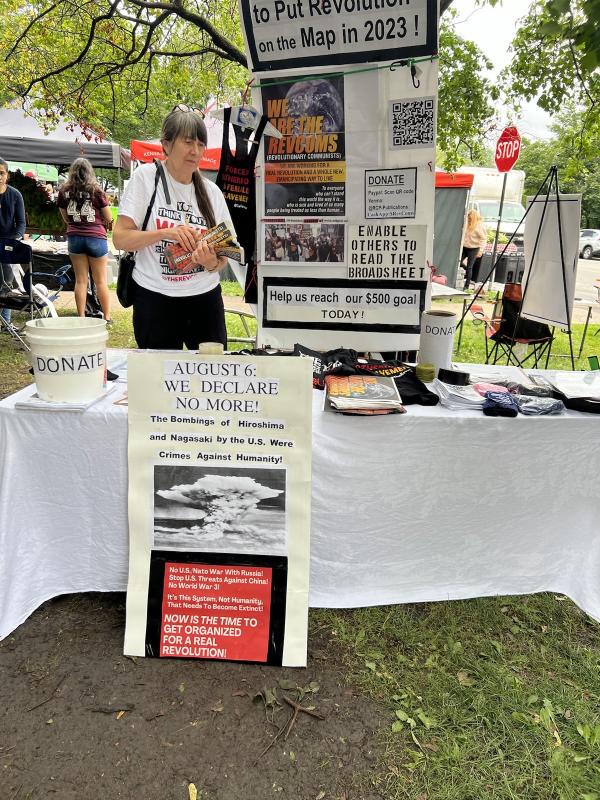
Hiroshima Day, August 6, 2023, Logan Square Market, Chicago. Photo: revcom.us
We raised $214. We had about 15 donors, including a $100 donor. We got out 145 “We Are the Revcoms” broadsheets, including one bundle to a young African American man, as well as 145 Hiroshima Day flyers and 29 “We Need and We Demand” pamphlets. We had the article on the Oppenheimer film, as well as flyer about Raymond Lotta’s speech.
Raymond Lotta speaking on "Robert Oppenheimer Served America’s Empire: We Have the Responsibility and Possibility to End This Horror, and Bring a Far Better World Into Being."
Most people did not know August 6 was Hiroshima Day, but a number of people who did were attracted to the table. The theme of Hiroshima—that you are living in the only country that twice used nuclear weapons, incinerating, and later killing as many as 200,000 civilians and that your government is now risking annihilation of many more to continue the domination of U.S. imperialism—prompted some to donate.
The $100 donor initially said not a word, but just made his donation. We then drew him out as to why he made that donation. He started by bringing up the crisis in housing, rents so high, many unable to afford rent and just a lack of available housing. And nothing being done about it! He saw this as an example, not the only one, of unnecessary deprivation. He felt it does not have to be this way. When our comrade posed to him “Revolution—is it possible, is it to be urgently worked for?,” apparently he did not want to go really deeply there.
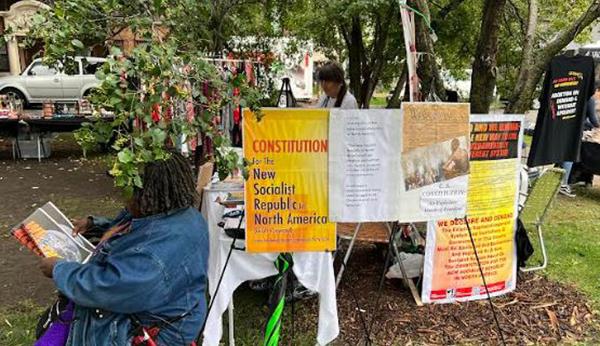
Hiroshima Day, Logan Square Market, Chicago. Photo: revcom.us
A white youth gave $15. First, he read the short leaflet on Hiroshima. Then he went to the table and stood reading the Constitution for the New Socialist Republic in North America. When asked to donate, he took his phone out and gave, saying, “I would like to contribute more but I am unemployed… I want to contribute because what you are doing is important. Everyone needs to stand together. Yes, everyone needs to stand together to end nuclear weapons and for world peace! Absolutely right, why should we give over control of this planet and humanity’s future to these nut jobs??!!” He noted the Chicago Revolution Club event on Oppenheimer later that day, and signed up on the contact sheet. As he left with his friends, he waved his hand towards our table and displays, with the compliment, “You are bad-ass!” I countered, “Only when thousands become millions and we make a revolution. What’s needed is YOU!”
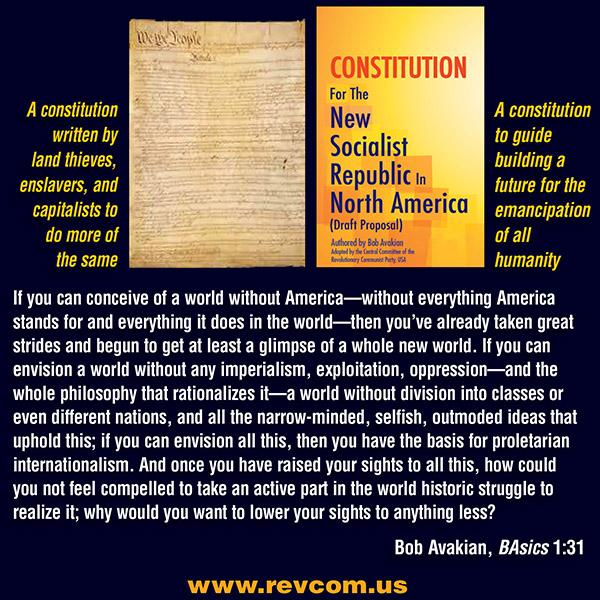
Read the Constitution for the New Socialist Republic in North America (Draft Proposal), authored by Bob Avakian.
One older white man donated $5, saying simply “you are right” that we need to put revolution on the map in 2023. He stayed but a few seconds, just remarking, “Something has to be done!”
One man had been to the museum in Hiroshima and knew a great deal more than most anybody else about this horror. An artist, white, in his 30s, who had his infant on his chest, was open to what we had to say. After talking a while, he said, “I’ve been so beaten down these last few years! I’ve been so pessimistic!” He was attracted to the Constitution for the New Socialist Republic in North America, though he initially said he thought inequality was more important than nuclear war. When our team member pointed out that yes, inequality IS very important but nuclear war and the environment are existential issues that we need to move on NOW, then he agreed with us. After hearing that this is a rare time and why and that a crisis of legitimacy is accelerating, he began to see that maybe there is an alternative. When it was sharply posed to him: was Hiroshima a crime or something that had to be done for some greater good, he at first said it was a hard call. But when confronted by our team members that it was two imperialist forces faced off against each other then, and two imperialist forces faced off against each other now, he saw that we can’t support them and we can’t support the U.S., that we need a different future.
A woman, young, white, donated as soon as she took the leaflet, realizing it was Hiroshima Day, not staying to talk but exclaiming, “I’m from New Mexico, I’m one hundred percent with you!” Another young white woman, who donated $10, was also from New Mexico, and told about how the radiation-caused cancers are still a huge issue today, though she stayed talking a long while about the broader picture and underlying contradictions and the revcoms’ whole strategy. She was meeting friends at another spot at the market and said she’d bring them all over to the table to donate. (Though they did not show.)
A Black man, a vendor, saw the mushroom cloud we were displaying—and told us that the anniversary had been on the morning news. But he was incensed because in the news segment that he heard, the issue of the danger of nuclear weapons in Ukraine was not even mentioned.
A British man who lives in Chicago said that people in this country are fed all this U.S. propaganda, most especially about the U.S.’s wars, though its prevalent in Britain too, since they are the ally of the U.S. He took the film review and the Lotta half-sheet as well.
Another man who had just seen the Oppenheimer movie the night before found the film disturbing and took our article on the film and QR code to Lotta’s speech.
Regarding the situation where most people did not know August 6 is Hiroshima Day, many people who stopped to get the flyer, and hear about the crime of Hiroshima, did care. At the same time most did not seem to see any connection between the nuclear bombs the U.S. dropped in 1945 and those they threaten the world with today; people did not seem to connect Hiroshima to the looming possibility of nuclear war today, let alone see the genesis of this whole complex of nuclear and environmental catastrophe in the system of capitalism, and certainly for most, never had considered revolution as the solution.
