College campuses are supposed to be sites of questioning, debate, investigation, and learning—places where students and faculty can follow the evidence to the truth about the world and strive to improve it. But none of this can be allowed under the Trump fascist regime. Professors are being denounced for speaking out against fascism, instructors removed from class, tenured faculty smeared and threatened, students criminalized or put under investigation for protest—while the federal government dangles funding and other “carrots” in exchange for institutions’ submission. It is a strategic campaign to break academic dissent, frighten immigrant students, and transform higher education into a transmission belt for the regime’s poisonous, Christian fundamentalist, white supremacist, male supremacist, hateful fascist program.
Look at what is happening on the ground.
Indiana University: Speaking Truth About White Supremacy Punished
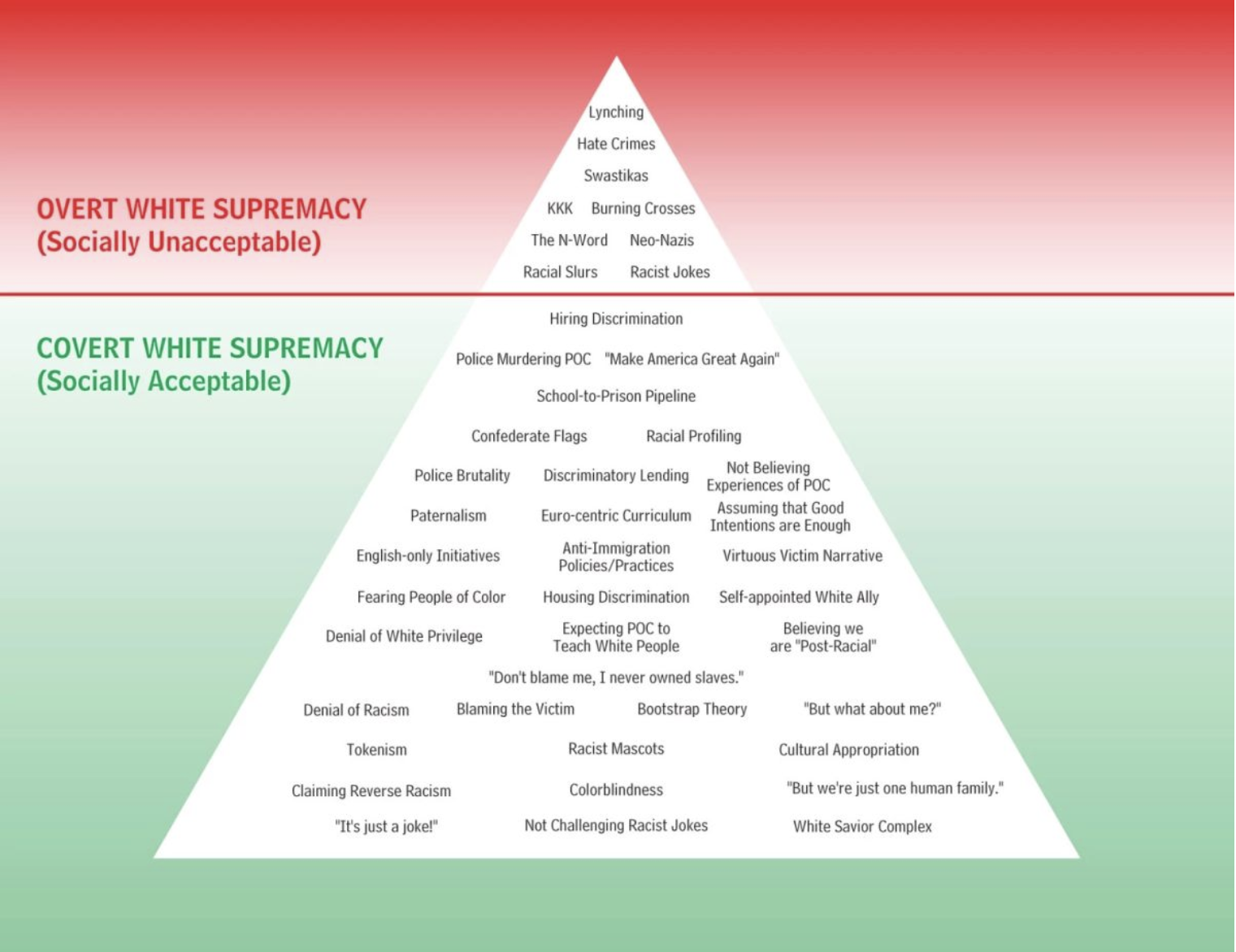
At Indiana University, lecturer Jessica Adams was removed from teaching her class while the university investigates a complaint about her use of a “pyramid of white supremacy” graphic that included “Make America Great Again” (MAGA) as “covert” white supremacy.
A student submitted the complaint to Senator Jim Banks, whose office forwarded it to IU. The pyramid tool is widely used for teaching about structural racism, but Adams says she was denied basic procedural protections: she was not allowed counsel during the investigation, and her dean became the primary complainant. The case points to a terrifying inversion: a state “intellectual diversity” law (Senate Enrolled Act 202) is being used to punish a teacher for teaching about structural racism.
UNC-Chapel Hill: Tenured Professor Threatened for Anti-Fascist Ideas
At UNC-Chapel Hill, Professor Dwayne Dixon—a tenured teaching associate professor in Asian and Middle Eastern Studies—was placed on administrative leave after fascist media outlets and groups like Turning Point USA circulated accusations that he had engaged in “politically motivated violence,” pointing to his past involvement with Redneck Revolt, an anti-racist, anti-fascist community defense network that formally disbanded years ago. They also attempted to link him to inflammatory flyers that had appeared at Georgetown University, despite no evidence connecting the professor to them. UNC responded by initiating a “robust threat assessment,” pulling Dixon from the classroom and—according to the ACLU of North Carolina—even barring him from communicating with students or colleagues without dean-level approval. Yet after consulting campus security, system officials, and law enforcement, the university found no basis for the allegations, no threat, and no violation of policy. Dixon denounced the suspension as an attempt to “suppress my free speech,” and his students and fellow faculty organized petitions, rallies, and public statements demanding his reinstatement.
What makes this incident even more alarming is that Dixon is tenured—one of the few remaining structures in academia meant to safeguard academic freedom from political interference. Tenure is not a perk; it is a core principle that protects scholars from being fired or disciplined for teaching controversial material, holding dissenting views, or engaging in political activism. To fire or even suspend a tenured professor for their political associations is supposed to require extraordinary justification and due process, precisely because tenure is designed to guarantee that intellectual inquiry is not subordinated to political pressure.
Dixon’s reinstatement, forced in part by student mobilization, faculty pressure, and intervention from civil liberties organizations, does not erase the significance of the suspension itself. The fact that UNC removed a tenured faculty member from the classroom over unsubstantiated accusations means even the protections of tenure can be eroded when the target is someone whose politics collide with those of the regime.
Political Purges After the Kirk Assassination
Across the country the fallout from the assassination of Charlie Kirk has been used as a pretext to purge educators and staff. Dozens of faculty and K-12 educators were suspended or fired after social-media posts about that event; many of those terminations have produced lawsuits alleging retaliatory discipline and First Amendment violations. These were clear politically charged firings and suspensions over social-media posts that violated no law, chilling dissent far beyond the individuals targeted: speak, and you may be next.
Legal Threats Replace Debate as Universities Are Pushed to Silence Dissent & Protest
Meanwhile, the regime’s reach has not been limited to personnel actions. It is extending to institutional blackmail and legal pressure. High profile suits and federal investigations have been used to punish and extract concessions from universities that had pro-Palestine encampments or whose students and faculty criticized the genocide in Gaza. UCLA—among other institutions—has faced suits and Department of Justice findings tied to not cracking down hard enough on pro-Palestinian protests last year. Administrations are pressured to hand over names of student and faculty activists—a tactic straight out of the McCarthy era. This is not about “campus safety”—it is political policing. The financial penalties and legal threats mean the choice is to capitulate, hand over lists, police your students and faculty, or face ruinous litigation and federal scrutiny.
“The Compact”: The Regime’s Push of Funding-for-Ideology Bargain on Higher Education
And now comes the Compact: a White House letter and accompanying “Compact for Academic Excellence in Higher Education.” Disguised as demands for “protection of conservative ideas,” it explicitly invites universities into an agreement promising preferential access to federal grants and other “benefits” in exchange for institutional commitments that, in practice, would embed the Trump administration’s political priorities into hiring, admissions, and curriculum oversight. This Compact amounts to coercion—conditioning public funding and access on political compliance—and is designed to re-shape curriculum, change approach to hiring of critical voices, and institutionalize a politically enforced “balance” that privileges fascist and regime-friendly perspectives.
Some institutions are refusing to go along. MIT rejected the proposal, warning that tying funding to institutional conformity undermines academic freedom. The University of Virginia also declined, arguing that merit-based research, not political litmus tests, should drive federal support. This is a fascist-style bargain: money for silence, grants for ideological control.
Turning Zones of Inquiry into Zones of Control
Put these pieces together, and the picture is stark. Administrations are being harassed and sued; they respond by handing over names, suspending faculty, canceling events, or opening investigations that destroy careers and chill debate. The Department of Education, DOJ, and other federal instruments have been marshaled or used as a threat as part of this broader campaign. All this is happening as immigrant students live under the threat of ICE raids on or near campuses, afraid for their own safety at school—and that attending class could mean coming home to deported parents.
It is a conscious political project of a fascist regime that zeroes in on colleges because campuses are supposed to be where entire generations learn how to think—or at the very least provide some space to independent, critical, scientific inquiry that can push at the boundaries of what world young people believe is possible.
From Campuses to the Capital: An Urgent Call to Join the Movement for the Fall of the Trump Fascist Regime
And yet, this assault also exposes a choice—a dire, urgent choice. We can watch academia—one of the last refuges of critical thinking—be turned into a pipeline for fascist indoctrination. Or we can refuse to comply. History shows that the tentacles of fascist regimes have to be cut back at their base, and campuses are one of the critical bases. That means protecting students from ICE raids and deportation fear; it means defending faculty tenure, whistleblowers, and classroom speech; it means institutional opposition to any Compact or so-called “agreement” that trades federal resources for political submission; it means refusing to let administrations turn over lists of activists to the feds.
But most of all, what history demands now is millions rising up to stop this. The mobilization that began November 5 in Washington, DC, called by RefuseFascism.org is not a symbolic gesture. It must grow—to millions in DC, spreading nationwide—nonviolent, sustained, determined—until the Trump Fascist Regime is driven from power.

Listen to and watch message Revolution #115 from Bob Avakian
This is not a gentle appeal. The stakes are the soul of our future: whether campuses continue to be places where truth is pursued, or whether they are converted into tools of propaganda and repression. We must choose—to submit, or to resist. History will not be kind to those who choose submission.
In his social media message @BobAvakianOfficial REVOLUTION #115: “The Trump Fascist Regime Must Go—NOW—before it is too late!”, the revolutionary leader Bob Avakian described clearly what is urgently needed now:
This truly life-and-death fight against fascism requires, and needs to involve, rapidly increasing ranks of people, drawn from all parts of society and all walks of life—including Black people, immigrants, college students and other youth, professionals and government workers, women, LGBT people, and others—all who actually have a profound interest in defeating this fascism: people with a broad diversity of political views and perspectives, uniting all who can be united and overcoming all “divide and conquer” schemes, in order to bring forward the millions who can be the decisive force in driving out this fascist regime.