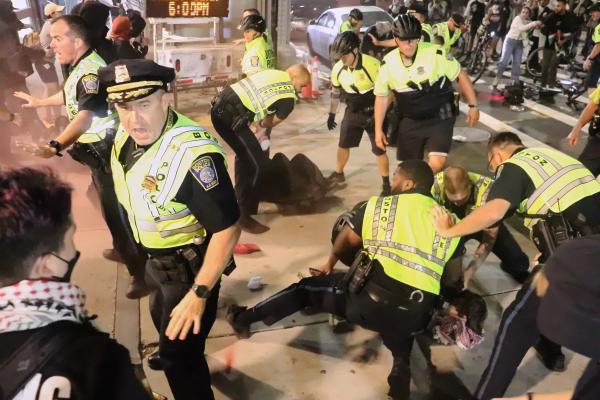
Police in Boston arrest protesters against Israel's Gaza genocide, October 7, 2025. Photo: AP/Bryan Hecht/The Berkeley Beacon via AP
Thirteen people who were arrested at a protest in Boston on October 7 against Israel’s U.S.-backed genocide in Gaza were hit with state felony charges of “promotion of anarchy” (also called “inciting riot”). They could face up to three years in prison if convicted. This is an outrageous and serious escalation on the part of the Suffolk County prosecutors, who had originally charged the protesters with disorderly conduct, resisting arrest and disturbing the peace.
The October 7 protest in Boston was part of protests around the world demanding an end to Israel’s massacres and starvation of Palestinians. According to the Berkeley Beacon, student newspaper at Emerson College:
The protesters gathered to mark “Two Years of Genocide” in Gaza. They also called for a free Palestine and urged people to boycott companies that have been associated with support for Israel.
The protest, which drew hundreds, began Tuesday night at The Embrace statue on Boston Common before marching up Tremont Street, where the arrests then occurred by the Park Street T stop. Clashes between police and protesters broke out as demonstrators from Students for Justice in Palestine (SJP) began crossing Tremont Street near Winter Street shortly before 7 p.m.
In the ensuing moments, while protesters set off smoke flares, various officers detained protesters, holding them down so they could be zip-tied…. One protester was seen with a potential leg injury after being tackled and carried away by several officers, while another was seen being treated by other protesters for pepper spray exposure…
The Boston police claim that several cops were injured during the protest. Some of the 13 protesters indicted for “promotion of anarchy” face additional charges including “assault and battery” on police officers. The judge set high bails for some of the protesters, ranging up to $10,000—higher than even what the prosecutor had asked for.
An Attack on Constitutional Rights
The district attorney justified the addition of the felony “anarchy” charges by claiming some of the material promoting the protest included “violent imagery and rhetoric,” like a graphic of a burning police car on one flyer posted on Instagram. The actual circumstances behind this flyer and other supposed “evidence” from the prosecutors are unclear. But as a report by Boston’s public radio station WGBH noted, the developments in this case raise serious First Amendment concerns, given that the prosecutors are using political speech as a reason for piling on the felony charges.
One of the legal experts quoted in the WGBH report, Jessie Rossman of the ACLU of Massachusetts, said:
We don’t know at the ACLU all of the underlying facts of the specific cases here, but what I do know is that the Constitution and the First Amendment only allows the government to criminalize speech in very limited circumstances.
As recently as 2021, the Massachusetts Supreme Judicial Court emphasized that this particular law, the one that has been at issue in these cases, is a relic of the Red Scare1 and can only be applied where speech meets the threshold for a true threat or incitement, which is a very high bar. Any attempt to apply this law beyond this exceedingly limited scope would be unconstitutional and a cause for great concern.
Kylah Clay, a National Lawyers Guild lawyer representing some of the protesters, said that the police “brutalized antiwar marchers on Tuesday night, knocked cameras from the hands of young people recording their brutality, and left young protesters with injuries requiring medical care.” Clay said of the felony “anarchy” charges, “The additional charges are part of a pattern of government overreach and the criminalization of dissent targeting Palestine advocacy across the country.”
The protesters were right to be out in the streets and struggling for the just demand of an end to Israel’s U.S.-backed slaughter and terror against the Palestinian people. They need to be supported, in the face of the repressive attacks from the police, prosecutors and courts.