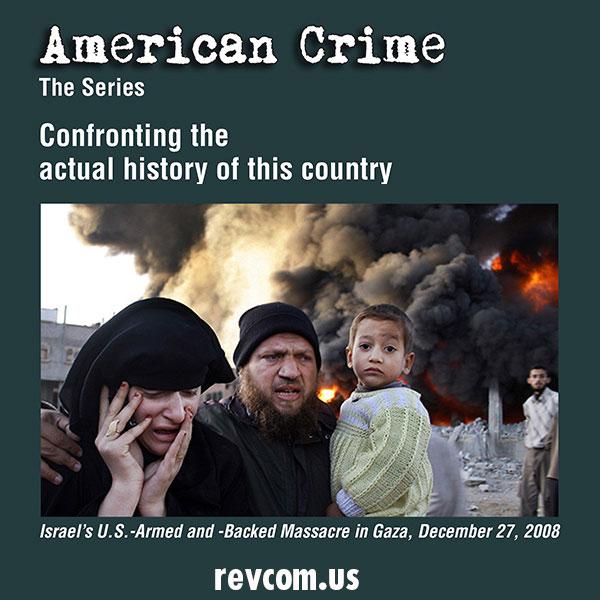
This year, the 250th anniversary of the founding of the United States, we are experiencing an ugly torrent of red-white-and-blue celebrations of America as a “great country”—spearheaded by Donald “Make America Great Again” Trump. This is a celebration of America now led by fascists. But the truth is that America was NEVER “great,” whoever was heading up the government.
As revolutionary leader Bob Avakian said, if people are stung by that truth about America, they need to look at reality:
This “Republic” to which we are supposed to pledge allegiance was founded on slavery and genocidal robbery: keeping millions of Black people in chains for generations... killing off huge numbers of Native Americans and stealing their land... waging a war that ripped off half of Mexico, greatly expanding slavery.
So, was this a great country all during that time—when millions of people were enslaved—owned by bloodsuckers who constantly whipped the slaves to make them work harder under horrific conditions, slave-owners who raped masses of enslaved women? Was this country great then?!
Was it great when, for generations after slavery was formally ended, Black people as a whole were segregated, discriminated against, and continually terrorized, with repeated massacres of Black people and thousands of Black people lynched? Was it great when, all during that time, LGBT people were “illegal,” when women were legally treated as inferior to men—and men could legally rape their wives? Was it a great country then?!
Or is it great, now, when people are everyday denied basic rights? When the police kill a thousand people every year, especially people of color, and in the 60 years since Civil Rights Acts were passed, segregation and discrimination has remained as bad, or worse, as it ever was, and thousands of Black people have been killed by police—even greater numbers than all those who were lynched during all the years of Ku Klux Klan terror after the Civil War!
Has this country ever been great, when, right from the beginning and down to today, the whole thing has literally been built on the broken bodies, the blood and bones, of millions and now billions of people, worldwide—cruelly exploited, used and abused, by this system—with all this backed up by murder on a massive scale carried out by the police and the armed forces of this country?
No, this country has never been great. It has always been a horror for masses of people.
(from social media message REVOLUTION #2: When has the USA been a “great country”?)
It’s way past time for this system—capitalism-imperialism—that rules in this country, dominates the world and now has spawned fascist rule, to be thoroughly abolished, through an actual revolution.
Below is Part 36 of a series that highlights aspects of how 250 years of America has been nothing but a horror for the masses of people, here and around the world. We call on our readers to send in your contributions to this series—articles, video, audio, artwork, social media posts. Email revolution.reports@yahoo.com or message @therevcoms via social media.
Part 36: American Crime Case #77: Christopher Columbus Brought Genocide and Slavery to the "New World," and America Celebrates Him for It
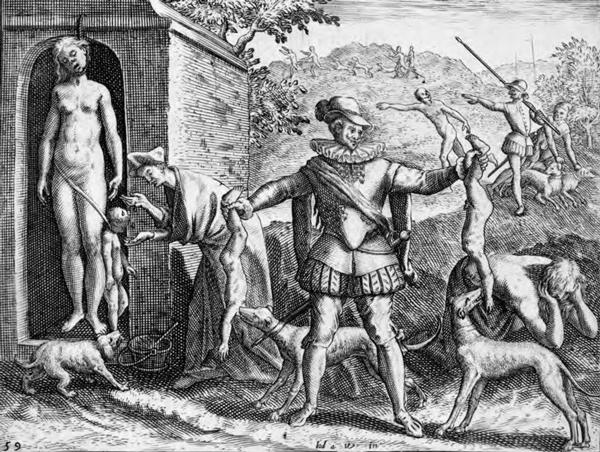
(The figure in the center of this 16th century drawing is not Columbus.)
Spaniards killing women and children and feeding their remains to dogs. Illustration based on eyewitness account by Bartolomé de las Casas.
• American Crime Case #77: Christopher Columbus Brought Genocide and Slavery to the "New World," and America Celebrates Him for It
On October 12, 1492, Christopher Columbus, an Italian sailing for Spain, landed on what is now the Bermuda Islands. Columbus is celebrated in the U.S. as the person who first “discovered” the “New World,” making it possible for those who came after him, through hard work, to create the greatest global power in the world today, as the official declaration of “Columbus Day” as a national holiday would have you believe.
Columbus did not “discover” the Americas—they had been inhabited by many different indigenous peoples for some 13,000 years. But he did bring conquest and enslavement, and launched one of the most massive, horrific genocides in human history.
See also:
- Part 1: American Crime Case #98: 1953 CIA Coup in Iran: Torture and Repression–Made in the U.S.A.
- Part 2: American Crime Case #12: The 1921 Tulsa Massacre and the Destruction of Black Wall Street
- Part 3: Emmett Till and Lynchings, Past and Present—An excerpt from Revolution: Why It’s Necessary, Why It’s Possible, What It’s All About by Bob Avakian
- Part 4: American Crime Case #6: Lynching in America—The Torture, Mutilation and Murder of Thousands of Black People and the Terrorizing of Millions More, 1865-1950
- Part 5: American Crime Case #57: The 1973 CIA Coup In Chile
- Part 6: American Crime Case #94: November 2004—War Crime Fallujah
- Part 7: American Crime Case #96: Vietnam, March 16, 1968—The My Lai Massacre
- Part 8: American Crime Case #95: Reagan’s Butcher Carries Out Genocide in Guatemala
- Part 9: American Crime Case #59: The U.S. Invasion, Occupation, Domination, and Plunder of Cuba: 1898 to 1959
- Part 10: American Crime Case #97: August 6 and 9, 1945—The Nuclear Incineration of Hiroshima and Nagasaki
- Part 11: American Crime Case #91: School of the Americas—Training Ground for Mass Murderers and Torturers, 1946-Present
- Part 12: American Crime Case #99: May 13, 1985: The MOVE Massacre
- Part 13: American Crime Case #16: “La Matanza”: A Decade of Lynching & Terrorizing Mexican People in South Texas, 1910–1920
- Part 14: American Crime Case #70: "Operation Iraqi Freedom," 2003
- Part 15: American Crime Case #39: The Palmer Raids of 1919-1920
- Part 16: American Crime Case #92: Ronald Reagan Condemns 180,000 Gay Men and Others to Demonization, and Death by AIDS
- Part 17: American Crime, Case #89: 120,000 People of Japanese Descent Put in U.S. Concentration Camps During World War 2
- Part 18: American Crime Case #78: "Operation Wetback"—1954-56
- Part 19: American Crime Case #71: The Colfax Massacre of 1873... and the Supreme Court Stamp of Approval for Racist Terror
- Part 20: American Crime: 400 Years of Crimes Against the Native Peoples in the U.S.
- Part 21: American Crime Case #2—Slavery in America
- Part 22: American Crime Case #1—250 Years of Suppressing the True History of Black People
- Part 23: American Crime Case #101: The Firebombing of Tokyo and the Air Raids over Japan in World War 2
- Part 24:
- Part 25: American Crime Case #81: September 13, 1971—Massacre of Heroic Attica Prisoners
- Part 26: American Crime Case #51: Tazreen Bangladesh Garment Inferno
- Part 27: American Crime Case #82: 20 Years Since Hurricane Katrina Devastated New Orleans: A Crime of a Genocidal System
- Part 28: American Crime Case #76: U.S.-UN Sanctions on Iraq—“A Legitimized Act of Mass Slaughter”
- Part 29: American Crime Case #84: Medical Racism and Homicide—the Tuskegee Syphilis “Study”
- Part 30: American Crime #67 - 1848-1900: Brutal Exploitation and Ruthless Oppression of Chinese Immigrants
- Part 31: American Crime, Case #7: The 1963 Birmingham Church Bombing and the Cold-Blooded Murder of Four Black Girls
- Part 32: American Crime Case #61: Monuments to the Confederacy Across the United States
- Part 33: American Crime Case #85: December 1984, Bhopal, India: Union Carbide’s Poison Gas Massacre
- Part 34: American Crime Case #30: Israel’s U.S.-Armed and -Backed Massacre in Gaza (2008-2009)
- Part 35: American Crime Case #29: Contra War of Terror in Nicaragua 1979-1989

Bob Avakian, "They're selling postcards of the hanging," clip from Revolution: Why It's Necessary, Why It's Possible, What It's All About, a film of a talk by Bob Avakian, a film of a talk.