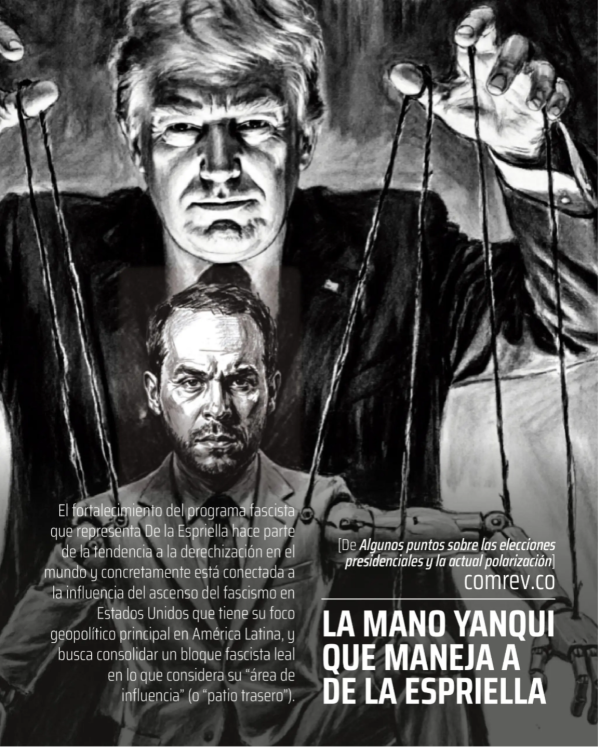
THE YANKEE HAND THAT CONTROLS DE LA ESPRIELLA
The strengthening of the fascist program that De la Espriella represents is part of the rightward shift in the world and is specifically connected to the influence of the rise of fascism in the United States, which has its main geopolitical focus in Latin America, and seeks to consolidate a loyal fascist bloc in what it considers its “area of influence” (or “backyard”).
[From Some points about the presidential elections and the current polarization]
The election results of the presidential runoff, in which the fascist Abelardo de la Espriella (ADLE) won 49.7% of the vote, narrowly defeating the ruling party’s candidate Iván Cepeda by a margin of just 1% (approximately 250,000 votes), confirm the marked political polarization in the country between the far right and the (increasingly crude) “leftist” forces.
ADLE’s election is part of a fascistic wave in the region that has been reversing the earlier “pink wave” of the early 2000s… and is underpinned by the international far right, primarily Trump, but also by the “Madrid Forum”—the anti-communist “International” of Abascal, Milei, Kast, Bolsonaro, Uribe, etc. It highlights the influence of reactionary, traditional, and patriarchal values on the morality and mindset of a large sector of society, characterized by rabid anti-communism, which labels anything other than the far right as “guerrillas,” prioritizes “order and security,” and calls for the militarization of society—even if that means dismantling any form of political freedom or legal safeguards—and among sectors, particularly the urban middle class, that dreams that economic liberalization will allow them to climb the social ladder and become wealthy.
As several commentators have correctly pointed out, De la Espriella seeks to implement a fascist program that promotes rabid anti-communism, defends an open and violent capitalist dictatorship, and threatens to destroy all bourgeois-democratic guarantees. A central element of this program is the strengthening of U.S. imperialist domination and submission to Trumpist fascism. The arrest in the United States of the pro-Petro influencer Beto Coral at the request of Marco Rubio (for the “crime” of having denounced ADLE), the accusations and intimidation directed at journalists such as Daniel Coronell, and the threats against the new Congress should it dare to oppose De la Espriella’s political program, reveal what will be the nature of his government. Seeking to withdraw Colombia from the international system of multilateral organizations or to legalize the carrying of firearms, for example, are some of the proposals that set him apart from the liberal-conservative right wing that, for the most part, governed the country for decades.
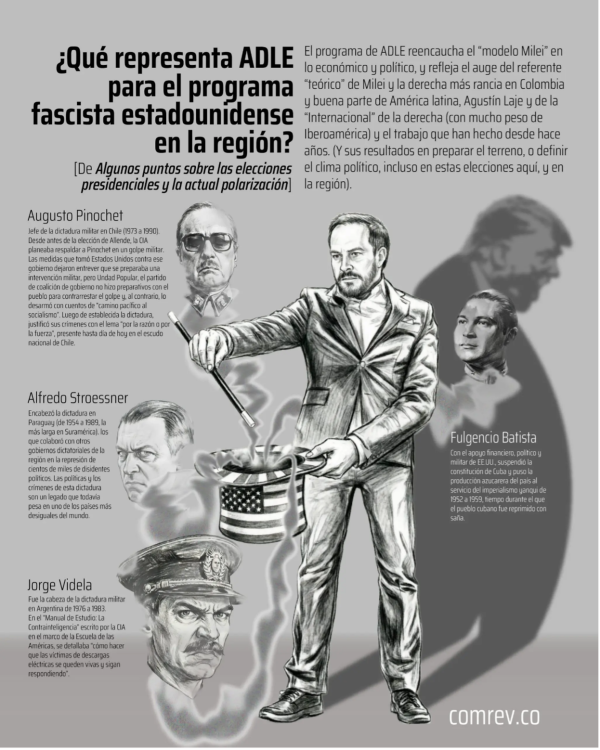
What does ADLE represent for the fascist program of the United States in the region?
[From Some points about the presidential elections and the current polarization]
The ADLE program revives the “Milei model” in economic and political terms, reflecting the rise of Agustín Laje, the “theoretical” inspiration for Milei and the most reactionary elements of the right in Colombia and much of Latin America, and of the right-wing “International” (with significant Ibero-American influence), and the work they have been doing for years. (And their results in preparing the ground, or defining the political climate, even in these elections here, and in the region.)
Augusto Pinochet
Head of the military dictatorship in Chile (1973 to 1990). Beginning before the election of Allende, the CIA was making plans to back Pinochet in a military coup d'état. The actions of the United States against the Allende government made it clear that it was preparing a military intervention, but Unidad Popular, the government coalition party, made no preparations with the people to resist the coup and, on the contrary, disarmed the people with stories of a “peaceful road to socialism.” Once the Pinochet dictatorship was established, it justified its crimes with the slogan “por la razón o por la fuerza” (either by reason or by force), which is to this day on Chile’s national shield.
Alfredo Stroessner
Headed the dictatorship in Paraguay (1954 to 1989, the longest in South America) collaborating with other dictatorial governments in the region, repressing hundreds of thousands of political dissidents. The policies and crimes of this dictatorship are a legacy that still weighs upon one of the most unequal countries in the world.
Jorge Videla
Head of the military dictatorship in Argentina from 1976 to 1983. In the “Study Guide: Counterintelligence” written by the CIA for the School of the Americas, it lays out “how to shock victims with electricity while keeping them alive and responding.”
Fulgencio Batista
With the economic, political and military support of the United States, he suspended the constitution of Cuba and put Cuba’s sugar production at the service of Yankee imperialism from 1952 to 1959, during which time the Cuban people were viciously repressed.
Trump’s open support for De La Espriella, while apparently having little impact on ADLE’s victory, does reveal the role that the incoming regime will play in relation to the United States’ imperialist strategy of dominating the entire Western Hemisphere much more thoroughly, from Greenland and Canada in the north to Tierra del Fuego at the southern tip of Latin America. Petro’s government, while working without hesitation to keep Colombia moving judiciously in step with the capitalist-imperialist system (with the occasional “slip-up” in which it adopted some correct political positions in various cases, but mostly to appease the public) and did not attempt to break with U.S. imperialist domination over Colombia, did not entirely please the Trump administration, which considered him an uncomfortable and inconvenient figure and openly backed ADLE as the most convenient pawn for U.S. imperialist interests.
ADLE is an outspoken admirer of Donald Trump, Javier Milei, and Nayib Bukele. A U.S. citizen, he has been a donor to the U.S. Republican-fascist party and has sworn allegiance to U.S. imperialist interests above those of any other nation. As some liberal critics have pointed out, he declares himself a patriot through and through, but it is unclear which country he is referring to. Against the backdrop of a growing struggle among imperialist powers—especially the United States and China—for global domination, the incoming regime will seek to be a loyal pawn within the Yankee fascist bloc in its “backyard.”
Within social democracy, some harbor the illusion that the “checks and balances” of the Colombian political system can counteract any attempt by ADLE to implement its fascist program, and they cling to its promises to “respect the constitution and the law.” Some even repeat the hackneyed illusion that Abelardo the candidate was one thing and Abelardo the elected official another, and—given that his victory was by a narrow margin—they cling to the hope that he will “govern for everyone.” This isn’t even naivety. Insisting on such an absurdity—even though the overwhelming evidence from fascist regimes such as those in the United States, Argentina or El Salvador demonstrates the real danger and the extent of what fascists are capable of once they come to power and consolidate it—ends up, whether one likes it or not, serving to legitimize fascism and pacify resistance against it.
Within that liberal social democratic left, there are many people who are genuinely concerned about some of the crimes committed by this system—such as the destruction of the environment and the erosion of political freedoms—and who support the implementation of social reforms that provide some degree of well-being to the working classes; however, they cling to a false hope that a change of regime—without overthrowing the current capitalist-imperialist system—can bring about fundamental change that, in one way or another, serves the interests of the people. Some sectors of the left even brand those who do not align with this agenda as reactionaries.
Yes, polarization has been a constant in Colombia’s history, often leading to military conflict—from the various civil wars of the 19th century, through “La Violencia” in the mid-20th century, to the present day. Under no circumstances can it be allowed to simply remain part of the political and social landscape. This is not the time for despair or paralysis. We cannot leave these alignments and polarizations as they are. It is possible—and necessary—to transform them.
An ideological and political repolarization is necessary, one that leads the masses to refuse to take sides with one group of oppressors or another and to recognize that the ruling classes’ choice of this form of fascism is a product of the needs of the capitalist-imperialist system and the limits and contradictions it is facing. This is an opportunity to take advantage of the deep divisions among the ruling oppressors and confront their entire system in order to bring it down and build something much better in its place. It is both possible and necessary to fight against fascism and imperialism—and even to defend bourgeois-democratic guarantees such as political freedoms—without falling into the trap of defending bourgeois democracy, but rather as part of a genuine revolutionary struggle.
Although today the revolutionary communist movement is quantitatively very weak—and far from the size and strength it ought to have—that must change, and it can change. As part of this, we must take up the struggle against fascism and against imperialist domination as part of the struggle to transform the terrain, transform the people, and transform the vanguard for a genuine revolution. Only the radical emancipatory revolution represented by the New Communism—the new synthesis of communism developed by Bob Avakian—can put an end to these horrors and create a truly emancipatory society and, ultimately, a world where human beings can truly flourish together and give full expression to their humanity.