
A dense column of smoke rises more than 60,000 feet into the air over Nagasaki from U.S. atomic bomb strike in 1945. Courtesy of the National Archives.
Introduction: The world has entered a very dangerous phase in its history. The threat of major wars has returned with renewed vigor, and the conflict currently unfolding in the Middle East—especially the military aggression by the U.S. and Israel—is not simply a regional crisis. This conflict is a direct reflection of the deep crisis in the global capitalist-imperialist system and the intensifying competition between the great powers to maintain or change the world order.
What is happening in Iran and across the Middle East today is part of a larger conflict between power blocs in the imperialist system. The U.S. and its allies are trying to preserve the order that emerged after World War II—an order based on U.S. hegemony in the global economy, financial structures, military networks, and political power. But this order no longer works as it used to. Economic crises, political instability, and geopolitical rivalries show that the structure of the post-World War II global order is in deep crisis.
Meanwhile, China, as a major economic and geopolitical power, has increasingly challenged U.S. global hegemony. This competition between imperialist powers is taking place at a time when the global economy is facing deep crises. The result is increasing pressure to redivide the world and rebalance the power in the global order.
A war in Iran could become a point where these major global conflicts converge. The Middle East is one of the world’s most strategically important regions: a region where energy resources, global trade routes, and the geopolitical rivalries of great powers are intertwined. For this reason, any escalation of war in this region could have consequences far beyond a local conflict.
The real danger is that these wars could escalate to a much more dangerous level. The threat of nuclear war is not just a political slogan or psychological warfare; it is a real scenario in the strategic calculations of the imperialist powers. [Revolutionary leader] Bob Avakian warns in his analysis of the state of the current world situation: The capitalist-imperialist world is facing crises that could lead to great catastrophes for humanity, and these crises cannot be resolved within the framework of this system.
In such circumstances, we face [some] fundamental questions:
What exactly is a nuclear weapon? How does it work? And why do scientists believe that even a limited nuclear war could threaten the future of human civilization?
The world entered the nuclear age with the explosion of two atomic bombs [by the U.S. on two cities in Japan of] Hiroshima and Nagasaki in 1945. Those two explosions killed more than 200,000 people in a short period of time, and many more died because of radiation in the years that followed.
The energy released in a nuclear explosion comes from nuclear fission or nuclear fusion reactions, a process in which a very small amount of mass is converted into energy.
This conversion is done according to Einstein's famous equation: E = mc2 where:
- (E) Energy released
- (m) Converted mass
- (c) Speed of light
Because the speed of light is such a large number, even the conversion of a few grams of matter can produce energy equivalent to tens of millions of tons of TNT. For this reason, nuclear weapons are many times more destructive than any conventional weapon.
The power and nature of modern nuclear weapons
The power of nuclear explosions is measured in kilotons or megatons of TNT1.
[A kiloton is equivalent to 1000 tons; a megaton is one million tons.]
To better understand this, let's look at a few examples:
Weapon
Hiroshima bomb
Nagasaki bomb
Many modern [nuclear] warheads
Explosive power
15 kilotons
20 kilotons
100 to 500 kilotons
This means that many of today's nuclear warheads are 20 to 30 times more powerful than the Hiroshima bomb. According to data from SIPRI [Stockholm International Peace Research Institute] and the Federation of American Scientists, there are about 12,000 nuclear warheads in the world today.
When a nuclear weapon explodes, it has four main types of effects:
1. Blast wave
The blast wave can destroy buildings, bridges, and urban infrastructure.
2. Thermal radiation
The temperature at the center of the explosion reaches several million degrees Celsius and can cause severe burns at a distance of several kilometers [1 kilometer = 0.621 miles].
3. Ionizing radiation
The gamma and neutron radiation damage the [human] body's cells and destroy DNA.
4. Radioactive fallout
Radioactive particles enter the atmosphere and later settle on the ground.
These four effects combined can completely destroy a city within a radius of several kilometers [1 kilometer = 0.621 miles].
Explosion scenario in a big city
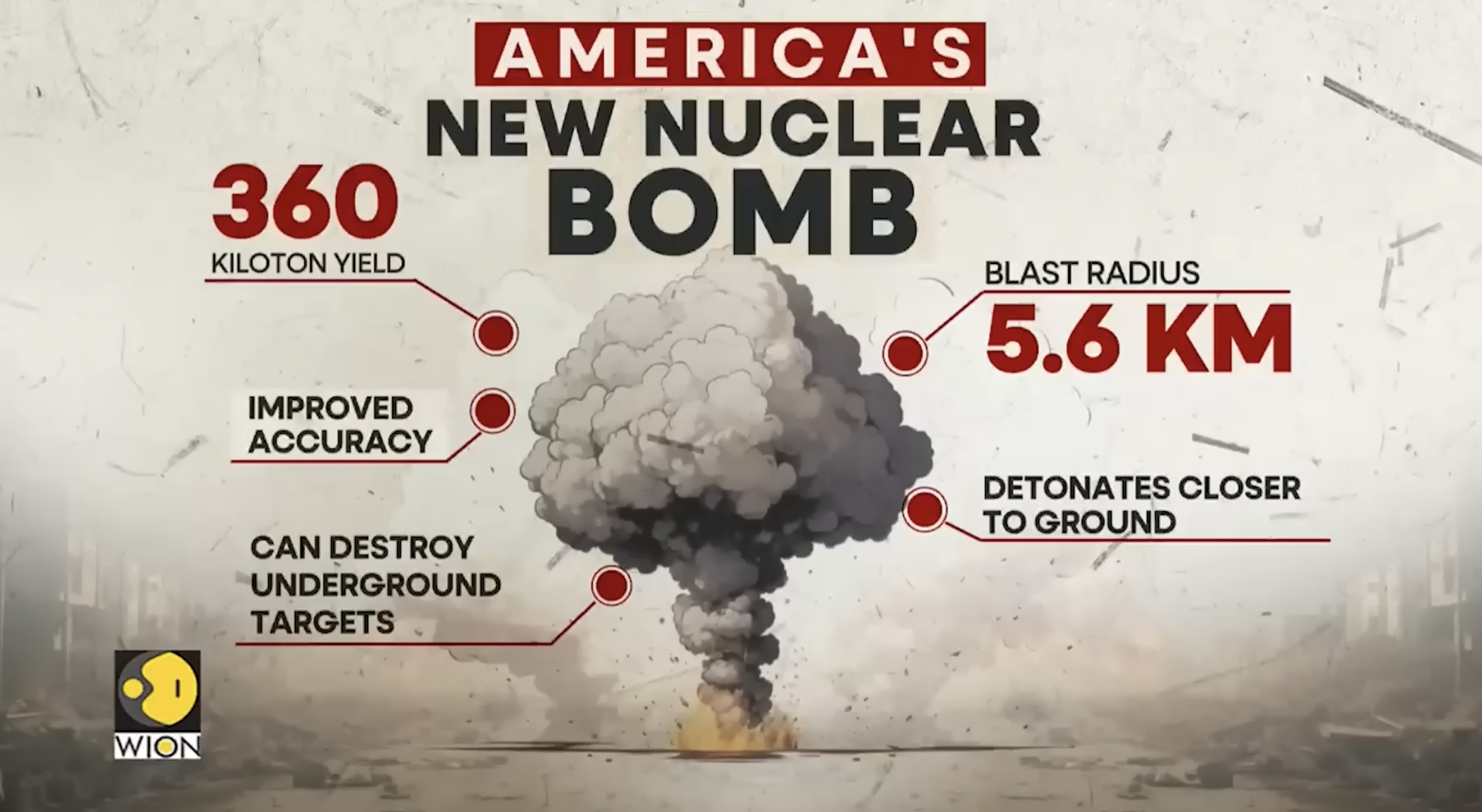
Nuclear B61-13 gravity bomb, which will be deployable by both B2 and future B21 bombers. Click to expand. Photo: YouTube WION
To better understand the consequences, let's imagine a 300 kiloton nuclear bomb detonating in a major Middle Eastern city.
Simulation models such as NUKEMAP show that:
- Complete destruction radius: about 2 to 3 kilometers [1-2 miles]
- Severe burn radius: up to 10 km [6+ miles]
- Serious damage to buildings: up to 15 km [9+ miles]
In such a scenario, hundreds of thousands of people would likely be killed in the very first moment.
But the disaster does not end there.
Many people may lose their lives in the days and weeks that follow because of:
- Burns
- Injuries caused by debris
- Radiation sickness
Medical studies show that radiation doses exceeding 4 sieverts2 are fatal in more than 50% of cases.
Radioactive contamination
One of the most dangerous consequences of a nuclear explosion is radioactive fallout. In this process, radioactive particles are dispersed into the atmosphere and then settle on the Earth's surface....These elements can enter the food chain....
Nuclear winter
One of the most important concerns of scientists is a phenomenon called nuclear winter. If several cities were to burn in a nuclear war, the massive fires would produce large amounts of soot and carbon particles. These particles can enter the stratosphere and remain there for years.
The result of this process:
- Reduced sunlight
- Global temperature drop
- Rainfall disruption
Climate studies suggest that global temperatures may drop by 1 to 5 degrees Celsius. This amount of change is very large for the Earth's climate system.
Global food crisis
One of the most dangerous consequences of nuclear winter is reduced food production. Studies from [U.S.] Rutgers University have shown that even a limited nuclear war could reduce world grain production....In a world of more than 8 billion people, such a decline in production could be catastrophic. Some estimates suggest that more than a billion people could be at risk of severe hunger.
Environmental consequences
Nuclear radiation can have long-term effects on the environment....Some species may become extinct in polluted areas. Research in the [1986 nuclear disaster in Russia’s] Chernobyl area indicates that many animals and plants have undergone genetic changes....
Conclusion
Scientific studies in various fields show that even a limited nuclear war could have catastrophic consequences. These consequences include:
- Immediate destruction of cities
- Death of hundreds of thousands of people
- Widespread radioactive contamination
- Climate change
- Global food crisis