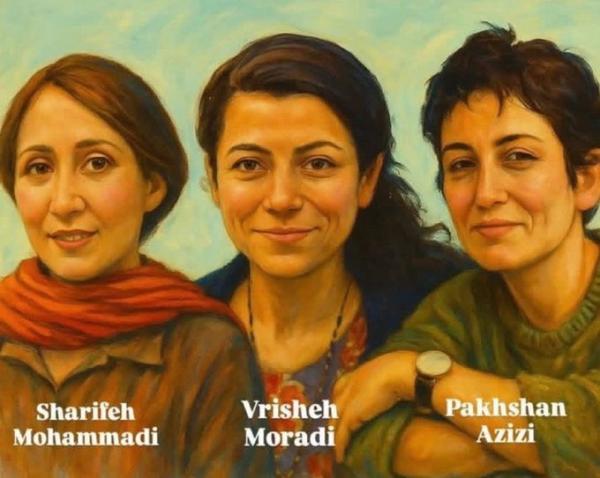
Three women activists at risk of imminent execution by Iran’s theocrats. Illustration: social media
Forty-four political prisoners1 issued a statement condemning the death sentences of Sharifeh Mohammadi, Pakhshan Azizi, and Varisheh Moradi, reposted on 9/2/2025 by @burnthecage
Although the effects of authoritarian rule become more evident every day—manifesting as growing dysfunction in the economic, social, cultural, and political spheres—nevertheless the authorities see the solution in intensifying repression and issuing sentences of a repressive nature, aimed at instilling fear and preventing widespread popular protests, while also attempting to boost the morale of the regime’s repressive apparatus. Human rights are universal rights, common to all societies and countries. Article 3 of the Universal Declaration of Human Rights, as a global covenant, recognizes the right to life as one of the inalienable rights of every individual. Depriving a human being of this right, for any reason, has long been regarded in most human societies as reprehensible, irrational, uncivilized, and devoid of humanity’s higher moral consciousness. We, the undersigned, while firmly and explicitly opposing the death penalty both now and in the future, strongly protest the death sentence issued against Sharifeh Mohammadi as well as against Pakhshan Azizi, and Varisheh Moradi. We call upon all international organizations and awakened consciences to take immediate action and respond to these unjust rulings.
Voices of Compassion and Comradery from the Dungeons
This is not the first call for justice from some of these brave prisoners. Two of the 44—Mehran Raouf and Fouad Fathi—were among nine men and women who sent out a letter from Evin Prison condemning Israel’s launch of its genocide in Gaza and in support of the Palestinians.
Evin Prison has long been notorious worldwide as a torture chamber for dissidents and resisters. First built by the U.S. CIA-installed regime of Mohammad Shah,2 it has been expanded by Iran’s theocrats in the past 46 years. Prison under all oppressive regimes like the Shah or the Mullahs are meant to break down, not build up, people’s dignity and humanity. In conditions of the hourly fight for personal survival, the world can learn from these prisoners who embody and project the spirit of collective resistance, of taking risks to CARE FOR OTHERS NEAR AND FAR, of daring persistence and hope such as in the “No to Execution Tuesday” hunger strike now entering its 85th week on Tuesday, September 9, now in 51 prisons across Iran, of hundreds, possibly thousands of the incarcerated. Every decent person in this currently terrible world order can learn from them and strive for a better future for all humanity.

IEC volunteer wears mask of Mehran Raouf and “booking card” to highlight his case at International Women’s Day 2023 rally, Santa Monica, California. Photo: Courtesy of IEC
In the first week of this month, several social media posts brought attention to the case of Mehran Raouf, including @burnthecage and @Tavaana, that spoke about him being an example of the systematic persecution of political prisoners, especially dual nationals (citizenship in two countries) like him. Raouf, now age 67, has served nearly five years of an eight-year sentence in a sham 2021 trial. According to Iran’s own laws, he is eligible for release after serving one third of the sentence. Yet he has requested parole six times with no response, even though by law he is to be released if the authorities do not reply after three requests. During this same week, over two dozen Iranian political activists signed a statement demanding “the immediate release of elderly and sick prisoners” and named Mehran Raouf as one of those “whose lives are in danger” and must be freed. Their courage stands out given that in the same week, numerous lawyers inside Iran were arrested, and some disappeared.
Iran as the Axis of Repression That Demands the People’s Resistance
The human rights groups Amnesty International and Human Rights Watch issued a joint report last week that more than 20,000 people have been arrested since June 13, 2025 (when Nazi-Israel started its “12 day” war on Iran), including dissidents, human rights activists, victims’ families, social media users, Afghan refugees, and members of ethnic and religious minorities (e.g,. Arabs, Kurds, Baluchs, Afghans, Christians, Jews, Sunnis, Baha’is). There have been hundreds of arrests of Arabs and Kurds, and the massive, violent expulsion of Afghan immigrants continues. Sara Hashash of Amnesty stated: ”Government officials and media have called for rapid executions and even the repeat of the 1988 killings.” (For a detailed documentation of the 1988 massacre, read Voices of a Massacre: Untold Stories of Life and Death in Iran, 1988 by Nasser Mohajer, OneWorld Publications.)
Scenes from the Woman, Life, Freedom uprising posted by Shekib Mosadegh over his “Burn the Cage, Free the Birds” anthem.
The many decades-long repression and inspiring fierce resistance of the people of Iran is a trail that runs from the regime of the U.S. imperialist puppet Shah to that of the Islamic Mullah regime today. The months of August and September are indelible markers for millions across generations of Iranians, from the CIA coup on September 18, 1953, to the theocrat’s massacre of over 5,000 political prisoners in August-September of 1988, to the Woman, Life, Freedom uprising sparked by Iran’s murder of Mahsa Amini for improper hijab (headscarf) on September 16, 2022, which lasted well into early 2023.
There is a call from Mansoureh Behkish3 for protests in over a dozen cities in Europe and Canada on September 20. Their broad demands are: Lift the death penalty; free the political prisoners; no to expelling Afghan refugees; no to war and genocide. Woman, Life, Freedom.” There will also be a cultural-political gathering in solidarity on the same day at Revolution Books in Berkeley, co-sponsored with the IEC (check RBB website for details).
Stop Official and Extrajudicial Executions

According to the most comprehensive data since 2013 at www.mappingpoliceviolence.org, as of August 18, 2025, U.S. police have street-executed 873 people so far this year. This is not counting the official executions of prisoners in the U.S. or those who die in prison or immigrant detention. In comparison, according to data from Iranian human rights group HRANA there have been 845 executions in Iran so far this year, as of September 1. This amounts to three to four people killed by the government per day in each country. As horrific as these statistics are in any context, keep in mind that Iran’s population of 92 million is less than one-fourth of the U.S. population of 340 million, so the effect of state killings in Iran on devastated families and the society as a whole is fourfold (again, this doesn’t even include the uncounted number of “extra-judicial” killings in Iran under torture or on the street). These state murders in both countries are unacceptable and cruel and promises to accelerate in both Trump fascist U.S. as well as Islamic fascist Iran, and must be collectively and urgently resisted with all our might. The righteous demand to stop all state executions, as well as murders in police stops or custody such as Mahsa Amini, should be supported along with freeing all political prisoners in Iran. Of particular urgency is the struggle to stop the impending execution of the three women political activists on death row in Iran: Sharifeh Mohammadi, Pakhshan Azizi, and Varisheh Moradi.

An inspiring quote from Varisheh Moradi, showing why political prisoners like her are hated and feared by reactionaries, and must be freed by the people’s struggle. Graphic: IEC