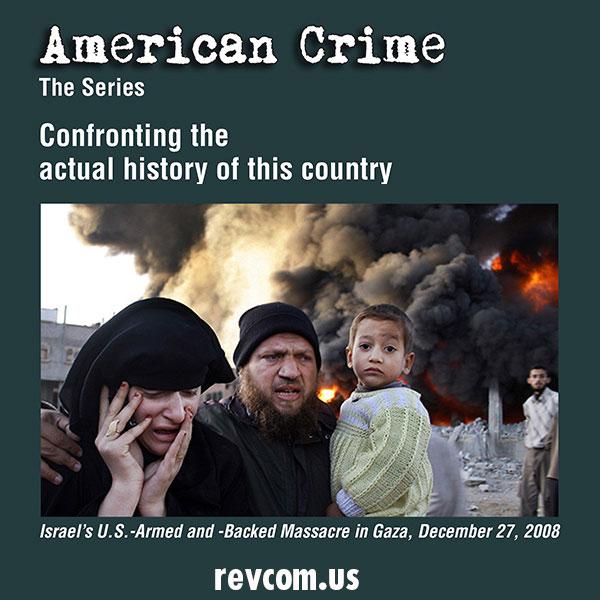
Bob Avakian has written that one of three things that has “to happen in order for there to be real and lasting change for the better: People have to fully confront the actual history of this country and its role in the world up to today, and the terrible consequences of this.”
3 Things that have to happen in order for there to be real and lasting change for the better:
1) People have to fully confront the actual history of this country and its role in the world up to today, and the terrible consequences of this.
2) People have to dig seriously and scientifically into how this system of capitalism-imperialism actually works, and what this actually causes in the world.
3) People have to look deeply into the solution to all this.
Bob Avakian
May 1st, 2016
In that light, and in that spirit, “American Crime” is a regular feature of revcom.us. Each installment focuses on one of the 100+ worst crimes committed by the U.S. rulers—out of countless bloody crimes they have carried out against people around the world, from the founding of the U.S. to the present day.

See all the articles in this series.
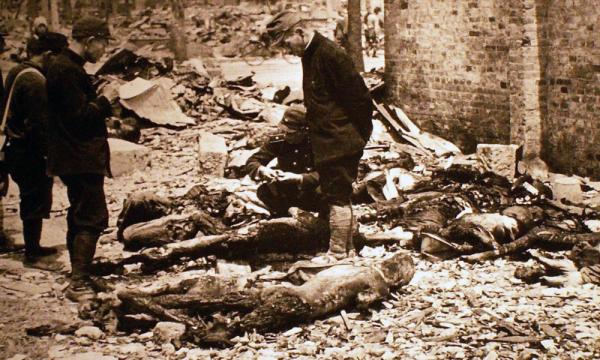
After U.S. firebombed Tokyo, March 9, 1945, residents search charred ruins. Photo: Kushu via Wikimedia
The Crime
On the night of March 9-10, 1945, United States General Curtis LeMay sent approximately 300 B-29s over Japan, where they dropped 1,665 tons of bombs aimed at starting fires upon impact,1 including the newly developed napalm2 over the Shitamachi district of Tokyo.3 The firebombing killed over 100,000 civilians and destroyed 16 square miles of the city,4 which included 267,171 houses, stores, and businesses.5 This currently stands as the most destructive bombing raid in human history.6
“The scalding inferno caused canals to boil, metal to melt, and people burst into flames spontaneously. The victims, LeMay reported, were ‘scorched and boiled and baked to death.’”7
A United States Strategic Bombing Survey stated, “Probably more persons lost their lives by fire at Tokyo in a six-hour period than at any time in the history of man.”8
Funato Kazuyo, a sixth-grade schoolgirl at that time, recounted the horror and terror of the fire bombing:
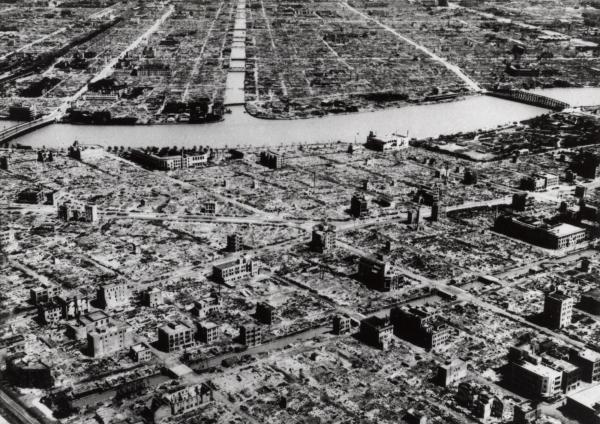
This aerial photo taken in March 9, 1945 shows the industrial section of Tokyo before the U.S. firebombing on March 10, 1945. Photo: AP
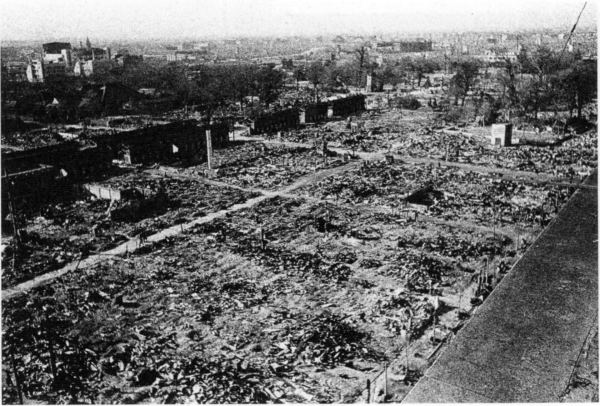
One of Tokyo's oldest shopping districts destroyed by U.S. firebombing, March 10, 1945. Photo: Wikimedia
“Abandoning their home, Funato and her remaining family ran from the fires in a city she described as hell on earth. Houses burned, debris fell, electric wires sparked and a deadly wind blew across the city. Funato found another shelter with her siblings, but the shelter did little to stop the heat of the fires burning outside. Her brother caught fire and ran out, her other brother went outside after him, both were blown away out of sight…Funato and her only other sibling Hiroko in the shelter had no choice other than stay and endure the burning heat inside. Hiroko’s hands were badly burned and Funato tried to relieve the pain by putting Hiroko’s hands in a puddle of water. After the fires subsided Funato and Hiroko walked back to their home, passing blackened and charred corpses strewn over the city. The surviving family had suffered burns especially her mother, who still carried the burnt and dead body of Funato’s baby brother on her back. Two of her siblings and her grandmother were never found.” (Hiroko later died from the tetanus virus she contacted from the water puddle.)9
LeMay had been bombing Japan for the past 6 months with little effect. In February 1945, he received a telegraph with the orders to bomb the urban areas of Nagoya, Osaka, Kawasaki, and Tokyo. On February 25th, he initiated a limited bombing attack on Tokyo with low-flying B-29s and incendiary bombs.10 The strike was successful, destroying 27,970 homes and shops. It incinerated one square mile of Tokyo, ten times more area than any of the previous strikes. This set the stage for what was to happen on the evening of March 9-10 and beyond.11
Two days after the March 9-10 strike on Tokyo, the U.S. military dropped incendiary and napalm bombs on Nagoya. The next day, more napalm on Osaka. Four days later, more on Kobe.
On April 13, the U.S. launched “Operation Perdition,” an air raid that lasted almost 4 hours, making it the longest of the six maximum-effort incendiary raids on Tokyo during the war. The fires burned over 11 square miles, and destroyed 160,000 to 180,000 dwellings, making 575,000 to 625,000 persons homeless. 2,459 people died during Operation Perdition. The lower casualty number from the previous bombings was attributed to different wind and topographic conditions.12
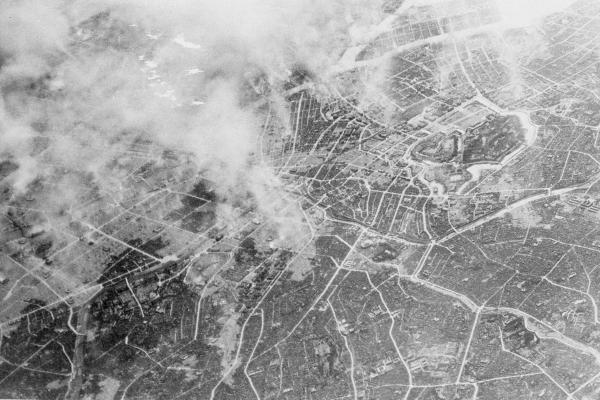
After the U.S. firebombed Tokyo on March 10, 1945, plumes of smoke rose 15,000 feet in the air. Photo: AP/US Air Force
The U.S. followed up with three more firebombings of Tokyo in April and May. In total, all the firebombings of Tokyo accounted for over 56.3 square miles burned, over 100,000 civilians killed, and over 2.5 million left homeless.
During a six-month period, LeMay bombed 67 cities. He continued to firebomb Japanese cities after the atomic bombs were dropped on Hiroshima and Nagasaki. (See American Crime Case #97: August 6 and 9, 1945—The Nuclear Incineration of Hiroshima and Nagasaki.) The civilian death toll from all these raids has been estimated to be 300,000.13 This was more people killed than the atomic bombings combined. In a three-month period, LeMay’s firebombings laid waste to 75-90 square miles of Japan’s four largest cities14 Approximately 50% of Tokyo (a city the size of New York City) was burned to the ground.15 The fire bombings incinerated over 130 square miles in the country.16
Just after the attack on Pearl Harbor by the Japanese, Lt. Colonel James H. Doolittle developed the plans to use B-25 bombers to launch attacks on a number of Japanese cities. On April 18, 1942, Doolittle began the raid, bombing Tokyo, Nagoya, Osaka and Kobe. Although the bombings did little damage and killed 50, it set the framework for the U.S. to develop long-range bombings that would result in the brutal and inhumane firebombing attacks in 1945.17
In total, Japanese civilian deaths for all air raids on its mainland and on Okinawa and Saipan during World War 2 were about 553,000.18
The Criminals
General Curtis LeMay: LeMay, the commander of the XXI Bomber Command in the Pacific, was charged with commanding the B-29 squadrons in the Pacific. He was the sole architect of all aspects of the firebombing raids. LeMay said, “There are no innocent civilians. It is their government, and you are fighting a people; you are not trying to fight an armed force anymore. So it doesn't bother me so much to be killing the so-called innocent bystanders.”19 “You’ve got to kill people,” he said, “and when you kill enough of them, they stop fighting.”20
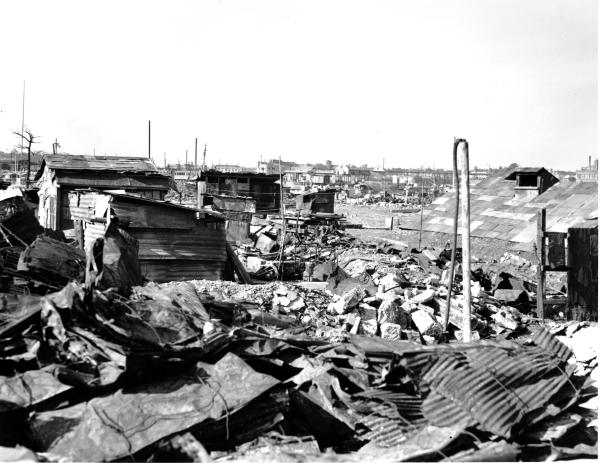
This September 7, 1945 photo shows makeshift housing from galvanized iron roofing of burned buildings amidst residential districts razed by U.S. firebombing of Tokyo in March. Photo: AP
In 1965, LeMay wrote, “We knew that we were going to kill a lot of women and kids when we burned [a] town [Tokyo]. Had to be done.”21
It was later reported that LeMay said, “...if we’d lost the war, we’d all have been prosecuted as war criminals.”22
In his memoirs, LeMay is quoted as saying this about North Vietnam: “We’re going to bomb them back into the Stone Age.” LeMay later said that this quote was “invented.”23
In 1968, LeMay ran for Vice President along with the Presidential candidate, George Wallace, the white supremacist former governor of Alabama. During their campaign, LeMay advocated for use of nuclear weapons to force a swift victory in Vietnam.
The U.S. Military:
Henry “Hap” Arnold, Air Force general, who put General Curtis LeMay in the position where LeMay could direct the firebombing raids. Arnold was one of the few military higher-ups who had an idea of what LeMay was planning to do. On March 7, two days before the attack on Tokyo, Arnold said, “We must not get soft—war must be destructive and to a certain extent inhuman and ruthless.”24
The Pilots and Crew who flew the B29 bombers in the air raids.
The chemists and companies that developed the napalm bombs during World War 2:
A team of scientists, Louis Fieser, chemistry professor, Harvard University, Dr. E. B. Hershberg, chemistry professor, Harvard University, and Hoyt C. Hottel, chemical engineering professor, MIT, developed napalm in the Harvard chemistry laboratory.25
Nuodex Products Company produced the original napalm powder used in the bombs.
Standard Oil of New Jersey built the napalm bombs.26
President Franklin D. Roosevelt: In a speech to Congress on December 8, 1941, Roosevelt said, “No matter how long it may take us to overcome this premeditated invasion, the American people in their righteous might will win through to absolute victory.”27 This speech came to be known as the "Day of Infamy" speech as it was delivered the day after Japan attacked U.S. military bases in Pearl Harbor in Hawaii.
Roosevelt initially opposed the mass urban bombing of cities. Rather, he wanted precise strikes on military installations. Winston Churchill, prime minister of the United Kingdom, favored the mass bombings and used them against Germany. Due to their success, he convinced Roosevelt to support the mass urban firebombing of cities.28
President Harry S. Truman: Truman took office on April 12, 1945, when President Roosevelt died. Truman was president during some of the firebombings on Japan. Truman obviously knew the terrible suffering caused by this and upheld it. He said, “Despite their heavy losses at Okinawa and the firebombing of Tokyo, the Japanese refused to surrender. The saturation bombing of Japan took much fiercer tolls and wrought far and away more havoc than the atomic bomb. Far and away. The firebombing of Tokyo was one of the most terrible things that ever happened, and they didn't surrender after that although Tokyo was almost completely destroyed.”29
The Alibi
The rationale for the massive firebombings on Japan was that the U.S. felt that if it took a land invasion to win the war, the U.S. casualties would be very high, with an estimated death toll of 50,000-250,000.30
In order to prevent those U.S. casualties, General Curtis LeMay was given the green light to do what he was going to do best—burn cities to the ground and kill civilians. The United States plainly hoped that by causing significant damage to Japanese civilians, the morale of the Japanese would suffer. It was claimed that the Tokyo firebombing was aimed at breaking the will of the Japanese people.31
The New York Times reported that LeMay said, “If the war is shortened by a single day, the attack will have served its purpose."32
The Real Motive
In September 1945, World War 2 ended with the formal surrender of Japan. In the months leading up to that, devastating blows were delivered to Japan to force its surrender and set the framework for the balance of power in the world in the aftermath of the war.
Read/listen to this social media message from @BobAvakianOfficial.
The U.S. feared that the Soviet Union (USSR) would invade Japan and take over the country, expanding the communist sphere of influence in Asia similar to what the Soviet Union was doing in Eastern Europe at that time. In August, the Soviet Union invaded and defeated the Japanese in the Kuril Islands, which is off the coast of Russia and 700 miles north of the main Japanese islands. Then in August 1945, the Soviet Union declared war on Japan. The U.S. had real reason to fear that the USSR would invade Japan. As the defeat of Japan became imminent, the Soviet Union took control of North Korea, which was a deal they made with the U.S. and the allies to divide Korea with the U.S. Further, the USSR was supporting the Chinese communists in their civil war. The influence and control of the USSR in that area was growing. Any further incursion in that area of the world by the Soviet Union was seen as a further threat to the U.S.’s plans to dominate much of the Pacific Rim of the world. Defeating Japan and taking control of the country before the Soviet Union could move its military forces further south to Japan and gain control of more territory was essential for the U.S. in terms of the rivalry between it and the Soviet Union. The U.S. did not want to lose its foothold and influence in an area that it had seized during World War 2.
By the end of World War 2, the U.S. saw its opportunities to be able to broaden its influence throughout the world, and to do that it needed to finally defeat Japan and end the war. In speaking about the real purpose of the horrific atomic bombings of Japan, Bob Avakian stated:
It was fundamentally motivated by the needs and imperatives of U.S. capitalist imperialism. It was done as part of the moves to establish the USA as “Number One” coming out of that war—number one imperialist oppressor, number one in plundering and destroying people and the environment. It was a declaration of U.S. supremacy—and a warning—most of all to the then-socialist Soviet Union, which had actually been an ally of the U.S. during the war, but with the end of the war was once again regarded as an enemy which represented the main obstacle to American imperialist domination in the world.33