Bob Avakian has written that one of three things that has “to happen in order for there to be real and lasting change for the better: People have to fully confront the actual history of this country and its role in the world up to today, and the terrible consequences of this.”
3 Things that have to happen in order for there to be real and lasting change for the better:
1) People have to fully confront the actual history of this country and its role in the world up to today, and the terrible consequences of this.
2) People have to dig seriously and scientifically into how this system of capitalism-imperialism actually works, and what this actually causes in the world.
3) People have to look deeply into the solution to all this.
Bob Avakian
May 1st, 2016
In that light, and in that spirit, “American Crime” is a regular feature of revcom.us. Each installment focuses on one of the 100+ worst crimes committed by the U.S. rulers—out of countless bloody crimes they have carried out against people around the world, from the founding of the U.S. to the present day.

See all the articles in this series.
This is Part 1 of American Crime Case #2: The Atlantic Slave Trade—The Middle Passage. Part 2 is Slavery in America.
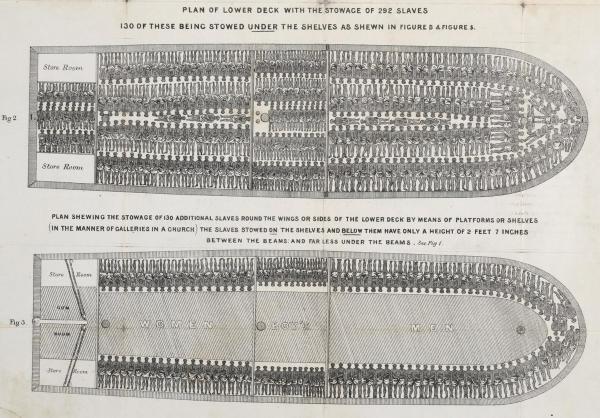
A slave ship showing typical arrangement of 292 slaves, 130 stowed under shelves (Figure 3). Graphic: Wikipedia
The Crime:
Between 1501 and 1867, an estimated 12.5 million African people were put on slave ships that crossed the Atlantic to be sold into slavery. The overall death toll during the ships’ crossings has been estimated to be 15 percent.1 To put it another way, between 1 ½ and 2 million people. The word “horrific” cannot begin to do justice to the numbers of people and monumental suffering involved.
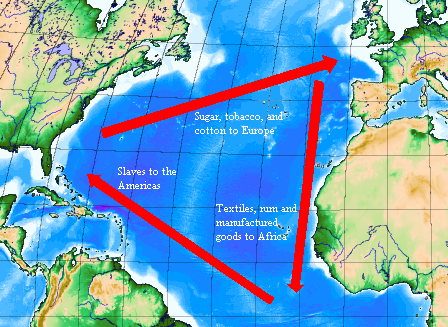
Graphic: Wikipedia
The “Middle Passage” constituted the middle portion of the “Triangular Trade” network connecting Europe and Africa to the Americas by way of the Atlantic Ocean. The first leg took manufactured items like guns, cotton cloth, and tools from Europe to Africa to trade for captives, the middle leg trafficked Africans to work as slaves in the Americas and the Caribbean, and the third leg brought exports produced on the plantations (sugar, rice, tobacco, indigo, rum, and cotton) back to Europe.2
It was a brutal forced voyage for enslaved Africans who endured up to months of starvation, dehydration, disease, sexual violence, torture, and mass murder. Most trafficked Africans were between the ages of 15 and 25.3
The early slave ships arrived in Brazil and the Caribbean where slaves faced barbarous hard labor primarily on sugar plantations, where their life expectancy was only about seven years after arrival.4 Later, from 1626 to 1867, slave traders from North America trafficked at least 472,000 captured people from Africa.5
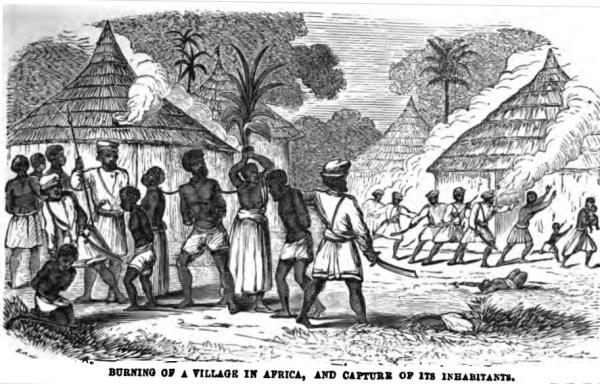
Slave traders burned villages to capture inhabitants for slavery, 1859. Graphic: Wikipedia
Before being forced onto slave ships, African people were violently kidnapped from their villages and towns by rich slave dealers or seized through warfare by wealthy, powerful African rulers. Captives were bound together by rope or chains, two-by-two, in long lines called coffles and forced to walk for up to hundreds of miles until they reached the coast, where they were sold to European slave traders.
In some areas, villages became so depopulated that there were few people left to farm the land.6 This devastating system ripped mothers, fathers, and children away from highly developed African civilizations. Those captured included skilled medical healers, farmers, metalsmiths, weavers, traders, and herders.
Upon reaching the coast, kidnapped Africans were forced into dungeons and heavily-guarded holding enclosures named barracoons to wait for the ships that would take them across the Atlantic. African captives were forced to remain on slave ships that remained docked—at times for months—until they had loaded enough “human cargo” to make the passage sufficiently profitable for the enslavers. The death toll was astronomical—at least ten million died while waiting for the forced crossing of the Atlantic.7
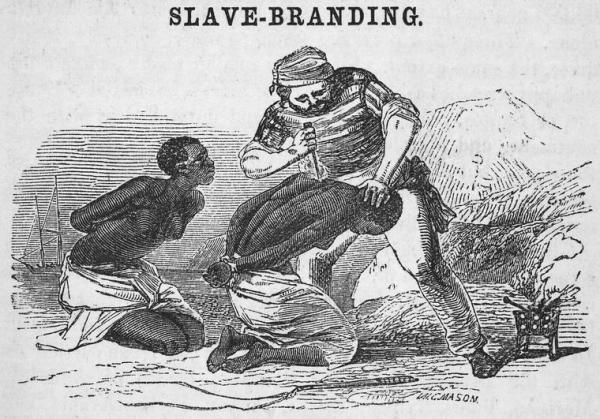
Slaves were viewed as property. Slaves were branded by their slave owners. Graphic: Wikimedia Commons
As captives were stripped naked and loaded onto ships, men and women were separated and tightly packed into the ships’ holds under extremely inhumane conditions. Some boat captains had their slaves branded with hot irons to show who now owned them. Alexander Falconbridge, a white surgeon who participated in the slave trade, later testified that captives “had not so much room as a man in his coffin, neither in length or breadth, and it was impossible for them to turn or shift with any degree or ease.”8
People were forced to lie in urine, feces, vomit, blood, and mucus, with little or no fresh air. Some prisoners suffocated from the lack of air below deck. Diseases and illnesses were rampant and spread rapidly in the close quarters of a ship’s hold resulting in horrible deaths. During violent storms, sea water rushed into some of the ships' holds that resulted in the drowning of chained African people. Often, dead bodies were left shackled to the living for hours or days after they had died, and then thrown overboard.
African women and girls suffered similarly horrific conditions below deck—but they also endured a whole other level of terror and sexual violence, constantly in fear of being raped or assaulted by the white crew, who whipped those who resisted. “One surviving account details the experience of ‘a little girl of eight to ten years’ who was repeatedly raped by a ship’s captain over three consecutive nights.”9
Some African women faced yet more terror. Many women captives had their children and infants forcibly ripped from them when they were kidnapped or awaiting the slave ships. Some mothers carried their babies with them but were unable to protect them from abusive sailors who used them to control and terrorize their mothers. One account details a sailor who “tore the child from the mother, and threw it into the sea when the newborn would not stop crying.”10
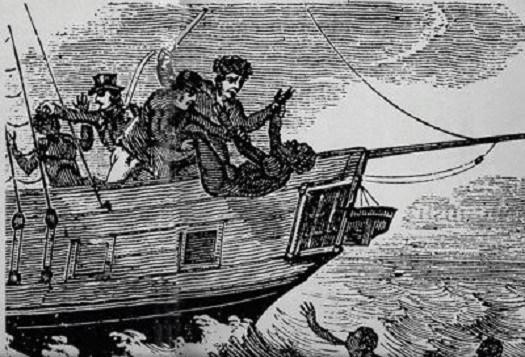
British sailors throw sick captured Africans overboard during the Middle Passage, 1781.
Slave traders and their crews violently terrorized captives into submission, aiming to prevent any resistance or rebellion, through repeated whippings and torture using devices like thumb-screws that literally crushed the fingers. Ships' crews often retaliated against perceived insubordination by throwing abducted Africans overboard to be attacked by sharks. The horrific treatment meted out against African people caused great physical and psychological harm that also served to coerce submission when they were sold as slaves in the Americas.
The Criminals:
Slave trading states and wealthy slave dealers arose in Africa that captured more than 22 million Africans in the interior of the continent and sold them to the European slave traders on the coast.11
European nations—Great Britain, France, Portugal, Spain, the Netherlands, and Denmark all participated in the Transatlantic Slave Trade. Great Britain banks in particular helped finance slave trafficking to North America and large parts of the slave economy in the U.S. British industries were the world’s largest purchasers of cotton produced by slave labor in the southern U.S. states.
When Britain finally abolished slavery in 1838, the government compensated slave traders for their “lost property” that totaled 20 million pounds or 40 percent of its total annual expenditures.The enslaved received nothing except the requirement that they work for free as “apprentices” to former slave owners.12
The Roman Catholic Church was essential to the efforts of global expansion by Portugal, Spain, and France, and the creation of massive commercial enterprises built on the suffering and death of enslaved people. Pope Nicholas V issued a decree sanctifying the slave trade because it would help to Christianize enslaved people.
Slave traders from North America trafficked about 472,000 captured people from Africa via the Middle Passage; of these, nearly 18 percent died crossing the Atlantic in slave ships.13
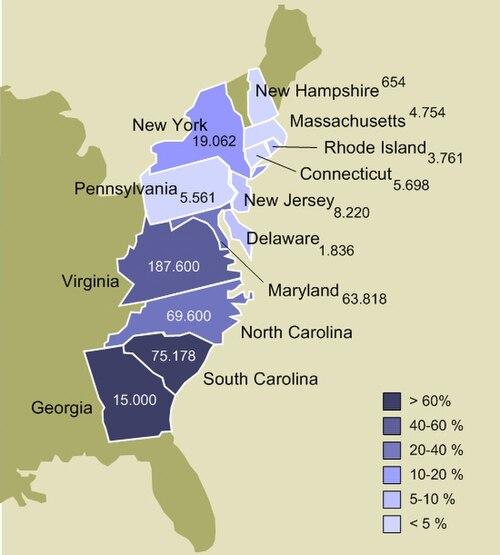
A map of the Thirteen Colonies in 1770, showing number of slaves in each colony and percentage of colony's total population held as slaves. Map: Wikipedia PD
The U.S., state, and colonial governments either participated in or protected the slave trade. In 1644, Boston merchants began importing enslaved people directly from Africa to the West Indies, where they exchanged them for West Indian sugar and molasses, which would be distilled into rum (a major New England industry) to pay for more enslaved people—the Massachusetts version of the “Triangular Trade.”14 The Continental Congress passed the Slave Trade Act in 1787 that mandated that Congress could not prohibit “importation” of persons by federal law for 20 years—until 1808.15
While Rhode Island passed the first law banning slavery in 1787, it became the principal North American hub for the illegal slave trade by way of the Middle Passage. Ships embarked on more than 1,000 crossings, trading primarily rum for more than 100,000 kidnapped Africans to the Americas, principally to the sugar plantations in the Caribbean that enabled Rhode Island to produce more rum.16
Northern capitalists made fortunes in the slave trade itself and in the rum, tobacco, shipbuilding, and textile industries—all based on slavery in the Caribbean and the U.S. South.
Insurance companies—New York Life and Aetna, Inc.—in Connecticut, insured slaveholders and shipowners for hundreds of dollars for each captive who died on slave ships or while laboring under murderous conditions. In 1781, slave traffickers murdered 133 abducted Africans on the slave ship Zong by throwing them overboard to collect insurance money.17
The Alibi:
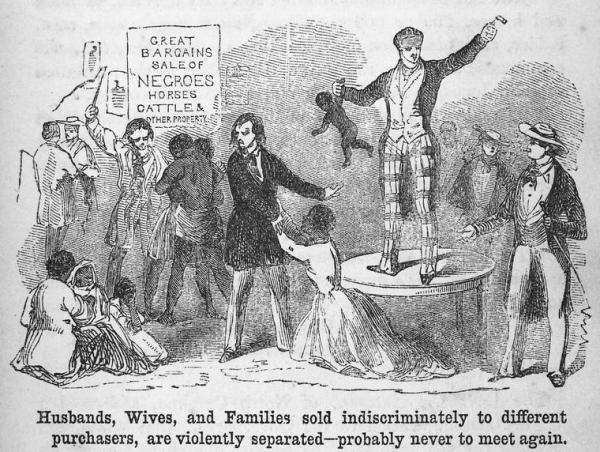
Slave auction, families separated, babies ripped from mothers. Graphic: Wikipedia PD
Fundamentally, slave traders saw African people not as human beings but as “commodities” to be bought and sold to the highest bidders. These “commodities” were essential to lucrative slave economies in North America and the Caribbean, and the foundation of U.S. capitalism-imperialism.
"In 1452 and 1455, Pope Nicholas V formally supported Spain and Portugal’s mass kidnapping and enslavement of Africans because it would help to Christianize enslaved people…. The Pope issued a mandate to the Portuguese king, Alfonso V, and instructed him: … to invade, search out, capture, vanquish, and subdue all Saracens and pagans whatsoever … [and] to reduce their persons to perpetual slavery, and to apply and appropriate to himself and his successors the kingdoms, dukedoms, counties, principalities, dominions, possessions, and goods, and to convert them to his and their use and profit.”18
“Scientists” like Josiah Nott, Samuel Cartwright, Charles Caldwell, and Samuel Morton, provided an anti-scientific rationale for American racism that was used as an argument for slavery. Nott wrote, “Nations and races, like individuals, have each an especial destiny: some are born to rule, and others to be ruled. No two distinctly-marked races can dwell together on equal terms.”19
The Actual Motive:
The discovery of gold and silver in America, the extirpation, enslavement and entombment in mines of the aboriginal population, the beginning of the conquest and looting of the East Indies, the turning of Africa into a warren for the commercial hunting of black-skins, signalised the rosy dawn of the era of capitalist production. These idyllic proceedings are the chief momenta of primitive accumulation.20—Karl Marx
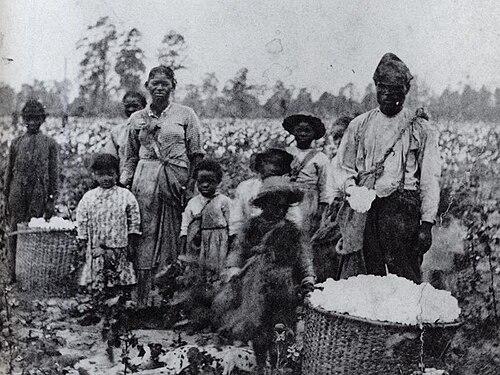
Slaves with the cotton they had picked. Georgia, c. 1850. Graphic: Wikipedia
The Transatlantic Slave Trade was a fundamental source of capital for the emerging capitalist system, and served as a source of enslaved labor for the areas of the Americas where the slave system was the mode of production, especially in the southern colonies. The expansion of slavery necessitated increasing numbers of slaves to exploit.
The decimation of enslaved indigenous peoples in the Americas forced slave traders to look elsewhere for a source of slave labor primarily on sugar and cotton plantations. The indigenous slaves were replaced with the enslaved peoples brought through the horrendous Middle Passage from Africa.
The slaves themselves were capital. The slave trade was a lucrative enterprise in itself as a source of investment by capitalist financiers who used profits to launch other companies and subsidize technical innovations that made industrialization and the rapid spread of capitalism profitable.21 The expansion of banking and credit systems, maritime industries and navigation technology, and the creation of a consumer market for European and American manufactured goods, were all precipitated by the Transatlantic Slave Trade.22
Estimates of the wealth generated by the Transatlantic Slave Trade and the buying and selling of enslaved people range from hundreds of billions to trillions of dollars in modern equivalents. Because enslaved people were treated as financial assets, the market value of human chattel served as a foundational building block for Western capitalism.23