Bob Avakian has written that one of three things that has “to happen in order for there to be real and lasting change for the better: People have to fully confront the actual history of this country and its role in the world up to today, and the terrible consequences of this.”
3 Things that have to happen in order for there to be real and lasting change for the better:
1) People have to fully confront the actual history of this country and its role in the world up to today, and the terrible consequences of this.
2) People have to dig seriously and scientifically into how this system of capitalism-imperialism actually works, and what this actually causes in the world.
3) People have to look deeply into the solution to all this.
Bob Avakian
May 1st, 2016
In that light, and in that spirit, “American Crime” is a regular feature of revcom.us. Each installment focuses on one of the 100+ worst crimes committed by the U.S. rulers—out of countless bloody crimes they have carried out against people around the world, from the founding of the U.S. to the present day.

See all the articles in this series.
This is Part 2 of American Crime Case #2: Slavery in America. Part 1 is The Atlantic Slave Trade—The Middle Passage.
In the words of abolitionist and former slave Frederick Douglass, in a July 4th speech in 1852:
For revolting barbarity and shameless hypocrisy, America reigns without a rival.
As Bob Avakian states concisely in BAsics: 1:1:
There would be no United States as we now know it today without slavery. That is a simple and basic truth.
~~~~~~~~~~
THE CRIME:
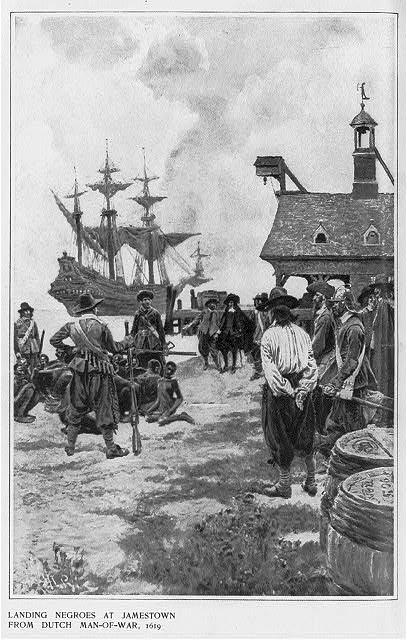
Africans arrive at Jamestown, 1619. Graphic: Wikipedia PD
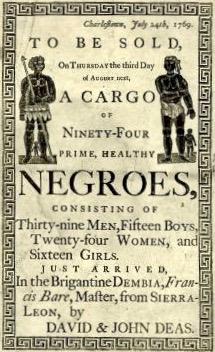
Ad for slave auction in South Carolina, 1769. Graphic: Wikipedia PD
In August of 1619, just 12 years after the English settled Jamestown, Va., the colonists bought 20 to 30 enslaved Africans from English pirates. Those slaves who came ashore that day were the beginning of American slavery.1 And for the next 245 years, millions and millions of enslaved Africans and their offspring would create tremendous wealth for the slaveowners, while the slaves themselves were forced to endure cruel, inhuman bondage.
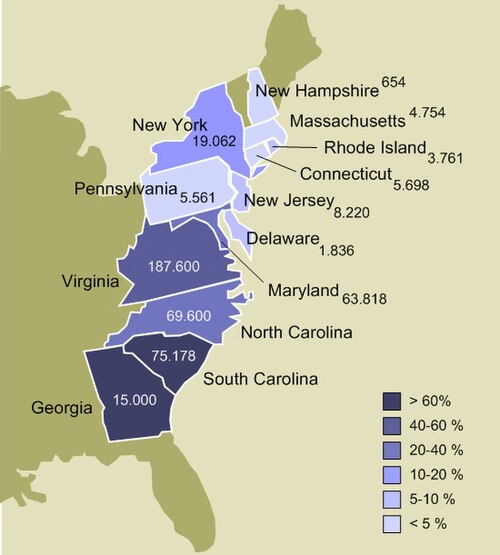
By 1700, all of the 13 colonies held slaves. Before the international slave trade was abolished in 1808, more than 400,000 slaves had been sold to the American colonies. After that, with enslaved women used as "breeders" of new slaves, a brutal internal slave trade flourished, and by 1860 there were nearly four million slaves, more than half living in the cotton-producing states of the South.
Slavery quickly became the dominant mode of production in the southern colonies. With an ideal climate and plenty of land, property owners established plantation farms for cash crops like rice, tobacco and sugar cane. The expansion of these crops required increasing amounts of labor, so wealthy planters bought more and more slaves.
Charleston, South Carolina, founded by English settlers in 1670, became one of the largest ports of entry for the transatlantic slave trade, processing nearly 40 percent of all of the Africans arriving in North America. The city became a marketplace where African men, women, and children were inspected like animals, sold, and dispersed throughout the South. The slave markets in Charleston were institutions of horror—public auctions where families were torn apart and lives commodified. By 1708 South Carolina's population was a majority Black, and remained that way for the next two centuries—well into the 1900s.
The rice plantations of the South Carolina Low Country became some of the most profitable in the world, with massive profits feeding into the development of banking institutions, insurance companies, and trade networks.
The Northern colonies and states were complicit in slavery in America. Northern capitalists made fortunes in the rum, tobacco, shipbuilding, and textile industries—all based on slavery in the Caribbean and the U.S. South. Northern merchants in Rhode Island and Massachusetts dominated the slave trade. Finance capitalists based in New York like Lehman Brothers and JP Morgan Chase not only financed the slave-based cotton plantations but directly managed plantation assets.
Harriet Beecher Stowe, author of Uncle Tom's Cabin, once said: “The Northern slaveholder traded in men and women whom he never saw, and of whose separations, tears, and miseries he determined never to hear.”2
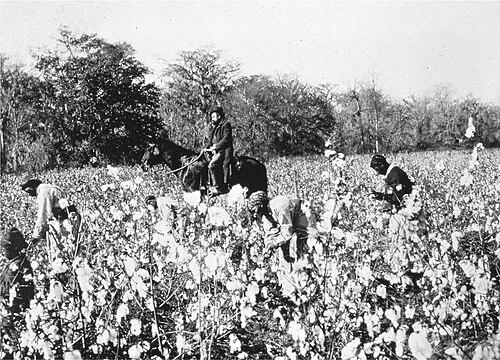
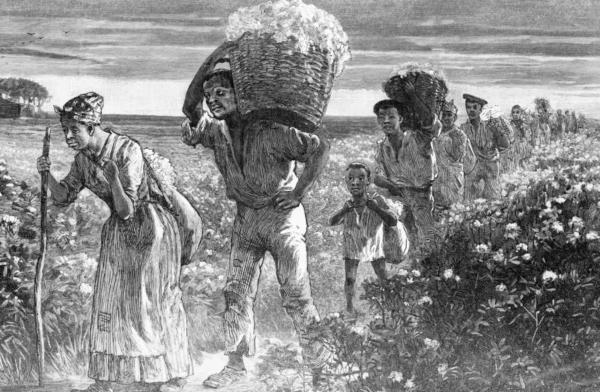
Slaves picking cotton while being observed by an overseer on horseback, c. 1850 Graphic: Wikipedia
Slaves were considered property, not human beings, and they were treated that way their entire lives. They lived under constant fear and control. They were subjected to brutal physical, emotional, and psychological abuse, including whipping, forced labor, and separation from their families. Abuse of slaves was regular and often used by slaveowners and overseers as a way of increasing production, and maintaining order on the plantation. A slave could be beaten or whipped for working too slowly, stealing, or trying to escape. They could be punished for visiting a spouse living on another plantation, learning to read, arguing with white people, possessing anti-slavery materials, or trying to prevent the sale of their relatives. Slaves were also branded by their slaveowners.3
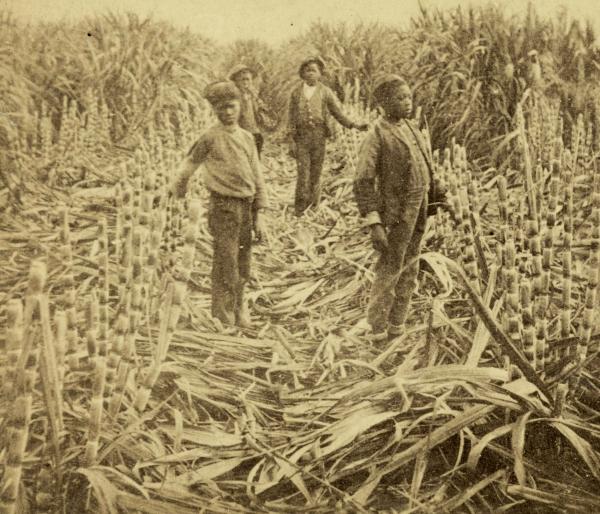
Children on a Louisiana sugarcane plantation, c.1885. Photo: Schomburg Center for Research in Black Culture, New York Public Library
Enslaved women were routinely raped or coerced by owners, overseers, and men in positions of authority. Estimates suggest that a majority of enslaved women aged fifteen to thirty experienced sexual assault. 4 While the majority of slaves worked in the fields, a smaller number were used as domestics, or "house servants," "mammies" and surrogate mothers. Women in bondage were harassed, sexually stalked and used as long term concubines by their masters. Children of such rapes were also legally considered slaves.5 And enslaved women fundamentally were treated as "breeders"—reproducing future slaves.
The basic cause of America's War of Independence in 1776 was the increasingly antagonistic conflict between two different exploitative and oppressive forces: on one side, the British empire, headed by a king; and on the other side slavery, along with merchants and other elements of the developing capitalist class in the colonies. In the period leading up to the war, the British—facing enormous debts from their Seven Years' War (French and Indian War) that ended in 1763—began imposing taxes on the colonies, and tightening control.
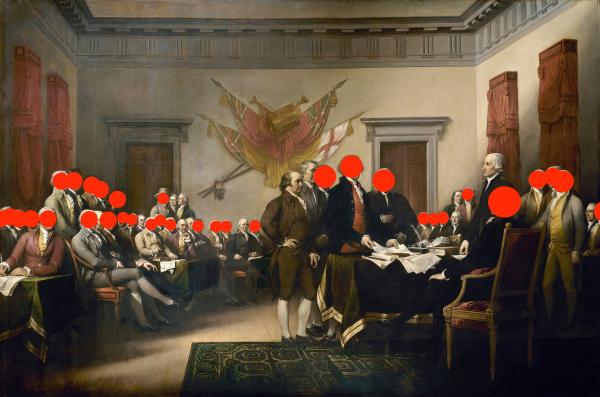
Of the 56 signers of the Declaration of Independence, 49 were slaveowners. The “Founding Fathers” who were slaveowners have red dots on their heads. Twitter: @arlenparsa
On top of that, there were developments in England calling for outlawing slavery, that would have included the colonies. Southern slaveholders, who led the war of independence, feared this possibility, and were determined to end British rule over the colonies. The essential “liberty” brought about through the American War of Independence was the removal of the constraints that the British empire enforced on the slaveowners and developing capitalists in the colonies. These were the “founding fathers” and basic beneficiaries of this war. In short, a growing system of exploitation in the colonies was given further impetus by breaking free of British colonialism.
The U.S. Constitution, ratified in June of 1788, included provisions explicitly protecting slavery. Enslaved people were counted as three-fifths of a person for representation and taxation, giving southern states disproportionate influence in Congress. It included the African slave trade clause, saying that Congress would not block the importation of enslaved people for 20 years following the ratification of the Constitution. It included the fugitive slave clause, requiring states to return escaped slaves to their master in the state they escaped from. And the language of the Second Amendment was crafted to preserve the slave patrols and militias in the southern states, which enabled slaveowners to quickly crush any rebellion or resistance from their slaves.
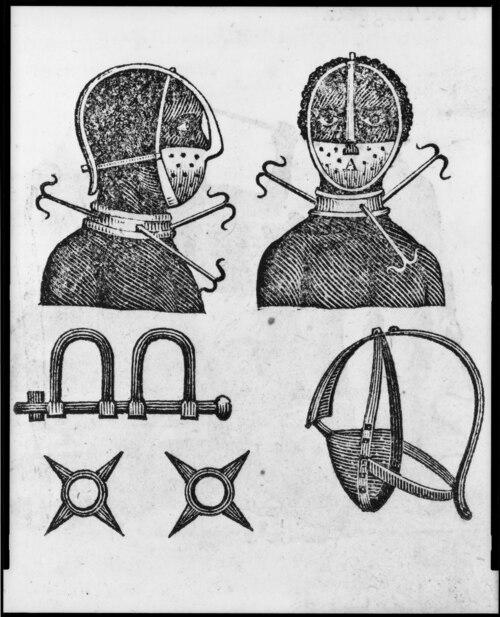
Instruments of torture used to restrict slaves. Graphic: Wikipedia PD
Sold down the river. Cotton’s profitability, combined with the expansion of the domestic and international markets, fueled demand for more and more enslaved labor, making the life of the slaves even more of a horror. Over the next half century, the domestic slave trade replaced the importation of slaves. It's estimated that one million enslaved people were forcibly transferred from the Upper South to the Lower South between 1810 and 1860.
Kentucky became one of the largest "slave-growing states," and Louisville one of the largest slave-trading marketplaces in the country. Slaves would be taken to Louisville to be "sold down the river"—the Mississippi or Ohio Rivers—and transported to the cotton plantations in states further south. It is estimated that more than half of all enslaved people held in the Upper South were separated from a parent or child through sale, and a third of all slave marriages were destroyed by forced migration. It's been said that the slaves considered the threat of being "sold down the river" a death sentence. And as the global demand for cotton grew, the demand for slave labor in the South grew more and more.
THE CRIMINALS:
First, the slaveowners themselves, who were responsible for developing a whole economic system based on the unspeakable exploitation and treatment of millions of human beings for profit. And all of those who served them; the overseers, the slave hunters and slave chasers, and the slave militias.
The northern industries and businesses—shipbuilding, ports, banks, insurance companies, textile mills, slave merchants—all who profited from the slave labor in both the North and South.
The political leaders of the colonies, North and South, and then the political leaders of the system that the war of independence established, based on the Constitution. This includes all of the U.S. Presidents, eight of whom were themselves slaveowners, as well as the members of Congress, and the Supreme Court. All were responsible for the existence and expansion of this slave mode of production in America. The author of the Declaration of Independence (Thomas Jefferson) and the main author of the U.S. Constitution (James Madison) were both slaveowners.
THE ALIBI:
Graphic: Wikipedia PD
For over two centuries to justify the barbarity of slavery, white Americans created a culture that treated people descended from Africa as a distinct and inferior race. This ideology, reinforced not just by laws, but by religious leaders quoting the Bible, and by racist "science" and literature, maintained that Black people were subhuman, a belief that allowed white Americans to live, and enjoy the benefits of slavery without question. This ideology continues to saturate American life.
On the eve of the Civil War, March 6, 1857, the U.S. Supreme Court made the inferiority of all Black people the law of the land. In the Dred Scott decision,6 Supreme Court Chief Justice Taney ruled that Blacks, both free and slave, were “beings of an inferior order and altogether unfit to associate with the white race… and so far inferior, that they had no rights which the white man was bound to respect.”
That is, from the beginning of this country, white supremacy was poured into the foundation and built into the institutions and the ongoing functioning of this system.
THE ACTUAL MOTIVE:
The story of American economic development is inseparable from the story of American slavery. From the start, access to enslaved Africans made possible, especially in the southern colonies, a source of increasing wealth based on slave-based agricultural production. Slavery became deeply embedded in the Southern economy, where plantations relied on enslaved labor for cash crops like tobacco, rice, indigo, and later cotton production.
The period following the War of Independence saw the rise of cotton as the dominant cash crop in the country, replacing tobacco in many regions. The invention of the cotton gin (engine) in 1793—a machine that quickly and easily separated cotton fibers from their seeds—transformed cotton into a highly profitable crop. It allowed farmers to grow far larger quantities and process them at speeds never before possible. This led to a boom in cotton cultivation, especially in the Deep South, which was expanding westward into new territories. By the early 19th century, cotton became the foundation for the developing textile industry in New England, spurring the industrial revolution which transformed America in the 19th century.
Northern banks and investors financed Southern plantations and the slave trade, further entrenching the economic benefits of slavery in the Northern economy. This financial relationship created a vested interest in the continuation of slavery, as it was profitable for Northern investors. Northern ports were crucial for the export of cotton and other goods produced by enslaved labor. And the shipping and trading industries in the North benefited from the transportation of these goods, contributing to the overall economic prosperity of the region.
SOURCES:
The Half Has Never been Told: Slavery and the Making of American Capitalism, Edward E. Baptist
Another Kind of Blood: Edward Baptist on America’s Slaver Capitalism « The Junto.pdf
Inhuman Bondage: The Rise and Fall of Slavery in the New World, by David Brion Davis
SLAVERY IN AMERICA – The Montgomery Slave Trade
Slavery in South Carolina – BlackWallStreet.org
Uncle Tom's Cabin, by Harriet Beecher Stowe
Slave Resistance and Rebellions
Slaves organized many rebellions to escape slavery, one of the earliest being the Stono Rebellion in South Carolina in 1739, the largest slave rebellion in North America during the colonial era. Scores of enslaved Africans began an armed march to Spanish Florida, where slavery was outlawed, and fought militias that tried to stop them.
Denmark Vesey, Nat Turner, and John Brown were just some of the leaders of slave rebellions that took place before the Civil War.7 All of these uprisings were brutally repressed. But they also instilled fear in their enslavers, and white people in general, of slave revolts.
The successful Haitian slave revolution, on an island in the Caribbean occupied by the French, took place just six years after the United States was founded. The number of slaves in that colony greatly outnumbered their enslavers. Still the U.S. slaveowners and political leaders were terrified of the domestic implications. George Washington worried of a potential international “spirit of revolt among the blacks.” Once started, “where it will stop, it is difficult to say.” And Jefferson wrote in 1802 that the fighting in Haiti “appears to have given considerable impulse to the minds of slaves in different parts of the U.S.”
This drove the slaveowners to do everything they could to prevent the organizing of such slave revolts—and to brutally murder any slaves who took part—sending a message to others not to even consider trying to escape their bondage. And there were organized forces—slave patrols, militias, and slave-catchers that could be and were mobilized to hunt down slaves whenever such rebellions occurred.
In addition, it's estimated that 65,000-100,000 enslaved men, women, and children managed to escape to freedom before 1865. Many were aided by the Underground Railroad, an abolitionist network developed to provide shelter, transportation, food, and other resources to thousands of runaways into the north. One of its most famous and effective leaders was Harriet Tubman, a Black woman who escaped slavery in 1849 and returned to the South at least 15 times to guide more than 200 people to freedom. Another leader, Henry Highland Garnet, escaped slavery as a child in 1824 and, as an adult, sheltered more than 150 runaways in his Albany, New York, home in a single year.