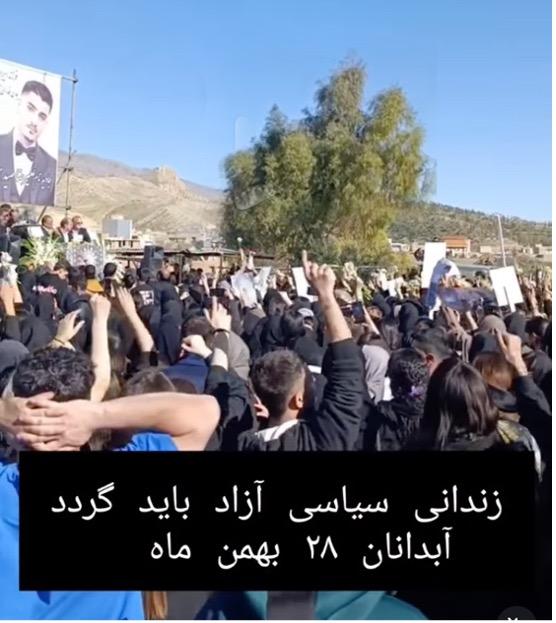
The Farsi caption of the crowd’s chant, “Political prisoners must be freed!, Abdanan, February 18.” Photo: Screenshot of video posted by @mahshiid_nazemii on IG
On January 8-10, the massive street protests in Iran were met by unprecedented, premeditated state violence. Many thousands of protesters were massacred by the Islamic Republic of Iran (IRI).1 Forty days later, February 17-19, despite the regime’s threats against public mourning, there were large, loud gatherings all across Iran to mourn and celebrate the lives of those murdered by the IRI during the uprising. Commemorations at the end of the 40-day mourning period are a key cultural tradition among the people of Iran, that at times have turned into mass social gatherings and occasions for protest, as happened over the IRI’s morality police murder of Mahsa Gina Amini that sparked the Woman, Life, Freedom uprising in 2022-2023.
This video titled “Mourning Party” reposted by Burn The Cage, celebrates the vibrant energy of the mostly youth killed in the January 8-10 violent crackdown. It shows how the deceased are honored with pride and rage alongside grief. Video: Siamash Saba
For this reason, Iran’s theocratic regime sought to prevent families from holding public 40th day commemorations, and paraded armed soldiers and armored vehicles in the streets in some towns. In the Kurdish town of Abdanan, in northwest Iran, security forces fired from an armored vehicle at people and arrested activists holding a memorial for 16-year-old Alireza Saydi, where large crowds chanted “Down with [Ayatollah] Khamenei” and significantly, “Political Prisoners Must Be Freed.” The IRI has detained tens of thousands of January ’26 protesters on top of the thousands of political prisoners already in its dungeons.
University students at more than two dozen colleges called for a nationwide strike closing schools and workplaces on February 17 and 18, calling for schools to hold memorials. Their statement concludes: “Our heads have not and will not bow to any dictatorship. The Islamic Republic must be destroyed.”
The Coordinating Council of Iranian Teachers’ Trade Associations called for school strikes on those days, honoring the 230 documented cases of children under 18 who were murdered in the protests, as well as several teachers killed, and many more arrested. It was reported to Al Jazeera that the school strike was backed by large numbers of teachers and students, and schools in a number of towns near the capital, Tehran, were effectively shut down. A spokesman of the regime’s education commission noted that 17 percent of the participants in the January nationwide uprising were teenagers, saying that in some provinces, up to 45 percent of protesters were under 20 years old.
Performance in Evin Prison: “Government Treats Them like Garbage”
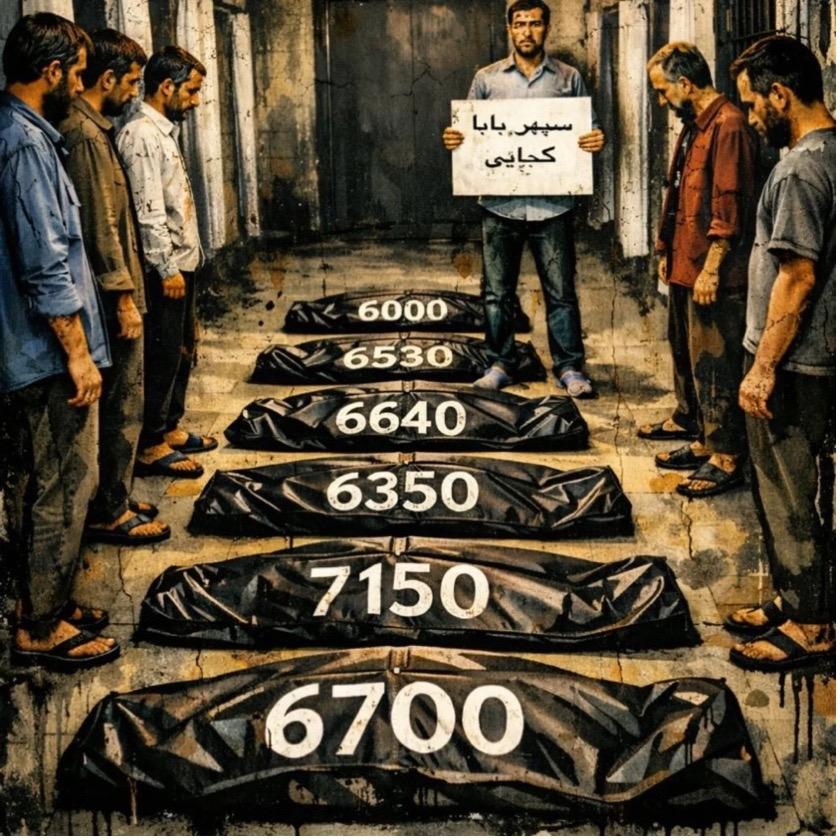
Recently released Evin Ward 7 prisoner Nasser Amirlo created this depiction of an action where the placard carried in a prisoners’ protest performance reads, “Sepehr, where are you, my boy?”, echoing the cry of a father who walked through rows of body bags in search of his 19-year-old son in a widely-shared video. Numbers were placed on the bags, reflecting numbers recorded on actual body bags at morgues. Graphic: posted by Nasrin Sotoudeh
According to a report by the prisoner Reza Khandan published by his wife, Nasrin Sotoudeh, political prisoners in Ward 7 of hellish Evin Prison in Tehran performed a dramatic enactment on February 6, “in protest of the widespread and brutal killing of protesters and people on the streets. A large number of political prisoners participated in the performance in the presence of nearly 90 prisoners, both political and non-political.”
First, a number of garbage bags in the shape of a corpse filled with garbage were spread throughout the corridor by political prisoners. Following this, 9 political prisoners voluntarily placed themselves inside the bags that had been prepared in advance… Morteza Parvin [imprisoned artist] said that the Iranian government ignored the human dignity of the protesters and in fact treated them like garbage... [Another political prisoner] expressed his hope that the perpetrators of this great and unprecedented crime in history would be tried and punished as soon as possible and in the absence of the Islamic Republic in a competent court. Some said with anger, some with tears in their eyes, that this was very moving and deeply affecting them. One political prisoner said that “I could barely breathe from the anger and inside the bags I could see a loved one who had already been killed.” Another prisoner said that “I could visualize each and every one of my loved ones inside them. Maybe one day it will be our turn.” As night fell and the program ended, despite the grief and anger that the prisoners felt, they remained hopeful for a bright future in which their dignity would not be violated nor would their honor be ignored.
Weekly Hunger Strike Prisoners
On February 17, the "No to Execution Tuesdays" campaign now in the 108th week of the ongoing prisoners’ hunger strike against executions in 56 different prisons, announced they were acting in solidarity with “the families and brave people who, at the 40th ceremony of their loved ones… instead of mourning, have determined to continue the path to victory.”
Tens of thousands of detainees from the recent protests are now under pressure and torture, and plans are being made to issue death sentences and heavy prison sentences for them…. [From January 20 to February 17], more than 300 prisoners… have been hanged.
Stop to think about the erasure of actual lives in the statistic of 300 executed in a single month—the equivalent of about 10 people per day.
State Terror in Schools, Towns and “Black Box Detention Sites”
The Center for Human Rights in Iran published an Op-Ed in Foreign Policy (a U.S. imperialist think tank magazine] which described:
Across Iran, especially in smaller cities and towns where information cannot easily reach the outside world, entire communities are being terrorized long after the demonstrations have been crushed… Those taken were not only protesters. They included teenagers accused of chanting slogans, bystanders wounded during demonstrations, doctors and nurses who had treated the injured, lawyers who had attempted to provide legal assistance, and citizens who had posted supportive statements on social media… Many have been transferred to unofficial holding sites: warehouses, container units, abandoned buildings, and other facilities operating entirely outside Iran’s legal detention framework… there is no paper trail, no judicial oversight, and no way for families to confirm whether their loved ones are even alive. The risk of torture, coerced confessions, sexual abuse, and death in custody in such facilities is extreme.
On February 8, Nobel Peace laureate Narges Mohammadi’s lawyer announced that after 59 days of her detention, he received a short call from her, saying that she had been sentenced to an additional 7.5 years in prison, as well as two years of internal exile (moved to a remote prison). According to the Narges Foundation, “With these new charges, Narges Mohammadi has now been sentenced to a total of over 44 years in prison throughout her life. She currently faces more than 17 years of active imprisonment, in addition to the 154 lashes carried over from her previous sentences.”
U.S. Gangster-like Threats Against Iran: “Bad Things Happen”
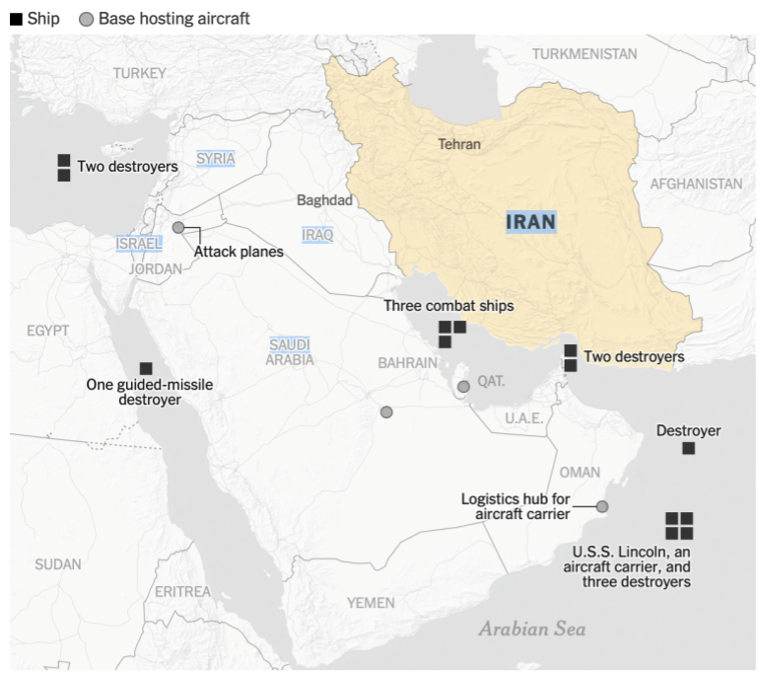
Map of U.S. military forces around Iran, even before the arrival of the aircraft carrier USS Gerald Ford. Click to enlarge. Graphic: Screenshot, New York Times
All this is taking place in the midst of a U.S. military buildup around Iran while the U.S. and Iran are negotiating. In his February 19 speech to his so-called “Board of Peace,” Trump threw in this threat against Iran: “We have to make a meaningful deal, otherwise bad things happen,” and military action could come “over the next, probably 10 days.”
On February 14, at the annual NATO Munich Security Conference, there were open calls for U.S. military intervention, including from U.S. Senator Lindsey Graham and “crown prince” Reza Pahlavi2 insisting that only “rapid intervention” by the U.S., not negotiations, could succeed. (Pahlavi offers himself as a pro-U.S.-Israeli substitute ruler with close ties to top Iranian military officials.) This took place in the larger context of mobilizations around the world by tens of thousands of Iranians in the Diaspora, to denounce the massacre of protesters in Iran. While these marches were not all homogeneous, varying significantly from region to region, the Western mainstream media gave a boost to the visibility of Pahlavi supporters, who often threaten and physically attack others if they don’t support restoring Pahlavi rule in Iran.
Inside Iran, some university student organizations made public statements refuting Pahlavi’s claim that his supporters led the campus opposition to the IRI. Others have taken to social media to expose that, for example, some of the videos posted by Pahlavi monarchist forces had been doctored or manipulated to alter the protesters’ chants to instead say “Javid Shah” (or “Long live the King”). In this context, the urgent and clarifying politics as expressed on the banner of the January 28 “Day of Grassroots Solidarity” vigil in San Francisco by IEC and UUSF Human Rights Working Group reflect the demands which are more urgent than ever for people, especially in the imperialist U.S., to raise at this crucial moment:
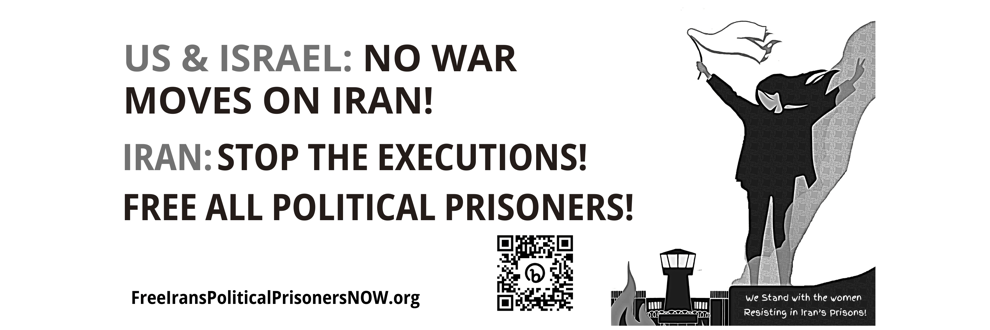
Graphic: IEC
In the context of rapidly escalating U.S.-Israeli threats of military aggression and war against Iran, and counter-threats by the IRI that portend further repression in Iran, the IEC developed some radically simple solidarity activities posted at our website: https://www.freeiranspoliticalprisonersnow.org/support