Posts by issue number/Posteos por número de la edición


Articles in this issue (scroll down or click to read article below):

  • HUMANITY ON THE BRINK: A Forced March Into the Abyss, or Forging a Way Forward Out of the Madness? 
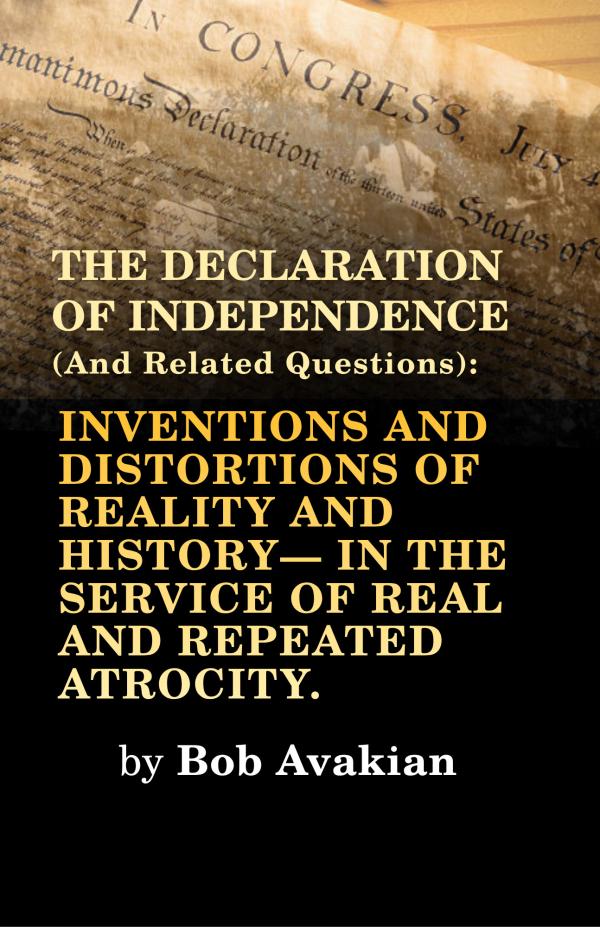
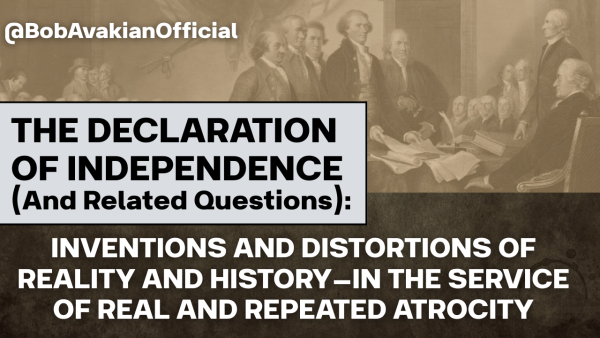
  • THE DECLARATION OF INDEPENDENCE (And Related Questions): INVENTIONS AND DISTORTIONS OF REALITY AND HISTORY—IN THE SERVICE OF REAL AND REPEATED ATROCITY.
  • THE DECLARATION OF INDEPENDENCE (And Related Questions): INVENTIONS AND DISTORTIONS OF REALITY AND HISTORY—IN THE SERVICE OF REAL AND REPEATED ATROCITY.

    Part 1: Profound Inequality, Brutal Oppression—and Crude Distortion of the Actual Foundation and Nature of this Country.

  • THE DECLARATION OF INDEPENDENCE (And Related Questions): INVENTIONS AND DISTORTIONS OF REALITY AND HISTORY—IN THE SERVICE OF REAL AND REPEATED ATROCITY.

    Part 2: Rights Are Not "Endowed" by "God," and "To Secure These Rights" Is Not the Reason Governments Are Established. 

  • THE DECLARATION OF INDEPENDENCE (And Related Questions): INVENTIONS AND DISTORTIONS OF REALITY AND HISTORY—IN THE SERVICE OF REAL AND REPEATED ATROCITY.

    Part 3: NO to a Celebration of Slavery, Capitalist Exploitation and Worldwide Plunder—This Is a Time for a New, Urgently Needed, Truly Emancipating Revolution

  • Mutual Aid—For What, As Part of What: Reform or Revolution?
  • The U.S.-Iran Ceasefire Negotiations: Highly Fraught And Potentially Explosive IN THIS MOMENT, MORE THAN EVER, WE NEED TO FORGE A WAY FORWARD OUT OF THE MADNESS
  • From OSYAN

    An Urgent Struggle Against War and Imperialism, and the Hesitant Progressives
  • WHY BLACK PEOPLE FLOODED INTO THE UNION ARMY IN THE CIVIL WAR...AND WHAT THAT HAS TO DO WITH NOW
  • Celebrate 250 Years of America? NO! America Was NEVER “Great”We Need an Emancipating Revolution!
  • American Crime Case #2 (Part 1): The Atlantic Slave Trade—The Middle Passage
  • American Crime Case #2 (Part 2): Slavery in America
  • Ebola Outbreak: A Deadly Disease and a Far Deadlier System
  • On the Importance of Meteorology

    A review of Dangerous, Dirty, Violent & Young by Zayd Ayers Dohrn

  • From RefuseFascism.org

    AMERICA AT 250
    RULED BY AN ILLEGITIMATE FASCIST REGIME
    ON TRACK TO DESTROY THE WORLD

    The Trump Fascist Regime Must Go NOW!

    In the Name of Humanity, We Refuse to Accept a Fascist America!

  • From Alborada Comunista, website of the Revolutionary Communist Group (GCR), Colombia

    Marjane Satrapi: The sadness of her death and the passion of a life with meaning
  • From Alborada Comunista, website of the Revolutionary Communist Group (GCR), Colombia

    Some points about the presidential elections and the current polarization
  • ANSWERING IGNORANT AND IDIOTIC IDEASPart 1
  • ANSWERING IGNORANT AND IDIOTIC IDEASPart 2
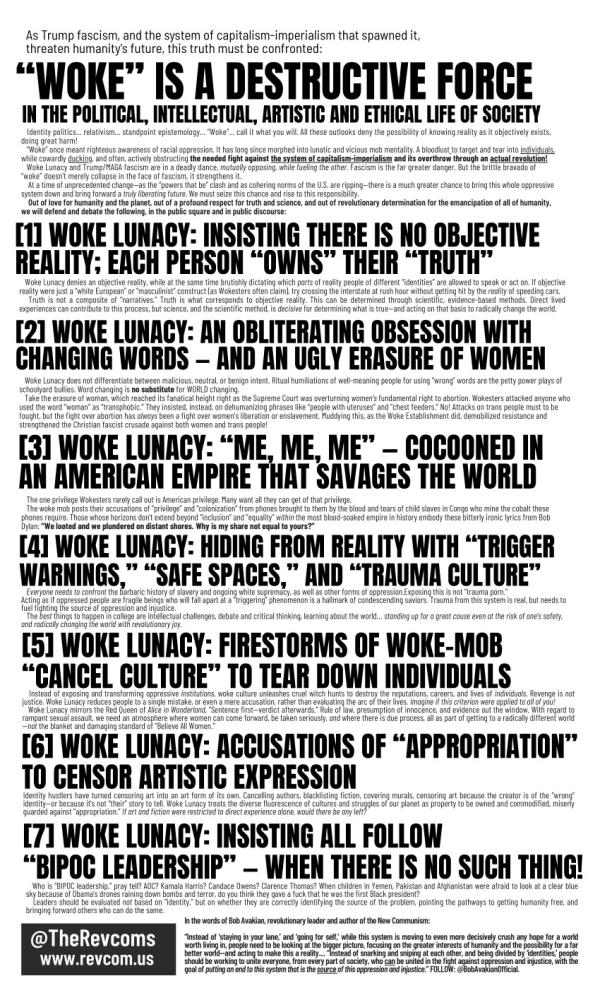
  • “WOKE” IS A DESTRUCTIVE FORCEin the political, intellectual, artistic and ethical life of society
  • From Bob Avakian

    An Observation: I TOLD YOU NICKI “MIRAGE” WAS NO FUCKING GOOD!*
  • Making "Thinking About Others" the Social Norm in Socialist China

    Early Memories from a Reader

  • Some Crucial Points of Revolutionary Orientation — in Opposition to Infantile Posturing and Distortions of Revolution
  • Letter from a reader:

    To Those in and Around the Revcoms and the Movement for Revolution, and All Who Hunger for Fundamental Change
  • On the "Driving Force of Anarchy" and the Dynamics of ChangeA Sharp Debate and Urgent Polemic: The Struggle for a Radically Different World and the Struggle for a Scientific Approach to Reality
  • Background to Confrontation:

    The U.S. & Iran: A History of Imperialist Domination, Intrigue and Intervention
  • 85 Down, I Still Have 15 to Go... but Trump Has to Go Now

    A note from C. Clark Kissinger, on the occasion of his 85th birthday

  • In the 1960s, the Government Spread Lies to Foment Violent Conflict Within the MovementThe Lessons of That Time Need to Be Learned Anew Today
  • “Don’t Talk”—A Fundamental Principle for Resisting Repression and Defending the Rights of the People 
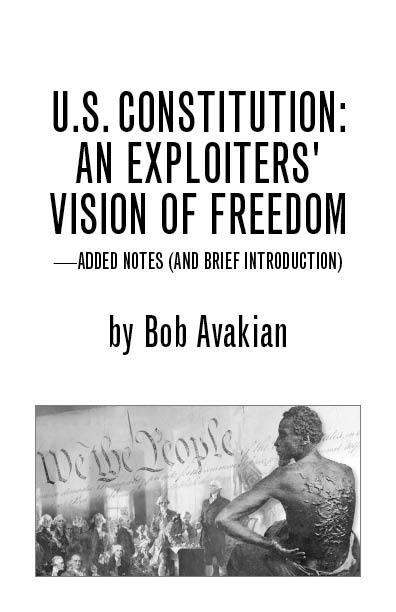
  • U.S. CONSTITUTION: AN EXPLOITERS’ VISION OF FREEDOM—ADDED NOTES (AND BRIEF INTRODUCTION)
  • ARTICLE:

    HUMANITY ON THE BRINK: 

    A Forced March Into the Abyss, 

    or Forging a Way Forward Out of the Madness? 

    The Problem: Capitalism-Imperialism—Confining and Force-Marching Humanity to Disaster

    In The Communist Manifesto, Marx and Engels refer to historical experience where the struggle between contending classes—between oppressor and oppressed groups in society—has led at times to the victory of one or the other, but also, at times, to the “common ruin of the contending classes.”

    (There are many striking examples of this in the new book Goliath’s Curse, by Luke Kemp.)

    Today, the prospect of “common ruin”—not just of contending classes and social forces, but of humanity as a whole—is a real and terrible prospect, as a result of the confinement of humanity within the awful relations and dynamics of the system dominating the world, the system of capitalism-imperialism. This gives concrete meaning to and underlines the urgency of my statement:

    We, the people of the world, can no longer afford to allow these imperialists to continue to dominate the world and determine the destiny of humanity. They need to be overthrown as quickly as possible. And it is a scientific fact that we do not have to live this way.

    Since the emergence of class and social divisions and antagonisms among human beings thousands of years ago, and the development of powerful oppressive states, history has been marked by the rise and then the fall of empires—only to be replaced by other empires. But today’s world is different.

    There is the all too present, and now once again increasing, danger of nuclear war, particularly between the U.S. imperialists on the one hand and Russia and China, also capitalist-imperialist, on the other hand.

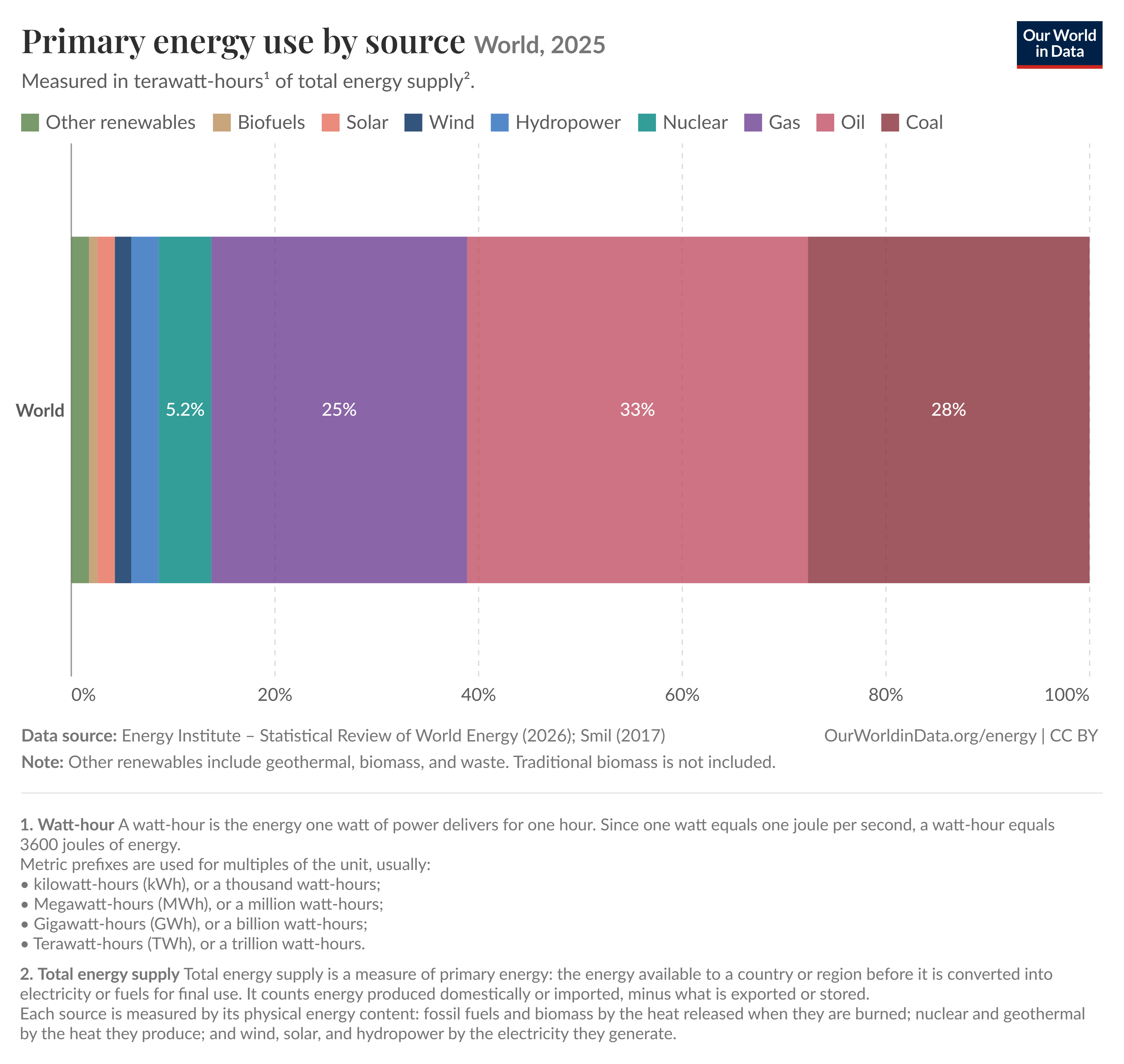
    There is the ongoing, and rapidly increasing, destruction of the environment. 

    At revcom.us, in a number of works by Raymond Lotta, and others, as well as answers I provided to an interview requested by the publication Markaz Review (answers which they then declined to publish), there is scientific analysis of how the basic necessity and underlying dynamics of the capitalist system are accelerating the already far advanced danger of climate catastrophe. And with the rule now of the Trump fascist regime in this country, long a major polluter of the environment, things are rapidly going from very bad to even more terrible.

    Trump ran on a platform of “drill baby drill!”—and since coming to power he has opened up new areas, including public lands, for exploration and exploitation of oil and other resources—fossil fuels in particular. He has denounced, including in a speech at the UN, the reality of climate crisis as a “con job”: “It’s a con job, only losers believe it...” And at the recent COP 30 conference in Brazil the whole thing was a farce. They couldn’t even agree, even in words, on what would have been a meaningless pledge to reduce fossil fuel—and, in fact, as I’ve said, the plundering of fossil fuels is increasing—not being curtailed, let alone eliminated. 

    There is the melting of the polar ice as part of the overall warming of the planet. And here is something very striking: What do these imperialists all around do in the face of this melting of the polar ice? Do they say, “Oh, this is terrible, it’s gonna contribute in a major way to accelerating the climate crisis.” NO. They see it as a question of strategic contention for control of key sea lanes that are now being opened up by the melting ice. This has a great deal to do with why Trump keeps proclaiming that he’s gonna “by one means or another”—I was gonna say “fair or foul” but they’re bound to be foul—he’s going to take control of Greenland, because it has everything to do with what I just mentioned in terms of strategic contention. This is the way the imperialist system and the leaders of the imperialist system respond to a major development in the climate crisis.

    At the same time, Trump has proclaimed what many have called a new Monroe Doctrine: the insistence that the Americas are the “backyard” of the U.S. This goes along with his changing the Gulf of Mexico to the “Gulf of America”—in his own mind at least, and all too much in how some others have responded to that. He has engaged in naked military aggression against Venezuela, with the declared intent of taking over and “running” that country, with its vast oil reserves. He has also threatened Cuba, and the president of Colombia as well as the president of Mexico, interfered in the affairs of Brazil, Argentina and Honduras—all with the aim of insisting on and re-enforcing the whole notion of the Americas as the backyard, and as the sphere of influence and province to be dominated by U.S. imperialism. 

    Trump is aggressively reviving the role of classical Imperialist Bully, committing yet more acts of aggression and war crimes against less powerful countries, in line with the long, ugly tradition of Yankee military intervention in Central and South America in particular.

    Yet this is not the world of the 19th or the early 20th century, and it remains to be seen what will result from Trump’s big power bullying and old-style colonialist military aggression.

    In a larger dimension, Trump’s aggressive actions toward Latin America are part of strategic great-power imperialist contention with China in particular, which has become a major force in trade and relations with Latin American countries, including Venezuela: China has, for some time, been a major source for the export of Venezuelan oil. (Trump and his affiliated fascists regard China, not Russia, as the main challenger and threat to U.S. global dominance; even Trump’s approach to Russia and the war in Ukraine is aimed, at least in part, at severing, or at least weakening, Russia’s ties with China.)

    Trump’s aggressive military posture and actions with regard to Latin America, and overall, are an expression of the monstrous system of capitalism-imperialism, which has given rise to fascism, as an extreme expression of the predatory, and moribund, nature of this system, in this country and as a broader phenomenon in the world.

    In the statement from Refuse Fascism calling for massive nonviolent but determined mobilization aiming to drive out the Trump regime, there is this important description of the comprehensive nature of this fascist regime and its actions: 

    The Trump Fascist Regime is shredding the rule of law. Making a mockery of due process. Illegitimately deploying the military on U.S. soil. Disappearing immigrants and other brown-skinned people into brutal concentration camps. Aggressively resurrecting genocidal white supremacy. Reversing the gains not only of the 1960s, but even of the Civil War and Reconstruction. Enslaving women through the brutality and suffocation of forced motherhood. Erasing LGBT people. Trampling democratic rights. Violating international law. Assaulting and threatening politicians and judges. Paving the way for boundless terror against the people. Accelerating climate collapse. Cutting science and medicine, costing millions of lives. Depleting humanity’s store of knowledge. Destroying truth. Drowning out reason. Subjugating the arts to fascist cruelty and conformity. Targeting everything that is decent, moral and good. All at the whim of a debased lunatic tyrant.

    In short, this is: A white supremacist, “masculine” woman-hating, American supremacist, anti-scientific Christian fundamentalist fascist regime whose power is exercised with deliberate terror and cruelty directed against real or imagined “enemies,” against anyone it sees as actually or potentially resisting, or obstructing, its barbaric rule.

    An article at revcom.us sharply summarizes this:

    Faced with a huge crisis of that very system [of capitalism-imperialism], the fascist section of this imperialist ruling class—Trump, Miller, Vance and all the rest—are on a mission to save that system through a fascist form of rule. In their view, a fascist form of rule—one rooted in blatant, open and violent white supremacy, in male domination of women and repression of LGBT people, and in open hatred and massive scapegoating of those they consider “foreigners”; one saturated in anti-scientific ignorance and theocratic fundamentalist Christianity; and one in which due process and civil liberties are essentially wiped out—[this in their view] is the only thing that can save the empire. (Stephen Miller [a major force within this fascist regime] says immigrants come from—and must return to—“broken homelands”… but the REAL question isWho Broke Those “Homelands”? And What Does That Tell Us About the Fascists Who Now Rule This One?)

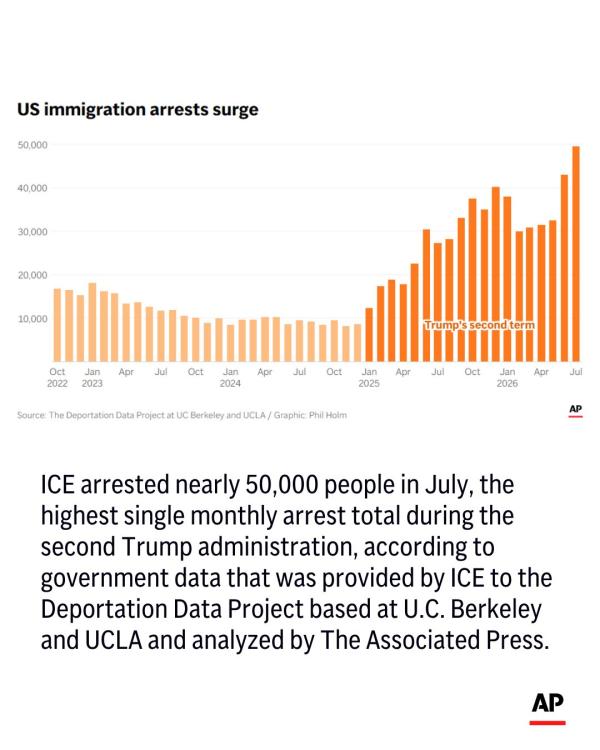
    This fascist assault on immigrants—which has overwhelmingly targeted non-criminal immigrants, many of whom have been in the country for long periods and have made significant contributions to the economy—this is being carried out with a concentrated attack on people from the Third World, as part of the Trump fascist drive to Make America White Again, despite the fact that, as Raymond Lotta has pointed out, “immigrants from the Third World are essential to profitable functioning of key segments of the U.S. economy.” (This is from the essay by Lotta, Imperialist Parasitism and Class-Social Recomposition in the U.S. From the 1970s to Today: An Exploration of Trends and Changes.)

    This fascism is a concentrated expression of the fact that this system of capitalism-imperialism is running up against its limits. It is proclaimed that in this country there is “liberty and justice for all,” but there is a whole history, and continuing reality, of savage inequality and brutal, literally murderous oppression of Black people and other people of color. There is the ongoing oppression based on sex and gender. Even short of all-out war between imperialist powers, this system is the fundamental cause of continuing wars as well as environmental devastation and plunder of countries throughout the Third World especially—all resulting in the uprooting of huge numbers of migrants into the U.S. (and other capitalist-imperialist countries). All this is built into and results from the basic relations, dynamics, and compulsions of this system, which cannot provide any positive answer to all this. At the same time, it remains true that where there is oppression there will be resistance—and the righteous resistance and rebellion against the oppressive relations and actions of this system has in turn strengthened the appeal of fascism among sections of the people, and of the ruling class, who are determined that not only the basic oppressive relations, but the most extreme expressions and excesses of this, must be brutally enforced. (In this country this is concentrated in the slogan “Make America Great Again,” while it finds different particular expressions in countries in Europe, and elsewhere, where powerful fascist forces have developed as an horrific expression of these basic contradictions. In my social media message #118, available @BobAvakianOfficial, I get into some of the key dimensions of this more fully.)

    To repeat this crucial point from my January 2021 New Year’s Statement

    to the degree that things are maintained within the limits of this system, this will actually have the effect of furthering the horrors for humanity that are built into this system, while also reinforcing and giving further impetus to the underlying economic—and the social and political—forces that will strengthen the fascism that has already shown great strength in this country (and a number of others).

    But, fascism:

    as an open and aggressive dictatorship, trampling on and perverting the rule of law, relying on violence and terror, on behalf of the predatory capitalist system and as an extreme attempt to deal with profound social division and acute crises (both within the country and in the global arena)... might hold things together, in an extremely negative way, for a certain period, [but] in the final analysis this cannot succeed—cannot indefinitely preserve this system of capitalism-imperialism, and cannot lead to any future but one of horrors for humanity, if indeed we have a future at all. And the supposed “alternative,” as represented for example by the Democratic Party in the U.S., involving a “more democratic” means of exercising the rule of this system, will also continue to embody and enforce terrible and completely unnecessary suffering for the masses of humanity and pose an existential threat to humanity as a whole, even if not always through the same brute and unmitigated juggernaut of horrors as the fascist form of capitalist dictatorship.

    Here it’s worth stepping back and reviewing the history of this country and the system in this country from the Declaration of Independence and the U.S. Constitution to today—to the thoroughly outmoded monstrosity of capitalism-imperialism. At the beginning of this country, at the initiation of the war of independence (which they like to call a revolutionary war), it was declared that “all men are created equal.” But the whole history of this country from that time forward has proven that it is definitely not the case within this country that there is equality for all. Even at the time when the Declaration of Independence and then the Constitution were written, there were huge numbers of slaves. There were Native Americans whose land was being stolen and who were being subjected to genocidal atrocity. There were women who basically had no rights, and certainly none equal to men. There was, in short, a system of exploitation which was given further impetus by breaking free of British colonialism. 

    So when you watch, for example, the Ken Burns series on the American Revolution—if you can work your way through and put aside the disgusting hosannas about how great this revolution was, how it was the greatest thing that’s ever happened in the world, and so on—there are some of these things that I’ve talked about, but it’s all in the framework of what liberals today like to talk about: “Yes, there were certain flaws—we even had the certain original sin of slavery, yes, we did this and that, terrible things to the Native Americans, people without property and women didn’t have the same rights as rich men—but we’ve always been moving toward a more perfect union.” When in reality, what they’ve actually been working toward—or, in any case, what has resulted from what was set in motion with the American Revolution, in the context of the larger world—is a completely horrific system of capitalism-imperialism which, again, has long since become outmoded, is long past its expiration date, and its continuation can only involve the continual infliction of terrible suffering for humanity.

    The point is not that we should be nihilists—just thoughtlessly negating everything about the American Revolution and the founding documents of this country. As I’ve pointed to before, there are certain things in the U.S. Constitution, particularly in the Bill of Rights (the first 10 Amendments to the Constitution), which can be learned from—and I have incorporated some of this into a fundamentally different framework in the Constitution for the New Socialist Republic in North America. The point is that, despite some positive elements at the time of the founding of this country, it was even then a system of vicious exploitation and literally murderous oppression; and all this had within it the seeds and elements of where it has gone—to a terrible place, with the system of capitalism-imperialism now.

    It is crucial to understand, and to enable growing numbers of people to understand, these basic truths—which are not “self-evident,” but are hidden and disguised through the very functioning of the system we live under, the system of capitalism-imperialism—basic truths that must be brought to light through the application of a scientific method and approach to reality.

    The political system in this country is the rule—the dictatorship—of the section of society that dominates the economic system—the capitalist-imperialist class—a dictatorship that finds concentrated expression in the monopoly of political power, and more especially the monopoly of “legitimate” violence, exercised by the political representatives of this system and its ruling class. All the dominant processes and institutions of this system (including its elections) fundamentally serve and enforce this dictatorship. In its “normal” form, and as administered by the “mainstream” section of the ruling class, this is a dictatorship representing the interests of the capitalist class as a whole, and this dictatorship is more or less disguised as “democracy” and “rule by the people,” with basic adherence to a “rule of law” which ultimately embodies and reflects the basic relations in society and serves the fundamental interests of the ruling class while being applied, however unequally, to people in society generally.

    As one significant example of the way in which this dictatorship, and its “rule of law,” “ultimately embodies and reflects the basic relations in society and serves the fundamental interests of the ruling class,” there is the fact that it is perfectly legal, under this system, for capitalists to “lay off” masses of people, if they can no longer be profitably exploited, even if this means that those who are “laid off” might become homeless, or even starve; but it is definitely illegal for people in this desperate situation to just take the basic necessities they lack, without paying for them, even if the reason they cannot pay for them is because they have been denied employment. All this corresponds to the basic “property relations” of the capitalist system. The “rule of law” in any system will essentially be an expression of those basic property relations—most fundamentally the production relations of the underlying mode of production. (More, later, on the crucial role of the mode of production as the foundation of any system, which ultimately determines the nature of that system, including its politics, ideology and culture, as well as its social relations.)

    In the more overtly political dimension, as spoken to in my social media message number #17, beneath the outer shell of “democracy” in this country there is 

    living proof that this so-called “great American democracy” is in reality a dictatorship, where the power of the ruling institutions is used to viciously persecute, punish, and even eliminate people who pose a threat to the interests of the ruling class. Along with the murder by police and mass incarceration of thousands and millions of people in this country...there is the vicious repression being brought down against people protesting the genocide in Palestine carried out by Israel, with the full backing of the U.S. government and both ruling class political parties (Democrat and Republican)....

    Why is this happening? Because fundamental interests of U.S. capitalism-imperialism are at stake. 

    There are many other examples that sharply illustrate this basic truth about the actual dictatorship under the “normal democratic” rule of this system—such as the outlawing of opposition to the U.S. role in World War 1, and the imprisoning of Japanese people in concentration camps during World War 2 (which was done during the administration of the great “hero” of “progressive” bourgeois democrats, Franklin Delano Roosevelt).

    The rule of the Trump regime is the dictatorship of one section of the ruling class, which is determined to impose fascism as the form of capitalist-imperialist rule, utilizing the force and violence of the state (police and military forces and repressive institutions of government, such as the FBI, “Homeland Security,” etc.) not only against people in society as a whole but also against the “mainstream” section of the ruling class. With fascism, dictatorship is open, blatant, undisguised dictatorship, and the exploitation and oppression that is the actual basis and nature of this system of capitalist-imperialism, within this country and internationally, is blatant, undisguised exploitation and oppression, unrestrained by the “norms” and “rules” of “mainstream” capitalist-imperialist dictatorship. The following, from “Something Terrible, Or Something Truly Emancipating,” clearly points to what, in fact, is taking place now:

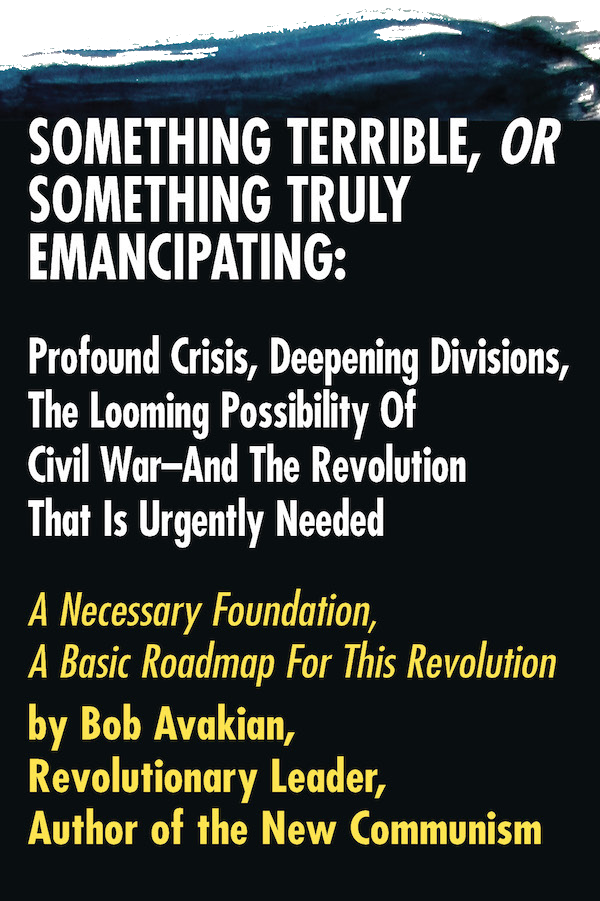
    Given the nature, objectives and actions of the fascists, there is the real possibility of actual civil war. But given the nature, objectives and actions of the “mainstream” section of the ruling class (as represented by the Democratic Party and media such as MSNBC [now MS-NOW], the New York Times and CNN), and given the current situation with those, from different parts of society, who tend to support, and politically tail behind, this “mainstream” section of the ruling class, it is possible that the fascists could achieve and consolidate power without a civil war, but with all the terrible consequences that would follow this fascist consolidation of power. Or, as emphasized in the “Declaration and Call” [from the revcoms] in what would amount to a one-sided civil war, these fascists could carry out a slaughter of those they hate, including Black people and other people of color, “illegal immigrants,” “uppity women” and those who don’t conform to “traditional” sexual and gender relations and “norms."

    In any case, it is a deadly serious reality that these fascists are determined to crush—as violently as necessary—anyone and anything, anywhere in society, that stands in the way of implementing their horrific objectives.

    Both parts of this situation are vitally important to understand: There is a real and important difference between “mainstream” and “fascist” rule, and both “fascist” and “mainstream” rule are fundamentally forms of the dictatorship of the ruling capitalist class, representing, and enforcing, the interests of the capitalist-imperialist system, not just in this country but throughout the world. 

    In Hope For Humanity On A Scientific Basis, Breaking with Individualism, Parasitism and American Chauvinism, written during the first Trump regime, there is this important discussion of both very real and important differences, as well as the ultimate, underlying unity, between the different sections of the ruling class:

    In an article in the New York Times, “Racism Comes Out of the Closet,” Paul Krugman makes the point that not just Donald Trump but the Republican Party as a whole has gone from “dog whistling” racism to overtly and crudely expressing it. Krugman concludes this article this way, referring to the Republican Party’s dropping of even any pretense of opposing racism:

    It’s tempting to say that Republican claims to support racial equality were always hypocritical; it’s even tempting to welcome the move [on their part] from dog whistles to open racism. But if hypocrisy is the tribute vice pays to virtue, what we’re seeing now is a party that no longer feels the need to pay that tribute. And that’s deeply frightening.

    Krugman does have a point—an important and relevant point—here, as far as it goes. The problem is that it doesn’t go far enough, and in particular does not break out of the constricting terms of contradictions and conflicts among ruling class parties (the Republicans and the Democrats). The stance of hypocritically pretending opposition to such outrages as racist oppression, while in fact acting as the representatives, functionaries and enforcers of a system that has this oppression built into it and could not exist without this oppression—this does not just apply to the Republican Party in the past...but also applies to the Democratic Party. What is concentrated in this situation is the need to recognize, and correctly handle, a very real and acute contradiction: the fact that, on the one hand, the Democratic Party, as much as the Republican Party, is a party of a system that continually commits, and cannot help committing, massive crimes against the masses of humanity and embodies an existential threat to the very future of humanity; and, on the other hand, the fact that (to paraphrase what is cited above from Krugman’s article) there is a very real difference and very direct danger embodied in the fact that one of these ruling class parties (the Republicans) openly abandons much of the pretense of being anything other than a rapacious, and yes racist, plunderer of human beings and of the environment. This requires the correct synthesis of, in fundamental terms, opposing the whole system, of which both of these parties are instruments, and actively working, in an ongoing way, toward the strategic goal of abolishing this system, while also, with the same fundamental strategic perspective, recognizing the acute immediate danger posed by [in that case] the fascist Trump/Pence regime, and working urgently to bring forward masses of people in non-violent but sustained mobilization around the demand that this regime must go! 

    This same basic, and crucial, understanding is expressed in the recent article at revcom.us, Venezuela and the Fascist Way of War, Mass Murder Is Legal Because We Say So:

    The U.S. military has always been a machine of war crimes and crimes against humanity. Just look through the American Crime series on this website, revcom.us, for mountains of evidence. (See for instance, American Crime Case #96: Vietnam, March 16, 1968 and American Crime Case #93, U.S. Invasion of Korea—1950.) But Hegseth is moving to rip away any pretense of legality. This is a fascist military doctrine aiming to reforge the existing U.S. military into a fascist fighting force: a force ready and willing to carry out illegal orders and kill civilians because the fascist tyrant said so.

    While they have very serious differences with the fascists, the “mainstream” imperialists and institutions like the Democratic Party will not, and cannot, fight these fascists the way they need to be fought. (As one important indication of this, there is the fact that, instead of acting with the necessary “deliberate speed” to indict Trump for his flagrant crimes, in particular his attempt to pull off a coup after he lost the 2020 election but refused to accept the results of that election and rallied forces in the attempt to unlawfully overturn it, the Biden administration dragged out the process of indicting Trump, squandering the political initiative and momentum Biden’s administration had because of the outrage over Trump’s attempted coup. The Biden administration, and its Attorney General, Merrick Garland, failed to act quickly and decisively to indict Trump because they did not want to appear to be “politicizing the process”! This is the same kind of logic that Biden applied when he refused to take action to expand the Supreme Court, when it was already obviously “politicized,” and the result of Biden’s inaction was that the Supreme Court has continued to be dominated by fascists, with all the consequences of that, especially now with Trump having returned to power with a vengeance.)

    Now, the Trump regime is on a rampage to viciously suppress opposition and resistance to its fascist rule—including by declaring that any forces that are “anti-capitalist” or “anti-American” or “anti-Christian,” and generally anyone that the Trump regime designates as “enemies” (including by using the vague and “catch-all” term “Antifa”) can be labeled “domestic terrorists” and subjected to severe government repression.

    Meanwhile, forces which are an extension of or aligned with the Democratic Party (and in general the “mainstream” section of the ruling class), have joined—and given their own particular “progressive” spin to—the attacks on Refuse Fascism and the revcoms who, along with others from many different political perspectives, are active in Refuse Fascism. This is an expression of the desperate determination to keep things within the confines and on the basis of the “norms of this system”—norms that the fascists are openly defying and running roughshod over (and “norms” that, in fact, are criminal to begin with).

    As one significant dimension of this, it is another expression of the fact that, as soon as anything with which we revcoms are associated gains traction—as soon as the Call by Refuse Fascism to mobilize masses to DC around the one unifying demand that the Trump fascist regime must go, now—as soon as this has galvanized political sentiment and found active support among significant numbers of people, even if not the millions it has called for: out come the knives. This is a repeat of the experience in 2022 when, as it was made clear that there was a real possibility that the Supreme Court would rip away the right to abortion by reversing Roe v. Wade—and revcoms united with others to form RiseUp4AbortionRights!, determined to rally mass opposition to this outrage of reversing Roe—instead of joining in with RiseUp and the tens of thousands it was mobilizing, a motley group of opportunists launched slanderous attacks on RiseUp and the revcoms.

    These attacks, on RiseUp, and now on Refuse Fascism, are on the level of that old crazy, cartoonish movie “Reefer Madness,” with the promotion of irrational anti-communist hysteria, involving crude distortions and ludicrous and long-disproven lies about the revcoms and Bob Avakian, including mindless accusations of “cult.”

    The basic, and extremely harmful, position of those making these unprincipled attacks is, yes, unite all who can be united against this fascism—so long as it remains confined within the norms and limits of the capitalist-imperialist system.

    The basic method is not to engage and express principled opposition to actual positions and work of Refuse Fascism or the revcoms, but to repeat and rely on low-level rumors, gossip, and plainly stupid snark—to blatantly lie and hope that no one looks into what is being lied about.

    These kinds of attacks are giving opportunism a bad name. If these present-day opportunists felt the need to appear as if they were dealing with the substance of things (as was sometimes the case with opportunists in the past), then they would make a show of engaging—even if crudely distorting—the actual substance of what BA and the new communism are about (as expressed at revcom.us as well as the Collected Works of Bob Avakian, and concentrated in the Constitution for the New Socialist Republic in North America). These opportunist attacks do not even put up a real pretense of doing that. Instead they rely on—and get over to the degree that they do because of—the putrid culture that prevails overall in society now, and far too much among those who consider themselves “progressive” or “left”: a culture that revels way too much in “snark”; a culture that has too much in common with the approach of the Trumpites, relying on things like “a lot of people really think, a lot of people are saying,” instead of the approach of seriously looking into serious things, examining what people and groups actually say and do, and determining how it relates to the reality that has to be confronted and where different outlooks and programs will lead if they are taken up and acted on. 

    It is not hard to recognize the likelihood of involvement in all this by operatives of the Democratic Party and the “mainstream” section of the ruling class, who are desperate to keep things within the confines, terms and “norms” of this system, even as this means accommodation with and capitulation to Trump/MAGA fascism and its all-around and accelerating enforcement of very real horrors for humanity.

    In the face of all this, it is crucial to remain firmly grounded in and resolutely apply the basic principle that, as I emphasized in my social media message #129: “Irresponsible opportunist distortions should not be allowed to sabotage the unity of the millions needed to drive out the Trump fascist regime.” And they should not be allowed to sabotage and derail serious searching, discussion and debate in regard to critical questions such as: what has given rise to this fascism, and what should be brought forward as the positive alternative to this?

    All this drives home the important point expressed in my social media message #119: "Democratic Party politicians may contribute to the crucial struggle against Trump/MAGA fascism—but the Democratic Party will not, and cannot, lead this struggle where it needs to go."

    The fundamental reason, once again, is that the Democrats are representatives of the same monstrous and moribund system as the fascists. This has been driven home, in terribly graphic terms, in the fact that the Biden Administration and the Democratic Party overall, has backed and aided Israel in the genocide it is perpetrating in Palestine, massively armed by the U.S., under both Democratic and Republican administrations. As sharply posed by a doctor who volunteered in Gaza and witnessed first-hand the awful consequences for the Palestinians there, including children, as a result of Israel’s relentless slaughter and massive destruction: what does it mean that there is no major political party in the U.S., neither Republican nor Democrat, for whom genocide is a “no go”?!

    As I pointed out in my social media message #7:

    Israel plays a “special role” as a heavily armed bastion of support for U.S. imperialism in a strategically important part of the world (the “Middle East”). And Israel has been a key force in the commission of atrocities which have helped to maintain the oppressive rule of U.S. imperialism in many other parts of the world.

    And from social media message #35:

    Maintaining Israel as a “western-oriented” state is of decisive importance for the U.S. imperialists, and in turn the Zionist (Jewish supremacist) nature of Israel is of critical importance in maintaining Israel as this bastion of support for U.S. dominance, especially in opposition to the influence of Iran—and beyond that Russia, and increasingly China—in this strategic region.

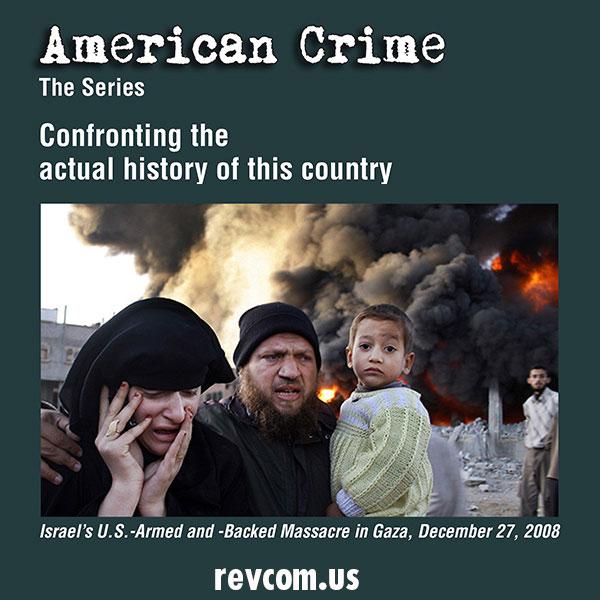
    And, while U.S. support for the apartheid and genocide perpetrated by Israel is a particularly grotesque example, the fact is that there is a whole long history of war crimes and crimes against humanity presided over by Democrats, as well as the Republicans—something which is extensively documented in the American Crime series and other works at revcom.us.

    With all this, there remain very real, and very sharp, differences between different sectors of the ruling class, very significantly with regard to the maintenance of the U.S. empire and the “world order” that the U.S. has imposed and enforced with massive destructive violence since the end of World War 2, in 1945. These differences—and the fact that the ruling class of this country is deeply divided and cannot continue to rule as a unified ruling class—has definite significance in relation to the immediate and urgent necessity of driving out the Trump fascist regime (as I have spoken to in my social media message #141) and, beyond that, in relation to the fundamental necessity and goal of revolution, to abolish, uproot and move beyond this whole system of capitalism-imperialism.

    At the same time, it is important to understand that the immediate problem with which we are confronted is not “authoritarianism,” or “oligarchy,” and the fundamental conflict is not “democracy vs. oligarchy” or “democracy vs. authoritarianism.”

    To refer to my social media message #114:

    The specific and essential thing that is represented and is being enforced by the Trump regime is not “oligarchy,” it is not “billionaires”: it is fascism.

    Fascism is a qualitatively different way that this system enforces its rule over people.... 

    As for “oligarchy” and “billionaires,” the Democratic Party, as well as the Republican Party, receives heavy financing from the super-rich, heads of corporations, and so on. Even more fundamentally, both of these parties are instruments of the system of capitalism-imperialism, which is based on mercilessly exploiting billions of people, and enforcing literally murderous oppression of masses of people, here and all over the world. This is why the Democratic Party, and those who are tied to or aligned with it, will never challenge the rule of Trump the way that is necessary in order to actually defeat it. For these “mainstream” (or so-called “progressive”) representatives of this system of capitalism-imperialism, the stability of this system, and the dominant position of U.S. imperialism in the world, is of greater concern than actually defeating Trump/MAGA fascism.

    (The formulation “authoritarianism,” and its misuse, is analyzed more extensively in one of my articles on the war in Ukraine available at revcom.us: Shameless American Chauvinism: “Anti-Authoritarianism” as a “Cover” for Supporting U.S. Imperialism, updated with an Added Note, June 5, 2023.)

    To return to a crucial point in relation to all this: Bourgeois (that is, capitalist) “democracy” is actually a form of the dictatorship of the bourgeoisie (capitalist class).

    This puts into proper perspective the opportunist accusation that we revcoms (advocates of the new communism) do not believe in—are opposed to—“democracy.” What these opportunists mean by “democracy” is, in reality, capitalist-imperialist rule, with the “democratic” capitalism-imperialism of “the good ole USA” dominating the world and preying on the people of the world. We are most definitely opposed to that. (What is involved here is very much related to why, decades ago now, I wrote a book with the deliberately provocative title, Democracy: Can’t We Do Better Than That?)

    The essence of the matter—in opposition to the fostering of illusions about the system in this country and its “great democracy”—is concentrated in these three sentences:

    In a world marked by profound class divisions and social inequality, to talk about “democracy”—without talking about the class nature of that democracy and which class it serves—is meaningless, and worse. So long as society is divided into classes, there can be no “democracy for all”: one class or another will rule, and it will uphold and promote that kind of democracy which serves its interests and goals. The question is: which class will rule and whether its rule, and its system of democracy, will serve the continuation, or the eventual abolition, of class divisions and the corresponding relations of exploitation, oppression and inequality.

    Also very relevant here is the following from “Hope For Humanity,” in the section “Particular Interests and General Interests—Differing Class Interests and the Highest Interests of Humanity”:

    In The Eighteenth Brumaire of Louis Bonaparte, Marx makes the point that every class viewpoint identifies the particular interest of the class it represents with the general interests of society. 

    This is certainly true of the ruling capitalist class—the bourgeoisie—while it is also true of those expressing the viewpoint of the middle class (the petite bourgeoisie), which imagines itself “above” (or “outside”) the fundamental conflicts in society and strives spontaneously for a kind of “classless democracy,” for a form of government, that does not embody and serve the interests of any powerful dominating force in society—neither the exploiting capitalist class, nor the exploited class under the capitalist system, the proletariat, whose fundamental interests lie in completely abolishing all exploitation, and all oppression, everywhere, while the achievement of this emancipation must pass through an historic transition in which socialist rule, the dictatorship of the proletariat, serves the advance to the “4 Alls” which Marx identified as the goal of the communist revolution: the abolition of all class distinctions, all the production relations on which those class distinctions rest, all the social relations corresponding to those production relations, and the revolutionizing of all the ideas corresponding to those social relations.

    This is an expression of the third of those three sentences on democracy: The question is: which class will rule and whether its rule, and its system of democracy, will serve the continuation, or the eventual abolition, of class divisions and the corresponding relations of exploitation, oppression and inequality.

    (How this eventual abolition can find living expression, in some qualitatively new ways, is embodied in the Constitution for the New Socialist Republic in North America, which I have authored.)

    In light of this, it is worth examining a prominent fascist idiocy—which is shared, in basic terms, by all apologists of capitalism, whether fascist, “mainstream” or “progressive,” and is often expressed in this wrong-headed, simple-minded question: “When has communism ever worked?” (or the direct insistence that “communism has never worked”).

    For example, the New York Times opinion writer Maureen Dowd’s “conservative” brother Kevin (to whom Maureen turns over her column once a year during the Thanksgiving period) baldly (I was going to say badly, but in any case baldly) asserted in this column (Sunday, November 30, 2025): “Socialism has never worked anywhere in the world.” He then adds: “Our country is built on capitalism, and that has served us well for almost 250 years”! Here is a striking example of the old saying that paper will put up with whatever is printed on it—no matter how crudely it distorts reality.

    To take the last part first (“Our country is built on capitalism, and that has served us well for almost 250 years”), and leaving aside the question that is begged by this (“what do you mean by us, reactionary white man?”), the basic answer to this is the following (from my 2017 speech “The Trump/Pence Regime Must Go!”):

    The USA is a country which established its territory and built the foundation of its wealth through the armed conquest of land, genocide, slavery, and ruthless exploitation of successive waves of immigrants to America. And it has continued as a country marked by white supremacy, patriarchy and male supremacy, and other oppressive divisions, while expanding its domination into an empire stretching across the globe, sitting atop a lopsided world of profound inequalities and plunder of the environment (it would take the resources of nearly 5 earths for the rest of the world to have the kind of “consumer society” that exists in the U.S.)—all this backed up and enforced by a massive machinery of death and devastation, the U.S. military, and reinforced with a constant barrage of ideas and culture rationalizing and justifying all this oppression and destruction, propagated through an equally massive machinery of molding public opinion.

    This has been built on the historically-established foundation of the capitalist system overall—which Marx captured in these graphic, powerfully ironic terms:

    The discovery of gold and silver in America, the extirpation, enslavement and entombment in mines of the aboriginal population, the beginning of the conquest and looting of the East Indies, the turning of Africa into a warren for the commercial hunting of black-skins, signalized the rosy dawn of the era of capitalist production....[Capital emerges] dripping from head to foot, from every pore, with blood and dirt.

    (Although coming from an ultimately bourgeois-democratic outlook, the book Goliath’s Curse contains considerable analysis of the terrible consequences of capitalist—as well as previous—empires.)

    This historical foundation, and now the development of capitalism into capitalism-imperialism, with heightened globalization and the corresponding parasitism (feeding off the exploitation of people throughout the world, and intense super-exploitation in the Third World, involving more than 150 million children): this is the basis on which the capitalist system has “served well” the development of the U.S. economy and the ruling class of this country above all.

    (This is analyzed in depth by Raymond Lotta in Imperialist Parasitism and Class-Social Recomposition in the U.S. From the 1970s to Today: An Exploration of Trends and Changes, available at revcom.us.)

    As for that commonplace idiocy repeated by Kevin Dowd—that communism (or socialist society under the leadership of communists) “has never worked”—it would take more time and volume of material than is possible here to respond fully to this, but the following are some important elements of a refutation of this idiocy, and its simple-minded substitution of prejudiced ignorance in place of serious analysis. Here I am going to focus on some key aspects of the experience of socialist societies, led by communists, in the Soviet Union from 1917 to 1956, before capitalism was restored there; and China from 1949 to 1976, when capitalism was restored there as well, after the death of Mao.

    (For further important background to all this, there is the Interview with Raymond Lotta, You Don't Know What You Think You "Know" About...The Communist Revolution and the REAL Path to Emancipation: Its History and Our Future; and the interview with me The Cultural Revolution in China... Art and Culture... Dissent and Ferment...and Carrying Forward the Revolution Toward Communism.)

    Briefly, on the experience of the Soviet Union. This was the first successful socialist revolution in the history of the world, which immediately was up against tremendous odds and obstacles. Almost immediately after the seizure of power by this revolution in 1917, the country was plunged into civil war, waged against this new liberating society by representatives of the old reactionary oppressive society, including capitalists, major landowners, reactionary generals and so on. (And these reactionary forces were aided by a number of capitalist-imperialist countries, including the U.S.) The result of all this was that several million people died and the country was plunged into terrible poverty. 

    This was what the Soviet Union faced as the revolution succeeded in consolidating power at the end of that decade and going into the 1920s. And tremendous gains were made, tremendous liberating transformations—the development of the economy (which I’ll talk about a little bit more); the liberation of women, including the right to abortion (the Soviet Union was the first modern country to legalize abortion—and this sharply contrasted with the U.S. then, for example); major advances in overcoming poverty, illiteracy and the influence of religious obscurantism among the masses of people, particularly in the countryside; a real florescence in art and culture. All this marked the development of the Soviet Union in the 1920s and into the early 1930s.

    There was also the development of the economy in the 1930s. Much as they don’t like to talk about it, the fact is that, while the entire capitalist world was plunged into the Great Depression which lasted the entire decade of the 1930s, the Soviet economy forged ahead, transforming the country economically in major ways. But there were problems with this, some of which Mao pointed out. There was too much emphasis on the development of heavy industry as opposed to all-around development of both agriculture and light industry as well as heavy industry. This continued, and even in some ways accentuated, the difference which can be an oppressive difference, between the city and the countryside and the people living in those two places.

    And beginning in the 1930s, while the economy rolled ahead, there was a reversal of some of the major social transformations that had been taking place, including the reversal of the right to abortion. This flowed to a certain degree from Stalin’s statement (Stalin who was the head of the Soviet Union at the time), his statement in the early 1930s that either we catch up with the economies of the imperialist world or they will destroy us. (That’s a paraphrase, but it’s the essence of the viewpoint he put forward.) This guided the rapid industrialization of the Soviet Union in the 1930s.

    But, even more specifically, in the Soviet Union in the 1930s, there was, in response to a major development in the world, a significant change. This took place especially around 1934. The big change in the world, and not just in the particular country, was the triumph of fascism in Germany, which was a major imperialist power—and which under Hitler from the beginning had identified the Soviet Union as a major enemy, and did, after a short period of an agreement, launch a full scale invasion of the Soviet Union. The ensuing war resulted in the death of somewhere around 25 million people in the Soviet Union—which, by the way, is 50 times the number of deaths of Americans in World War 2.

    It was on the basis of this very significant development—with the triumph of fascism in Germany and the threat it posed to the Soviet Union—it was especially on this basis that things became much more repressive in the Soviet Union. (This also followed the attempt by the Soviet Union, in the mid-1930s, to form a united front against fascist Germany with non-fascist imperialist countries, in particular Britain and France—an effort that was rejected by those countries.) In this situation, during the second half of the 1930s, Stalin increasingly would not allow and moved to repress any kind of opposition, and confounded the difference between criticism and actual enemy action and sabotage. A lot of people were wrongly caught up in this repression, even though all this has been greatly distorted by the apologists and mouthpieces of the imperialist system.

    Through World War 2, with all the death and destruction in the Soviet Union, the Soviet Union was—contrary to what we are constantly told in this country—the major force in defeating German Nazi imperialism. Its defeat of Germany in the battle of Stalingrad in the Soviet Union, some few years into the war, broke the back of the Nazi war machine and constituted the major turning point in World War 2 overall.

    So, the Soviet Union played this crucial role in defeating the fascists. But on what basis? Here, there are some important negative things to sum up. The war was waged crudely on the basis of rather old-line Russian patriotism, including the singling out of the Great Russian people as the first among the Soviet peoples. And so, coming out of that war, the question of where that society was going to go was sharply posed. Socialism had been significantly compromised in the context of waging and ultimately winning this war. No one should underestimate the tremendous challenge this war and the invasion of the Soviet Union by this Nazi war machine actually represented. Nonetheless, the question of socialism was up for grabs, so to speak, in the period coming out of World War 2. And before long, shortly after the death of Stalin, this contradiction between socialism and old-line nationalism and ultimately capitalism was resolved with the restoration of capitalism under the leadership of Khruschev in the mid-1950s.

    It is also important to underline the profound contrast between the situation of the Soviet Union coming out of World War 2 with that of the United States: Once again, the Soviet Union suffered massive destruction and the huge loss of life through that war, with a major front of that war fought on Soviet territory, while war was never fought on U.S. territory and it emerged greatly strengthened through the war. This placed the U.S. at a great advantage in what became a global contest between the U.S. imperialist empire and the emerging Soviet imperialist empire over the next number of decades, until the Soviet Union “came unraveled” by the early 1990s, with a diminished and weakened Russia remaining in its place.

    But, returning to the whole idea that “socialism, communism has never worked,” you can see that put to the lie just by what I have briefly outlined here—how this claim is a crude distortion of very rich and important history that people need to learn about. Think about what it would mean if, in this country, something like 50 million people died as a result of a war fought on the soil of this country! How repressive would the government be that waged the war to defeat that invasion (with whatever particular form of warfare it was). This is the kind of situation the Soviet Union experienced as a socialist society through World War 2. And this whole experience of socialism in the Soviet Union has to be evaluated with this historical perspective—from the beginning, from the initial seizure of power, all the way up through World War 2, and with the threat of attack by an atomic bomb-armed U.S. coming out of World War 2. 

    Here I can make a very controversial statement. So far there has only been one country that has used nuclear weapons—the U.S., with its atomic bombing of two Japanese cities at the end of World War 2 in 1945—only one country has done it and that country only did it once. But certainly it has to be considered whether one of the main reasons that the U.S. didn’t do it more than once is the fact that the Soviet Union also developed atomic weapons shortly after the end of World War 2, and a whole different question got raised about the use of nuclear weapons—even though the U.S. imperialists drew up plans to wage nuclear war against the Soviet Union and China, calculating that this would cost the lives of several hundred million people! This is the nature of these imperialists that we’re dealing with, who bray about how capitalism has been so great for them and how “socialism and communism has never worked,” as they’ve worked forever not to allow it to “work,” and even with all the great advances it has broken through in the face of that. 

    So let’s look next at China. We hear so much slander of Mao and the Chinese Revolution and the Cultural Revolution in particular—once again, conscious, or at least ignorant, idiocy. What, after all, were the objectives of Mao and the Chinese communists in waging the revolution? What was the situation of the masses of people in China that established the necessity for a revolution and made masses of people supportive of the revolution? The terrible conditions in the countryside, where people regularly starved in the millions; where families had to sell their children, and in particular their young girls, to landlords and others to be exploited and sexually plundered, just in order to try to have a meager existence for the rest of the family; where there were terrible diseases and epidemics that regularly struck China, owing to the backward conditions of the country.

    There was the situation in the cities where masses of people were working as exploited proletarians—where the situation of the exploited workers, the proletarians in the factories, was one of desperate conditions as well. Even attempts at trade union organizing by these workers were met with vicious, murderous repression by the ruling regime backed up by the imperialists, the ruling regime headed then by Chiang Kai-shek.

    This was in the context of the overall domination of China by imperialism, with all of its different effects, including in the cultural realm, where Mao made the striking statement one time that this imperialist domination and the subordination of the Chinese people was so extreme that it could be said that if a foreigner farted in China, there was always some Chinese who could be found to say that it smelled good. But in a more serious expression of this—emblematic of the larger situation, a concentration of it—was the fact that there was a sign in a major park in Shanghai: “No Dogs or Chinese Allowed.” In a major city of China. 

    This is what the revolution was aimed at overcoming—and did, in really marvelous ways, overcome—eliminating scourges like drug addiction on a massive scale, diseases and epidemics that had plagued the country for decades and centuries. You can read the Pearl Buck novels about China and see some of the conditions I’m talking about.

    Tremendous advances were made in developing the economy. It’s always talked about how many people Mao supposedly killed—and contests to up the numbers from so many millions, to so many times that millions, to so many times that. But think about all the lives that were saved during the period of socialism led by the Chinese Communist Party and Mao. To cite one very meaningful statistic: At the time the revolution came to power in 1949, the average life expectancy was 32 years; and at the time of Mao’s death, less than three decades later, it had risen to 65. The infant mortality rate at that time in the city of Shanghai—remember Shanghai? “No Dogs or Chinese Allowed”—the infant mortality rate in Shanghai at that time was lower than it was in New York City.

    So this is expressive of some of the major gains that were made, including the emancipation of women. The elimination of foot binding, where the feet of a woman were forcibly turned under, causing them to have to wobble when walking, making them supposedly more desirable to men. This practice was eliminated. 

    All these things were eliminated, not by state repression, but by mobilizing the masses of people, including the mass campaigns against disease, against drug addiction, against prostitution, where the people were not victimized and persecuted who had been caught up in this, but there was education and struggle carried out and they were given a new lease on life in a real sense to become productive members of society. Tremendous gains were made—and it’s just disgusting the slander against this and the ignorance that is promoted.

    Similarly about the Cultural Revolution. You could have a lot of fun in a certain sense by asking all these people who spread all this garbage about China and Mao: What was the actual aim of the Cultural Revolution? What policy did Mao foster and further during the course of the Cultural Revolution? What was the actual course of the Cultural Revolution? “Blu, blu blub, blub, bluh...” That’s the content and substance of the answer you would get from all these people crudely slandering China—the revolution and in particular the Cultural Revolution. The Cultural Revolution was a mass uprising—yes, led by Mao and elements in the Chinese Communist Party who were on the revolutionary road. But it involved a swirl of debate and struggle, overwhelmingly not violent; and when there was violence, this was opposed by Mao and directives were issued to counter it and steps taken to prevent it and to bring things back to the course of mass debate. And, yes, there were some excesses. There has never been a truly mass upheaval in the world that has not involved some excesses. But it’s not as if Mao were fanning and encouraging the excesses. He was moving to direct people away from them and to get things back on the course that they needed to be on. 

    In the major cities hundreds, literally hundreds, of mass newspapers were produced by the masses of people rising up and debating the questions of socialism and what road forward for China, and so on. This was the essence of the Cultural Revolution. 

    And one of the real ironies of the Cultural Revolution—which, of course, all these idiots don’t know anything about or choose to ignore—is this: one important aspect of the Cultural Revolution is that it was an attempt by Mao to deal with the threat to socialism, to deal with the moves to overthrow socialism and restore capitalism, coming from within the Party and the state itself, to counter this and oppose it and defeat it by means other than the kind of massive purges carried out by Stalin in the Soviet Union. Mao had summed up that experience, and the mass struggle of the Cultural Revolution was Mao’s means to take on this problem of forces moving to restore capitalism and the question of transforming the people and their basic values, in a different way than state repression. That’s one of the great ironies of all the vicious attacks on the Cultural Revolution.

    During the course of the Cultural Revolution, another great achievement was the creation of revolutionary art and culture, really for the first time in history, on this scale and with the actual backing of a government, with one of its outstanding features women playing a prominent role as revolutionaries, not as playthings for men.

    So this was a real struggle which had come to a head in China over which road to take—the road of socialism or the road of capitalism—and, as I said, there were powerful forces within the Chinese Communist Party who were determined to take the country on the road of capitalism, whose involvement even in the Communist Party was always more—was never so much, I should say—actually wanting to advance society on the road of socialism and ultimately the world toward communism, with the abolition of exploitation and oppression, but was really centered on making China a great powerful country. 

    And for a while, during certain stages of the communist revolution, those viewpoints could somewhat coexist within the leadership of the revolution; but then, once the foreign yoke had been thrown off and the question of, yes, how do you develop the economy and develop the country as a whole came to the fore, those viewpoints increasingly came in conflict with each other. There were those who said, like Deng Xiaoping: “What does it matter whether it’s a black cat or a white cat as long as it catches mice?”—meaning: who cares whether we use capitalist methods or socialist methods, capitalist methods are fine as long as this develops the economy. 

    Another one of the ironies here is that a slander of Mao commonly repeated by so-called scholars of totalitarianism and authoritarianism, and so on, is that Mao “invented” this danger of capitalist restoration in order to purge a whole bunch of people and carry out repression, so as to further assert himself as the unquestioned leader.

    Well here are the facts: Mao said there are forces in the Chinese Communist Party who are moving to restore capitalism, that’s why we need a cultural revolution to defeat them as well as to further transform things on the revolutionary road, including the thinking of the people. The political objective was to defeat this move on the part of powerful forces inside the party and the state to restore capitalism. Supposedly Mao “invented” this danger so he could be an even more powerful tyrant. Well the simple fact is this: what these people have done, beginning with Deng Xiaoping after the death of Mao, is exactly what Mao said they were going to do—exactly moving to restore capitalism in China. And here we see that, once again, what was really at stake was two different roads. Not as an abstraction but how—by what means, on what road—do you, for example, develop the economy, as was recognized generally as a very important goal of the revolution: to develop the economy, to lift the country out of the remaining poverty for masses of people.

    Here I can tell a little story. When I visited China in 1971 we went to a dinner, the delegation I was part of, we went to a dinner in Shanghai. And one of the leading people there in Shanghai hosted this dinner for us. Well, prior to this dinner he had regaled us for nearly an hour with statistics about how they were developing the economy in Shanghai and contributing to the overall development of the economy in China. This was not some sort of soulless bureaucrat. During the course of the dinner, for example, the same guy—we had some crab for dinner, and the same guy at one point proclaimed humorously, “The person who invented crabs is a genius!” Now this is not your typical dogmatic communist, or your faceless bureaucratic official. But the reason that we were given such a rundown on the development of the economy was because of all the slanders that the people—Mao and others— who wanted to stay on the revolutionary road, and Shanghai was then a stronghold of that, supposedly they didn’t care about developing the economy; they just wanted to wage “class struggle” and persecute people, and so on and so forth. 

    So what was at stake was not whether or not to develop the economy, it was on what road. And toward what end? Do you develop the economy on the basis of re-establishing and restoring capitalism and its principles of development—which means basically exploiting people within your country and ultimately internationally? Or do you do it on the basis of moving to overcome exploitation and the profound differences that accompany exploitation—such as the difference between the countryside and the city, where the city tends to dominate the countryside, be more privileged if you will, and the difference between the people living in the two places; the difference between mental and manual labor, between people who work mainly in the realm of ideas and those who work with their backs, mainly. Do you do it in a way that’s moving to overcome these great differences, as well as the differences in income and so on, that are part of that whole picture? Or do you do it by just unleashing all those differences fully?—which is the path China has taken after the death of Mao and with the restoration of capitalism beginning in late 1976. 

    A lot of talk is made—here’s an irony—all these people who say “socialism has never worked, communism has never worked”: they’ll acknowledge, on the other hand, that China has lifted hundreds of millions of people out of poverty; and that’s under a system that these idiots call “communism,” even though it’s not—even though the Chinese Communist Party continues to be the ruling party, it has long since abandoned any objectives of continuing to transform society and the world toward communism. So here is the big irony on the part of people who say, “communism and socialism have never worked”: this Communist Party-led country in China has lifted hundreds of millions of people out of poverty. 

    Another kind of irony here is that, even though the ruling class in power in China, since shortly after the death of Mao in 1976, is capitalist, and definitely not “communist,” the foundation on which they have carried out capitalist development was actually built through the development of the economy on a socialist basis, during the period of Mao’s leadership. Without that, China would have remained a backward, deeply impoverished country. At the same time, the restoration of capitalism in China has been accompanied by the re-emergence of profound inequalities and terrible social ills, such as prostitution; and accompanying all this, in the realm of ideology and culture, the slogan “to get rich is glorious” has been promoted in place of the principle popularized in socialist China, with Mao’s leadership: “serve the people.”

    Now, let’s speak to this. If the path that Mao charted, the revolutionary path, had been continued, would that have meant that people would not have been lifted out of poverty? Perhaps it would have taken a little longer. But China’s economy was already rapidly developing—that’s reflected in what I cited about the life expectancy. That reflects the development of the economy, or else that could not have happened. And by the way, that was happening while the population was expanding not contracting. They didn’t kill off a bunch of poor people so the life expectancy would be statistically higher. The population was expanding while the life expectancy was doubling. So if they had continued on the road that Mao was fighting for, and those who were with him, they would have also lifted millions, hundreds of millions of people out of poverty—but on a different road. It wouldn’t have been a road of China being a great power exploiting people around the world, in Africa and other parts of the world, as it is doing under the rule of these phony communist— actual capitalist—rulers of China.

    So, if you look at the actual experience which I’ve only been able to briefly sketch here—and people should look into it more fully in the works I’ve cited, including the interviews with Raymond Lotta and myself, and see what they were actually up against and what they actually achieved—you can see the complete, yes I’ll say it once again, idiocy, and deliberate fostering or, in any case consistent fostering, of ignorance, to deny people who are feeling the weight of living under this system and hungering for something better: to deny them the whole knowledge of this experience and therefore the understanding that there could be a real alternative.

    At the same time, I’ve spoken to some shortcomings, and even some very serious errors in the overall experience of socialist society led by communists—and yes, I’ve used the word “grievous” in speaking of errors on the part of Stalin in particular, but also some significant problems with Mao’s leadership, some shortcomings in Mao’s orientation and approach. For example, through the Cultural Revolution there was recognition of the importance of ferment and debate, carried out as it was on a grand scale, through the Cultural Revolution (as I’ve briefly described here). But the scope of this was still too restricted. It was still too much on the terms of: If you want to get anywhere in this debate, it has to be conducted on the basis of upholding Mao’s leadership and you’re for the socialist road, while those who are opposing you are not. It wasn’t as open-ended and as broad-based a debate as it needed to be.

    This was also reflected in the realm of art and culture, even with the very great breakthroughs and tremendous achievements that I briefly described. There was, again, a certain constriction of art and culture to revolutionary themes and not enough florescence and ironically not enough flowering of different tendencies in art, and for that matter, not enough support for art that wasn’t directly political—even while revolutionary art, art that’s directly promoting the revolution, including in the most artistic way, is very important. But there was a certain limitation there and a certain constricture in terms of what would get backing at least. 

    In the more philosophical dimension, if you will, there was a certain “reification” of the oppressed masses: the common view that had influence, was actually being promoted there, that the oppressed masses by the very nature of their position had, as the current parlance puts it, a particular purchase on the truth—or at least that they would be spontaneously more inclined toward striving for revolution. Now it’s true that where there’s oppression, there’s resistance—but that doesn’t spontaneously lead to people understanding where that resistance needs to go, how it needs to develop into revolution, what’s the character of that revolution and how to deal with the problems of the revolution. All that requires science—it doesn’t reside just in the oppressed masses by virtue of their oppressed condition.

    So there was this tendency, which included the idea of “class truth”—as opposed to objective truth. The idea that for the proletariat and other oppressed people there was a truth that corresponded to their interests, and opposed to that a “truth” that corresponded to the interests of their exploiters and oppressors, so you had to go with the “proletarian truth” not the “bourgeois truth.” This is in opposition to the scientific understanding that truth does not have a class character. Truth can be wielded on behalf of a class, but truth itself does not have a class character—it has an objective character. Truth resides in, or represents, an accurate reflection and concentration of objective reality—not the subjective viewpoint of this or that class, whether bourgeois or proletarian.

    At the same time, there was, on the part of Mao and that party generally, a sort of an eclectic mix of communism as the main guiding outlook and method, yet secondarily, but significantly, this was mixed in with a fair amount of nationalism. This is understandable, in a certain sense, given the whole oppressed history of China as a country, as a nation (Mao’s sharp comment, which I referred to, and the more brute example of the sign in the park in Shanghai, speak to that). Nevertheless, the outlook of communists has to be internationalist and not nationalist. Yes, you apply that to particular conditions, but the outlook and the overall approach has to be internationalist not nationalist, yet there was kind of an eclectic mix, including in Mao. This was also reflected in the realm of culture, where one of the guidelines that was promoted was “have foreign things serve China.” And this really went to a bad place with a rejection of some “foreign culture” that was actually quite positive, such as jazz and rock and roll in the U.S. then (the 1960s and early 1970s), which was criticized as essentially decadent by the dominant line in China at that time.

    This negative nationalist tendency came out very dramatically when, in the early 1970s, with the leadership of Mao, China adopted a policy of the opening to the West—identifying the Soviet Union as the main enemy (a Soviet Union which, again, had since the mid 1950s, been a capitalist country and had developed into a powerful capitalist-imperialist country, but in the name of communism). The Soviet Union was posing a direct threat of invading and even using nuclear weapons against China in the1960s, particularly the late 1960s. In the face of that, in the early 1970s, Mao and the Chinese party adopted a policy of “opening to the West.” In other words, seeking certain relations and even a certain kind of alliance with the U.S. in particular, in order to deal particularly with the threat of the Soviet Union. But this led to all kinds of terrible policies and actions on the part of the Chinese government, including supporting people like Marcos in the Philippines, a brutal oppressor kept in power by U.S. imperialism for a long time. The irony was that there was actually a Maoist revolutionary force waging armed struggle against the Marcos regime in the Philippines—and yet the Chinese Party, as part of this opening to the West, was supporting the Marcos government. 

    There are many other examples of this. Some of it became rather—well, I’ll use the word, disgusting. I read some of the things that have been retrieved from discussions that Mao held with Henry Kissinger, representing the U.S. government, during this period of the opening to the West in the 1970s, and in these discussions it’s almost hard to distinguish Mao as a communist, to be blunt. So this was an extension of the view that you had to maneuver in this way to deal with the threat of the Soviet Union. The point is not to be dogmatic. It’s one thing if you make tactical alliances even with imperialists—if you don’t compromise fundamental principles. But, unfortunately, too much fundamental principle was compromised as part of this. I can’t go into this more fully here, but it’s a very important experience that needs to be seriously confronted and scientifically dealt with.

    So, that’s some important discussion of the historical experience of communism, in particular socialist society led by communists, in the Soviet Union and China. In a real sense, the major work of mine, Breakthroughs: The Historic Breakthrough by Marx, and the Further Breakthrough with the New Communism, A Basic Summary provides a bridge from the historical experience of the communist movement to the further synthesis with the new communism. (Later in this presentation, I will come back to a discussion of some of the key elements of the new communism as a continuation of, but also a qualitative leap beyond, and in some important ways a break with, communist theory as it had been previously developed. And in a two-part interview with me in early 2025—available at revcom.us and thebobavakianinstitute.org—I discussed more fully the basic principles and methods of the new communism.)

    But here it is important to come back to this essential point: Once the possibility of a really radical and truly emancipating alternative—a fundamentally different system and way to live, as represented by the communist revolution—once this is closed off, in reality and in people’s minds, all kinds of horrors will continue, and sooner or later those whose minds have been closed to this emancipating alternative will become complicit in, or at least accommodate to, those horrors, one way or another. This is expressed in particularly acute terms now, in the situation where this system is running up against its limits—something which I have spoken to here (and discussed more fully in other places, including my social media message #118.)

    But let’s look further at the contradictions of capitalism. Lenin made this very important observation about capitalism and its effect on people who live under the capitalist system: He noted that capitalism forces people to calculate with the stinginess of a miser. You can think about everyday experience and what people are put through. There is not just some inherent human nature of selfishness. The operation of this system constantly pits people against each other in all kinds of ways, and forces them to compete with other people for jobs, for promotions, for admission to college, and on and on. And this does, as Lenin said, foster this tendency to calculate with the stinginess of a miser: “How am I doing vs. all these other people who are competing with me? How am I advancing?” And there are real things at stake. It’s not just people’s careerism in many cases—especially among the more oppressed and exploited masses it’s literally a matter of survival, or at least being able to some way provide for those who depend on you in many cases. So it’s important to understand: It isn’t just that capitalism gives rise to a flourishing of this calculating with the stinginess of a miser—it compels people, as Lenin said, to calculate with the stinginess of a miser. 

    To draw once again from “Hope For Humanity”:

    Here is a very important statement by Marx, from the Grundrisse—one of his major works—as cited in Ruminations and Wranglings:

    In the money relation, in the developed system of exchange (and this semblance seduces the democrats), the ties of personal dependence, of distinctions of blood, education, etc. are in fact exploded, ripped up (at least, personal ties all appear as personal relations); and individuals seem independent (this is an independence which is at bottom merely an illusion, and it is more correctly called indifference), free to collide with one another and to engage in exchange within this freedom....

    This is a way of elaborating on what Lenin was pointing to in emphasizing that capitalism forces people to calculate with the stinginess of a miser. Particularly important in this statement by Marx is the analysis that this “independence” of people under capitalism is really “an illusion,” which “is more correctly called indifference.” It is often celebrated about capitalism that it gives qualitatively greater scope to the individual than systems like feudalism (to say nothing of outright slavery), where the positions and the restraints on individuals are much more fixed and frozen. Marx is getting at the fact that, while this is a real difference with feudalism, it is nevertheless the case that, within the exchange relations of capitalism (fundamentally rooted in its economic/production relations) the “independence” of individuals is not nearly as real, or as expansive, as it appears, and in the end it is essentially illusory: people are still confined within and conditioned by the fundamental relations of the system.

    And the “indifference”—the “not caring,” particularly about other people—relates to the competition between individuals (“free to collide with one another”) under capitalism and the way that, as Lenin put it, this system compels people to calculate with the stinginess of a miser.

    There’s all this talk—what we could readily identify as tautological talk, round in a circle reasoning—about human nature. And this was also spoken to by Marx and Engels in The Communist Manifesto. Marx made the point that the development of society involves the continuous transformation of human nature. So whatever is the prevailing system of social and economic relations, and their corresponding ideas and culture and political system, will be the dominating character of “human nature.” In other words, the philosophy or the ideology and the morals of people. “Compelled to calculate with the stinginess of a miser” under capitalism—they made the point, Marx and Engels in The Communist Manifesto, that this is another tautology, another round in the circle argument, that really amounts to saying that under the capitalist system (I’m paraphrasing but this is the essence of it) under the capitalist system, the dominant viewpoint that prevails will be one in correspondence with the capitalist system. Or, as they put it in that work: The ruling ideas of any age are always the ideas of the ruling class. 

    As I said, Marx made the point that the development of human society and its transformation involves the continuous transformation of human nature—that there is no such thing as unchanging “human nature,” but what is called human nature is ideas, attitudes, outlooks, morals, and so on, that are shaped by the prevailing system. Which people can and do rebel against, but nevertheless, those are going to remain the dominant ideas in the society so long as the society is dominated by a ruling class whose interests lie in promoting those ideas. So this is something very important to understand in opposition to the whole...you know people always say “well, it’s just human...”—if they don’t say “it’s god’s will,” they say it’s human nature, or they say both. And this, of course, is a shackle on people, keeps people from recognizing the possibility of real change, fundamental change. (I speak to this question of “human nature” more fully in my social media message #21: “There is no such thing as ‘human nature.’”)

    Now I referred to “Ruminations And Wranglings,” which is an important work of mine, and the full title is: Ruminations And Wranglings, On the Importance of Marxist Materialism (something I’ll come back to), Communism as a Science, Meaningful Revolutionary Work, and a Life with Meaning. The specific reference here is to the section, “More on Individuals and Social Relations,” which contains important discussion of this question of individualism and the contradiction between people’s existence as individuals and as part of fundamental economic and other social relations.

    This is a basic contradiction of bourgeois (capitalist) society—and in fact of all societies, but this takes a particularly pronounced expression in capitalist society: people obviously exist as individuals, while at the same time they are part of larger social relations, most fundamentally production relations, and under capitalist society that’s production relations and social relations of exploitation and oppression.

    Further from “Hope For Humanity” on this contradiction:

    As I have pointed out, in Ruminations and Wranglings (and in other works), the contradiction that people exist as individuals, but they also exist in a larger social context and are largely shaped by that social context, is a complicated contradiction that is important to handle correctly. And this contradiction is acutely expressed today in the fact that while people do exist as individuals, the terrible suffering of the masses of humanity and the urgent challenges facing humanity as a whole as a result of the escalating destruction of the environment by this system of capitalism-imperialism as well as the possibility of nuclear conflagration that continues to loom as an existential threat over humanity—all this cannot be seriously addressed, let alone actually solved, by each person pursuing their particular individual interests, and in fact people acting in this way constitutes a major obstacle to bringing about the necessary solution. 

    It’s worth repeating this part: this contradiction is acutely expressed today in the fact that while people do exist as individuals, the terrible suffering of the masses of humanity and the urgent challenges facing humanity as a whole as a result of the escalating destruction of the environment by this system of capitalism-imperialism as well as the possibility of nuclear conflagration that continues to loom as an existential threat over humanity—all this cannot be seriously addressed, let alone actually solved, by each person pursuing their particular individual interests, and in fact people acting in this way constitutes a major obstacle to bringing about the necessary solution. (Continuing the quote from “Hope For Humanity")

    Individualism is a significant factor and “unifying element” in much of the negative trends that play a major role in keeping people from recognizing the reality and depth of the horrors continually brought about by this system—and recognizing the urgent need to act, together with others, to abolish and uproot all this, at its very source. This highlights and heightens the fact that individualism, which is encouraged and expressed in extreme forms in this particular society at this time, is a profound problem that must be confronted and transformed.

    With the extreme parasitism of this country, and (to borrow a phrase from Marx), the culture conditioned thereby, it is hardly surprising that extreme individualism is extensively promoted and constitutes a serious obstacle to positive social transformation. 

    What compounds the problem is that the “workings”—the dynamics as well as relations and institutions—of this system work to create the conditions in which “in normal times” there is not just a definite “spontaneous” inclination, but a strong material necessity and compulsion, for individuals to act on the basis of their own individual interests (and those in their close circle). It is in rare times and circumstances of serious crisis for the system and disruption of the “normal functioning” of society, that the basis comes into being for masses of people to act more broadly in the interests of larger concerns. And, once again, this is one of those rare times and circumstances.

    Along with the individualism so characteristic of this society is the problem of infantilism (the infantilization of younger and even somewhat older adults—treating and conditioning them to think and act like dependent, and in some cases pampered, children, even as they are often burdened with the “expectation” that they must “succeed” according to the terms and standards of this system—a real “toxic combination”) along with the widely promoted philistinism: a disregard for or disgust with knowledge and the pursuit of knowledge (serious knowledge, as opposed to rumors and gossip). Or, in other words, just plain dumbing down, including through the influence of much of social media.

    “Woke identity politics” is in effect a species of individualism: The individualism is extended to the “identity” of which one is a part (a race, gender, etc.) while the different “identities” are posed (objectively and in many cases consciously) in opposition to each other, despite attempts by some to overcome this through “intersectionality” of different identities. This is expressed, in terms of epistemology (theory of knowledge) with the notion that each “identity” has its own particular “truth.”

    As I discuss in “Breakthroughs,” in a society like the U.S., based as it is on exploitation and oppression: “The ruling class repeatedly seeks to pit different sections of the people against each other and, contrary to the illusions of ‘intersectionality,’ the ruling class has many powerful ways to do that if you’re not proceeding from the point of view of the emancipation of humanity as a whole,” but rather from the standpoint of different “identities.”

    In opposition to all this, as emphasized, again, in my January 2021 New Year’s statement:

    To understand why we are confronted with the situation we are, it is necessary not merely to respond to—and in effect be whipped around by—what is happening on the surface at any given time, but to dig beneath the surface, to discover the underlying mainsprings and causes of things, and arrive at an understanding of the fundamental problem and the actual solution. This means coming to the scientific understanding that we are living under a system, and what that system actually is (the system of capitalism-imperialism)working to grasp the deeper relations and dynamics of this system and how this is setting the framework for how different sections of society spontaneously think and react to events in society and the world; and what is the possible way forward to transforming all of this in the interests of the masses of humanity and ultimately humanity as a whole.

    And:

    This means fully breaking with and moving beyond an approach of merely embracing truths—or supposed truths—with which one is comfortable, while rejecting, dismissing, or evading actual truth which may make one uncomfortable. One important dimension of this is rising above and repudiating methodologically the philosophical relativism of “identity politics,” which does a great deal of harm through its own version of reducing “truth” to partial, unsystematized experience and subjective sentiment (“my truth”...“our truth”...) in opposition to real, objective truth, which is correctly, scientifically arrived at through an evidence-based process, to determine whether, or not, something (an idea, theory, assertion, etc.) corresponds to actual material realityWhile politically this “identity politics” may be proceeding from a desire to oppose various forms of oppression—even if this is often characterized, and vitiated, by people of different “identities” seeking to claim “ownership” of opposition to oppression—in terms of epistemology (the approach to understanding reality and arriving at the truth of things) “identity politics” has a lot in common with the reliance on “alternative facts” (assertions that are in opposition to actual facts, often wildly so) that is the hallmark of the fascists. Even as it is important to recognize the political distinctions involved, the situation is far too serious, and the stakes far too high, to allow ourselves to fall into, or conciliate with, any form of opposing the scientific method and its pursuit of objective truth about actual reality.

    Closely related to the flawed epistemology of “identity politics,” in opposition to the scientific method and its pursuit of objective truth about actual reality, is “post-modernist” insistence that it is not possible to arrive at objective truth, and even that there is no such thing as objective truth. This is refuted at some length in “Breakthroughs,” while the following from my article “Philosophy And Revolution,” Part 1 also provides important refutation of this:

    Ultimately, the test of any theory, etc., is whether or not what it projects about reality is borne out (or not). At the same time, a scientific theory, correctly wielded, can—on the basis of accumulated historical experience and knowledge—accurately project what would likely result from a developing trajectory of things. This, for example, is the basis on which climate scientists can make essentially correct projections about what will develop from historical and current trends. And this is why it can be scientifically asserted that the overthrow of capitalism, and its replacement by communism, is in the fundamental interests of the masses of humanity, and ultimately humanity as a whole.

    At the same time—and far more dangerous than “identity politics” and its flawed epistemology—is the attack on intellectualism (and even on certain expressions of individualism) by fascist “intellectuals” (such as JD Vance, and a number of tech billionaires, rightly described by someone as the “tech reich,” referring to the Nazi third reich) in the service of today’s fascism, “U.S. style.”

    Along with all this, within “movements” opposing (or posturing as opponents of) the existing political system, (with some claiming to be opposed to capitalism—but, don’t actually know what capitalism is, as I put it in my social media message #38), there is what I refer to as PIE: Parasitic Imperialist Economism.

    This is an approach to politics—and specifically electoral politics—that argues for backing and elevating people running in the Democratic Party on a platform of “affordability” as the pivot, with other, social (or “cultural”) issues as essentially secondary accompaniments to that.         

    As an explanation of the essential, and fundamental, problem with this approach, there is the following (from “Breakthroughs”):

    As Marx pointed out, one of the distinguishing features of reformists—including reformist “socialists”—is that, insofar as they identify the economy as the source of inequality and other social maladies, they tend to locate the problem in the sphere of distribution, whereas the fundamental source of the oppression and inequality that characterize an exploitative society, such as capitalism, resides in the sphere of production, and more specifically the relations of production.

    In today’s world, these production relations are fundamentally international relations, with the wealth that reformists seek to “re-distribute” (through increasing taxes on the super-rich, etc.) resting on the extreme parasitism of “the U.S. economy” as an international system of exploitation and super-exploitation. Along with that—and along with the fact that much of this “economist” program would actually undermine the functioning of this system and the competitive position of U.S. imperialism in the world—is this awful truth that may be ignored but cannot be avoided in reality:

    At his rallies against “Oligarchy,” Bernie Sanders has revived the “Occupy” formula of the “99 percent” against the “one percent” of super-rich. But the problem is that nearly half of the “99 percent” are fascists. Why? Because, as I have pointed out before, it is not just their economic position but also their social position that they are worked up about. For the ranks of the MAGA fascists, even beyond their economic situation, a powerful, perverse motivating factor is their insistence on white supremacy and male supremacy, hatred of LGBT people and of immigrants (especially immigrants from “shithole countries,” in Trump’s disgusting racist terms). This is what these fascists mean by “Make America Great Again.” And all this is wrapped up with and driven by blatant lies, anti-scientific lunacy and crazed conspiracy theories—with vulnerable groups made into targets of hatred and persecution, like immigrants denounced as “dangerous criminals” and trans people treated as perverted predators. [This is from my social media message #114.]

    With the development and heightening of capitalism into capitalism-imperialism, Lenin spoke to the consequences of this for the revolutionary movement in what he wrote about Imperialism and the Split in Socialism. He talked about how with this development of what we would today recognize as the parasitism of imperialism (in fact that was Lenin’s term, gotta be fair to Lenin, Lenin was the one who talked about parasitism, excuse me) anyway, with the parasitism of imperialism, Lenin recognized that there was a section of the working class that was bribed from the spoils of this parasitic imperialism, and more or less bourgeoisified. Now, he didn’t write them off totally in terms of the revolution—he said that with the development of events, we’ll see where different parts of these bourgeoisified workers fall out—but he emphasized the importance of building the revolutionary movement in the lower and deeper sections, the more bitterly exploited sections of the working class, of the proletariat. 

    But in these social democrats today, like the DSA—Democratic Socialists of America—we see once again the attempt to actually build a movement based on imperialist parasitism; that is the heart of their “affordability” appeal. It’s not that the conditions of the masses of people, even in the middle class, let alone the bitterly exploited, should be ignored. It’s not that there are not real problems with that. But to try to base a movement to change society on “affordability” means that the changes you’re seeking are going to be very limited and are ultimately going to be incorporated within this parasitic imperialist system. So this is a fundamental distinction between social-democrats like the DSA, who are basically a part of and seeking to take over the Democratic Party as an instrument of imperialist rule, on the one hand, versus actual socialism and its ultimate aim of communism throughout the world.

    The basic and profound truth is that this system of capitalism-imperialism cannot be “reformed”—it cannot somehow be made into a just system acting in the interests of the masses of humanity.

    This system rests on, and cannot do without, vicious exploitation, here and (super) exploitation around the world, particularly in the Third World (Latin America, Africa, the Middle East and Asia).

    It is rapidly destroying the environment, at an accelerating pace.

    It is once again propelling things toward the existential threat of nuclear war.

    In this country itself, very real and literally murderous oppression is built into the dominant system and its essential relations: white supremacy, patriarchy and male supremacy and other savage inequalities and brutal oppression.

    And now, as a perverse attempt to preserve the rule of this system and the dominance of U.S. imperialism in the world, there is the rise to power of fascism. This involves what is, in essence, a “revival” (or, continuation) of the Confederacy: along with the “resurrecting” of Confederate monuments and “heroes,” there is even talk by fascists that slavery was not such a bad thing, was even a good thing. This fascism also prominently involves attacks on Trans and other LGBT people, along with forcefully asserting the subordination of women (not only ripping away the right to abortion and threatening birth control, but even with some fascists openly arguing that women should once again be denied the right to vote).

    This fascism has, as a battering ram, the attack on immigrants, on the basis of an “immigration crisis” that is being grossly exaggerated—and even to the degree that it is real, this reality is being crudely distorted. This fascism openly defies and tramples on the rule of law, both within the country and in international relations, with the open declaration that it refuses to recognize, or be restrained by, any national or international law regarding the waging of war, including through the deliberate and wanton targeting of non-combatants. This fascism is continually committing, and escalating, all manner of atrocities, deliberately at a dizzying pace, in order to disorient and demoralize those who would oppose this.

    While defeating—removing from power—this fascist regime is an immediate and urgent objective, it is necessary, once again, and critical to understand this: Any hope that relying on and tailing the Democratic Party can bring about a just solution to the crisis, any attempt to make the Democratic Party something other than what it is—a ruling class party—and, more broadly, any attempt to “work within this system” as a means of ending its terrible oppression and ruthless exploitation, its existential threats to humanity through environmental destruction and the danger of nuclear war—any such hope, any such attempt, is fundamentally bankrupt and bound to result in failure, with the resulting continuation, indeed accentuation and acceleration, of all too real horror.

    So let me end the first part of this presentation with this very important conclusion:

    So long as people, not just in one or another country but in the world as a whole, remain locked within the framework and confines of this system of capitalism-imperialism, there can be no good resolution to the already terrible situation with which humanity is now confronted and the suffering to which the masses of humanity are continually subjected—and humanity will continue to be forced marched into an even worse disaster, into an even more awful abyss, and possibly even to extinction.

    The Solution: Wrenching a Radically Emancipating Revolution Out of This Madness

    First, what is meant by revolution? The following, from “Something Terrible, Or Something Truly Emancipating,” speaks to the essence of this: “the institutions of violent suppression of this system must finally be broken apart, defeated and dismantled by an organized revolutionary force. That is what is necessary for things to go beyond just mass protest, however militant and determined, and become a real revolution.” And, quoting from the revcom “Declaration And Call”:

    A revolution means a force of millions, drawn from many different parts of society and organized for an all-out fight to overthrow this system and replace it with a radically different and much better economic and political system, a socialist system, based on meeting the needs of the people and carrying forward the fight for a communist world where there will finally be an end, everywhere, to the exploitation, oppression, and destruction of the environment that is built into this system of capitalism-imperialism. Anything less than this revolution will completely fail to deal with the root of all the problems or lead to the actual solution.

    In short: In today’s world, to fundamentally change society, you must seize power—overthrow the existing state power and establish a new state power.

    In “normal times”—or, to put it another way: with the exception of extraordinary times when the basic functioning, relations and “rules” of the system are seriously disrupted and their “permanence” is seriously brought into question not just among a few people but more broadly throughout society—people are shaped and confined within, “locked into,” the existing dominant system. This is why, as a general phenomenon (but not something to be made into a dogma) it is in times of acute crisis that fundamental change becomes possible.

    So, what then are the necessary conditions for revolution? As explained in “This Is A Rare Time When Revolution Becomes Possible”:

    A revolution becomes possible, even in a powerful country like this, when three main factors have been brought into being:

    A crisis in society and government so deep and so disruptive of the “usual way of doing things,” that those who have ruled over us, for so long, can no longer do so in the “normal” way that people have been conditioned to accept.

     A revolutionary people in the millions and millions, with their “allegiance” to this system broken, and their determination to fight for a more just society greater than their fear of the violent repression of this system.

    An organized revolutionary force—made up of continually growing numbers of people, from among the most oppressed but also from many other parts of society—a force which is grounded in, and is working systematically to apply, the most scientific approach to building for and then carrying out revolution, and which is increasingly looked to by masses of people to lead them to bring about the radical change that is urgently needed.

    These factors for revolution, as a whole, clearly do not exist right now—but, again, this is one of those rare times when these factors for revolution could be brought into being.

    Without being mechanical about this, there is a definite importance to understanding, in a living way, the role of these three conditions—and their ongoing interconnection, or dialectical relation as we would say—in relation to the possibility of revolution. The first condition essentially exists now, and this situation is continually intensifying—particularly through the accelerating juggernaut of the Trump fascist regime.

    As for the second and third conditions, these are seriously “lagging” behind the development of the first condition. In regard to the second condition, while there are millions, and tens of millions, who are deeply disturbed and outraged by the escalating outrages of the Trump/fascist regime, there has been, up to now, very little (there is a near complete lack of) hunger and searching for a radical solution outside the framework of the existing system. Closely interconnected particularly with the status of things in regard to the second condition, while revolutionary communist forces based on the new communism do exist, at this point they are far short of what they urgently need to be, quantitatively (very small numbers) and qualitatively (a very uneven grasp of and application of the new communism). 

    In the context of the deepening, and overall intensifying, situation relating to the first condition, with the dialectic between the atrocities of the regime and resistance against this, initiative must be seized to transform the second and third conditions, through struggle—both struggle against the oppressive system and the intensification of its atrocities under the Trump fascist regime, and fierce ideological struggle to raise people’s sights beyond the narrow confines of this system, to win rapidly growing numbers of people (including among those not presently in motion) to recognize and seize on the necessity and the possibility for a real revolution to sweep away this system as a whole—which, among its overall ongoing atrocities, has given rise to the Trump fascist regime.

    As has been previously emphasized in works of mine (and others) what is needed is a repolarization—for revolution—which involves the crucial struggle against the Trump fascist regime but also the recognition that this fascism has arisen out of the particular development of the system of exploitation and oppression in this country, in the context of the larger world, and it is this whole system of capitalism-imperialism that has to go.

    Once again, the reality is that this is a rare time when the revolution to abolish and uproot this system, and bring into being a fundamentally different and far better system, is possible. And this rare time must not be squandered—wasted, thrown away—but must be seized on, and acted on, by all those who, at any given time, are hungering and searching for a whole different, really liberating and uplifting, way that people could be living and relating to each other.

    While the objective reality—in particular the domination of this system over people, not only in the material form of exploitation and oppression, but also in terms of culture and ideology and how people are conditioned to think—while all this is a major factor in the difficulty we are experiencing in winning people to revolution, with the new communism as its foundation and guideline, the fact is that significant shortcomings among the new communists have been responsible for this as well. Essentially, this is a matter of consistently proceeding, or not, on the basis of the new communism, above all its scientific method and approach, and on that basis carrying out the necessary work, and waging the necessary struggle, to win people, on that solid basic foundation, to the understanding of the profound need, and the real possibility, of an actual revolution—yes, even in this most powerful capitalist-imperialist country—and why there is nothing more meaningful than working to bring about this revolution. To the degree that this has not been consistently done, it is a major reason why the ranks of the new communist revolutionaries are not overcoming the very real obstacles that need to be overcome in order to continue to be strengthened, quantitatively as well as qualitatively, in the way they urgently need to.

    To put things in terms that are stark—but scientific—it is not only humanity that is at the brink...it is also the “communist project,” and the further breakthrough with the new communism, which represents the only path to a future worth living in for the masses of humanity and ultimately humanity as a whole.

    I will come back to this profound reality—and to the overall question of what is to be done in seriously striving to transform the situation. But, first and as the foundation for this, it is important to go further into how all the horrors with which people are now being confronted have fundamentally arisen out of the very nature and dynamics—driven by the basic contradictions—of the capitalist system, particularly now when this system has become a system based on worldwide exploitation—the system of capitalism-imperialism.

    And it is important, in turn, to speak to the basic scientific orientation, method and approach that leads to this critical understanding.

    This involves the necessity and importance of taking up and systematically applying the scientific method of dialectical and historical materialism, in opposition to all kinds of unscientific notions and rationalizations that serve to maintain this monstrously outmoded system. 

    In basic terms, materialism is the recognition that all of reality consists of matter, and nothing else—no supernatural forces or beings, nothing which does not have real, material existence (as one important expression of this, human thought is itself the result of real material processes within human beings, especially their nervous systems and in particular their brains, in interaction with the larger material world). Dialectics refers to the fact that material reality (including human society) is not static but is full of contradiction, is constantly changing, and in certain circumstances can undergo a major, qualitative change (from one form of matter to a qualitatively different form—like the everyday experience where water that is boiled becomes steam; or when a new species emerges in the process of natural evolution; or when a revolution in human society brings into being a qualitatively new system—for example, when socialism results from the overthrow of capitalism). Historical materialism is the application of dialectical materialism to the development of human society (as well as nature generally).

    Let’s start with this: mode of production... mode of production... mode of production!

    This refers to the economic system—the way in which it functions—the way things are produced, exchanged and distributed. This constitutes the foundation for, and ultimately determines the character of, the society overall: the social relations, political institutions, dominant ways of thinking and culture. The following, from “Breakthroughs,” provides an important explanation of the relation between the economic base of society (the mode of production) and the superstructure (the politics, including laws, as well as ideology and culture) and why the superstructure is, and has to be, in basic accordance with the economic base:

     Here we get to another important component of Marxist scientific understanding: the relation between the economic base of society and the political and ideological superstructure (the political structures and institutions, and the dominant culture and ideas). Ultimately—not in the mechanical sense that everything can be immediately reduced to this, but ultimately and fundamentally—the superstructure of society has to correspond to the underlying production relations. The economic base of society, the “mode of production”—how society actually carries out the production and reproduction of the material requirements of life and enables people to reproduce—that sets the terms for what the political institutions and processes will be and what the prevailing ideas and culture will be. And I’ve made the point, for example in Birds Cannot Give Birth to Crocodiles, But Humanity Can Soar Beyond the Horizon, that if the superstructure is in any significant way and over any period of time out of whack with, in conflict in any essential way with, the economic base, society will grind to a halt....There is an interconnection between the two; there is a certain “life of its own” to the ideas and culture of society and to the political institutions and processes, but they are also interwoven closely with, and ultimately determined by, the production and social relations.

    Once again, if the superstructure is in any essential way and over any period of time out of whack with the underlying production relations, it will cause society to grind to a halt, and then forces will intervene to try to restore “order” by one means or another, including by the most extreme means.

    To illustrate this basic point, I have used the question of “the right to eat”—why such a “right” cannot be an operating principle of the capitalist system: As I spoke to earlier, under this system, if people who cannot afford food and other basic necessities of life were to declare that, no matter what, they had the right to those basic necessities, and proceeded to take those necessities without paying for them, the whole system of capitalism would be thrown into profound crisis and cease to function. This is an expression of the critical point that Marx emphasized: rights are determined by, and cannot be in fundamental conflict with, the basic character and relations of the economic system (the mode of production); and the superstructure of politics, ideology and culture, including the law, will be an expression of this profound reality. Or in Marx’s own words: “Right can never be higher than the economic structure of society and its cultural development conditioned thereby.” (In “Birds and Crocodiles” as well as “Breakthroughs,” the interview with me in early 2025 and an earlier interview on the RNL [Revolution, Nothing Less] Show in 2022, I get more extensively into the relation between the economic base and the superstructure and why, in any system, the superstructure must be in essential correspondence with the economic base, the mode of production.)

    The mode of production of any given society, at any given time, is not static and unchanging, but is constantly undergoing development and change, as the development of the productive forces brings forth changes. (The productive forces refers to land, raw materials, buildings, machinery and other technology used in production—and people with their knowledge and abilities, who bring about changes in the productive forces.) At certain points, the development of the productive forces requires a major, qualitative transformation of the relations of production—which in turn requires a revolution in the superstructure, to abolish the political system, in particular the state power, that is enforcing the old economic system (or mode of production). 

    All this is true of all modes of production, including the capitalist mode of production, which is what needs to be focused on here.

    (In the interview in early 2025 I discussed what capitalism is—and is not—the basic relations and dynamics of capitalism as a system and how this finds expression on a global scale now that capitalism has long since developed into the system of capitalism-imperialism. Here, I am going to touch on some key aspects of this.)

    There is a basic and crucial contradiction inherent in (built into) capitalism as a system of commodity production and exchange. As explained in my article Commodities & Capitalism—And The Terrible Consequences Of This System, A Basic Explanation, a commodity is something that is produced in order to be exchanged, not something consumed by the person who produces it (for example, if food is grown to be sold on the market, that food is a commodity; but if it is grown to be consumed by the person who grows it, it is not a commodity). With the capitalist system, things are produced and exchanged overwhelmingly as commodities.

    Another distinguishing feature of capitalism is that labor power (the ability to work in general) is a commodity. (This is what happens when people apply for a job: they are seeking to sell their unique commodity, their labor power—their ability to work—in exchange for a wage, or salary.) This means not just a particular kind of work in a particular situation, but the ability to work in general. That’s an important understanding and distinction.

    This is different from slavery and other forms of exploitation. Under slavery the distinguishing and defining feature is that the exploited class is owned by the exploiting class—literally chattel slavery. Under feudalism, for example, the exploited class—in particular the serfs, the peasants on small parcels of land—are fixed to that land in relations from which they cannot easily or readily escape.

    On the other hand, the exploited class under capitalism, the proletariat, is a much more mobile class, because of the nature of capitalism. Under capitalism it is not profitable for the exploiting class, the capitalists, to actually own those it exploits, because that requires a big investment in purchasing those that one owns, and then you have to make that back. Under the capitalist system it’s much more dynamic than that, and you’re likely to be driven out of business by some other force if you actually tried to purchase and own as slaves the people that you exploit. So this is an important distinction. Given the nature and dynamics of capitalism, it is in the capitalist’s interests to pay the workers wages over the course of the time that they are working for the capitalist—and creating wealth for the capitalist: This leaves the capitalist free to lay off workers, if it is in the capitalist’s interests to do so, without having laid out a considerable sum to actually purchase the workers, as actual slaves, before they have created wealth for the capitalist. This is an important difference between outright slavery and capitalist exploitation—which, again, has to do with the basic nature and dynamics of capitalism, in contrast with slavery.

    The exploited class under capitalism, the proletariat, as I’ve said before, has to be free in two senses. It has to be free of any ownership of the means of production, so it has no other choice but to work for someone who does. It can’t own a factory, it can’t own a small business, it has to have no other means to live other than being exploited by a capitalist. That’s a “freedom” of the proletariat under capitalism: freedom from any ownership of means of production. Otherwise, you could never force people to work under the conditions of capitalist exploitation. The other freedom is this: it has to be free to be mobile, to move, to go from one place to another, even traveling far away from where it was at one point. And it has to be mobile so that it can be laid off and then re-employed/re-exploited (and vulnerable, in its unemployed condition, to being even more bitterly exploited, as the condition for being employed again by some capitalist).

    All these are things that set capitalism, and the form of exploitation under capitalism, apart from other systems of exploitation. 

    What is in common is that wealth of the exploiting class is created and accumulated on the basis of the exploitation of the class subordinate to it. That’s what is common to all systems of exploitation.

    But what is particular about capitalism is important to understand, because it has to do with the dynamism of capitalism: how it is compelled to rapidly transform the very conditions of production, and to seek new arenas of exploitation within the country—for example, moving factories from the North to the South—or even internationally. This is how capitalism has become a global phenomenon, having spread its tentacles throughout the world—encompassing, and enchaining, masses of humanity and ultimately all of humanity.

    Then there is the fundamental contradiction of capitalism—which is different, again, from all other exploiting systems—this contradiction between socialized production and private accumulation. Under capitalism you will see factories with literally thousands of people under one roof, with a division of labor—people carrying out different particular tasks, for example, on an assembly line—and overall you have millions and ultimately billions of people involved in the production and transportation of things produced, including through the supply chains of international capitalism, and so on, and so forth. That is different, again, than in the other systems of exploitation; even while there were groups of people working together under slavery, or whatever, that is different than the massive socialization of production under capitalism, which is a defining feature of capitalism. But, the accumulation of what is produced and the wealth thereby is not social—it is private, in the hands of different and competing capitalists. And that “different and competing” is important because it results in, or contributes to, the anarchy of capitalism, where things are constantly being disrupted and businesses are taking over other businesses. We see these giant mergers now taking place in the media, and so on, and so forth. This is a very dynamic system in that way. And its dynamism has, as Marx pointed out, actually created the material basis for a different, radically different and much better system, where the contradiction between socialized production and private accumulation is resolved by society as a whole, through its government, socially appropriating the means of production and wealth that is produced, and then using this in the interests of the masses of people to meet their fundamental needs, not only materially but culturally, intellectually and so on. (The means of production under capitalism are themselves the result of social production.)

    This basic contradiction of capitalism—between socialized production and private accumulation (or private appropriation)—leads, or contributes to, the anarchy of capitalism because of the fact that the private accumulation is not one capitalist class accumulating together but distinct and competing capitalists accumulating in rivalry with each other. And ultimately this takes shape on an international scale, including in the form of different capitalist countries in rivalry and contention with each other, even to the point of warfare, which has already resulted twice in two devastating world wars.

    In addition to analysis of this in Breakthroughs, the basic character and contradictions of the capitalist-imperialist mode of production are expanded upon in the article by Raymond Lotta in Demarcations number 3, On the “Driving Force of Anarchy” and the Dynamics of Change, A Sharp Debate and Urgent Polemic: The Struggle for a Radically Different World and the Struggle for a Scientific Approach to Reality.

    To go back to commodities: At the core of all this, all the essential contradictions of capitalism, is the contradiction inherent in commodities, built into commodities. Marx, for a very important reason, started his major work, Capital, examining the development of commodities. Because the contradiction of commodities is ultimately at the core of the contradictions of capitalism. What do I mean by that? In order for a commodity to bring remuneration, to bring back something in exchange, there are two qualities it has to have. It has to have use value: in other words, it has to be useful to some person or group of people, or large numbers of people (that can be in terms of something they prefer, it doesn’t have to be use in the narrowest sense materially, meeting a material need). But it has to be useful to people. It has to have use value. And it has to have realized exchange value: it has to actually be sold or exchanged on the market in order for the exchange value to be realized. (The exchange value of a commodity is determined by the amount of socially necessary labor that goes into its production.) 

    In other words, to put it simply, you create things and they have to be sold—or you’re in big trouble. The reason you’re in big trouble is because you don’t start at zero when you put commodities on the market. A lot of expenditure went into creating the commodity in the first place. Getting the raw materials, working on them, paying people, paying for the facility in which this takes place, and so on, and so forth. So already this commodity, when it goes on the market, has a lot of value in it (value that, again, is determined by the amount of socially necessary labor, at each stage, that went into its production) but that value also involves expenditure that you, as a commodity producer, have laid out (and if you’re a capitalist you’re exploiting other people to get this commodity produced, or these commodities produced). So it goes into the market, but the problem is that you’ve already laid out the expenditure for this, but nobody can know—because of all the competing capitalists, nobody can know how much of your product, or if your product at all, is actually going to be consumed, if it’s actually going to realize its potential exchange value.

    So this contributes to the anarchy of capitalism, because all these different capitalists are putting products into the market in competition with each other, but all kinds of things can influence whether their particular product, or even the products generally, actually find something in exchange, namely money, in some form or another as the most common form of exchange. So again, beginning with this basic cell of capitalist society, which generalizes commodity production, this basic cell of the commodity, you see all the contradictions that unfold in capitalism around the need to actually rely on the use value in order to realize exchange value—in other words, in order to get back what you put into it, and hopefully get more so that you can expand and compete. 

    Now, this is the kind of thing that’s hidden, obviously, in everyday life and from most people. They have no understanding. The common understanding—and social-democrats and progressive people, and all these people that say, “I don’t like capitalism, I hate capitalism, I’m against capitalism,” they think it’s just greed. But there are internal dynamics of capitalism that lead to anarchy, lead to the bitter competition and lead to conflict, not only between the exploiters and exploited but also among and between exploiters themselves, including on the level of capitalist states contending and warring.

    Yet it is all rooted ultimately in this contradiction inherent, built into, commodities which are generalized under capitalism. Very rarely, it’s a very small part of the picture, that people produce and utilize (consume) the things that they themselves produce without putting them on the market and getting something in exchange. But in a highly developed capitalist system, all this is obviously not readily apparent to people. You know, you take your phone, you put it up there to pay, and you don’t realize that underneath all that is a whole bunch of labor going on and a whole bunch of exchange of commodities, including the commodity labor power. 

    So there are tremendous consequences of this system which have now become extremely expressed under this system of imperialism, especially as it’s running up against its limits, this capitalist-imperialist system. Not only consequences for those who are bitterly exploited, like the children in the Congo, or the women in Bangladesh, and people in Egypt and all around the world, in Latin America, but also the consequences for the environment, the danger of nuclear war—the consequences for society in general in terms of how it’s perverted to conform to the dynamics of capitalism.

    For those who are exploited under this system, the only fundamental means of coming out from under and doing away with their exploited condition is to abolish the system as a whole. If you do not do that, then you are constantly going to be forced back into the terms of the system. That’s why I use the term people are being “forced marched.” They are being conditioned, compelled, confined and forced marched in a certain way by the dynamics of the system. And as long as you’re within the enslaving confines of that system, as individuals you have no real alternative and no real options, or they’re very limited. Maybe particular individuals can change their position but, as Marx pointed out, for the masses of people they cannot change their conditions except by abolishing the oppressive system.

    I have put so much emphasis on mode of production... mode of production... mode of production, because it is fundamental. But it would be dogmatic and wrong to approach this in a mechanical way, as if the mode of production and the relations encompassed in it were the only important relations in society. With regard to “4 Alls” that Marx spoke of, he includes the social relations that correspond to the production relations on which class exploitation is based, or class relations are based. And this is one of the things that people say by way of supposed critique of Marxism: “Well, Marxism only deals with class, it doesn’t deal with race, it doesn’t deal with women...” No! As represented by those “4 Alls,” it deals with everything. It recognizes that the mode of production is fundamental, but also that there’s a whole complex of relations that are interconnected with and ultimately grounded in the mode of production as the foundation, but also have a life of their own, to put it that way, and a culture which is developed in relation to them. It’s not just that the prevailing ruling culture only reflects the mode of production, in a linear sense; it also reflects all the different social relations—racial oppression, the oppression of women, gender oppression generally, and so on. And it reflects the approach to the environment. All that gets reflected in the culture, in the superstructure, in the ideology and politics of the society that is ultimately, essentially and fundamentally, grounded in the mode of production, but is not reducible to that. It’s very important not to be reductionist about this.

    So we have two important points here. Mode of production...mode of production...mode of production—that’s fundamental. At the same time, there’s a whole complex of social relations bound up with this, which should not and cannot be ignored if you’re trying to bring about any kind of positive change.

    (Again, these relations are discussed more fully in “Breakthroughs” as well as Birds Cannot Give Birth To Crocodiles, But Humanity Can Soar Beyond the Horizon, which can be found in my Collected Works.)

    Returning to the question of revolution to transform society—and this applies especially to the communist revolution as the most fundamental transformation, an historic transformation—this takes place, and must take place, can only take place, in the superstructure. You don’t make a revolution in the mode of production. You can’t fundamentally change the mode of production without changing the system overall—and in particular the system of rule, the state power, that maintains and enforces the mode of production (and the corresponding social relations). You make a revolution in the superstructure, which enforces that mode of production, so that you can break that enforcement, and then go to work on the mode of production and the social relations. You have to overthrow the old, capitalist state power, the actual dictatorship of the bourgeoisie, which enforces exploitation and oppression, and you have to bring about the establishment, in its place, of socialist state power (the dictatorship of the proletariat)—aiming for the abolition of exploitation and oppression, not just in a particular socialist country itself, but ultimately and fundamentally in the world as a whole. With the achievement of communism, throughout the world, will finally come an end to any need or basis for dictatorship of any kind, and in place of that a world community of human beings, based on principles of cooperation and collective decision-making, and giving increasing scope to the flourishing of human beings on that foundation and in that framework.

    The most decisive objective and fundamental necessity of this socialist revolution and new socialist state power is the radical transformation of the economy (the mode of production), to uproot the basis for any exploitation, for any situation in which one part of society is accumulating wealth, and power, through controlling, dominating, and profiting from the labor of others. This transformation of the economy is the basis on which the transformation of social relations (racial, sex and gender, and other social relations) can and must be transformed, along with the prevailing culture and morality, to eliminate oppressive divisions. I have spoken, once again, to how this has to be approached dialectically, not mechanically or in a reductionist way. 

    The transformation of the mode of production is also the foundation—not the entirety, but the foundation—for carrying out the internationalist orientation and responsibility to support the advance of communist revolution throughout the world, based on the scientific understanding that ultimately the thorough elimination and uprooting of exploitative and oppressive relations can only happen with the achievement of communism, which in turn can only be achieved on a worldwide basis. (While delving further into key aspects of internationalism and the advance to communism, worldwide, is beyond what I can get into here, in a number of works available at revcom.us—for example, “Breakthroughs,” “Birds and Crocodiles,” and “Putting An End to Exploitation, and All Oppression,” including the footnotes to that article, which are themselves important—there is some important discussion of this. There is also very important discussion of this in the polemic “Communism or Nationalism? by the Revolutionary Communist Organization, Mexico, which appears in the online theoretical journal Demarcations, Issue No. 4.)

    At the same time, as I have been emphasizing, there is not a “static” and “one-way” relation between the economic base of society (the mode of production) and the superstructure of politics, ideology and culture, as well as the social relations. There is a dialectical relation—a back-and-forth relation, in which the economic base is the foundation, which overall sets the terms of things, but other social relations, and the superstructure, impact and influence the character and direction of the economic base. If there is the intention to develop the mode of production based on relations that do not involve exploitation, but the social relations are oppressive, and the politics, ideology and culture promote oppression and exploitation, the development of a non-exploitative mode of production will be seriously undermined, and ultimately reversed.

    The following (from the book The New Communism, also quoted in “Breakthroughs”) summarizes the essential dynamics involved in the relation between the mode of production and the transformation of social relations to abolish oppression:

    Ultimately, the mode of production sets the foundation and the limits of change, in terms of how you address any social problem, such as the oppression of women, or the oppression of Black people or Latinos, or the contradiction between mental work and manual work, or the situation with the environment, or the situation of immigrants, and so on. While all those things have reality and dynamics in their own right, and aren’t reducible to the economic system, they all take place within the framework and within the fundamental dynamics of that economic system; and that economic system, that mode of production, sets the foundation and the ultimate limits of change in regard to all those social questions. So, if you want to get rid of all these different forms of oppression, you have to address them in their own right, but you also have to fundamentally change the economic system to give you the ability to be able to carry through those changes in fundamental terms. To put it another way: You have to have an economic system that doesn’t prevent you from making those changes, and instead not only allows but provides a favorable foundation for making those changes.

    All this, once again, can only be achieved on the basis of a revolution, in the superstructure, to establish socialist state power (the dictatorship of the proletariat) in place of the capitalist state power (the dictatorship of the bourgeoisie).

    From the fundamental point of view of moving beyond the horrors of capitalism-imperialism—and, in more immediate terms, in order to open the way to the possibility of any decent relations within this country and in the world overall—it is crucial to defeat and remove the fascist Trump regime, on the basis of massive, nonviolent but sustained and determined mobilization, involving people with many diverse political perspectives, as has been called for and actively worked for by Refuse Fascism.

    With regard to this fight against Trump/MAGA fascism and the fight for the future, the following are possibilities:

    ** First, fascist consolidation with all that means: the Trump regime remains in power and brutally enforces its reign of terror and atrocity, within the country and in the larger world. Things are already very far along in this direction—and this further emphasizes the critical importance of massive mobilization against this regime with the aim of actually removing it from power.

    ** Second, through a combination of massive nonviolent but determined struggle from below interpenetrating with very real, sharp and deepening contradictions at the top, the regime is driven from power.

    ** Third, the swirl of events leads to a situation where revolution, to abolish the whole system, becomes immediately and sharply posed as the necessity, even in order to remove the Trump fascist regime from power. Or, the regime is removed from power, short of revolution. In that case, the ouster of the regime would likely lead to at least a temporary cooling off of the struggle from below, giving rise to illusions, and new challenges—but a fundamental revolutionary resolution still could be possible (although certainly not guaranteed, especially in more immediate terms). At the same time, an actual civil war is a real possibility in that situation, if fascist forces, among the ruling class as well as in society more broadly, refuse to accept the defeat and removal of the Trump regime and turn to civil war to re-establish fascist rule. 

    It is in light of this, and the overall consequences of allowing this fascist regime to remain in power, what I emphasized in my social media message #111 is crucially important: “We revcoms are serious—and all decent people need to be serious—about actually defeating this Trump/MAGA fascism.” And:

    One of the most fundamental principles of the new communism I have developed is the need to consistently approach things in a serious, scientific way—and this means being open and honest about what our objectives are. As I said at the beginning, we revcoms (revolutionary communists, based on the new communism) are serious about defeating this fascism—because this fascism represents a very real horror not only for the people in this country but for people throughout the world.

    At the same time, as I have repeatedly emphasized, this fascism has been brought forth by—has grown out of the very soil of—the system of capitalism-imperialism and its development through the history of this country. By its very nature, this system has continually brought forth horror after horror; and only an actual revolution can open the way to finally ending the terrible atrocity and needless suffering constantly caused by this system.

    We revcoms will continue to work urgently to win people, in the thousands and then millions, to see the need—and to act on the need—for revolution. If it turned out that a massive movement actually succeeded in defeating Trump/MAGA fascism, without that involving the revolutionary overthrow of the whole system of capitalism-imperialism, then we would certainly not somehow be “disappointed”! We would recognize the great importance of this victory, for the cause of humanity. And we would continue to work tirelessly to carry forward the struggle toward the goal of revolution which is necessary to end the endless horrors of this whole system of capitalism-imperialism, and bring into being a much better system—as set forth in the Declaration at revcom.us: WE NEED AND WE DEMAND: A WHOLE NEW WAY TO LIVE, A FUNDAMENTALLY DIFFERENT SYSTEM.

    The present situation is one where the efforts to drive out the Trump regime, as focused in Refuse Fascism’s Call and mobilization to D.C. last November, have not succeeded, at least in immediate terms. In light of this, while resistance against the regime’s overall onslaught (and different particular egregious outrages, such as the ICE raids) must and will continue, the attention of decent people will increasingly be drawn (spontaneously and through the action of the Democratic Party and those aligned with it) toward the 2026 mid-term elections (and even beyond that toward 2028). In relation to this, there are also different significant possibilities:

    * Through a combination of factors, a profound and acute crisis for the regime could arise which would prominently, and more or less immediately, put its removal, through one means or another, “on the agenda.” In this connection, there is once again the real question of whether, in the event of a serious move to remove Trump, this could lead to a civil war in some form, with the Trump/MAGA fascists, including figures within the ruling structures, refusing to accept this and moving to armed rebellion.

    * The Trump regime could move to prevent (or “delay”) the mid-term elections.

    * The regime could move in (other) ways to maintain Republican control of both houses of Congress: “rigging” the elections and/or refusing to accept results that allow the Democrats to win a majority in one or both houses of Congress.

    * Somehow, as a result of those elections, the Democrats become a majority in at least one house of Congress while the Trump regime remains in power otherwise, very likely with the continued backing of the fascist-dominated Supreme Court.

    In relation to all these (and other possible) scenarios, it will be crucial to maintain active resistance and a basic “organizational structure” to give orientation and effect to the overall fight against the Trump fascist regime.

    In any case, what is said in my social media message #141 will be continually borne out: 

    “Every day this is driven home more and more forcefully and cruelly: There is no living with this Trump/MAGA fascism.”

    It is not possible, at this point, to determine which of these scenarios—or perhaps some other situation—might develop. But this orientation is crucial: While the resistance against the fascist regime must continue, the advocates of the new communism, while continuing to be actively involved in this resistance, must be firmly oriented and prepared to carry out ongoing work for revolution—theoretical, political, practical and organizational work—even as this will need to be done under the conditions that will likely be qualitatively more repressive and difficult.

    A very important question in relation to this is: what are the forces for revolution?

    One definite and potentially very important factor is that among those actively opposing the Trump fascist regime, there is a fairly widespread questioning of “what should come next,” after this regime is no longer in power—and a fairly widespread sentiment that “just going back to what was before” is not the answer—even if, at this point, this thinking and questioning still remains within the framework of the existing system. So, while uniting broadly to defeat and remove the Trump fascist regime, it is vitally important to deeply engage, and carry out principled discussion and struggle over, the question: what has given rise to this fascism and what is the fundamental solution to all this?

    Key forces and critical problems.

    Black people.

    My January 2021 New Year’s Statement speaks to this major development:

    Since the end of World War 2 (75 years ago), the situation of Black people has dramatically changed....Over the past several decades, due to heightened globalization and automation of production, interacting with continuing discrimination, there has been the elimination of a great deal of factory employment which provided Black men (and some women) with better-paying jobs in the urban areas. At the same time, as a result of the civil rights and Black liberation struggles of the 1960s/early ’70s, and other factors, there has been the growth of the Black middle class. But there has also been an increase of the so-called “underclass,” concentrated and contained in urban ghettos and more or less permanently locked out of regular employment in the “formal” economy.

    Unable to provide a positive resolution to acute contradictions bound up with these changes—unable to end systemic racism which involves degrading discrimination against even economically better-off sections of Black people—unable to integrate large numbers of Black people into the “formal” economy—the ruling forces in society have responded to this situation with mass incarceration of millions of Black males (and growing numbers of females) with arrests, trials, convictions and sentences embodying yet more discrimination and injustice, and by unleashing and backing systematic police terror, which is especially directed against Black people in the inner cities but can target any Black person, anywhere, at any time. The attempt to brutally enforce “law and order,” given that a more just solution is impossible under this system, heightens the volatility of this whole situation, leading to further upheaval—including completely justified and righteous protest and rebellion—which, in turn, is seized on by fascist forces in promoting their grotesque white supremacist portrayal of the masses of Black people as “criminals” and “uncaged animals.”

    The Trumpite fascists seize on the existence of crime, gang conflicts and violence in the inner cities as part of their overall aggressive assertion of white supremacy and vicious repression, not only in justifying the ongoing rampant murder by police, especially of Black people and Latinos, as well as Native Americans, but also now the mobilization of National Guard and other military forces against the people in urban areas with large populations of Black people, and Latinos. The truth is that, as I stated in my social media message #130: “This is not about ‘fighting crime’ but is about enforcing police state fascist rule and carrying out the racist terror that is at the heart of Trump/MAGA fascism.”

    These fascists—and, for that matter, all sections and representatives of the ruling class—fail, or refuse, to recognize and acknowledge that the conditions that are the fundamental source of crime and violence are rooted in the basic relations, and the dominant ideology and culture, fostered and enforced by this monstrously criminal system of capitalism-imperialism.

    (Two important articles of mine, “Racial Oppression Can Be Ended—But Not Under This System,” and Police and Prisons: Reformist Illusions And The Revolutionary Solution,” go into these questions in some depth—showing how all this is fundamentally rooted in this system, and why this cannot be fundamentally transformed through reforms within this system, but can be through an actual revolution to sweep away and uproot this system and the relations and conditions it forcibly imposes on masses of oppressed people and on society overall.)

    On the one hand, the major changes in the situation of Black people, since the end of World War 2, involved an end to legal segregation and the open subjugation of Black people in the status of (at best) “second-class citizens,” while at the same time these changes have created new difficulties for Black people overall and the struggle for their complete emancipation from centuries of racist oppression and terror. The growth of the Black petite bourgeoisie (middle class) has led to the increase of Black intellectuals, more than a few of whom have done important scholarly work to expose not only the history but the present reality of the terrible oppression to which Black people continue to be subjected. At the same time, there is the phenomenon that is discussed in “Hope For Humanity,” referring to Marx’s important insight that every class viewpoint identifies the particular interest of the class it represents with the general interests of society. In “Hope For Humanity” I specifically spoke to how this applies to Black people:

    Black people as a whole suffer horrific oppression in many forms, including one of the most egregious expressions of this, murder by police, as well as rampant discrimination and racism throughout the society; but different classes, strata and sections of the Black population experience this differently and respond to it differently. You can see it in people like Beyoncé and Jay-Z. The basic outlook they hold, and propagate, is essentially this: The way to deal with all this is to get big bank—get that paper, that’ll deal with all this. Well, this is obviously the outlook and the aspiration of bourgeois strata, what have become bourgeois strata among Black people. And then there are other manifestations of the same kind of outlook among the more bourgeois and petit bourgeois strata of Black people who see the solution as working within the system and getting a better place within this system. That is their spontaneous inclination, their spontaneous view of the problem and the solution. And, among other things, this explains why there has been such enthusiasm for having Obama as the first Black president.

    Along with this, among the Black middle class, and with significant influence among Black people generally, there is the phenomenon of “identity politics,” which involves an incorrect understanding of the fundamental cause of, and the actual solution to, the oppression of Black people.

    Among the masses of Black people who are not part of the Black middle (or upper) class, and especially the youth, there is definitely the influence of what is promoted by Jay-Z and Beyoncé (and the general idea of “making it” within this system—or in any case making it “out” of the terrible conditions to which especially more impoverished Black people are subjected—no matter what it takes). And the changes among Black people over the last number of decades—including the growth of the Black middle class, the elimination of more stable factory employment for large numbers of Black men especially, and the break up and break down of what were more cohesive Black communities that had existed even under terrible conditions of brutal oppression—all this has, in the short run, undermined the basis for the kind of powerful Black liberation movement that arose in the 1960s. (In the movie Bulworth, the character portrayed by Halle Berry gives voice to some of this, even if not in a fully developed, scientific way.)

    Along with all this, there have been the accompanying putrid ideological and cultural influences constantly promoted in the “entertainment” media and by the system overall. In “Breakthroughs,” part 2, there is a further discussion of this. One of the phenomena it points to is “Reaganism” among the masses of Black people (and others): the notion of getting rich by any means necessary (to invoke a perversion of Malcolm X’s defiant stand against oppression).

    (This “Reaganism,” of course, has not been limited to Black people, nor to the recent period in American history. In the first part of the 19th century, the French historian Alexis de Tocqueville, in his book American Democracy, noted that, among other distinguishing traits of the people in this country was a particularly pronounced acquisitiveness, a restless quest to acquire wealth. While this has been a feature of “the American character,” from the beginning, it has reached new heights—or depths—with the heightened parasitism of this capitalist-imperialist country, particularly since the 1970s.)

    Along with this “Reaganism,” certain hustlers, “influencers” and others promoting themselves and their narrow interests, often do so in the name of Black people, even as this “influence” and promotion is actually in conflict with, and working against, ending the continuing oppression of Black people overall.

    In “Fight the Power,” Chuck D proclaims: “most of my heroes don’t appear on no stamps.” And the reality is that those searching for a real way out of the madness, will not find “heroes” in the dominant rotten “culture” that is relentlessly promoted, in all kinds of ways, by this system.

    Desperate Conditions, Demoralization, a Logic of Defeat—Yet, Despite Everything...

    Here is some important understanding of major changes over the past period, since the 1960s, the continuing potential for revolution, and the crucial importance of a scientific approach to all this:

    We have seen the possibility of a world without oppression powerfully expressed in the not-too-distant past, during the radical upsurge that took place within this country and throughout the world during the 1960s and early 1970s. Within this country, the struggle of Black people was at the forefront of all this, and as that struggle became more radical in opposition to the system itself, and groups like the Black Panther Party, driven by the impatience and daring of Black youth, grew and gained influence, the advanced role of the struggle for Black liberation exerted an even more powerful positive role. And, as a very significant part of the widely and strongly held conviction that it was not only necessary but possible to put an end to the nightmare that had been endured for so long:

    [A]mong Black people—who we’re always told are just sort of inherently religious—there was a massive turning away from religion, especially among the youth. Why? Because people were filled with hope, they didn’t believe that there was no hope for a better world. They were full of hope for a better world right in this world. And so, among Black people, there was, on the part of the youth in particular, a major turning away from religion and from all the old conventions that went along with religion that were conservatizing influences holding down the people....**

    But the great promise of the 1960s radical upsurge, and the hopes that it raised, were not realized—fundamentally because things did not go all the way to an actual revolution. And, over the decades since then, through conscious policy by the ruling powers to foster the growth of more bourgeois and petit bourgeois strata among Black people, while at the same time maintaining and containing the masses of Black people in conditions of deprivation, oppression and vicious repression, this bitter reality has resulted:

    Among the basic masses of people, including Black people.... there was a tremendous amount of demoralization and sense of defeat, and the introduction (including through deliberate ruling class policy and action) of massive amounts of drugs further intensified the desperate conditions of the basic masses and further reinforced the sense of demoralization. A lot of people were dying or being reduced to broken wretches on the basis of turning to drugs out of despair—the lack of hope, or the death, in immediate terms, of the hope that inspired so many people, on a real basis, through the course of the 1960s upsurge, which had now ebbed and been transformed. And this situation was made even more desperate and demoralizing with the growth of gangs in the ghettos and barrios of this country (as well as internationally), with youth drawn to the gangs in conditions of increasing deprivation and desperation and what was for most the illusion of getting rich, with the orientation of “get rich or die trying,” fueled by the growth of the drug trade and the influence of the putrid culture promoted throughout society that fostered and extolled the exploitation and degradation of others as the means for making it big, whether on Wall Street and on the world stage, or on the streets in the neighborhoods of the inner city.**

    In the face of all this, amidst a feeling of fatalistic hopelessness, there has been, on the part of large numbers of Black people, a retreat into religion. It is often claimed that religion is what has allowed Black people to endure and persevere through all the trials and tribulations—the very real horrors—they have been subjected to throughout their experience in America, and that this remains the case now. But this is a logic of defeat—it rests on the underlying assumption (spoken or unspoken) that the system will basically remain as it has been, and that Black people will continue to be despised and discriminated against, persecuted, brutalized and terrorized, and the best they can hope for is to somehow survive, and strive to thrive, through all this—or, if you suffer in this life but you “get right with the Lord,” or submit to Allah, you will be rewarded in some “next life.”

    Once more, the question is sharply posed: How can Black people be finally and fully emancipated from centuries of oppression, and how does this relate to ending all oppression, of all people, everywhere?

    The answer is that the possibility of this is real, but it can happen only on the basis of a scientific approach to changing the world and the scientifically-grounded understanding that this oppression is rooted in and caused by the system of capitalism-imperialism—the same system that is viciously exploiting and murderously oppressing people not just in this country but all over the world and is plundering the natural environmentand that this system must and can be overthrown through an actual revolution and replaced by a radically different and far better system: socialism, whose final goal is a communist world, without any oppression or exploitation of anyone, anywhere....

    Religion may seem to give people comfort in the face of the oppression and anguish they are forced to endure, or to make people feel that with religion they can keep from “doing wrong”—or, even though they may “do wrong,” they still have some worth. And it is true that, for some people, their religious views are a motivation to fight against various forms of oppression, and many people who approach things from a religious standpoint have insights and knowledge that it is important to know about and learn from. But it is also true that, as a way of thinking and a guide to acting, religion relies on the invention of supernatural beings that do not exist but which are said to ultimately shape and control reality, including the fate of human beings. Religion calls on people to submit to those imaginary supernatural beings (or, to very human authorities speaking in the name of those imaginary supernatural beings) and to follow scriptures that in reality do not lead to ending oppression but actually promote and reinforce all kinds of degradation and horror. (This is something I have illustrated very concretely in the book Away With All Gods! Unchaining the Mind and Radically Changing the World, particularly with regard to the three main monotheistic [one-god] religions: Judaism, Christianity, and Islam.) In this way religion stands in direct opposition to taking up a consistently scientific approach to understanding reality and waging a scientifically-grounded fight to end all oppression....

    It is neither possible nor principled—and no one should ever try—to force people to give up beliefs they hold at any given time. In the most fundamental terms, emancipation—from every form of slavery and oppression—must be the voluntary and conscious act of people. But there is a great need and importance to waging ideological struggle, in a principled way but as sharply as necessary, to win people to take up a scientific approach to understanding, and changing, the world and break with ways of thinking that actually contribute to keeping them, and others, oppressed.

    Again, it is true that many religious people take part now in important struggles against oppression; and it is also true that many religious people will be among the millions taking part in the revolution to do away with this whole oppressive system. But this revolution, and the continuing struggle to end all oppression and bring about real and complete emancipation, must be led by those, among the most oppressed, and others as well, who have taken up a scientific approach to changing the world and have cast off the mental slavery of religion, along with every other way of thinking that promotes, or at least rationalizes and objectively justifies, oppression.

    (This is from my article Bob Avakian “On Emancipation From Mental Slavery And All Oppression.” The parts indicated by ** are quotes from Hope For Humanity On A Scientific Basis, Breaking with Individualism, Parasitism and American Chauvinism. There is also important analysis relating to this in social media messages #91-94 @BobAvakianOfficial, on the critical question of “A Profound Fight for the Soul of Black People: A Defeated People—Or, A Revolutionary People?”)

    Despite everything this system has subjected Black people to, and all the ways it has worked to degrade them, there remains, deep in the souls of Black people, a “deeply, deeply felt desire to be rid of these long centuries of oppression.”

    Given the overtly racist nature of the Trump regime—and the fact that the revival of the most crude, grotesque, and vicious racism is at the heart of this regime’s fascist onslaught—“Black People Should Be Among the Front Ranks in the Fight to Defeat Trump/MAGA Fascism,” as I put it in my social media message #116. It is a definite fact, borne out every day, that:

    The Trump MAGA fascists would have been on the side of the Confederacy in the Civil War, fighting to maintain, and expand, slavery....

    After the defeat of the Confederacy in the Civil War, these Trump/MAGA fascists would have been with the Ku Klux Klan, with its repeated lynchings and other terror to reinforce open segregation and brutal discrimination. [This is from my social media message #113.] 

    Even more fundamentally, Black people have a crucial role to play in bringing about a thoroughgoing, truly emancipating revolution. And it is a profound truth that:

    There is the potential for something of unprecedented beauty to arise out of unspeakable ugliness: Black people playing a crucial role in putting an end, at long last, to this system which has, for so long, not just exploited but dehumanized, terrorized and tormented them in a thousand ways—putting an end to this in the only way it can be done—by fighting to emancipate humanity, to put an end to the long night in which human society has been divided into masters and slaves, and the masses of humanity have been lashed, beaten, raped, slaughtered, shackled and shrouded in ignorance and misery.

    And let me repeat an important part of this: 

    Putting an end to this in the only way it can be done—by fighting to emancipate humanity.

    Another important aspect of the situation today is that, in fundamental terms, the same big changes that have been brought about by the operation of the capitalist-imperialist system have created the soil for the growth of religious fundamentalism, as well as gangs, especially in the Third World, but also among the oppressed masses in imperialist countries like the U.S. Both gangs, cartels, and so on, as well as religious fundamentalism among the masses of people, arise out of the upheavals and dislocations, as well as deprivations, created by this system, on a world scale as well as within particular countries. And the only alternative to all this, which is actually in the interests of the masses of people caught up in this situation, is revolution to overthrow this system and uproot the conditions it is imposing on those masses, and ultimately on humanity as a whole.

    Immigrants.

    As is cruelly enacted every day, immigrants, especially those from what Trump considers “shit-hole countries” in the Third World, are targeted by ICE, and other repressive forces of the Trump regime. This includes not only undocumented people but those with legal status, and even citizens (with Trump braying about eliminating the citizenship of many).

    To repeat the opening line of my social media message #124: “Donald Trump’s whole fascist regime is caught in a contradiction of its own making: his continual Big Lies”:

    From the day he returned to power, in January of this year (2025), Trump has repeatedly violated the Constitution and due process of law, viciously trampling on what are supposed to be basic rights of the people, whether undocumented immigrant, legal resident, or citizen.

    A concentration of this has been the Trump regime’s rounding up of immigrants, and moves to quickly deport them—including to a torture-chamber prison in El Salvador—without a hearing or even the chance to speak to a lawyer.... 

    A leading edge of Trump’s campaign [in 2024] was a repeat of his racist lies in his first (2016) campaign for president—slandering millions of immigrants as criminals, rapists, murderers—when the vast majority of immigrants, undocumented as well as documented, are just ordinary people who are seeking a better life for themselves and their families, and who make important contributions to society.

    So, since the reality is that there are not hordes of monstrous immigrant criminals, in order to carry out his perverted campaign “promise” to persecute and mass deport immigrants, Trump’s thugs are targeting immigrants, including children, just going about their daily lives—where they work, at school, or a store, or a church, in their homes—or when they are showing up at their regularly scheduled immigration status hearings!

    All this has called forth sustained, massive protest and resistance. This has involved immigrants from Latin America, as well as other parts of the world, including those who themselves are citizens but have relatives and friends whose status is less secure; and this has drawn forward people from other parts of society as well.

    All this demonstrates the potential of immigrants, both documented and undocumented, as a powerful force, not only in the immediate fight against the Trump fascist regime but, beyond that, in the revolution against this system of capitalism-imperialism, which is fundamentally responsible for the conditions that have driven masses of people to migrate, often over large distances and in the face of great danger—a system which continues to exploit, discriminate against and persecute them in the countries into which they have emigrated.

    Students and “educated youth.”

    The struggle against oppression and injustice requires the active involvement of youth, including “educated youth” in colleges and universities. To paraphrase a statement by V.I. Lenin, leader of the Russian Revolution in 1917: while people of different ages need to be actively involved, it is an essential truth that revolutions are made by people under 30. People under 30 often have more freedom, they’re not so plugged in and locked into the system as older people, and they also have physical conditions and other attributes that enable them to play the most important role in an actual revolution.

    At the height (so far) of the opposition to Israel’s genocide against the Palestinian people, and U.S. backing for that genocide, there were significant protests involving college students around the country, in which foreign students, particularly from the Middle East, were a driving force but many other students also took part—protests which were met with vicious repression, which has continued, and been intensified, with the return to power of the Trump fascist regime.

    But now, in the massive demonstrations that have taken place against the Trump fascist regime, college students and other youth have been largely missing. What explains this—and the general phenomenon that youth, and in particular college students, have not, in recent times, been a prominent and driving force in positive political protest and rebellion against the injustices of this system, let alone a force for revolution, as they have been in the past, in this country and more generally?

    There are significant material factors involved. As opposed to earlier generations, recent generations of college students have faced significant financial difficulty, being saddled with very heavy debt which takes a long time to pay off, and which funnels and channels them toward jobs, and even toward education which prepares them for jobs, which enable them to more readily pay off the debts. So that’s one material factor.

    But there are also cultural and ideological factors: the individualism I’ve spoken about, the relativism and identity politics, the influence of dumbing down social media. And the question does arise: how educated, after all, are these “educated youth” today? This is a real question. 

    At the same time, there is defeatism and depression among youth, including college students. The instances of depression as well as anxiety among this section of society are at an all time high, from all indications.

    But again, there’s the “Reaganism,” the imperialist parasitism and American supremacism that influences all sections of society, not excluding the youth. This American supremacism is often not included, by “progressive” people, among the very harmful “supremacies,” such as white supremacy and male supremacy, but it is a very real and powerfully influencing factor.

    Then there is the question of “masculinity,” which has been promoted in the most grotesque ways over several decades now, including through these “podcast bros” and their audiences. The misogyny among male youth, including college students, is a marked factor of the political and ideological terrain.

    In her book Jesus and John Wayne, How White Evangelicals Corrupted a Faith and Fractured a Nation, Kristin Kobes Du Mez makes this important, succinct summation regarding the white “evangelical” Christian fundamentalists who are the backbone of present-day American fascism:

    White evangelicals have pieced together this patchwork of issues, and a nostalgic commitment to rugged, aggressive, militant white masculinity that serves as the thread binding them together into a coherent whole. A father’s rule in the home is inextricably linked to heroic leadership on the national stage, and the fate of the nation hinges on both. [emphasis added]

    The brute fascism of Trump and his backers has become so undisguised and unapologetic that the billionaire co-founder of the tech company Palantir has openly called for the return of public hangings in the U.S., as an important means of re-establishing “masculine leadership”! (Palantir is already negatively notorious for its surveillance technology in coordination with ICE and the overall repressive moves of the Trump regime.)

    Some have told me that I shouldn’t say this, but I’m going to say it anyway: The absence of college students, as a general phenomenon, from the crucial struggle against the Trump fascist regime is a disgrace. And I’m going to go on to say: If this were happening in earlier times—for example, the time of the civil rights and Black liberation struggles, and the anti-war movement of the 1960s—every campus across the country would have been shut down and students would be flooding into the streets in sustained protest.

    “OK, boomer”—I know that’s the likely response. But, first of all, I have to say, I’m not actually a “boomer.” I was born before the beginning of the boomer period in 1946—during, not after, World War 2. But more significantly, this “OK, boomer” thing is a complete distortion of what that generation has been about and the tremendous contribution it made to the struggle against oppression, not only in this country but throughout the world, in its involvement in the Civil Rights and Black Liberation, women and gay rights movements, the struggle against the despoliation of the environment, the war in Vietnam, and on and on. That is the actual legacy it’s left, even if some, in fact far too many, from that generation have retreated from that into pale reformism.

    At that time there was a whole generation, or the defining element of a generation, that was determined to bring about radical change and was supportive of a revolution, however they conceived of revolution.

    The notion, widely held among the generation today, that earlier generations just fucked up the world so badly, and left this as a legacy for youth now, does not speak to the actual reality, and cannot be legitimately invoked as a rationalization for not actively taking part in the struggle now to change the world in a positive way.

    Thanks to Tom Hanks and Tom Brokaw, we’ve heard a great deal of talk about the World War 2 generation as “the greatest generation.” Bullshit! The greatest generation so far was the generation of the 1960s. Not only was it the greatest generation, it can honestly be said, it was the first generation that in its defining quality recognized and acted on—that is, acted in opposition to—the actual nature of the system in this country, up against the power of this system.

    But let me say this: All that I’ve said about “disgrace,” and so on, should be taken as a prod to transform this. It would be a great thing for other generations to surpass “the '60s generation.” Take this up as a challenge. Break out of the confines, both material and ideological, and join in the struggle against the Trump fascist regime and for a better world through revolution. 

    Still, fundamentally this is not a matter of “generations”—it is a matter of the system. The following gets at the deeper reality behind all the talk about “generations”:

    It is very common these days to hear things posed in terms of generations, and for generations to be pitted against each other....

    Generations are real societal groupings, and particular generations do have common experiences that differ from other generations. But, first of all, generations are not “homogenous”—they are made up of different classes, nationalities (or “races”), genders, and so on. And, even more fundamentally, everything that is experienced by people, of all different generations, is shaped by the system that people live within—most of all, by the economic system (the mode of production) and its basic relations and dynamics, as well as the corresponding social relations (for example, racial and gender relations) and the political system and the dominant culture and ideas that reflect and enforce these economic and social relations. (This is from my article “‘Boomers’—‘X,Y,Z’: The Problem Is Not ‘Generations,’ It’s The System.” Also very relevant in this regard is the article “Bob Avakian Responds To Mark Rudd On The Lessons Of The 1960s And The Need For An Actual Revolution—Infantile Expressions of Outrage, or Accommodation to This Monstrous System, Are Not the Only Alternatives.”)

    With all the very real contradictions, there are, in this country, the potential forces for a truly emancipating revolution. Along with what has been said here regarding Black people, as well as Latinos and other immigrants, as I pointed out in “Breakthroughs,” the potential “bedrock” and key driving forces for revolution are those who catch the worst hell under this system, those impoverished and bitterly oppressed and repressed masses, who do exist in their tens of millions in this country, particularly though not only among Black people, Latinos and immigrants and other oppressed people—even as the revolution cannot, and must not, be limited to that, but must also involve people broadly from other parts of society, including in particular, yes, youth and students, who constitute what must become a crucial force in the revolutionary process. As has happened in the past, an upsurge of not just spontaneous rebellion but the growth of revolutionary forces among the bitterly oppressed, and a culture giving expression to that, can inspire and call forth growing numbers of people from other parts of society.

    In sum, and in basic terms, the challenge is this: through struggle—both struggle against the oppressive system, and struggle against the harmful ways of thinking among the people that actually reflect and reinforce the oppressive system—bring forward the basic, bedrock driving forces for the revolution, while drawing forward forces among all sections of the people.

    A little later, I will come back to a key force for revolution, in this country specifically as well as more generally in the world, which I have not spoken to yet. But, first, this key problem:

    Strategic Orientation in a Changed World.

    In a number of works, including “Breakthroughs,” I have spoken about the separation of the communist movement from the labor movement. It is a hallmark of reformist socialists that they attempt to base things, at least to a significant degree, on what Lenin identified as more bourgeoisified, or at least unionized, workers, which also happens to be a very small part of the proletariat in this country and is not what is the actual social base for revolution among the working class—namely the lower, deeper sections of the proletariat that Lenin identified in speaking about imperialism and the split in socialism.

    There is clearly a role for that lower and deeper section of the proletariat in the revolutionary process, but the revolution will not be conducted and the advance to socialism will not be achieved as a result of a general strike, or just by relying upon that section—and certainly not by pitching things to the more narrow and immediate interests of the working class.

    And there is the fact that in the world overall, “old models” for revolution won’t work now, even in the Third World as a general rule. The model of the Chinese revolution, which so many have tried to repeat—even though Mao said don’t repeat what we do—that model of waging an armed struggle in the countryside and then eventually carrying it into the cities has run up against very significant changed objective conditions which have posed very formidable obstacles to that strategy.

    If you look at the experience, for example, of Peru in the 1980s and '90s and Nepal into the early 2000s, they both made advances in the countryside where the rule of the oppressive regime is less evenly imposed, where there’s more room to maneuver around the ruling structures, and where the people are heavily impoverished; all those things meant that it was possible to make certain significant advances in waging an armed struggle in the countryside and in bringing forward a lot of support among the masses of people for that armed struggle, which is why it wasn’t crushed quickly in the countryside. In short, the rule of the system was less uniformly imposed and not as powerful in the countryside, and the conditions of the people also combined with that to provide a favorable material basis for revolutionary armed struggle to have a lot of support.

    But in both cases, both in Nepal and Peru, they ran into serious contradictions that they were not able to overcome once the attempt was made to carry the revolution from the countryside into the city, where you face the backbone of the state, of the armed forces of the oppressive regime. And in neither case were they able to break through. In fact, there were sort of opposite poles of the same error made in this context: In one case, the revolutionaries in Peru attempted to carry out armed struggle as the main form of struggle in the city, before the conditions had been created for that, and this led them into some bad situations where they were actually carrying out violent actions against people against whom they shouldn’t have been carried out; and this made it easier to repress them. On the other hand, when the Nepalese revolutionaries got to the same basic place, they gave up the armed struggle altogether and went for elections, to get elected to the government, which they did in the short run, but nothing fundamental changed, including the character of the society overall and the character of the state and specifically the armed forces enforcing the system.

    Now, both of these struggles had very positive qualities to them, as well as serious mistakes, which were also related to ideological problems and errors, which I won’t get into fully here.

    But the point is: without, again, making a dogma out of this and turning living science into dogma, it has to be recognized that you can’t just simply repeat a model when, first of all, the Chinese revolution itself was something of an exception—it was not in every Third World country that revolution was able to be made this way; but even beyond that, the fact is that conditions have radically changed in the world and in the Third World specifically, including the fact that for the first time in the history of humanity, the majority of people live in the urban areas, and the countryside has been significantly depopulated. That, along with the growth of bourgeois classes in these Third World countries and their ability to enforce their interests, as well as their collaboration with the imperialists—all these are dramatically changed conditions. So, as Mao himself actually said, you can’t just copy and repeat something which was successful before, even as the Chinese revolution in an overall sense was a tremendous inspiration and support for revolution throughout the world, especially at its high point.

    Related to this in this country is what we can refer to, and have referred to, as the “George Jackson question” or the “George Jackson contradiction.” George Jackson was a Black prisoner who became a revolutionary while in prison, and then was ultimately murdered by the authorities on the basis of his having become a revolutionary, in essence. And he posed things this way, or one of the important contradictions he posed was this: to a slave (I’m paraphrasing, but this is the essence of it), to a slave who does not expect to live past tomorrow, talk of revolution in some vague abstract distant way, has no meaning. This is both true and an acute contradiction for revolution in general, but also particularly and acutely in this country. 

    If we could initiate the all-out struggle, and sustain and advance it, beginning now, that would go a long way toward dealing with this contradiction. It would create the basis to win large numbers of youth in particular, among the most bitterly oppressed but also among other sections of the people, and would create a favorable basis to wage the struggle to transform their thinking—their world outlook. (This happened in the Chinese revolution, even from the beginning of the armed struggle there.) We could transform not only the situation, but the basic outlook, orientation and morality of masses of oppressed youth, and others: what they are willing, and determined, to dedicate their lives to struggling for, and if necessary give their lives to.

    But we can’t do that now—and an attempt to initiate some form of all-out struggle now, when the conditions do not exist to make it possible, would lead to a serious defeat, not only in more immediate terms but more strategically, with the demoralization that would involve among masses of people.

    A fundamental principle of a real revolution is that it must have the active involvement and support of masses of people, and cannot be carried out—and must not be attempted—by a small group isolated from and lacking that mass involvement and support.

    In line with that, what we can do, and need to do, is to actively prepare, ideologically as well as practically: preparing minds and organizing forces—fighting the power (actively resisting oppression and injustice) and transforming the people, for revolution—with all of this aimed at creating the basis so that, when the conditions come together, or can be brought together, the rare opportunity for revolution will not be missed, or squandered, but actively seized on. This is important as a basic orientation and approach—and it is particularly and acutely important in the present situation, which is a rare time when revolution could become possible. Through all this, while working consistently on this basis, it is necessary and crucially important to remain tense to the possibility of openings to make leaps in preparing for revolution, and tense to signs that the coming together of factors that make revolution possible is developing.

    In the short run, and even most of the time, the desperate conditions especially of the most bitterly downpressed, actually can work against their active involvement in revolution—because they are, of necessity, consumed and weighed down by the desperate struggle to keep from going under and being able to provide for those close to them—but their condition of being downpressed by this system, and their longing for a way out, is strategically favorable for revolution. Grasping and acting on this understanding—dealing, in a living way, with this contradiction—is especially important in the times and circumstances we are living in now, when everything could come to a head and “come up for grabs,” and people broadly are forced out of their “normal routine.”

    In terms of the basic approach to working for and then seizing on the situation where the all-out struggle for power can be waged, in works at revcom.us—including the 5-part series Revolution: A Real Chance To Win, and Revolution, Building Up The Basis To Go For The Whole Thing, With A Real Chance To Win: Strategic Orientation And Practical Approach—there are important elements of the necessary strategy for an actual revolution, yes in this most powerful capitalist-imperialist country. But, at the same time as it is crucially important for anyone seriously considering (or questioning) the possibility of this revolution to dig into these works, it is also true that there is a need for ongoing work to further develop and refine this strategic approach to revolution, especially given the way in which the conditions in this country, and the world overall, continue to profoundly and rapidly develop and undergo major changes.

    Women.

    To turn to a crucial force for revolution to which I alluded earlier: Another very important factor, with tremendously favorable potential for the radical transformation of society, is the pivotal role of the fight against patriarchy—and gender relations overall among all sections of the people.

    The conditions that this system has created and continues to enforce, resulting in horrific oppression of women in many different forms, has as its other side the potentially crucial role of women in bringing about a positively radical, revolutionary solution. Yes, the deeper source of the oppression of women is the exploitative and oppressive nature of the system as a whole, and the contradiction between men and women, resulting from the unequal, dominant relation of men in relation to women, is a part of that larger and more fundamental oppressive nature of the system as a whole—and, yes, the spearhead of the struggle needs to be directed against the system as a whole—but that does not negate or eliminate the fact that in the relationship between men and women, men often act in the role of the oppressor, and this relationship needs to be radically transformed as part of the revolution to radically transform the world.

    The crucial relation between the liberation of women and a revolution aiming for the emancipation of all humanity from all relations of oppression and exploitation, is captured in the following:

    You cannot break all the chains, except one. You cannot say you want to be free of exploitation and oppression, except you want to keep the oppression of women by men. You can’t say you want to liberate humanity yet keep one half of the people enslaved to the other half. The oppression of women is completely bound up with the division of society into masters and slaves, exploiters and exploited, and the ending of all such conditions is impossible without the complete liberation of women. All this is why women have a tremendous role to play not only in making revolution but in making sure there is all-the-way revolution. The fury of women can and must be fully unleashed as a mighty force for proletarian revolution. (BAsics 3:22, from the talks and writings of Bob Avakian)

    Today, in this country, and in the world as a whole, there is indeed the powerful potential of women—and the fight against the oppression of women, in so many hideous and horrendous ways—to be unleashed as a mighty force for proletarian (communist) revolution, with its fundamental aim of putting an end to all forms of oppression and exploitation, everywhere throughout the world.

    What I wrote in “Something Terrible, Or Something Truly Emancipating” needs to be given powerful, liberating expression now, in opposition to the Trump/MAGA fascism, and the whole system that has given rise to this fascism:

    Even with all the ways that the heavy chains of hundreds, and thousands, of years of oppressive tradition weigh down on the masses of people—and place a heavy burden particularly on the half of humanity that is female—there is a deep yearning to be free of all this, which not only leads to imaginary hopes of supernatural salvation but also erupts in unrestrained fury right in this real world. And that fury needs to be fully called forth, given a scientific, revolutionary expression—focused toward the emancipation of all the oppressed and exploited of the world, and ultimately all humanity—directed to fighting against the fundamental source of all the suffering: this system of capitalism-imperialism, with its suffocating and brutal, patriarchal male supremacy, along with all its other outrages. This takes on even more powerful meaning and urgent importance in the current situation in this country (and others), where the forceful assertion of raw misogyny (hatred of women) and patriarchal subjugation of women is becoming more blatant and unbridled, focused to a significant degree now in the escalating moves to even further deny women control over their own lives and their very bodies, with the right to abortion, and even birth control, being brought under mounting attack. Right now, this slogan and call needs to be taken up broadly and made a powerful material force: Break the Chains, Unleash the Fury of Women as a Mighty Force for Revolution!

    As I have spoken to previously, there have been profound changes in the situation and social position of large numbers of women, both within this country and internationally. To cite one important dimension of this, much of the sweatshop labor in the Third World involves women, forced to work under horrific conditions. At the same time, tens of millions of women and girls are ensnared and literally enslaved in the horrific conditions of international sex trafficking and prostitution. (This, in its full terrible dimensions, is analyzed in the essay by Raymond Lotta The “Industrialization” of Sexual Exploitation, Imperialist Globalization, and the Descent Into Hellavailable at revcom.us.)

    In this country, changes in the functioning and structure of the economy (as part of the increasingly globalized world economy) have led to extensive employment, and exploitation, of Black women (and other women of color), in the service and retail sectors in particular. There have also been significant numbers of women, including Black women, employed in government agencies—something that has been crudely slashed, cruelly reduced under the Trump fascist regime. At the same time, not only is there more opportunity for large numbers of women (especially white women, but some women of color as well) to find positions in the professions and in business, but this has also become a necessity in order for their families to maintain a “middle class way of life.” This situation where great numbers of women are employed outside the home, including a significant increase in the number of women in better-paid middle class positions, has seriously strained and significantly undermined the “traditional” patriarchal (male-dominated) family and patriarchal relations in society overall.

    Yet the elimination of male supremacy is impossible within the confines of this system. This is true because male supremacy has been deeply woven into the fabric of this society, and because this system is based on capitalist commodity relations and exploitation—things are produced to be exchanged (sold), through a process in which masses of people work, for a wage or salary, to create profit that is accumulated by capitalists who employ them and control their work—a system in which the patriarchal family unit remains an essential economic and social component and requirement, even as it is being put under increasing strains. And the fascist section of the ruling class has, over a number of decades now, waged a relentless attack on Constitutional rights, and mobilized their social base of religious fundamentalist fanatics, to forcefully and often violently assert “traditional” patriarchal oppression—with the assault on the right to abortion, and even birth control, a major focus of this attempt to essentially enslave women.

    What has gone along with the changing position of women has been an increased possibility and “space” for the assertion of gender “identity” and relations that run counter to the traditional oppressive gender relations—and, in vicious opposition to that, the often violent move to reassert and reinforce the traditional relations and to suppress anything that does not conform to this. Now, the Trump fascist regime has directed its venom against LGBT, and in particular Trans, people, underlining and accentuating the fact that the forceful imposition of “traditional gender roles and relations” will be a sharp focus of the overall contention over which direction society can and must take.

    Another striking manifestation of the move to forcibly impose traditional roles and relations is the manifestations of “revenge” against the gains that women have made in the struggle against traditional oppressive patriarchy in many different forms. One prominent, vile manifestation of this is the degradation of women through the widespread promotion of pornography, often in the most grotesque and violent forms, along with the open assertion of “rape culture”—“your body, my choice” as fascists chanted after Trump was re-elected.

    What I wrote 40 years ago now is all the more profoundly true and sharply posed today:

    The whole question of the position and role of women in society is more and more acutely posing itself in today’s extreme circumstances—this is a powderkeg in the U.S. today. It is not conceivable that all this will find any resolution other than in the most radical terms and through extremely violent means. The question yet to be determined is: will it be a radical reactionary or a radical revolutionary resolution, will it mean the reinforcing of the chains of enslavement or the shattering of the most decisive links in those chains and the opening up of the possibility of realizing the complete elimination of all forms of such enslavement.

    Dealing with repression.

    In relation to all this, there is the importance of confronting and moving to not only oppose but actually defeat the severe repression the Trump regime is threatening, and is moving rapidly to enforce—for example, with its targeting of so-called “antifa” as a dragnet and broad framework in which to go after anybody who is (as they say) “anti-capitalist,” “anti-Christian,” “anti-American,” taking supposedly “extreme positions” against deporting immigrants, and so on and so forth. It is only realistic and scientific to expect this repression to take leaps, and very likely in the near future. So it is necessary to be prepared, actively as well as ideologically in terms of orientation, to meet and defeat this repression, broadly mobilizing people in opposition to it, including people who have political disagreements with those targeted at any given time.

    And through this fight, it is necessary to win more people, building up more organized forces, for the fight against Trump/MAGA fascism, in terms of the immediate situation, and for the fundamental goal of revolution—giving life to what we describe as the R/CR/More R phenomenon (that is, revolution and resistance against the system, met by the counter-revolution of the repression of the regime, and met in turn by calling forth more powerful resistance and building for revolution). This is going to be an extremely acute focus and front of the struggle against the Trump regime and for the possibility of something even more fundamental to change. So it is necessary, as I said, to be prepared both ideologically and practically, and to make this a mass question, and give life to the orientation of uniting all who can be united against this repression, regardless of even significant differences among those so united—but, at the same time, not allowing this, even as serious as it is likely to become, to cause people to panic and to backtrack on struggling against the regime and for more fundamental change. 

    This is obviously a very difficult and will be increasingly intense contradiction to deal with, and it requires the best application of science and of the necessary principles in order to handle it correctly. But handling it correctly is necessary and crucial in terms of everything that’s being talked about, and any possibility of a decent way forward and fundamentally a revolution.

    Some essential features of the new communism.

    So, in the context of everything I’ve said so far, I want to turn to the question of the new communism as a continuation of, but also a qualitative leap beyond, and in even some important ways a break with, communist theory as it had been previously developed. (Here it is important to note that important grappling with major contradictions involved in the history of communism, including questions of epistemology and its relation to the communist revolution, is contained in the 2004 document Bob Avakian in a Discussion with Comrades on Epistemology—On Knowing and Changing the World.)

    In “Breakthroughs,” at the start of the second part, on the new communism, this critical point is emphasized: 

    communism is not only not a religion, it is not a philosophy or an ideology in the wrong (that is, the subjective, unscientific) sense, something unmoored from, and ultimately in opposition to, a scientific method and approach. It is fundamentally and essentially a scientific method and approach for analyzing and synthesizing human social development and its prospects. But there have been unscientific tendencies that have developed within communism, which to a significant degree have run counter to its fundamentally scientific foundation.

    And in the first of the Six Resolutions of the Central Committee of the Revolutionary Communist Party, USA, January 1, 2016, there is this important statement:

    The new synthesis of communism brought forward by Bob Avakian, on the basis of 40 years of revolutionary work, represents a qualitative advance in the scientific approach to making revolution and emancipating humanity. It provides the foundation and point of departure for a new stage of communist revolution that is urgently needed in the world today.

    This further leap with the new communism is of decisive importance, because as this Resolution makes clear:

    Where there is oppression, there will be resistance—the masses of people will continually rise up against their conditions of oppression and those who enforce this oppression. But, without the necessary scientific theory and leadership, the struggle of the oppressed will be contained, and remain confined, within the system which is the source of oppression, and the horrors to which the masses are subjected will go on, and on. The new synthesis and the leadership of Bob Avakian represents and embodies the scientific understanding and approach the masses of the oppressed need to make the revolution they need—a revolution whose ultimate goal is a communist world—to emancipate themselves and ultimately humanity as a whole.

    As Bob Avakian himself has emphasized, the new synthesis:

    represents and embodies a qualitative resolution of a critical contradiction that has existed within communism in its development up to this point, between its fundamentally scientific method and approach, and aspects of communism which have run counter to this.

    Breakthroughs” includes an important discussion of the different dimensions of this crucial leap in the development of communism as a consistently scientific method and approach, contrasting this with how, in secondary but significant ways, previous communist theory had “run counter” to its fundamental scientific method and approach.

    Prominent in this is the extremely important point that is driven home in “Breakthroughs” concerning the need to consistently pursue the truth, even when it makes you uncomfortable, and the relation between this and the overall goal of communism:

    In terms of the new synthesis—the new communism, and the further development of communism through this—it is important to focus on epistemology, the theory of knowledge. The question of what your theory of knowledge is and how you proceed to determine the truth—or whether you even think there is such a thing as objective truth—is obviously pivotal and central to whether or not you are going to have a scientific approach to things. This statement of mine, which is found in Observations on Art and Culture, Science and Philosophy, concentrates a great deal, including fundamental dividing lines in epistemology and the overall approach to reality and its radical transformation: “Everything that is actually true is good for the proletariat, all truths can help us get to communism”....

    What’s being spoken to here is the dialectical, and sometimes acutely contradictory, relation between going for the truth and carrying forward the struggle for communism, and the insistence that even when, in the short run, going for truth might cause you to suffer setbacks and cause you more difficulties, you still have to do that because otherwise you’re never going to get to the goal of communism.

    Along with this crucial breakthrough in the development of communism as a consistently scientific method and approach, there is the firm rejection of a tendency that has all too often marked, and plagued, the communist movement:

    And here we see the close interconnection between epistemology and morality. The orientation and principle that “Everything that is actually true is good for the proletariat, all truths can help us get to communism” is not only extremely important itself but is also closely related to the fact that the new communism thoroughly repudiates and is determined to root out of the communist movement the poisonous notion, and practice, that “the ends justifies the means.” It is a bedrock principle of the new communism that the “means” of this movement must flow from and be consistent with the fundamental “ends” of abolishing all exploitation and oppression through revolution led on a scientific basis.

    A central and defining element of the new communism is concentrated in the formulation solid core, with a lot of elasticity, on the basis of the solid core as a basic principle and method in leading a process, including socialist society. In the Constitution for the New Socialist Republic in North America this principle is spoken to and applied in terms of its relevance and application in socialist society and the transition toward communism on a worldwide basis. But it is also a more general principle beyond just its application in socialist society, as important as that is. It speaks to the need for a solid core around the basic objective of what all this is for—namely, advancing beyond exploitation and oppression, getting to a whole new stage of human development where there will not be the division and oppression between masters and slaves and all the terrible consequences of that. So that is necessary, on the one hand: the solid core has to have that objective firmly in mind, in terms of advancing to communism. But also incredibly important is the basic scientific method and approach for waging and for leading that struggle. That method and approach, and the principles connected with it, has to be at the core of leading the whole process. But, at the same time, this has to give scope and initiative to all kinds of tendencies and all kinds of pursuing different ideas and trends—thrashing through them to determine what will actually lead where things need to go. It is this dialectic between the solid core and the broad elasticity that’s based on that solid core, but has a life of its own—it’s the correct handling of that very complex and at times intense dialectic that is crucial in terms of actually being able to continue to make the advance toward communism, even when you’ve gotten to the stage of socialism.

    This involves a principle that I’ve also given emphasis to: the willingness to be prepared to go to the brink of being “drawn and quartered,” particularly in socialist society. What is meant by that? “Drawn and quartered” refers to a barbaric means of executing people in prior times, where literally people’s bodies were pulled apart in quarters. This is speaking metaphorically here, referring to the extreme tension that comes from actually not only allowing, but encouraging, the necessary elasticity: people pursuing different trends, working their way through and struggling over different ideas and trends, and so on, which is necessary to make socialist society the living thing it needs to be and have a basis to advance and not be turned back, to actually move toward the goal of communism. To apply that principle all along the way, including but not limited to socialist society, can become extremely intense, and there will be times when it feels like you’re being—if you’re at the center of this, leading this whole process and being involved with the solid core and applying that solid core, you can feel like you’re literally being pulled apart. It’s going to the brink, in other words, of losing everything without allowing that to happen. And again, handling that contradiction, that very complex and at times intense contradiction, is going to be one of the crucial things that a growing core of leadership has to develop the ability to do.

    I’ll speak to this a little more shortly, but contrary to all the attacks by people who don’t even know what principle is, I have no desire to be, and there is nothing positive that can come from, a one-man show. Yes, you need leadership, and when you have outstanding leadership that’s a great thing. But you need a growing core of people who are applying the same principles—and, yes, struggling with each other over how to apply them to the living and changing world. 

    This whole approach that I’ve talked about, epistemologically and in terms of solid core with a lot of elasticity on the basis of the solid core, represents an important advance beyond the previous experience of the communist movement and socialist societies led by communists, including the revolution and socialist society in China and the Cultural Revolution there.

    Another key aspect of the new communism is what we’ve referred to as meeting the material needs of the people and of the revolution, not only in the particular country but throughout the world, without “turning out the lights.” Now an interesting thing that I learned of recently is that when some of our people led a discussion of this with new people (people who are completely new to this whole new communism), a number of these new people actually took this “not turning out the lights” literally. They thought it meant, literally, that you couldn’t lose electricity. Well, that’s an important thing, part of meeting the material needs. But “not turning out the lights” is a metaphorical way of saying: not suffocating the life out of things. You know, giving people room to breathe, room to express themselves and air to breathe. That’s what it means. It means giving rise to, encouraging and fostering, intellectual and cultural ferment, even when it isn’t directly in line with the policies of the government at any given time in socialist society, for example. That’s what it means: not “turning out the lights.” It means not having everything go dark in the sense of things becoming depressive and repressive and suffocating. So, that contradiction is identified as one of the key questions to focus on, both even in building the movement toward the revolution to overthrow the old system and bring into being the new system, but in the concentrated way this finds expression in socialist society itself and for the leadership of that socialist society. 

    Now, returning to the question of the application of “solid core, with a lot of elasticity on the basis of the solid core,” there is the emphasis in the Constitution for the New Socialist Republic in North America on the importance of dissent as well as intellectual and cultural ferment, which I have spoken to—not “turning out the lights.” The Declaration from the revcoms, We Need And We Demand: A Whole New Way To Live, A Fundamentally Different System speaks to important aspects of this:

    As set forth in this Constitution for the New Socialist Republic in North America, the people in this new society will not only be allowed but encouraged and enabled to fully speak their minds politically, to express themselves freely through artistic and other means, to dissent and protest with constitutional and institutionalized protection of their right to do so. They will be provided with the means for doing this, because this is an important part of creating an atmosphere where people can “breathe” and feel at ease, and where they will be inspired to join with others in grappling with what will, and what will not, contribute to the emancipating transformation of society and the world as a whole.

    This is why I have not hesitated to make this no doubt controversial, but also profoundly true and important, statement:

    It is a fact that, nowhere else, in any actual or proposed founding or guiding document of any government, is there anything like not only the protection but the provision for dissent and intellectual and cultural ferment that is embodied in this Constitution [for the New Socialist Republic in North America], while this has, as its solid core, a grounding in the socialist transformation of the economy, with the goal of abolishing all exploitation, and the corresponding transformation of the social relations and political institutions, to uproot all oppression, and the promotion, through the educational system and in society as a whole, of an approach that will [quoting the Constitution] “enable people to pursue the truth wherever it leads, with a spirit of critical thinking and scientific curiosity, and in this way to continually learn about the world and be better able to contribute to changing it in accordance with the fundamental interests of humanity.” [end of quote from the Constitution] All this will unchain and unleash a tremendous productive and social force of human beings enabled and inspired to work and struggle together to meet the fundamental needs of the people—transforming society in a fundamental way and supporting and aiding revolutionary struggle throughout the world—aiming for the final goal of a communist world, free from all exploitation and oppression, while at the same time addressing the truly existential environmental and ecological crisis, in a meaningful and comprehensive way, which is impossible under the system of capitalism-imperialism. (This is originally from my 2021 New Year’s Statement.)

    (Again, in the interview with me in early 2025 I discuss more fully the basic principles and methods of the new communism, as a continuation of, but also a qualitative leap beyond, and in some important ways a break with, communist theory as it had been previously developed.)

    Now, here are some of the crucial elements that are necessary in order to actually apply the new communism and build the movement toward not only the defeat and removal of the Trump fascist regime, but toward the fundamental goal of revolution. There is a need for a cadre of revolutionaries with a much deeper and more solid foundation in the scientific method and approach of the new communism, including its analysis and synthesis on the history of the communist movement. This is an immediate and critical need, and a real leap needs to be made through struggle to bring about this core—this cadre of revolutionaries that can be a leading core.

    Then there’s the question of leadership itself, which is again a controversial question, especially with all the individualism afoot in the world, and particularly concentrated in this society, this parasitic imperialist country. The question of having a communist party, an organized vanguard, as the necessary and critical leadership for what is a truly world-historic communist revolution whose fundamental aim is nothing less than emancipating all of humanity from thousands of years of tradition’s chains—and with the achievement of communism actually doing away with the need for special groups acting as a vanguard. But not until those conditions have been created. 

    So this brings us to the controversial questions of vanguards and of individual leaders in the revolutionary process which are closely bound together (as the objections to this are closely bound together).

    By way of introduction and foundation for a scientific discussion of this crucial question, there is the following:

    In the Manifesto from our Party, Communism: The Beginning of a New Stage, the parallels are drawn between development and change (evolution) in the natural world and change in human society. In the words of that Manifesto, the dialectical materialist understanding of human society and its historical development:

    provides the basic answer to those who raise: Who are you to say how society can be organized, what right do you communists have to dictate what change is possible and how it should come about? These questions are essentially misplaced and represent a fundamental misunderstanding of the dynamics of historical development—and the possible pathways of change—in human society as well as in the material world more generally. This is akin to asking why birds cannot give birth to crocodiles—or why human beings cannot produce offspring that are capable of flying around the earth, on their own, in an instant, leaping tall buildings in a single bound, and having x-ray vision that can see through solid objects—and demanding to know: Who are you to dictate what can come about through reproduction, who are you to say that human offspring will have particular characteristics and not others? It is not a matter of "who are you" but of what the material reality is and what possibilities for change actually lie within the—contradictory—character of that material reality.

    In speaking to why vanguards are necessary, and at the same time the contradictions bound up with this, “Breakthroughs” contains this important observation: “In THE NEW COMMUNISM [that is, the book] it was put this way, and it is important to focus on this: the very contradictions that make a vanguard necessary are also the contradictions [particularly in the condition of socialist society, after the overthrow of capitalism] that can lead that vanguard back onto the road of capitalism.” 

    What is this speaking to and why is this important? Among other things, it has to do in particular with the role of intellectuals. Much as there has been in the so-called movements of socialism or progressive movements a lot of anti-intellectualism, the fact is that intellectuals are indispensable to any serious transformation of society. At the same time, there is a tendency for intellectuals to become divorced from the actual reality and the actual struggle that needs to be carried out to transform the world. So that is a matter of struggle and whether those intellectuals will remain grounded in a scientific method and approach and in the orientation of what this is all for—moving beyond all exploitation and oppression—or whether they turn against that or turn away from that toward more narrow, particular and personal interests.

    But the fact is, you are not going to make a revolution without grappling with complex reality on a continual basis and sometimes in very intense circumstances. And you need a core of intellectuals to lead the process of doing that. Those intellectuals generally come from the more privileged parts of society, to put it that way, people who have the opportunity to get a formal education. But at times they also come from among particular individuals, including people in very desperate conditions, who somehow turn toward and carve out a space to develop as intellectuals, including people, for example, in prisons, as has happened and as we’ve seen in our own ranks of the revolution. So, from one source or another, you need this core of intellectuals. 

    Why do you need it? Why do you need a vanguard in the first place? Because the conditions to which the masses of people are subjected under this system, as I’ve spoken to here, prevent them from acquiring the basis and being able to consistently devote themselves to actually scientifically grappling with the questions of what is the cause of what’s going on in the world, and what possible means are there to actually transform that in a way that would be in the interests of the masses of people, and ultimately of humanity as a whole. This is a complex process in an ongoing way. And, again, you’re not going to be able to do this without a leadership, including a core of intellectuals that is capable of and applies itself to grappling with this. So to put it in concise terms, it is the very contradictions of the capitalist system (and all oppressive systems for that matter) that create the need for a vanguard. Because of this inequality, these divisions, the rare circumstance of a small part of society having the opportunity to develop in this way, while the masses of people do not: it is that which make a vanguard necessary.

    On the other side of the picture, that difference carries over, and sometimes it’s a yawning gap, not just a minor thing, that carries over into the socialist society and it can be taken one way or the other: moving toward the eventual overcoming of this mental/manual antagonism, to put it that way, or it can reinforce the dominant position of those who, because of the contradictions of the old society which can’t be eliminated all at once, remain in a position above the masses of people, objectively. And I’ve made this point before, there is a real pull—and I saw this in reading Mao’s discussion with Kissinger, for example—there’s a real pull when you’re dealing in the realm of rarified ideas, or even practical questions but on a big scale, you get together and you can be talking in the realm of rarified ideas and you can get detached from and forget what it is you are supposed to be all about in doing that. You can get pulled over to either losing track of, or even turning back against, what gave rise to your being in that position in the first place.

    So this is a constant struggle, but it can’t be resolved by doing away with vanguards. All that will do is guarantee that you will be remaining within the terrible confines of the existing system. 

    Again, returning to the basic point, the contradictions that make a vanguard—and yes a core of leaders—necessary are also the contradictions that could lead that to turn into its opposite; yet you can’t do away with that by not having that core of leadership. But you have to wage continual struggle to keep it going on the road where it initially started out and where it needs to keep going.

    In “Breakthroughs” there is an extensive discussion of this contradiction, which is definitely important to dig into. Here I am going to focus on some key aspects of this which, especially in today’s conditions, are particularly controversial, even as they are very important.

    To begin, there is the fact that, along with the leadership role of communist vanguards, in certain circumstances individual leaders stand out in their particular role, as a concentration of the role of such vanguards—and, as a matter of fact, a concentration of objections to this type of vanguard leadership.

    A frequently repeated complaint in the opportunist attacks on the revcoms and myself is the focus on the importance of my leadership, and the claim that therefore we are a “cult,” and I am a “cult leader.” In a number of places, including articles at revcom.us, I and others have shown how this is crude and deliberate distortion. A particular distinguishing feature of these opportunist attacks is that they starkly reflect an overwhelming—in many cases, entire—and often deliberate ignorance of what I and the revcoms actually stand for and are working for, and specifically the content of the new communism, which has resulted from decades of work I have carried out, summing up the positive and negative experience of the communist movement and drawing from a broad range of human endeavor.

    One of the variations of these opportunist themes is that I want to be a dictator. As the hour is indeed getting late (to paraphrase a line from Bob Dylan), let me speak clearly to this. The fact is that I have no desire or interest in being a dictator—but I do have a profound interest in and determination to bring about the dictatorship of the proletariat (socialist state power) as the political means through which to bring about the fundamental transformation of society and ultimately the world overall, with whole new dimensions of human freedom, with the abolition of all relations of exploitation and oppression.

    So let’s get directly into this question of outstanding individuals and individual leaders. It is a fact, which is generally recognized broadly by people, that outstanding individuals do emerge in all kinds of areas of society. There are even cults around them: Taylor Swift being one among the latest. But there is something different, and people react differently, when it gets to the realm of politics and actually or potentially “running society.” There, people recognize that the role of outstanding individuals will have a disproportionate influence on the way society is—and therefore on them, how this affects them. But, spontaneously, people have an unscientific understanding of this. It often gets expressed—again, especially with the extreme individualism—as: “I don’t want anybody to tell me how to think.” (Even sometimes: “I don’t even want anybody to tell me what books to read.”) This kind of nonsense. As though you’re not being told every day and every minute what to think by the operation of this system, which is working on you constantly, even as some people refuse to recognize it. The fact is, you’re being shaped by this system and its dominant relations and ideology and culture and political institutions and the operation of the system. You’re being shaped in how you think all the time. That is, once again, why people think there’s “human nature.” Because there is a way that people think and act on the basis of being shaped by the system—and the less they’re aware that that’s happening, the more they are vulnerable to it, and held in its sway.

    So the question, really though, is not telling people what to think, but there is a real question of struggling with people over how to think. That is, whether to think on a scientific basis, with a scientific method and approach, or whether to go for any kind of subjective thing—usually more or less directly influenced by the operation of this system, or by people who are reflecting the outlook and values, and ultimately the relations, of this system. So, it’s not a matter of telling people what to think, and it’s not a matter of telling people how to think in a narrow sense; it’s a question of how people need to think in the broad sense—whether they apply an approach to objective reality of actually scientifically analyzing and synthesizing, looking at the patterns and the deeper relations, and drawing the necessary conclusions from reality, and then comparing that to reality by applying it. Whether they apply that method—or they just go for all kinds of personally pleasing subjective inclinations: that is the real question. 

    People can readily recognize, they can have a debate, “who’s the GOAT” in basketball. Is it Michael Jordan, is it Lebron James, or is it Wilt Chamberlain? They can have all kinds of debates about who’s the GOAT in basketball. But sometimes people say, “well, why do we have to put so much focus on an individual—isn’t science a collective process?” Yes it is. Just like revolution is a collective process. But it has leadership. Any team of scientists that is proceeding the way it needs to, needs to have and does have leadership.

    Why is it called “Darwinism”? Because Darwin—there were others who were moving toward similar conclusions—but it was Darwin who synthesized and brought forward the scientific understanding of evolution. That’s why evolution is associated with Darwin, because Darwin actually was the one who made this breakthrough and popularized it. Why do people talk about “well, you don’t have to be an Einstein” to do this and that? Because Einstein made a big breakthrough in the science of physics. And you can go down the line. People can recognize that. 

    Of course, this doesn’t mean that, when a breakthrough is made—is firmly established on a scientific basis— the science stops. No, the need to continue to apply the scientific method continues, but it continues on the basis of the breakthrough that has been made (even as this may, and often does, involve further development of what is involved in that breakthrough, as is the case for example with the science of evolution).

    The same applies in the realm of social relations and transforming society and the larger objective world. But people object because their individualism tells them, “Uh, oh, this might affect me, it might actually compel me to come to terms with what’s actually going on in the world, instead of just going by any old subjective thing that I saw on social media yesterday, or some idea that popped into my head, or ‘what everybody knows,’... ‘many people say...’” This is the kind of struggle that needs to be waged over what kind of outlook and method are people going to be applying. And when that outlook and method is associated with a certain group or a certain person who’s made a breakthrough—if that’s actually applied for the emancipation of humanity, that is a great thing, not a bad thing. It’s a great thing if that happens.

    And speaking for myself, everything that I’ve done has been about furthering the possibility and the emancipating character of the transformation of society. People can take it or leave it—but it’s there, it’s given: I’m not charging a price for it, and I have no interest in being remunerated for it. It’s there to be taken. As I said, that is what I’m about, and this is what we collectively are about, not about imposing our rule over people and being a “dictator” in the unscientific sense in which people talk about that.

    So, let’s get clear, the emergence of people in these different fields, including the field of communism, of the radical transformation of society to uproot and eliminate exploitation and oppression, is not a matter of “individual genius” isolated from the rest of the world and the rest of society. There are particular characteristics that people have. But it’s much more than “individual genius” or some special abilities and qualities in some “reified” sense; it’s much more a combination of factors, individual but above all social, including the role of accident, in how particular people come forward to play a certain leading role in different fields at different times.

    It’s necessary to understand this scientifically as well. The basic question that should be examined by everyone is: What is the content of this? What is it aiming for? What are the methods and principles that it’s acting upon and applying? What is it calling on people to do, and where will it lead if people do take it up and go with it? These are the questions that should be central in evaluating the matter of individual leaders. When we wrote this polemic answering this attack, this low level attack by this Hannah Zeavin, our response posed the question: BA has a whole body of work; which works of BA has Zeavin (who by the way, is in academia), which of these collected works of BA has she seriously engaged (or engaged at all)? And I don’t think it takes a lot of imagination to answer that question. 

    This is typical of these opportunist attacks. But on the other side, the point is: There it is, there’s the new communism. It’s open to everybody. The invitation is to everybody to engage it, to struggle to determine what it’s actually about and where it would lead. And to do so not only individually, but collectively with others. And then draw the conclusions on that basis. This is what we have to struggle for.

    So, once again, vanguards—and, yes, at times, individual leaders—are both a necessity and a great thing for the cause of the emancipation of humanity if that’s what they’re actually based on, working for and making an outstanding, and a necessary, contribution.

    We can put it this way. In terms of the fairly widespread (and at times quite virulent) opposition to individual leaders, regardless of the content and role of such leaders, it has to be said, once again, that a big part of this objection to individual leaders is the individualism that is so rampant in this most parasitic of all capitalist-imperialist countries. In essence, a lot of this objection amounts to“what about me—how can anyone be more important, play a more important role, than me?!”

    In relation to all this, the following from Ardea Skybreak, in the interview with her, Science And Revolution, is very relevant:

     And then there’s this other idea that some people put out: “Isn’t everyone equal?” Or shouldn’t our goal be to “make everyone equal”? Why do people say such stupid stuff?!

    [she laughs] Look, it’s one thing to say that all human beings are “equal,” in the sense that every human being is a full human being and should be recognized as such. There’s no such thing as an “illegal” human being, there’s no such thing as a human being that’s only “one-half, or three-fifths, of a human being, there’s no such thing as some kind of inherently “inferior” human being. All human beings are full human beings. That’s one thing. But when somebody poses the question, shouldn’t everyone be equal, what they’re really asking is shouldn’t everyone be able to throw their weight around to the very same degree, shouldn’t everybody be able to have the very same influence on things? Well, that’s not reality. I don’t know what kind of dream world you live in, but the reality is that different people in human societies have different degrees of influence, for good or bad reasons.

    You know, there are some bad reasons why some people have disproportionate weight and influence. For instance, the people who run the government, who run this society, who run the police and the military, you’re not equal to them. OK? [laughs] The bosses where you work, who have the ability to throw you out on the sidewalk, you’re not equal to them either. Not because you’re a less valuable human being, but because you’re objectively not equal to them in terms of the social position you occupy and the influence you are able to wield. So these are examples where you can see that everybody’s not “equal,” since some people clearly wield disproportionate weight and influence of a negative nature.

    The other side of this is that there are also people who wield disproportionate weight and influence of a positive nature, including in ways that can contribute positively to society, that can “serve the people” in various ways. Think of people who are “tops” in their fields, like a “top” doctor or lawyer or a “top” auto mechanic or a “top” athlete or musician. I don’t think of them somehow being “better” human beings than me, but I have no problem acknowledging that I don’t have their skills and experience in those fields and therefore that we are not all “equal” in that sense and therefore I wouldn’t expect to be wielding the same degree of authority or influence as those “top” experts in an operating room, on a basketball court, or on a concert stage, just to use those examples. But I’m not worried about that. I don’t feel threatened by that. We don’t need to be “equal” in every dimension of life. And the reality is we’re not all “equal” in terms of experience, skills and abilities. And in relation to positive things, it’s OK, it’s more than OK, if some people can wield more weight and influence. Which gets me back to BA. It’s not only OK, it’s more than fine, if BA is able to wield disproportionate weight and influence inside the Party he leads, in the larger movement for revolution, in the broader society at large. If he has the experience, skills and abilities that put him at the “top of the field” with regard to the analysis of the biggest social problems of this era and what to do about it, if he is objectively at the “top of the field” with regard to the development of the science of revolution and communism, then I, for one, want him to be able to wield as much disproportionate influence as possible!

    (Ardea Skybreak is a scientist with professional training in ecology and evolutionary biology, and an advocate of the new synthesis of communism. She is the author of, among other works, the very important book The Science Of Evolution And The Myth Of Creationism: Knowing What’s Real And Why It Matters.)

    This brings us back to the question of “breakthrough leaders” and the relationship between “breakthrough leaders” of this kind—outstanding people who do emerge in this way, as the quote from Skybreak was just speaking to—and the larger collective process. Both are indispensable if there’s going to be a successful revolution and a transformation of society that actually leads to emancipation.

    But there’s been an historic problem in the experience of the communist movement in this regard, going back to the beginning. For example, with the development of the socialist movements at the time of Marx, after a certain point, seeing how these people were not at all putting forward what he was about, but doing it in the name of that, Marx was forced to make the comment: One thing I know is that I am not a Marxist. Now, obviously, this is an ironic comment. But it reflects the objective contradiction that people in the name of Marx and Marxism were putting things forward that were actually very divergent from and in many ways opposed to the actual thing that Marx was bringing forward, the breakthroughs that Marx made that were of historic importance.

    Or you can look at the example of Lenin. He was surrounded by people who were not with him to a large degree through the course of  building up the revolution and even afterward, but in an acute way, right at the point where the seizure of power was objectively on the agenda and Lenin recognized it while none of the others did. It was so intense that at one point Lenin had to threaten to resign from the Central Committee of the Bolsheviks if they did not unite with him to carry out the insurrection when it was ripe to be carried out—or the opportunity would have been lost, which would have been an historic crime.

    The same thing with Mao. Mao had a certain small core of people with him at the very end, but, by and large, the majority of the leadership of the Communist Party, for the reasons I touched on earlier—including that many of them were just in it to make China a powerful country, once again, and not really for advancing to the emancipation of all humanity with communism—Mao found himself alone and isolated a lot, especially at the end. He made the ironic comment to someone who interviewed him, when they said, “Oh you’ve changed the world so much,” he said I’ve only changed a few kilometers around Peking (or Beijing, as they call it now).

    So this is an historic contradiction that, once again, is finding expression in the context of the new communism. And this is something that has to be transformed. We can’t repeat the experience that I just summarized with these other leaders of the communist movement and the breakthroughs or crucial advances that they were leading and fighting for. Yes, there is going to be a difference—it’s important to talk about this objectively and I’m not talking about it personally—there is going to be a difference when outstanding leaders emerge and there are others who are not on the same level. But that can’t be made into a principle, and it can’t be allowed to spontaneously increase. It needs to be worked on so that more and more people are in line with and striving to be on the same level, even if they don’t actually reach the same level, but striving to be on the same level and be part of a collective process where, in that sense, yes everyone is equal—in the sense that all ideas have to be equally evaluated, no matter who is the source of them, on the basis of whether or not they actually are true. Whether or not they actually conform to reality as it is and is moving and changing, and where they will lead.

    So, here’s an acute contradiction that needs to be addressed directly—and breakthroughs, further breakthroughs, need to be made. On the one hand, you have outstanding leaders. On the other hand, you can’t have a one-man show. You need a constantly expanding collectivity with a core, yes a solid core, of people who are firmly with that and who are striving to be on the same level, and in the context of that collective process all ideas are equal. Everybody’s contributions have to be evaluated on the basis that I just said and not on the basis of “well, you’re an outstanding individual and you’re not.” So this is an acute contradiction that has historic expression that we need to find a means quickly to transform in the positive direction, rather than allowing the spontaneity of it to take it in a negative direction. 

    Right now, in the ranks of the revcoms, there is very real and pressing need for a further leap—right now—in forging a collective core of scientifically-based leaders, firmly grounded in the method and approach of the new communism, consistently applying it and grappling with how to apply it to a complex and continually changing reality. This is necessary in order to draw forward and solidify—in a “finite” time frame, not in an amorphous time frame—a “critical mass” of dedicated, scientifically-based revolutionaries with a continually expanding, increasingly steeled cadre of “strategic commanders”—which is capable of drawing forward and leading continually growing broader revolutionary ranks with a solid foundation in the scientific method and approach of the new communism and correspondingly an ability to creatively apply it, capable of and oriented to confidently and energetically waging the fight to win growing numbers of people to this, including by waging principled and compelling struggle against unprincipled opportunist opposition and attacks.

    So this is the essence of communist leadership and what people need to rise to: scientifically analyzing and synthesizing reality; identifying and ranking contradictions in any given situation, as well as overall, and knowing how to focus on the main contradiction at a given time, but handling correctly, in relation to that, secondary but still important contradictions. Keeping in mind that this, yes, involves learning from while leading real human beings—learning from while leading real human beings—not machines or objects. Keeping clearly in mind and proceeding on the basis of the emancipation of humanity as the fundamental goal, applying the science of the new communism, and specifically the method and approach of the new communism, toward that goal. And, once again, handling correctly the relationship of ends and means which is not only complex at times, but can become extremely acute, as we’ve seen in the history of the communist movement and socialist society.

    It’s not some minor thing that the Soviet Union and then China, even with Mao’s leadership, took certain steps and went in certain directions that actually worked against what they were for overall, with the way that World War 2 was handled in the Soviet Union and the opening to the West, for example, by China. There were real compelling reasons. Nuclear weapons are not a joke. The slaughter of 25 million people in the Soviet Union is not a minor matter. These are real, and at times extremely acute, contradictions with monumental implications. And that’s why it’s all the more important to remain firmly grounded in, and struggle collectively to apply, the necessary scientific method and approach to deal correctly with the relationship of contradictions. What’s principal and what’s secondary at a given time? How might that be changing? How do you handle all that in the direction that leads where things need to go, even when in the short term things can be in contradiction to the fundamental goal? But you still have to handle that in such a way that overall advances things toward the fundamental goal of the emancipating communist revolution.

    So, in conclusion, to return to an important point: the bloody (and repressive) nature of the bourgeois (capitalist) revolutions, including the American Revolution, is something that needs to be recognized. One of the things that’s driven home, in watching the Ken Burns series on the American Revolution, is how bloody it was. How much violence—you know they’re always talking about, “oh we can’t have violence”—how much violence there was in that American Revolution. How much brutal repression there was, including different forces taking revenge on people on the other side—back and forth between those who were loyal to the British Crown and those who were in the American Revolution fighting for independence, and so on. If you watch that series, which is definitely worth watching, you can see how bloody and brutal this revolution was, in a way that we actually don’t want the revolution we’re working for to be—and we have to work so that it’s not bloody in that way, with vengeful reprisals even against civilians. But that doesn’t eliminate the fact that the American Revolution was bloody for a reason. Revolutions, as Malcolm X said, are bloody. There’s no getting around the fact that that’s the character of revolutions—fundamentally because of the resistance of the existing ruling classes to revolution, their bloody violence to brutally enforce their rule. But if you watch the Ken Burns series, you see that this was a bloody and, yes, repressive and at times vengeful revolution, which was in fact led by and serving above all the interests of slave-owners, and aspiring capitalists of various kinds—and, as comes out in this Ken Burns series, that revolution marked the beginning of the quest for an American empire, including the expansion to the West (which took place at the same time as that revolution) with the actual genocide of native peoples. So this was at the same time the launching of an empire of cruel exploitation and, yes, blood-soaked oppression.

    And there is all the terrible destruction and horrific suffering brought about by the capitalist system, as it has developed from that time (and in its even earlier origins) into a worldwide system of vicious exploitation and bloody oppression.

    What is on the “historical agenda” now, if there is to be a way forward for humanity to a future worth living in—what is desperately needed now to make this possibility a reality—is a revolution to abolish this system that was brought into being through events like the initial American revolution. A revolution in this era to abolish this system of exploitation, oppression and massive destruction, and replace it with something far more emancipating. Despite the claims of the Ken Burns series that the American Revolution was the most emancipating thing and provided the inspiration for the most emancipating things in the history of the world, that was puny in comparison to the emancipating character of the communist revolution. Not only was it puny, but it was full of, and gave further impetus to and unleashed, vicious and horrific oppression and exploitation. Whereas the communist revolution needs to make a leap beyond all that, to the abolition of all that.

    This is a revolution to abolish this system of exploitation, oppression and massive destruction, and replace it with something far more emancipating, especially as this capitalist-imperialist system has become completely outmoded (long past its expiration date) and poses an existential threat to humanity, as I’ve spoken to here.

    The revolution that is needed now depends on a revolutionary situation: a profound crisis affecting all of society and its dominant and ruling institutions—and this revolution must involve not the acts of isolated individuals or of small groups disconnected from masses of people, but the increasingly conscious and determined action and support of masses, of millions, led by a far-seeing, scientifically-based force with deep ties and a powerful organized basis among those masses. And again—unlike all previous revolutions led by exploiting classes (such as the American, or even the French Revolution of a previous era)—this communist revolution must aim to transform all of society, and ultimately the world as a whole, to bring about the abolition and uprooting of all exploitative and oppressive relations everywhere and enable human beings, at long last, to give the highest expression to their humanity.

    So, with all this in mind, the following, from my 2025 New Year’s Message, speaks to the essential reality and the urgent need and challenge:

    [Trump/MAGA fascism] was spawned by this system of capitalism-imperialism—a system which, by its very nature, perpetrates continuing horrors, on a level far beyond what even most “informed people” have been led to believe....

    The Trump/MAGA fascism... having arisen out of the soil of this whole system (and the whole history of this country), will unleash all this horror more fully and in more blatant ways, while at the same time the basic nature and dynamics of this system as a whole are subjecting the masses of humanity to terrible suffering, destroying the environment at an accelerating rate and heightening the danger of all-out war between the U.S. and its rivals in Russia and China—all nuclear-armed imperialist powers.

    What I have sharply stated before stands out all the more urgently now:

    We can no longer afford to allow these imperialists to dominate the world and to determine the destiny of humanity. They need to be overthrown as quickly as possible.

    There is a whole new way to live—with a fundamentally different system.

    There is no good reason why the world has to be the way it is, with all its very real horrors.

    There is no good reason why, beyond the massive death and destruction of World War 2, in the time since that war ended (in 1945) more than 500 million children have needlessly died from starvation and preventable disease, fundamentally because of the way the world, and in particular the poorer countries in the world, have been dominated by capitalism-imperialism, with the USA the “number one” imperialist predator.

    There is no good reason why anyone, anywhere in the world, should go hungry, or be without decent housing, health care, and other basic necessities—or live in constant fear of going without these necessities.

    No good reason for the endless wars and accelerating destruction of the environment, for which this system is fundamentally responsible.

    No good reason why the dominant culture and ways of thinking should serve to reinforce murderously oppressive relations, while drilling into people’s heads the ridiculous notion that there is no positive alternative to all this.

    No good reason why the long night continues in which human society has been divided into masters and slaves, and the masses of humanity have been lashed, beaten, raped, slaughtered, shackled and shrouded in ignorance and misery.

    There is no good reason for all thisbut there is one basic reason: the fact that the world and the masses of humanity are still forced to exist under the domination of this system of capitalism-imperialism.

    This system is completely absurd—criminally, monstrously absurd—and completely outmoded: long past its expiration date, past the time when it can lead to anything positive for humanity—and, on the contrary, it stands as the direct barrier to the emancipation of humanity from all this madness, atrocity, and unnecessary suffering. The rise of fascism, in many other countries as well as in the U.S. itself, is a glaring sign of the thoroughly outmoded nature of this system and the heightened danger it poses to humanity as a whole.

    We are now at the point where it is more and more urgently necessary to move beyond this whole monstrous system—beyond a situation where people are forced to struggle just for individual survival, with everyone compelled to be in competition and conflict with others, and the masses of people everywhere are chained down by outmoded oppressive relations, while the future, and the very existence, of humanity is increasingly endangered.

     And it is possible now to move beyond all this.

    A whole different way of living is possible: a whole different way to organize society, with a radically different economic foundation and political system, emancipating relations among people and an uplifting culture—all of this oriented to meeting the basic needs and fulfilling the highest interests of the masses of people. This is set forth, in both a sweeping and concrete way, in the Constitution for the New Socialist Republic in North America, which I have written. Summaries of basic points in this Constitution—shining a light on the truly emancipating way we could be living—are laid out in the Declaration WE NEED AND WE DEMAND: A WHOLE NEW WAY TO LIVE, A FUNDAMENTALLY DIFFERENT SYSTEM. (This Declaration, as well as the Constitution for the New Socialist Republic in North America, is available at revcom.us.)

    Becoming part of the organized ranks of revolutionaries taking up the challenge of making this real—joining with THE REVCOM CORPS For The Emancipation Of Humanity, working actively and urgently for this revolution—putting our lives on the line not for ourselves alone, or for a narrow circle or clique, but for the emancipation of humanity: that is something truly worth living for and dedicating your life to.

    IN THE NAME OF HUMANITY, WE REFUSE TO ACCEPT A FASCIST AMERICA!

    THIS WHOLE SYSTEM IS ROTTEN AND ILLEGITIMATE—WE NEED AND WE DEMAND A WHOLE NEW WAY TO LIVE, A FUNDAMENTALLY DIFFERENT SYSTEM!

    Key Works by Bob Avakian:
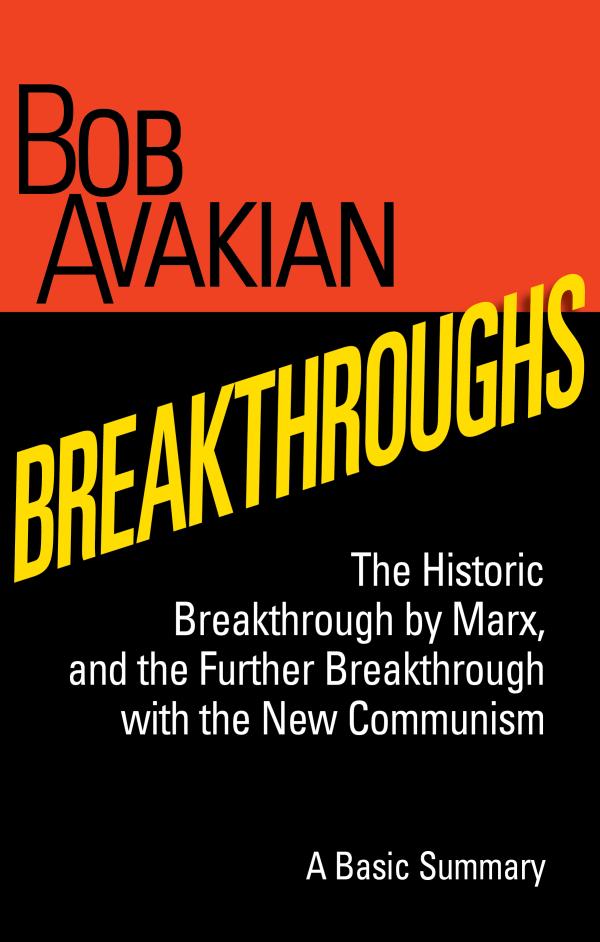
     

    Constitution for the New Socialist Republic in North America


    The New Communism


    Hope for Humanity


    THIS IS A RARE TIME WHEN REVOLUTION BECOMES POSSIBLE— by Bob Avakian


    Something Terrible or Something Truly Emancipating - Square, wo "NEW"


    Bob Avakian on Social Media:

    Interviews with Bob Avakian:
    Bob Avakian Interviews, 2025
    Bob Avakian Interviews, 2025


    "Humanity Does Not Have To Live This Way" (2025)
    The Bob Avakian Interviews on the RNL--Revolution, Nothing Less!--Show
    The Bob Avakian Interviews on the RNL--Revolution, Nothing Less!--Show


    Up Close and Personal with Bob Avakian, Heart and Soul & Hard-Core For Revolution (2022)   

    Also available at revcom.us:
    We Need and We Demand: A Whole New Way to Live, a Fundamentally Different System


    Six Resolutions


    American Crime Ad for whole series with image of U.S. airstrike in Gaza.


  • ARTICLE:

    THE DECLARATION OF INDEPENDENCE (And Related Questions): INVENTIONS AND DISTORTIONS OF REALITY AND HISTORY—IN THE SERVICE OF REAL AND REPEATED ATROCITY.

    Part 1: Profound Inequality, Brutal Oppression—and Crude Distortion of the Actual Foundation and Nature of this Country.

    This is Part 1 of a series of articles under the title "THE DECLARATION OF INDEPENDENCE (And Related Questions): INVENTIONS AND DISTORTIONS OF REALITY AND HISTORY—IN THE SERVICE OF REAL AND REPEATED ATROCITY." Part 2 is "Rights Are Not 'Endowed' by 'God,' and 'To Secure These Rights' Is Not the Reason Governments Are Established." Part 3 is "NO to a Celebration of Slavery, Capitalist Exploitation and Worldwide Plunder—This is a Time for a New, Urgently Needed, Truly Emancipating Revolution."

    To begin, there is this critical analysis in my recent work HUMANITY ON THE BRINK: A Forced March Into the Abyss, or Forging a Way Forward Out of the Madness?: 

    Here it’s worth stepping back and reviewing the history of this country and the system in this country from the Declaration of Independence and the U.S. Constitution to today—to the thoroughly outmoded monstrosity of capitalism-imperialism. At the beginning of this country, at the initiation of the war of independence (which they like to call a revolutionary war), it was declared that “all men are created equal.” But the whole history of this country from that time forward has proven that it is definitely not the case within this country that there is equality for all. Even at the time when the Declaration of Independence and then the Constitution were written, there were huge numbers of slaves. There were Native Americans whose land was being stolen and who were being subjected to genocidal atrocity. There were women who basically had no rights, and certainly none equal to men. There was, in short, a system of exploitation which was given further impetus by breaking free of British colonialism.1

    At the same time, I follow this important analysis with this observation:

    The point is not that we should be nihilists—just thoughtlessly negating everything about the American Revolution and the founding documents of this country. As I’ve pointed to before, there are certain things in the U.S. Constitution, particularly in the Bill of Rights (the first 10 Amendments to the Constitution), which can be learned from—and I have incorporated some of this into a fundamentally different framework in the Constitution for the New Socialist Republic in North America. The point is that, despite some positive elements at the time of the founding of this country, it was even then a system of vicious exploitation and literally murderous oppression; and all this had within it the seeds and elements of where it has gone—to a terrible place, with the system of capitalism-imperialism now.

    As I will show through this series, in the Declaration of Independence in particular, and in the celebration of what it has served to establish, maintain and expand, there are indeed fundamental inventions and distortions of reality and history, in the service of very real and repeated atrocity. 

    In terms of the present time—with this country now being ruled by a fascist regime—it is worthwhile examining briefly a recent speech at the University of Texas (“Remarks on the 250th Anniversary of the Declaration of Independence”) by Clarence Thomas, “Justice” of the U.S. Supreme Court.

    In this speech, Thomas attempted to set a new world record for shameless hypocrisy. 

    He used the occasion to attack “progressivism” as the source of essentially all evils in the modern world—when, in a basic sense, the “progressives” he is attacking have been a significant force in fighting against discrimination and oppression of various kinds, including white supremacy—and it is Thomas, and the fascists he is part of, who have consistently, vehemently and viciously opposed, attacked, and worked to destroy things that have been gained through this fight.

    In his speech, Thomas made a point of denouncing racism and segregation (invoking his own family’s experience with this) while he is in fact a crude instrument of the blatantly, aggressively racist Trump fascist regime.2

    This is a fascist regime which is carrying out an all-sided attack against the changes that have been brought about as a result of the fight against white supremacy and segregation over the past 70 years and more—an attack which recently involved a decision by the Supreme Court that effectively gutted the 1965 Voting Rights Act.3

    This is a fascist regime which actively spreads, and brazenly acts on, the ridiculous and outrageous lie that the real victims of discrimination in this country are somehow white people—when the reality (ceaselessly demonstrated in everyday life, and through countless scientific studies and investigations) is that segregation, discrimination and overall racist oppression continue, and continue to have terrible consequences, for Black people and others who have suffered the systemic, and often murderous, racism of this system—in housing, education, employment, health care, with police, courts and prisons—in every part of society.

    This is a fascist regime which is using its power to blackmail and bludgeon universities and other institutions into doing away with programs (generally under the heading of DEI) whose stated purpose is to counter the effects of actual discrimination and racism.

    This is a fascist regime that is aggressively restoring monuments to the Confederacy and reviving the celebration of Confederate “heroes”—which are nothing but monuments to and celebrations of slavery and lynch-mob white supremacy.

    This is a fascist regime headed by Donald Trump—a crude white supremacist, whose history of blatant racism goes back decades, including discrimination against Black people in housing owned by his family. (In a series written during the first Trump regime, Donald Trump— Genocidal Racist,4 I examined just some of the more outrageous expressions of this racism, up to that time. And, in this second version of the Trump fascist regime, this racism has become even more crudely and aggressively expressed, in word and deed.)

    This is the fascist regime in which Clarence Thomas is not merely a willing servant but an active force, overall and specifically in his role on the Supreme Court—with its rulings backing and facilitating white supremacy, as well as male supremacy (including with the overturning of the right to abortion), assaults on LGBT rights, and other outrageous rulings, including attacks on immigrants and on the separation of church and state, in the service of white Christian nationalism/fascism.

    As I pointed out in my social media message number 102: “there is a direct line from the pro-slavery Confederacy, at the time of the Civil War, to the fascism of today, with its determination to make America once again openly, aggressively white supremacist, male supremacist, and anti-LGBT people.” (At the time of the Civil War, which put an end to slavery, and for some time after that, the Republican Party was opposed to slavery and in favor of at least some basic rights for Black people. But that time is long gone: particularly since the 1960s, the Republican Party has become the party of blatant white supremacy, and over the decades since then it has become an overtly fascist party, with white patriarchal male supremacist Christian fundamentalism as its defining and driving force.5)

    As I have also emphasized: The Trump fascist regime came to power not through a military coup, or some other “extra-legal” means, but through the “normal processes” of this system—an election in 2016, and more recently in 2024. Among other important factors, this is an expression of the fact that (again from my social media message number 102):

    This election brings out sharply that there really are “two countries” within this country.

    This, in a real sense, is an extension of a fundamental division that has existed since the beginning of the so-called “United States” of America, with its foundation in slavery and genocide—a division which has never really been resolved throughout the history of this country—not through the Civil War in the 1860s, and not through changes that were brought about through the 1960s and in the years following....

    This division into “two countries” can find no good resolution under this system. The election of an outright fascist, Donald Trump, as the head of this system is a powerful demonstration of this.

    To return to Clarence Thomas, and his speech at the University of Texas, the core of his argument (and this is true of the Christian fascists generally) is the insistence that the rights of people come not from government, but from “god”—and the following well-known statement in the Declaration of Independence is invoked in support of this:

    We hold these Truths to be self-evident, that all men are created equal, that they are endowed by their Creator with certain unalienable rights.

    This is wielded by these fascists as part of their drive to obliterate the separation of church and state and institute a theocracy as the ruling force in society—rule based explicitly on enforced religion, and specifically scripture as interpreted by these Christian fundamentalist fanatics.

    In this series, beginning with the next part (2), I will examine further what is terribly wrong with all this, including how this pivotal and essential part of the Declaration of Independence—and this Declaration in its essence—in fact involves inventions and distortions of reality and history, which have been utilized in the service of real and repeated atrocity, and how there is now an urgent need to bring into being a radical, truly emancipating alternative to the system that was inspired by the Declaration of Independence 250 years ago, a system which has now become completely outmoded and poses an existential threat to humanity.

    ____________

    FOOTNOTES:

    1. HUMANITY ON THE BRINK: A Forced March Into the Abyss, or Forging a Way Forward Out of the Madness? is available at revcom.us.

    As for the actual nature and role of the U.S. Constitution, from the time of its adoption down to the present time, this is examined in some depth in my article U.S. Constitution: An Exploiters’ Vision of Freedom (also available at revcom.us). [back]

    2. There is a particularly disgusting dimension to the fact that someone like Clarence Thomas perverts his experience as a Black man in America into somehow a justification for the most extreme and grotesque expressions of white supremacy, as spewed forth and actively enforced by the Trump fascist regime, of which Thomas is an active advocate and instrument. This would be like someone utilizing their experience as a Jew in Germany in the 1930s to openly advocate for and aggressively act on behalf of Nazi fascism!

    Unfortunately, while not a major phenomenon in the U.S. today, the instances of more or less prominent Black people openly embracing Trump/MAGA fascism is also not a completely isolated phenomenon. Someone like Nicki Minaj has recently come out openly in support of Trump (see my recent piece commenting on this at revcom.us); and there are some other Black “celebrities” who have done the same. For example, the rapper, actor and comedian Nick Cannon has also recently come out in support of Trump.

    Some of the Black people who have gone over to supporting Trump/the Republican fascists have insisted that the reason they have done so is that the Democratic Party has long posed as the friend of Black people, and made promises to them, but has not made good on this. It is true that the Democratic Party is a ruling class party of this system—and this is a system which has the oppression of Black people, and other terrible oppression, built into it. But the Republican Party is a ruling class party of this system which does not even pretend to care about ending this oppression—and, particularly now that it has become an outright, all-out fascist party, it openly and aggressively promotes and enforces white supremacy, male supremacy, and other oppressive relations. (In another footnote [5] below, I get further into significant changes in the Republican Party.)

    The situation with these two ruling class political parties is as Malcolm X described it, only now even more extreme: one is a fox, and the other is a wolf—one says they’re for you, and the other one says they’re against you—but they’re actually both against you. It should be obvious that to jump from the one that claims to be against oppression (the Democrats) to one that openly proclaims it is going to enforce extreme forms of that oppression (the Republicans) will not contribute to ending that oppression. Taking this kind of position (supporting Trump and the Republican fascists on the basis that the Democrats have failed Black people) is, to say the least, lacking in imagination—or, better put, it is lacking in any scientific understanding of the real problem: the murderously oppressive system which both the Democrats and the Republicans are part of and work to enforce. Beyond that, in some cases, this jumping to support Trump and the Republican fascists, especially now that they are the ruling party, reflects a sense that doing so will put you in a better position to get in on the “goodies” of this system—in particular the “spoils” that come from this system’s ruthless plunder of countries, and super-exploitation of masses of people, including 150 million children, particularly in the Third World of Latin America, Africa, the Middle East and Asia. [back]

    3. Analysis of the Supreme Court’s gutting of the Voting Rights Act and important questions related to this is contained in the article at revcom.us: “The Fascist Rush To Rig The 2026 Election: Decimating The Black Vote and Terrorizing Election Workers.” [back]

    4. The 10-part series, Donald Trump—Genocidal Racist, is available in BA’s Collected Works at revcom.us, specifically in “Bob Avakian: Writings in 2020–A Momentous Year.” [back]

    5. My 2017 speech THE TRUMP/PENCE REGIME MUST GO! In The Name of Humanity—We REFUSE To Accept a Fascist America, A Better World IS Possible includes this important analysis:

    The Republican Party has been moving in a fascist direction since the late 1960s, with further leaps since then to becoming more and more openly fascist.

    In running for President in 1968, Richard Nixon adopted what has been called the “southern strategy,” which the Republican Party has followed ever since. This is a direct appeal to white supremacy—to the racism of white people, particularly (though not only) in the southern states, who are enraged that Black people are not “staying in their place.”

    The Republican Party is not “the Party of Lincoln”—as it sometimes demagogically claims to be—it has become much more the Party of the Confederacy.

    With Ronald Reagan, the Republican Party took another leap on the road of fascism. Reagan very deliberately began his campaign for president in 1980 in Philadelphia, Mississippi, where in 1964, three civil rights workers were kidnapped and brutally murdered by white supremacists. There, in Philadelphia, Mississippi, Reagan proclaimed his support for “states' rights,” which, particularly in the South, have long been code words for white supremacist lynch-mobism.

    And after George W. Bush took things still further in a fascist direction, the Trump/Pence regime has made the leap into all-out fascism.

    There is a direct line from the Confederacy to the fascists of today, and a direct connection between their white supremacy, their open disgust and hatred for LGBT people as well as women, their willful rejection of science and the scientific method, their raw “America First” jingoism and trumpeting of “the superiority of western civilization” and their bellicose wielding of military power, including their expressed willingness and blatant threats to use nuclear weapons, to destroy countries.

    In this light, it can also be seen how the moves by Republican-dominated legislatures across the South to gerrymander voting districts (specifically eliminating districts with heavy Black populations) is in a real sense another application of the Republicans’ “southern strategy” to enforce and benefit from white supremacy. [back]

  • ARTICLE:

    THE DECLARATION OF INDEPENDENCE (And Related Questions): INVENTIONS AND DISTORTIONS OF REALITY AND HISTORY—IN THE SERVICE OF REAL AND REPEATED ATROCITY.

    Part 2: Rights Are Not "Endowed" by "God," and "To Secure These Rights" Is Not the Reason Governments Are Established. 

    This is Part 2 of a series of articles under the title "THE DECLARATION OF INDEPENDENCE (And Related Questions): INVENTIONS AND DISTORTIONS OF REALITY AND HISTORY—IN THE SERVICE OF REAL AND REPEATED ATROCITY."   Part 1 is "Profound Inequality, Brutal Oppression—and Crude Distortion of the Actual Foundation and Nature of this Country." Part 3 is "NO to a Celebration of Slavery, Capitalist Exploitation and Worldwide Plunder—This is a Time for a New, Urgently Needed, Truly Emancipating Revolution."

    The title of this article is an echo—and refutation—of this famous passage from the Declaration of Independence:

    We hold these Truths to be self-evident, that all Men are created equal, that they are endowed by their Creator with certain unalienable Rights, that among these are Life, Liberty, and the Pursuit of Happiness—That to secure these Rights, Governments are instituted among Men, deriving their just Powers from the Consent of the Governed.

    As I will show in this article: Every major part of this statement, and this statement as a whole, contains inventions and distortions of reality and history, which have been utilized in the service of real and repeated atrocity, on the part of those who have “governed” this country, throughout its history.

    On the most obvious level, there is the striking hypocrisy of signers of the Declaration of Independence, many of whom were slave-owners—including Thomas Jefferson, the author of this Declaration. (The main author of the U.S. Constitution, James Madison, was also a slave-owner, and the same is true of four of the first five presidents of this country: Washington, Jefferson, Madison and Monroe.) As further graphic illustrations of the glaring hypocrisy of prominent people in the American Revolution, along with Patrick Henry, who proclaimed “Give me liberty, or give me death,” while he himself was a slave-owner, there is also the example of Richard Henry Lee, who conducted a public parade in Virginia denouncing the British-imposed Stamp Act’s “chains of slavery,” while he literally used his slaves to hold the protest banners!1

    Rights Do Not Come From (Are Not “Endowed By”) “God.”

    At the same time, the problem with the Declaration of Independence involves more than just glaring hypocrisy—so let’s take apart the famous statement from this Declaration that I included at the beginning.

    First of all, there is the basic fact that rights are not “endowed” by “god”—for the simple reason that there is no god. But, if it were true that a god (or gods) existed—and that rights come from some “god”—there would be the big question of which “god” supposedly “endows” people with these rights: the “god” of the Christian Bible...or the “god” (Allah) of Islam...or some other “god?” (In my book, Away With All Gods!—Unchaining The Mind And Radically Changing The WorldI analyze in depth the terrible and bloodthirsty oppression that is advocated by the writers of the Bible, speaking in the name of the Judeo-Christian “god,” and by Muhammad, author of the Qur`an, speaking in the name of Allah. The barbaric things advocated in these scriptures include slavery, the forceful subjugation of women, and other atrocities. So, those “holy scriptures” and the “god” they speak of, can in no way be considered a source of what any decent person would consider basic rights.2)

    But let’s move ahead from that, because there are other, fundamental ways in which what is set forth in the Declaration of Independence is a basic distortion of history and reality, which has served as rationalization for terrible atrocity. In this regard, it is critically important to understand scientifically the emergence and development of human beings and human society.

    To “Secure Rights” Is Not The Reason, Or Basis, For The Establishment Of Governments

    In the actual history of humanity, as human beings first came into being as a result of natural evolution, they existed in small groups that lived by hunting and gathering food (and other basic necessities). After thousands of years, owing to environmental and other changes, human societies emerged that were based on settled populations carrying out farming and related activities, which produced a surplus beyond what was immediately needed to meet the basic requirements of life. Together with this, there arose class and other social divisions and antagonisms, which often included the seizing of people as slaves and subjecting them to forced labor, as well as the oppressive male supremacist division between men and women. (In a previous article, speaking to why revolutionary socialist state power is crucial, and emancipating, I explained this: Antagonistic social divisions refers to a situation where the basic interests of one part of society require that the basic interests of other parts of society be fundamentally suppressed. This is the case in all systems based on exploitation, including capitalism as well as slavery—and it is the case, in a fundamentally different way, in socialist society, where attempts by part of society to exploit others are suppressed and prevented, and the corresponding exploitative outlook is criticized and struggled against.)3

    Together with—and as a means of enforcing—exploitation, oppressive social division and antagonism, there arose not just governments, but more specifically states: state power, exercised as the dictatorship of the economically dominant class in society, controlling and wielding a monopoly of political power, and more especially a monopoly of “legitimate” violence, embodied in the armed forces, police, and other institutions which enforce this rule of the economically dominant class, as violently as deemed necessary. (As I also explained in the article on why revolutionary socialist state power is crucial and emancipating: The economically dominant position of a particular class, in a society marked by class divisions, is based on that class’s ownership and control of the major means of production—including land, raw materials and other resources, technology, physical structures that are involved in production, and so on—and its exploitation of masses of people who do not own these means of production.)

    This has been the history of humanity for thousands of years, through different forms of exploitative and oppressive society, including slavery, feudal monarchies (with large land-holding lords exploiting impoverished serfs working the land), and capitalism, where dictatorship is exercised by the economically dominant capitalist class.

    Under these systems based on exploitation and oppression, if the masses of people have any “rights,” these are dependent on, conditioned and restricted in accordance with, the basic interests and dictates of the ruling class.

    Returning again to the situation that gave rise to the American Revolution (250 years ago), in basic and essential terms this involved the increasingly antagonistic conflict between two different exploitative and oppressive forces: on one side, the British empire, headed by a king, and on the other side, American slave-owners, along with merchants and other elements of the developing capitalist class. As I stated clearly in my recent work HUMANITY ON THE BRINK:

    At the beginning of this country, at the initiation of the war of independence (which they like to call a revolutionary war), it was declared that “all men are created equal.” But the whole history of this country from that time forward has proven that it is definitely not the case within this country that there is equality for all. Even at the time when the Declaration of Independence and then the Constitution were written, there were huge numbers of slaves. There were Native Americans whose land was being stolen and who were being subjected to genocidal atrocity. There were women who basically had no rights, and certainly none equal to men. ... [P]eople without property ... didn’t have the same rights as rich men.

    As a basic summation of this situation (once again from HUMANITY ON THE BRINK): “There was, in short, a system of exploitation which was given further impetus by breaking free of British colonialism.”

    At the same time, I emphasized that 

    [T]he point is not to "be nihilists—just thoughtlessly negating everything about the American Revolution and the founding documents of this country. As I’ve pointed to before, there are certain things in the U.S. Constitution, particularly in the Bill of Rights (the first 10 Amendments to the Constitution), which can be learned from—and I have incorporated some of this into a fundamentally different framework in the Constitution for the New Socialist Republic in North America. The point is that, despite some positive elements at the time of the founding of this country, it was even then a system of vicious exploitation and literally murderous oppression; and all this had within it the seeds and elements of where it has gone—to a terrible place, with the system of capitalism-imperialism now."4

    The point is that the “individual rights” that were supposedly “guaranteed” in the Constitution of the “United States” were, at the beginning and for some time, explicitly restricted to certain parts of society, while others were excluded from those rights, to varying degrees and with varying degrees of force and brutality. And, as I also wrote in HUMANITY ON THE BRINK, drawing from a statement by Karl Marx about the character, and the limits, of individual freedom under capitalism:

    It is often celebrated about capitalism that it gives qualitatively greater scope to the individual than systems like feudalism (to say nothing of outright slavery), where the positions and the restraints on individuals are much more fixed and frozen. Marx is getting at the fact that, while this is a real difference with feudalism, it is nevertheless the case that, within the exchange relations of capitalism (fundamentally rooted in its economic/production relations) the “independence” of individuals is not nearly as real, or as expansive, as it appears, and in the end it is essentially illusory: people are still confined within and conditioned by the fundamental relations of the system.5


    This basic understanding applies as well with regard to what is often proclaimed as the most basic right in a capitalist (bourgeois) democracy: the right to vote. As I have analyzed here (and extensively in other works), what essentially exists in capitalist democracy is the rule—the dictatorship—of the capitalist class (the bourgeoisie).  Voting in this system does not negate, or do away with—but in fact is incorporated within and actually serves—the dictatorship of the ruling capitalist class. The following, from U.S. Constitution: An Exploiters’ Vision Of Freedom, makes this clear:

    [A]s for voting, as I pointed out in Democracy: Can’t We Do Better Than That?:

    On the most obvious level, to be a serious candidate for any major office in a country like the U.S. requires millions of dollars—a personal fortune or, more often, the backing of people with that kind of money. Beyond that, to become known and be taken seriously depends on favorable exposure in the mass media (favorable at least in the sense that you are presented as within the framework of responsible—that is, acceptable politics)…. By the time “the people express their will through voting,” both the candidates they have to choose among and the “issues” that deserve “serious consideration” have been selected out by someone else: the ruling class….[emphasis added]

    But that is not all:

    If, however, the electoral process in bourgeois society does not represent the exercise of sovereignty by the people, it generally does play an important role in maintaining the sovereignty—the dictatorship—of the bourgeoisie and the continuation of capitalist society. This very electoral process itself tends to cover over the basic class relations—and class antagonisms—in society, and serves to give formal, institutionalized expression to the political participation of atomized individuals in the perpetuation of the status quo....[T]he very acceptance of the electoral process as the quintessential political act reinforces acceptance of the established order and works against any radical rupture with, to say nothing of the actual overturning of, that order. [emphasis added]

    At the same time, moving to basically rob people of the right to vote—as is being done by the fascist regime in this country with regard to Black people—represents the attempt to exercise undisguised and unapologetic dictatorship over those denied this right. This is a country with a long history of viciously and violently denying Black people the right to vote—and the fascist regime in power is determined to once again sabotage this right, along with other rights that Black people have gained through determined struggle. (This basic robbing of the right to vote for Black people today has been done by the fascist-dominated Supreme Court, gutting the Voting Rights Act of 1965, resulting in the fact that Black votes, particularly in the southern states, have been rendered ineffective through the elimination of voting districts that have involved a concentration of Black people and merging them with districts where Black people will be outnumbered by “conservative” white people. This has awful significance, especially in the “American South,” with its particular history of slavery and then brutal segregation and Ku Klux Klan terror.)

    A recent article, at revcom.us—“The Fascist Rush To Rig The 2026 Election: Decimating The Black Vote and Terrorizing Election Workers—What to do… and what not to do”—speaks to the significance of the Supreme Court’s gutting of the Voting Rights Act, as does Part 1 of this series on the Declaration of Independence, “Profound Inequality, Brutal Oppression—and Crude Distortion of the Actual Foundation and Nature of this Country,” which includes (at the end of the footnotes) this important conclusion: “the moves by Republican-dominated legislatures across the South to gerrymander voting districts (specifically eliminating districts with heavy Black populations) is in a real sense another application of the Republicans’ 'southern strategy' to enforce and benefit from white supremacy.” The Republicans' “southern strategy,” which they have applied since the 1960s, is a direct appeal to white supremacy—to the racism of white people, particularly (though not only) in the southern states, who are enraged that Black people are not “staying in their place.”

    As I have emphasized before, what is required in this kind of situation is, at one and the same time, an understanding of the very terrible thing that is involved in ripping away the right to vote, and accordingly the need to vigorously defend this right, while at the same time understanding the actual role of elections under this system, and the importance of not reinforcing the rule of this system by becoming trapped within, and acting in accordance with the “logic” and dynamics of, its electoral process.

    The Problem—and the Solution: A Scientific Approach 

    In all this, what is crucially important is to be consistently scientific: applying the scientific method and approach of dialectical and historical materialism, which, as applied to human society and its historical development, involves analysis of the basic contradictions—the relations, dynamics and “laws of motion”—of different societies as they have emerged, developed, and in turn given rise to other forms of human society, often as a result of revolutions that overthrew the old system and established a new system in its place.6

    What is especially important to understand, scientifically, is this: with all the very real changes that have been brought about through revolutions in previous periods of history (such as the American and French revolutions of the late 18th century), what was essentially involved was the overthrow of one system of exploitation and oppression (such as a feudal-monarchal system) and the establishment of a new system of exploitation and oppression—including capitalism, which through the American Revolution, beginning in 1776, rose to the ruling position together with the system of slavery centered particularly in the southern states. What is radically different now is that the revolution that has become possible, and urgently necessary, is a revolution—the communist revolution—whose fundamental aim is to do away with all exploitation and oppression, everywhere.

    With the method of dialectical and historical materialism, it is possible to understand scientifically why and how the “rights” that have—and have not—existed as a result of the American Revolution correspond to the fundamental nature of the system that emerged through the triumph of that revolution. 

    By applying dialectical and historical materialism, it is also possible to understand scientifically why there have been significant changes in this country over the 250 years since the Declaration of Independence was proclaimed. Obviously, a profound change was brought about through the abolition of slavery as a result of the Civil War in the 1860s. But what is the fundamental reason this Civil War came about, and why did it finally lead to the abolition of slavery? It is not that Abraham Lincoln just decided to wage the Civil War, on behalf of the Union, and then just decided to “free the slaves.” In basic terms, the Civil War arose because, over the course of nearly 100 years since the founding of the “United States” of America, changes within the country (and in the larger world) resulted in the fact that the two different economic systems (modes of production) that had existed within this country from the beginning, went from mainly reinforcing and benefitting each other to becoming fundamentally antagonistic (the basic interests of the one required the defeat of the other). In this particular case, the basic interests of the southern states, whose economies were based on slavery, required that they separate from the northern states, form an independent country and deal with the rest of the world on that basis; while the basic interests of the northern states, whose economy was based on a developing capitalism, required restricting the spread of slavery and maintaining the country as a whole, including the southern states, under one government—and, through the course of the Civil War, it became clear that the basic interests of the northern states required the abolition of slavery.

    On the one hand, the defeat of the Confederacy did result in the preservation of the country as a whole, with slavery outlawed. But, at the same time, after a brief period of Reconstruction (beginning in the mid-1860s, with the end of the Civil War), which provided certain basic rights for Black people, this was reversed only a decade later, with Black people subjected once more to the vicious exploitation of white plantation owners (many of them former slave-owners) and the terror of the Ku Klux Klan and the power structure in the South in particular, with the collaboration of the ruling capitalist class as a whole.

    Why did this happen? As I analyzed in Breakthroughs, this was the only way the capitalist class centered in the North could maintain the USA as one unified country:

    [T]hey had to put the country back together as a whole country, and the only way they could do that, given the prevailing production relations and social relations, was to make all kinds of “principled compromises,” once again, with the Southern aristocracy, the large landowners, who were, to a very large degree, former slave owners. So this is why Reconstruction was reversed, before very long after the Civil War, and the masses of Black people were betrayed again.7

    Since that time, there have been significant changes in the situation of oppressed people in this country—significant concessions have been made to the struggle against the oppression of Black people, women, LGBT people and others—even as this oppression continues overall, since all this has remained within the confines of this system of capitalism, which has now become an international system of exploitation, capitalism-imperialism, and which has all this oppression built into it.

    As I have examined in other works, these concessions—this extending of certain rights, particularly in the decades following the end of World War 2 (in 1945)—as much as they resulted from the heroic struggle and sacrifice of masses of people, have also been based on the needs of the ruling class of this country, in terms of the functioning of the economy and the stability of rule of the capitalist-imperialist system, in the context of international competition and rivalry.  And now, a section of that ruling class—a fascist section—has emerged and risen to power which is determined that reversing much of these gains, and trampling on basic rights and legal principles, within the country and internationally, is necessary for the maintenance of this system within the country and its dominant position in the world, in the face of serious challenges, especially from China. (Shortly after the death of Mao in 1976, socialism in China was overthrown and capitalism restored, and in the decades since then China has developed as an increasingly powerful capitalist-imperialist country.)8

    From all this, it should be clear: With regard to whatever rights different sections of society did, and did not, have within different systems, and within different historical periods—none of this was “endowed by” some “god”—nor was it the case that governments, and more specifically states (dictatorships), were established to guarantee these rights—nor have governments derived their powers from the consent of the governed. Rather, governments—and in particular states (dictatorships)—have arisen, and exercised their rule in society, fundamentally in correspondence with the particular mode of production that has come into being as the basic foundation of society; and both the rights and the denial of rights for the people who are governed, are, of necessity, in accordance with the interests of the ruling class (as determined by its political representatives).

    All of this, once again, is fundamentally grounded in the basic economic way of life (the mode of production), the relations of production of that mode of production (for example, slave or capitalist relations of production) and the social relations which, of necessity, correspond to those relations of production.9

    In this light, it can be seen how the Declaration of Independence—and the distortions it contains—have been used to “justify” all manner of vicious oppression and atrocity: legitimizing government (and in particular the state) ruling over and oppressing masses of people, on the basis that this rule is supposedly an expression of the will of some “god”—or that, in any case, this government has been founded on and maintains its legitimacy, with all its terrible crimes against humanity, on the basis that it supposedly exists through the consent of those it exploits and oppresses (“the governed”).

    (The American Crime series at revcom.us, chronicles and analyzes in depth the war crimes and crimes against humanity continually committed by the U.S., throughout its history and throughout the world, as well as “at home.”) 

    Significantly, the following from the Declaration of Independence (which comes immediately after what I quoted at the start of this article) is something that the ruling fascist regime (and, for that matter, more “mainstream” representatives of the ruling class) will not wish to see applied to the rule of their system of capitalism-imperialism:

    [W]henever any Form of Government becomes destructive of these Ends [providing basic rights, and deriving its power from the consent of the governed] it is the Right of the People to alter or abolish it, and to institute new Government, laying its Foundation on such Principles, and organizing its powers in such Form, as to them shall seem most likely to effect their Safety and Happiness.

    Leaving aside the somewhat archaic (outdated) use of language, and the unscientific terms, of this passage—which reflect the limitations of the time and the outlook of the signers of the Declaration of Independence—the fact is that not only the form of capitalist government (actual dictatorship) ruling in this country, but the underlying, exploitative mode of production and oppressive social relations that this dictatorship enforces, have become destructive of the basic interests—and indeed pose a growing threat to the very existence—not just of people in this country but of humanity as a whole. And what is sharply posed now is the urgent necessity, as well as the actual possibility, of a far more radical, deep-going and fundamentally emancipating revolution: the communist revolution.10

    Through this revolution, with the achievement of the final goal of communism, worldwide, a whole new concept and whole dimensions of freedom will become possible, far beyond the narrow horizons of capitalism (and all other systems of exploitation).

    In the next part (3), I will further examine and refute rationalizations for outmoded systems and their real and repeated atrocity.

    _______________

    FOOTNOTES:

    1. My article “The American Enterprise—Property and Slavery, Peculiar Notions of ‘Freedom’ and Profound Contradictions” (which is available in BA’s Collected Works at revcom.us) includes the following:

    In his book A Slaveholders' Union, Slavery, Politics, and the Constitution in the Early American Republic, George William Van Cleve captures, with biting and incisive irony, a contradiction which in fact gets to the very essence of this country and its posturing as the champion and model of freedom. Here is what Van Cleve writes about the very foundations, and "founding fathers," of the United States of America:

    Consider, for example, the conduct of Richard Henry Lee, the Virginia leader who moved the formal congressional resolution declaring American independence in June 1776. There is no evidence that Virginians thought it ridiculous for Lee to conduct a public parade in Virginia against the Stamp Act's "chains of slavery" while literally using his slaves to hold his protest banners. ...leaders such as Lee and Patrick Henry, like [American] Revolutionary leaders in other major slave colonies, saw their state's untrammeled ability to control slavery as a central part of what the Revolution was about. [back]

    2. In Part One of Away With All Gods, the section “The Bible, Taken Literally, Is a Horror,” contains a fuller accounting of the truly monstrous crimes that are “not just upheld, but advocated, commanded and celebrated” in the Bible. And in Part Two, the section “Islam Is No Better (and No Worse) Than Christianity” analyzes how the Qur’an advocates the same kinds of terrible oppression and atrocity that are found in the Christian Bible.  [back]

    3. The article ANSWERING IGNORANT AND IDIOTIC IDEAS, Part 2: “Only with Revolutionary Socialist State Power Can a Truly Emancipating Society Actually Exist,” is available at revcom.us. Part 1, “Yes—There Is Objective Truth—and It Is Possible To Know What Is True,” is also available at revcom.us.  [back]

    4. HUMANITY ON THE BRINK: A Forced March Into the Abyss, or Forging a Way Forward Out of the Madness? is available at revcom.us, and online at Google Books and The Internet Archive [back]

    5. The following is the longer passage from HUMANITY ON THE BRINK speaking to the character, and limitation, of individual freedom under capitalism, part of which is quoted above, in the main body of this article:

    Here is a very important statement by Marx, from the Grundrisse—one of his major works—as cited in Ruminations and Wranglings:

    In the money relation, in the developed system of exchange (and this semblance seduces the democrats), the ties of personal dependence, of distinctions of blood, education, etc. are in fact exploded, ripped up (at least, personal ties all appear as personal relations); and individuals seem independent (this is an independence which is at bottom merely an illusion, and it is more correctly called indifference), free to collide with one another and to engage in exchange within this freedom....

    This is a way of elaborating on what Lenin was pointing to in emphasizing that capitalism forces people to calculate with the stinginess of a miser. Particularly important in this statement by Marx is the analysis that this “independence” of people under capitalism is really “an illusion,” which “is more correctly called indifference.” It is often celebrated about capitalism that it gives qualitatively greater scope to the individual than systems like feudalism (to say nothing of outright slavery), where the positions and the restraints on individuals are much more fixed and frozen. Marx is getting at the fact that, while this is a real difference with feudalism, it is nevertheless the case that, within the exchange relations of capitalism (fundamentally rooted in its economic/production relations) the “independence” of individuals is not nearly as real, or as expansive, as it appears, and in the end it is essentially illusory: people are still confined within and conditioned by the fundamental relations of the system.  [back]

    6. In HUMANITY ON THE BRINK, there is the following basic explanation of dialectical and historical materialism:

    In basic terms, materialism is the recognition that all of reality consists of matter, and nothing else—no supernatural forces or beings, nothing which does not have real, material existence (as one important expression of this, human thought is itself the result of real material processes within human beings, especially their nervous systems and in particular their brains, in interaction with the larger material world). Dialectics refers to the fact that material reality (including human society) is not static but is full of contradiction, is constantly changing, and in certain circumstances can undergo a major, qualitative change (from one form of matter to a qualitatively different form—like the everyday experience where water that is boiled becomes steam; or when a new species emerges in the process of natural evolution; or when a revolution in human society brings into being a qualitatively new system—for example, when socialism results from the overthrow of capitalism). Historical materialism is the application of dialectical materialism to the development of human society (as well as nature generally).  [back]

    7. Breakthroughs: The Historic Breakthrough by Marx, and the Further Breakthrough with the New Communism, A Basic Summary is available as well at revcom.us.  [back]

    8. Further analysis concerning the reasons for these changes, with regard to the rights of different people who have been oppressed historically in this country, is contained in HUMANITY ON THE BRINK, as well as Breakthroughs and the book THE NEW COMMUNISM, The science, the strategy, the leadership for an actual revolution, and a radically new society on the road to real emancipation [back]

    9. Why and how the dominant social relations and culture, as well as the political system, in any society, must in fundamental and ultimate terms correspond to the mode of production is analyzed in depth in HUMANITY ON THE BRINK, Breakthroughs, and other works available at revcom.us.  [back]

    10. In Part 2 of ANSWERING IGNORANT AND IDIOTIC IDEAS, I examined in depth why the establishment and maintenance of socialist state power (the dictatorship of the proletariat, the exploited class under capitalism, whose emancipation from exploitation requires the abolition of all exploitation and oppression, everywhere) is necessary for the final achievement of communism, on a worldwide basis. As I analyzed in that article:

    Only with revolutionary socialist state power can a truly emancipating society actually exist, be sustained, and advance toward the fundamental goal of abolishing and uprooting exploitation and oppression, everywhere, with the achievement of communism, throughout the world.  [back]

  • ARTICLE:

    THE DECLARATION OF INDEPENDENCE (And Related Questions): INVENTIONS AND DISTORTIONS OF REALITY AND HISTORY—IN THE SERVICE OF REAL AND REPEATED ATROCITY.

    Part 3: NO to a Celebration of Slavery, Capitalist Exploitation and Worldwide Plunder—This Is a Time for a New, Urgently Needed, Truly Emancipating Revolution

    This is Part 3 of a series of articles under the title "THE DECLARATION OF INDEPENDENCE (And Related Questions): INVENTIONS AND DISTORTIONS OF REALITY AND HISTORY—IN THE SERVICE OF REAL AND REPEATED ATROCITY." Part 1 is "Profound Inequality, Brutal Oppression—and Crude Distortion of the Actual Foundation and Nature of this Country." Part 2 is "Rights Are Not 'Endowed' by 'God,' and 'To Secure These Rights' Is Not the Reason Governments Are Established."

    This July (2026), we will be subjected to official celebrations of the 250th anniversary of the Declaration of Independence and this much-proclaimed “great country” which has been inspired by this Declaration.

    As a basic response to this, there is the following simple but profound truth about this country:

    Any country which began with its foundation in slavery (and genocide against the native peoples); which maintained, and expanded, slavery (on land stolen from native peoples and Mexico) for nearly 100 years after its founding; which for another 100 years after the Civil War carried out thousands of lynchings of Black people, with mass celebrations of this, including the selling of postcards of lynchings throughout the country; which still has thousands of monuments to the Confederacy and white supremacy; and which today continues racist oppression in every dimension of society, enforced by continuing police terror—any such country has absolutely no claim to any positive celebration of itself or its history and heritage!1

    In Part 2 of this series on the Declaration of Independence, I summarized what, in reality, was the actual nature of the conflict that led to the American Revolution, and what was the nature of the system that emerged in the “United States” of America as a result of this Revolution:

    [I]n basic and essential terms this involved the increasingly antagonistic conflict between two different exploitative and oppressive forces: on one side, the British empire, headed by a king, and on the other side, American slave-owners, along with merchants and other elements of the developing capitalist class. As I stated clearly in my recent work HUMANITY ON THE BRINK:

    At the beginning of this country, at the initiation of the war of independence (which they like to call a revolutionary war), it was declared that “all men are created equal.” But the whole history of this country from that time forward has proven that it is definitely not the case within this country that there is equality for all. Even at the time when the Declaration of Independence and then the Constitution were written, there were huge numbers of slaves. There were Native Americans whose land was being stolen and who were being subjected to genocidal atrocity. There were women who basically had no rights, and certainly none equal to men....[P]eople without property...didn’t have the same rights as rich men....

    There was, in short, a system of exploitation which was given further impetus by breaking free of British colonialism.2

    Also in Part 2 of this series, as indicated by its title—“Rights Are Not ‘Endowed’ By ‘God,’ And ‘To Secure These Rights’ Is Not the Reason Governments Are Established”—I dissected and refuted this famous passage from the Declaration of Independence:

    We hold these Truths to be self-evident, that all Men are created equal, that they are endowed by their Creator with certain unalienable Rights, that among these are Life, Liberty, and the Pursuit of Happiness—That to secure these Rights, Governments are instituted among Men, deriving their just Powers from the Consent of the Governed.

    In this final Part 3 of this series, I will further examine inventions and distortions of reality and history which, along with the Declaration of Independence, have been wielded in the service of—or, in any case, have served as a “cover” for—real and repeated atrocity (including the rank American Supremacist rationalization: “Ok, this country has many faults and many bad things have been done in and by this country—but it is still far better than any other country”).

    What Was “Brought Forth” through the American Revolution Was Not a New Nation “Conceived in Liberty,” and Not a Nation “Dedicated to the Proposition that All Men Are Created Equal.” 

    This is a reference to famous lines from Abraham Lincoln’s Gettysburg Address, delivered in November, 1863, at a crucial point in the Civil War:

    Four score and seven years ago our fathers brought forth, on this continent, a new nation, conceived in Liberty, and dedicated to the proposition that all men are created equal....we here highly resolve that these dead shall not have died in vain—that this nation, under God, shall have a new birth of freedom—and that government of the people, by the people, for the people, shall not perish from the earth.

    What I have already indicated here (and examined more fully in the previous article in this series) reveals clearly that neither the American Revolution of 1776, nor the Civil War in the 1860s, was actually fought to establish, or to preserve, “government of the people, by the people, for the people.” The essential “liberty” brought about through the American Revolution was the removal of the constraints that the British empire enforced on the slave-owners and developing capitalists in the colonies, who were the “fathers” and basic beneficiaries of this Revolution.

    Yes, for the reasons I examined in Part 2, the Civil War did eventually lead to the abolition of slavery (and in that sense did bring about “a new birth of freedom”). But “freeing the slaves” was not Lincoln’s initial intent in this Civil War—and this came about only as “it became clear that the basic interests of the northern states required the abolition of slavery.”3

    Further, as also analyzed in Part 2:

    On the one hand, the defeat of the Confederacy did result in the preservation of the country as a whole, with slavery outlawed. But, at the same time, after a brief period of Reconstruction (beginning in the mid-1860s, with the end of the Civil War), which provided certain basic rights for Black people, this was reversed only a decade later, with Black people subjected once more to the vicious exploitation of white plantation owners (many of them former slave-owners) and the terror of the Ku Klux Klan and the power structure in the South in particular, with the collaboration of the ruling capitalist class as a whole.4

    With regard to the notion that what has existed (and exists today) in this country is “government of the people, by the people, for the people,” as I have shown in this series, what actually existed at the beginning of the country was government—and more especially state power, an actual dictatorship—of the slave-owners and developing capitalists. And, since the defeat of the Confederacy in the Civil War and the abolition of slavery, what has existed is government and state power of, by, and for the capitalist system and its ruling class—a system which has now developed into the extremely parasitic system of capitalism-imperialism, resting not just on the exploitation of people in this country but the even more vicious and predatory super-exploitation of literally billions of people, including 150 million children, throughout the world, in particular the Third World of Latin America, Africa, the Middle East and Asia. (All this is analyzed in depth in the essay by Raymond Lotta Imperialist Parasitism and Class-Social Recomposition in the U.S. From the 1970s to Today: An Exploration of Trends and Changes, which is available at revcom.us.) 

    The “Divine Right of Kings” and “Democracy”—Two “Cohering Mythologies” of Two Different Systems of Exploitation

    This is the title of a section in my 2010 work Birds Cannot Give Birth to Crocodiles, But Humanity Can Soar Beyond the HorizonThe reality captured in this statement (about “two cohering mythologies”) is concentrated in the following:

    In feudal society, it was "natural" that everyone had their particular place....And then there is "the divine right of kings," a cornerstone of feudal society. This was considered such an outrage by bourgeois revolutionaries and bourgeois theoreticians. Recently, I was reading Thomas Paine again, and he goes on and on about what an absurd and criminal idea the divine right of kings and hereditary role of kings is....

    Well, yes, this condemnation of the "divine right of kings" is understandable, from the point of view of the rising bourgeoisie....To them that really was an absurd and criminal idea—the divine right of kings and the absolute order of things as established in such a way that to try to change it would be to go against the very fabric of reality and of the universe as ordained by God and maintained by God's will. As much as those bourgeois theoreticians saw this as absurd and outrageous, in the feudal order it was just the opposite: to rebel against the king, the monarch, was to rebel against God and the God-ordained order. And everyone, from the nobles to the serfs, was supposed to know their role and play their role accordingly and appropriately.

    Now, if we move a little bit further away from the bourgeois era and look back on it from the historical perspective of where things need to go and can go...we can see that the great talisman* of bourgeois democracy, elections and the right of the governed to choose those who govern them, in fact, in the reality of the functioning of bourgeois society, has no more absolute legitimacy than the divine right of kings. It is just another form in which the needs and interests of the ruling class are asserted in this particular kind of society, and a mechanism through which...the interests of the ruling class are maintained and enforced. It is their version—DEMOCRACY, ELECTIONS is, in effect, their version—of the divine right of kings. It is a cohering mythology of a certain system. It's not mythology that they have elections, it's mythology what those elections are purported to be all about and what happens through them. In reality, they are not an expression of "the will" or "the sovereignty" of "the people," but an expression of the process through which the capitalist class maintains its system of exploitation and its domination, its dictatorship, over the classes and groups in society that it exploits and oppresses. (Emphasis added here. *“Talisman” refers to something that is believed to have magical power.)5

    (In Part 2 of this series—and in the works referenced there—I go more fully into how the electoral process under this system is not an expression of "the will" or "the sovereignty" of "the people," but an expression of the process through which the capitalist class maintains its system of exploitation and its domination, its dictatorship, over the classes and groups in society that it exploits and oppresses.)

    In the current situation, with the openly tyrannical rule of the Trump regime, there is a widely expressed sentiment that what this regime represents is an attempt to return to the rule of a “king” (Trump). But, as much as this sentiment has mobilized masses of decent people in protest against this regime, and many of its atrocities, this idea that the Trump regime somehow represents a return to the rule of a “king” is as outdated as the notion of “the divine right of kings” itself. This is not the time of the American Revolution (250 years ago), when rebellion against the rule of a king served as a mobilizing factor in that Revolution which (as I have analyzed in this series, in particular Part 2) led to the rule of slave-owners and developing capitalists in the emerging “United States” of America. Today, it is the capitalist system (which has developed into the system of international exploitation, capitalism-imperialism) that is completely outmoded, and the essential understanding of what is happening now in this country is contained in the following from Part 2 of this series:

    And now, a section of that ruling class—a fascist section—has emerged and risen to power which is determined that...trampling on basic rights and legal principles, within the country and internationally, is necessary for the maintenance of this system within the country and its dominant position in the world, in the face of serious challenges, especially from China. (Shortly after the death of Mao in 1976, socialism in China was overthrown and capitalism restored, and in the decades since then China has developed as an increasingly powerful capitalist-imperialist country.)

    This crucial understanding is spelled out more fully in HUMANITY ON THE BRINK:

    The political system in this country is the rule—the dictatorship—of the section of society that dominates the economic systemthe capitalist-imperialist class—a dictatorship that finds concentrated expression in the monopoly of political power, and more especially the monopoly of “legitimate” violence, exercised by the political representatives of this system and its ruling class. All the dominant processes and institutions of this system (including its elections) fundamentally serve and enforce this dictatorship. In its “normal” form, and as administered by the “mainstream” section of the ruling class, this is a dictatorship representing the interests of the capitalist class as a whole, and this dictatorship is more or less disguised as “democracy” and “rule by the people,” with basic adherence to a “rule of law” which ultimately embodies and reflects the basic relations in society and serves the fundamental interests of the ruling class while being applied, however unequally, to people in society generally....

    The rule of the Trump regime is the dictatorship of one section of the ruling class, which is determined to impose fascism as the form of capitalist-imperialist rule, utilizing the force and violence of the state (police and military forces and repressive institutions of government, such as the FBI, “Homeland Security,” etc.) not only against people in society as a whole but also against the “mainstream” section of the ruling class. With fascism, dictatorship is open, blatant, undisguised dictatorship, and the exploitation and oppression that is the actual basis and nature of this system of capitalist-imperialism, within this country and internationally, is blatant, undisguised exploitation and oppression, unrestrained by the “norms” and “rules” of “mainstream” capitalist-imperialist dictatorship.6

    While massive nonviolent mobilization aiming to bring about the defeat and removal of the Trump fascist regime remains crucially important, even more crucially important is for masses of people to come to, and decisively act on, the scientific understanding that the fundamental solution to all this is not to bring about the restoration of the “mainstream” form of the dictatorship of this long outmoded and truly monstrous capitalist-imperialist system of exploitation and oppression—not to harken back to a Declaration and a Revolution of slave-owners and capitalists, 250 years ago—but instead: What is radically different now is that the revolution that has become possible, and urgently necessary, is a revolution—the communist revolution—whose fundamental aim is to do away with all exploitation and oppression, everywhere.

    The Myth of “Multi-Racial Democracy” 

    This idea that what existed before Trump came to power was a “multi-racial democracy” is propagated by representatives of the “mainstream” ruling class, and others whose thinking has not broken free of and beyond the narrow, constricting confines of this system of capitalism-imperialism.

    In essence, the argument is that, in the decades after World War 2, through the gains made as a result of the Civil Rights movement, along with the extension of rights to women, LGBT people and others, this country, for the first time, became a real, and “multi-racial” democracy (which is now being seriously threatened by the Trump regime’s determined attacks on these rights, and on the basic principles of “democracy”). Here it should not be necessary to repeat all the analysis in this series (and other works available at revcom.us) which clearly demonstrate that the “democracy” in this country is in fact a form of the dictatorship of the ruling, economically-dominant capitalist class. On a more obvious level, if this notion of a real, and “multi-racial” democracy means that (at long last) everyone in this society has finally become equal—in the sense of having equal opportunity and “equality before the law”—that is glaringly not the case. 

    Despite the significant increase in the Black petite bourgeoisie (middle class) and, on a smaller scale, the emergence of extremely wealthy Black bourgeois, “the reality (ceaselessly demonstrated in everyday life, and through countless scientific studies and investigations) is that segregation, discrimination and overall racist oppression continue, and continue to have terrible consequences, for Black people and others who have suffered the systemic, and often murderous, racism of this system—in housing, education, employment, health care, with police, courts and prisons—in every part of society.” (That is from Part 1 in this series, Profound Inequality, Brutal Oppression—and Crude Distortion of the Actual Foundation and Nature of this Country,” which is also available at revcom.us.) 

    In the book The New Jim Crow, Michelle Alexander thoroughly documents how profound inequality, in particular in policing and the so-called “justice system” (including practices such as “Stop and Frisk,” carried out by police departments across the country, well before Trump first came to power) has precisely involved new forms of systematic oppression, discrimination and repression, directed against Black youth (particularly but not only young males) in the inner cities especially. Alexander shows how the “war on drugs”—and in particular huge differences in how this has been enforced and punished with regard to Black youth, as compared to white youth (and white people overall)—has been a major factor in the huge increase in the mass incarceration of Black (as well as Latino) men. Elizabeth Hinton, in her book From the War on Poverty to the War on Crime brings to light very clearly how in fact the “war on poverty,” initiated during the Johnson administration in the mid-1960s, quickly became principally a “war on crime,” which contributed in a major way to “The Making of Mass Incarceration in America.” (Significantly, these important books by Hinton and Alexander were written during the administrations of Barack Obama, before Trump first became president.)7 

    Along with mass incarceration, there is the continuing outrage of murder by police, with Black people killed by police in disproportionate numbers. As I have emphasized in a number of works:

    Since 1960 the police have killed more Black people than all those lynched during the days of “Jim Crow” segregation and Ku Klux Klan terror, and Black people as a whole live with the ever-present threat of being brutalized or murdered by police. 

    All throughout this period since World War 2, the demonization, criminalization, and deportations of immigrants and the militarization of the border have continued, under both Democratic and Republican administrations, even before Trump escalated this with a whole campaign of terror against immigrants, trampling on due process and what are supposed to be basic constitutional rights.

    At the same time as this all-around and literally murderous oppression of Black people, immigrants and Latinos, and other people of color has continued throughout the period since the end of World War 2 (in 1945), there is the continuing brutal oppression of women. As I have emphasized before, statistics barely serve to capture the terrible dimensions of this: In this country (the good ole USA) a woman is battered every 9 seconds, and hundreds of thousands are sexually assaulted every year. Just as Black parents have to have the “talk,” with their young sons especially, about how to avoid getting brutalized or killed by police, women have to constantly fear being assaulted, including in many “ordinary” situations that they cannot avoid. And there is the sex trafficking that ensnares women and girls in the tens of millions worldwide, including millions within the U.S. itself—and U.S. imperialism is, in a number of dimensions, a major force driving sex trafficking, which involves literal enslavement of masses of women and girls, enforced with the most grotesque brutality. As analyzed by Raymond Lotta, in The “Industrialization” of Sexual Exploitation, Imperialist Globalization, and the Descent Into Hell, along with sex trafficking, there is the phenomenon of widespread pornography and strip clubs—which do not involve an expression of the “agency” of the women caught up in this, but represent the sexual exploitation and degradation of not only the women directly involved but women overall.8

    Even before the fascist-dominated Supreme Court ripped away the right to abortion as a national right, in 2022, there have been decades of continuing attacks on abortion, as well as birth control. This has been driven by the rising forces of fascism in this country—while representatives of the “mainstream” section of the ruling class have over decades conceded more and more ground, politically and morally, to this misogynistic (woman-hating) fascist offensive. (Democratic Party politicians, including the Clintons and others, adopted the position that abortion should be safe and legal—but rareWhy “rare?”—why impose an unnecessary and harmful restriction like that if you are actually upholding the right to abortion?! This, again, was just a political and moral capitulation to the fascists and their offensive against the right to abortion). 

    Now, with the rise of the MAGA fascist forces and the “second coming” of the Trump fascist regime, the all-around assault on women has continued to intensify—but the reality is that the oppression of women has been built into this system, from the beginning of this country and down to today, and it continued to be a part of the overall oppressive nature of this system all during the supposed “multi-racial” democracy, which in fact has existed only in the imagination of representatives of the “mainstream” section of the ruling class, and others desperate to cling to, and promote, the illusion that, before Trump, this country had continued to advance toward a “more perfect union,” when this system has in fact become increasingly outmoded and increasingly poses an existential threat to humanity as a whole.

    Along with the very real and truly terrible forms of oppression that are essential and unavoidable components of this system—racial oppression, patriarchy and the oppression of women, discrimination and brutality against LGBT people, and others—there is the accelerating destruction of the environment and the once again growing danger of war between the U.S. and its rivals in Russia, and especially China—all nuclear-armed capitalist-imperialist powers. At the same time, in addition to the hundreds of millions of women, and 150 million children worldwide, who are cruelly exploited under this system, there is the fact that, over the 80 years since the end of World War 2 (with all its destruction and slaughter of tens of millions), more than 500 million children in the world, particularly in the poorer countries of the world, dominated by imperialism, have died as a result of starvation and preventable disease.

    Such is the nature of the system of capitalism-imperialism we are still forced to live under, with the U.S. having been the world’s number one imperialist predator over the decades since the end of World War 2, and the country most responsible for the terrible conditions in the world which I have only been able to touch on here.

    The “Last Refuge” of Apologists for American Atrocity: “Yes, America has done bad things, but other empires and countries have been just as bad, or even worse—and, unlike them, we have our great system of democracy and the freedoms it brings.”

    As I have pointed to before: The American Crime series at revcom.us, chronicles and analyzes in depth the war crimes and crimes against humanity continually committed by the U.S., throughout its history and throughout the world, as well as “at home.” A number of times I have also challenged people like Bill Maher, and other die-hard defenders of U.S. imperialism (and in Maher’s case, Zionism and Israeli atrocity) to look seriously into what is documented in this American Crime series and the ongoing coverage at revcom.us of these atrocities, including the full backing by the U.S. government of the genocide Israel has been flagrantly carrying out against the Palestinian people.

    So far as I know, none of those to whom I have issued this challenge has actually taken it up. What we do get from at least many of these types is what I indicated in the sub-head above—arguments insisting: “Yes, America has done bad things, but other empires and countries have been even worse—and, unlike them, we have our great system of democracy and the freedoms it brings.” This involves crude distortion and a disgusting display of American supremacist mentality.

    In defense of what is in fact genocide carried out by Israel, someone like Bill Maher is fond of pointing to what is the truly terrible character of forces like Hamas and the Islamic regime in Iran, with their religious fundamentalist-based, dark ages views and terrible oppression of women, LGBT people and others. But this is not unique to forces that, to one degree or another, pose some kind of opposition to U.S. imperialism. For example, there is Saudi Arabia: is its government any less an expression and instrument of religious fundamentalist, dark ages mentality and morality, and terrible oppression and exploitation in accordance with and rationalized by that religious fundamentalism? There are many other regimes throughout the world which promote outlooks and carry out actions which are no less monstrous, but which are not “enemies” of and obstacles to U.S. imperialism, and are often allied with this country. So, with typical willful blindness and/or disgusting hypocrisy, these apologists of U.S. imperialism would rather talk about forces like Iran and Hamas, who could not even realistically conceive of committing war crimes and crimes against humanity on anything like the massive scale of U.S. crimes.

    But let’s turn to and directly answer the argument that, even while terrible things have been done in this country and by this country, this is also the case with many other countries and empires throughout the world, and throughout history—and there is still something “special” about this country, with its “great system of democracy and the freedom it brings.” First of all, besides all the many and terrible ways that freedom is denied to and violently suppressed with regard to significant sections of the population in this country itself, there is this fundamental reality: to the degree that even restricted political freedoms are allowed for people in this country who are not part of the ruling class, this is directly related to and essentially dependent on the terrible atrocities—the ruthless exploitation and murderous oppression and massive destruction—perpetrated against people and countries throughout the world by the ruling capitalist-imperialists of this country. This is, in effect, the “political parallel” to the economic benefits that are distributed—although extremely unequally—to people in this country as a result of the parasitic plunder of people throughout the world by U.S. capitalism-imperialism. 

    In short, there is this basic truth, which I included in U.S. Constitution: An Exploiters’ Vision of Freedom: “The platform of democracy in the imperialist countries (worm-eaten as it is) rests on fascist terror in the oppressed nations” of the world. (This article of mine is available at revcom.us. The statement cited here is a quote from Lenny Wolff, The Science of Revolution: An Introduction.)

    It is not that there is “democracy and freedom,” over here (in the USA) and there is brutal oppression “over there,” in other countries, especially (though not only) in the Third World—with no connection between the two. No, the reality is that the one—”freedom and democracy” here, limited as it is—is dependent on the other: openly brutal oppression of masses of people in the countries dominated and plundered by U.S. capitalism-imperialism, with the cruel exploitation of masses of people in those countries, often at starvation or near-starvation wages, including large numbers of children.9

    The fact that, throughout history, and up to the present time, there is also terrible oppression and massive suffering for which other countries and previous empires have been responsible, cannot be legitimately raised as an excuse for the terrible atrocities continually committed by this country and its ruling class. To cite one awful dimension of this, even with all the terrible atrocities committed by other empires and major powers in the world before and during World War 2 (including Nazi Germany), none of them possessed nuclear weapons, as is the case with the U.S. today, with thousands of such weapons, which are many times more destructive than the atomic bombs the U.S. dropped on two Japanese cities at the end of World War 2. (Russia also has thousands of such weapons, and while at this point China has significantly fewer, it is rapidly expanding its arsenal of these weapons.)

    Finally, and most importantly: The crucial question is not comparison with past oppressive and murderous countries and empires, or with other oppressive regimes in the world now (although U.S. capitalism-imperialism far surpasses its rivals now in terms of war crimes and crimes against humanity). The decisive question is: what is now possible for humanity, in terms of actual and fundamental emancipation—in opposition to the way that this system of capitalism-imperialism stands as the direct barrier to the achievement of unprecedented emancipation, and the fact that this system is, in an all too real and terrible sense, force marching humanity toward the abyss.

    To return to the title of this final part of this series: NO to a Celebration of Slavery, Capitalist Exploitation and Worldwide Plunder—This Is a Time for a New, Urgently Needed, Truly Emancipating Revolution

    A revolution whose ultimate goal is to free humanity from the terrible situation that cruelly mocks the masses of humanity: a situation where there exists in the world today the means (the technology and knowledge) for everyone on the planet to have a decent life, overcoming want, and on the other hand the often desperate—and all too often unsuccessful—struggle for mere survival of so many. 

    A revolution aimed at overcoming all relations in which one small part of humanity rules over, exploits and oppresses the masses of humanity, and where the basic dynamics and “laws of motion” of the system dominating the world, the system of capitalism-imperialism, are rapidly dragging humanity toward unprecedented destruction, and possibly even the extinction of human civilization, through accelerating environmental devastation and the growing threat of nuclear war.

    This revolution is the communist revolution, for which the development of human society up until now has actually prepared the material foundation (even as all this has taken place, for thousands of years, under the domination of systems of terrible atrocity and mass suffering). This is the revolution which holds the potential to resolve the howling contradiction between the oppressive conditions and unnecessary suffering of the masses of humanity, and the terrible future (or no future at all) toward which the dominant forces in the world are dragging humanity, and on the other hand the possibility, and the urgent need, for a real leap forward toward an emancipation beyond what has been possible in all of previous human history. (The Constitution for the New Socialist Republic in North America, which I have authored, provides a sweeping vision and a concrete blueprint for a radically emancipating society aiming for the ultimate goal of communism, throughout the world. And the document from the revcoms WE NEED AND WE DEMAND: A WHOLE NEW WAY TO LIVE, A FUNDAMENTALLY DIFFERENT SYSTEM, includes important summaries of basic principles and provisions in this Constitution.)

    There is nothing pre-determined in human history, and no inevitable resolution to the profound and acute contradictions with which humanity is now confronted—but there is the possibility of a truly, historically emancipating leap forward with the communist revolution, and the profoundly liberating struggle to make this a reality.

    _______________

    FOOTNOTES:

    1. This statement, about why there is no legitimate basis for celebrating the history and present reality of this country, is found in my article ON STATUES, MONUMENTS, AND CELEBRATING—OR ENDING—OPPRESSION, in BA’s Collected Works, “Bob Avakian: Writings in 2020–A Momentous Year,” at revcom.us.  [back]

    2. HUMANITY ON THE BRINK: A Forced March Into the Abyss, or Forging a Way Forward Out of the Madness? is available at revcom.us, and online at Google Books and the Internet Archive. [back]

    3. This statement (“it became clear that the basic interests of the northern states required the abolition of slavery”) is part of this larger analysis in Part 2 of this series:

    Obviously, a profound change was brought about through the abolition of slavery as a result of the Civil War in the 1860s. But what is the fundamental reason this Civil War came about, and why did it finally lead to the abolition of slavery? It is not that Abraham Lincoln just decided to wage the Civil War, on behalf of the Union, and then just decided to “free the slaves.” In basic terms, the Civil War arose because, over the course of nearly 100 years since the founding of the “United States” of America, changes within the country (and in the larger world) resulted in the fact that the two different economic systems (modes of production) that had existed within this country from the beginning, went from mainly reinforcing and benefitting each other to becoming fundamentally antagonistic (the basic interests of the one required the defeat of the other). In this particular case, the basic interests of the southern states, whose economies were based on slavery, required that they separate from the northern states, form an independent country and deal with the rest of the world on that basis; while the basic interests of the northern states, whose economy was based on a developing capitalism, required restricting the spread of slavery and maintaining the country as a whole, including the southern states, under one government—and, through the course of the Civil War, it became clear that the basic interests of the northern states required the abolition of slavery. [back]

    4. As I explained in Breakthroughs: The Historic Breakthrough by Marx, and the Further Breakthrough with the New Communism, A Basic Summarythe reversal of Reconstruction came about fundamentally because this was the only way that the capitalist class centered in the North could maintain the USA as one unified country:

    They had to put the country back together as a whole country, and the only way they could do that, given the prevailing production relations and social relations, was to make all kinds of “principled compromises,” once again, with the Southern aristocracy, the large landowners, who were, to a very large degree, former slave owners. So this is why Reconstruction was reversed, before very long after the Civil War, and the masses of Black people were betrayed again.

    Breakthroughs is also available at revcom.us. [back]

    5. Birds Cannot Give Birth to Crocodiles, But Humanity Can Soar Beyond the Horizon, is available in BA’s Collected Works at revcom.us. [back]

    6. A fuller discussion, in HUMANITY ON THE BRINK, of what is in fact the dictatorship of the capitalist class—including in its “democratic” form—includes the following:

    As one significant example of the way in which this dictatorship, and its “rule of law,” “ultimately embodies and reflects the basic relations in society and serves the fundamental interests of the ruling class,” there is the fact that it is perfectly legal, under this system, for capitalists to “lay off” masses of people, if they can no longer be profitably exploited, even if this means that those who are “laid off” might become homeless, or even starve; but it is definitely illegal for people in this desperate situation to just take the basic necessities they lack, without paying for them, even if the reason they cannot pay for them is because they have been denied employment. All this corresponds to the basic “property relations” of the capitalist system. The “rule of law” in any system will essentially be an expression of those basic property relations—most fundamentally the production relations of the underlying mode of production....

    In the more overtly political dimension, as spoken to in my social media message number #17, beneath the outer shell of “democracy” in this country there 

    is living proof that this so-called “great American democracy” is in reality a dictatorship, where the power of the ruling institutions is used to viciously persecute, punish, and even eliminate people who pose a threat to the interests of the ruling class. Along with the murder by police and mass incarceration of thousands and millions of people in this country...there is the vicious repression being brought down against people protesting the genocide in Palestine carried out by Israel, with the full backing of the U.S. government and both ruling class political parties (Democrat and Republican).

    Why is this happening? Because fundamental interests of U.S. capitalism-imperialism are at stake.

    There are many other examples that sharply illustrate this basic truth about the actual dictatorship under the “normal democratic” rule of this system—such as the outlawing of opposition to the U.S. role in World War 1, and the imprisoning of Japanese people in concentration camps during World War 2 (which was done during the administration of the great “hero” of “progressive” bourgeois democrats, Franklin Delano Roosevelt).  [back]

    7. The New Jim Crow, Mass Incarceration in the Age of Colorblindness, by Michelle Alexander was published in the U.S. by The New Press and distributed by Perseus Distribution in 2010. Elizabeth Hinton’s book From the War on Poverty to the War on Crime, The Making of Mass Incarceration in America was published by Harvard University Press in 2016. Both of these books contain very important analyses which powerfully document the continuing terrible reality—and the existence of new forms—in which racial oppression continues to be a essential part of “American democracy”—refuting the ridiculous notion that this country somehow became “colorblind,” with the election of Obama supposedly “proof” of this.

    In Imperialist Parasitism and Class-Social Recomposition in the U.S. From the 1970s to Today: An Exploration of Trends and Changes, Raymond Lotta analyzes how precisely changes in the economy within the U.S. itself—in the context of the heightening parasitism of the U.S. economy, in which a great deal of production has been shifted to poorer countries where people are more vulnerable to extreme exploitation by capital—has, among other significant developments, led to a situation where large numbers of youth in the inner cities in the U.S. have been effectively locked out of the formal economy. This has resulted in the reality that (as “conservative” author Edward Luttwak put it bluntly in his book Turbo Capitalism: Winners and Losers in the Global Economy): for large numbers of youth in the inner cities, crime has become a rational choice. Whatever Luttwak’s intention, this is objectively yet another profound indictment of the bankruptcy (and completely outmoded nature) of this system of capitalism-imperialism!

    Along with mass incarceration and murder by police, and repressive measures like Stop and Frisk, over recent decades laws have been passed and policies adopted by police which amount to the pre-emptive criminalization of youth in the inner cities—for example, preventing youth from gathering in public places in more than very small numbers, on the basis they “might be” part of a gang and might commit a crime! There have also been the “three strikes” laws which mandate extremely severe punishment for the third conviction of a felony, even in situations where that third felony (or one or more of the previous felonies) might actually be a relatively lesser crime. And, as Hinton demonstrates in her book, increasingly after the mid-1960s, measures that even claimed to be addressing the desperate conditions that provide an impulse, and often a very real necessity, for criminal activity, have been replaced by an increase in repression and punishment for crime. 

    One of the most extreme, and perverse, expressions of this was the policy of “one strike,” enforced during the administration of Bill Clinton in the 1990s: This dictated that people would be expelled from public housing if they were related to, or visited by, someone who had been accused—not convicted but accused—of a crime. And it should not be forgotten that the concentration of masses of Black people in housing projects, after World War 2 especially, was a matter of official government policy which granted loans to buy homes for white veterans of that war but denied them to Black people, forcing them instead into housing projects—a phenomenon with lasting effects and consequences all during this supposed “multi-racial” democracy. [back]

    8. The essay by Raymond Lotta, The “Industrialization” of Sexual Exploitation, Imperialist Globalization, and the Descent Into Hell, is available at revcom.us. [back]

    9. What is true of U.S. imperialism today was also true of the British empire during a whole period encompassing much of the 19th century and the first half of the 20th century, up to the period involving World War 2. The book by Caroline Elkins, Legacy of Violence, A History of the British Empire (Alfred A. Knopf publishers, 2022) documents how that empire too rested on and was enforced by the most horrific violent atrocity, visited upon the colonial victims of that empire. More, this book illustrates another striking similarity with U.S. imperialism’s dominant role in the world after World War 2: the direct connection between barbaric violence directed against the conquered subjects of this empire and “liberal democracy,” with a certain sharing of wealth and privilege, limited as it is, in the imperialist country itself.

    In this connection, with regard to my assertion (for example in Shameless American Chauvinism: “Anti-Authoritarianism” as a “Cover” for Supporting U.S. Imperialism) that “the U.S. is the country which has, by far, carried out the most invasions and other acts of violent interference in other countries,” I do have to say that if there has been a rival to the U.S. for this dubious distinction, it was the British empire during the period when it occupied the top-dog position. [back]

  • ARTICLE:

    Mutual Aid—For What, As Part of What: Reform or Revolution?

    How do we revolutionary communists, based on the new communism, regard the approach of “mutual aid” that is a political trend among certain forces these days? The answer is that such “mutual aid” could, as a secondary dimension of things, contribute to building for an actual revolution, as the fundamental thing that is needed to deal with the outrages that masses of people are continually subjected to under this system. But, as a “thing unto itself,” this “mutual aid” has definite limitations—and as something posed as a substitute for, or in opposition to, the revolution that is needed, such “mutual aid” can only play a negative role.

    Consider the magnitude of unnecessary suffering in this world. To cite one horrific fact, in the period since the end of World War 2 (in 1945) more than 500 million children have died from starvation and preventable disease, fundamentally because of the domination of the world by this system of capitalism-imperialism, with the U.S. as the number one capitalist-imperialist predator. This at the same time as the means—the technology and knowledge—exist that could make it possible for everyone on the earth to have their basic material needs met, free from want (and the fear of privation). The only reason this has not been brought about is, once again, because of the domination in the world by the system of capitalism-imperialism and the consequences of this for the masses of people in the world. Only through a profound revolution—sweeping away this system and converting the means of production (including technology) into the common property of society, administered for the common good, and utilizing this, together with the growing store of human knowledge, to meet people’s basic needs (materially, and culturally and intellectually as well)—only in this way can the basis be achieved for doing away with poverty and needless suffering, along with ending the brutally oppressive relations to which the masses of humanity are continually subjected.

    As I emphasized in “Reform or Revolution: Questions of Orientation, Questions of Morality” (the Supplement to Chapter 1 in the book BAsics, from the talks and writings of Bob Avakian):

    Now, when you come up against the great gulf that often, and even generally, exists between the conditions and the suffering of the masses of people, on the one hand, and what you are able to do about that at any given point—when you run up against that repeatedly, everyone feels a definite pull which expresses itself in moral terms: how can you stand by and not do something about what’s happening to the masses of people? As I have said a number of times, I have enormous respect for people who do things like volunteer for Doctors Without Borders. But the fact is that while they’re doing what they’re doing, and even with the good they do, this is being engulfed and overwhelmed by a tsunami of suffering (metaphorically speaking and sometimes literally) that’s brought forth by larger objective forces.

    And, as I also emphasized:

    In fundamental and strategic terms, it is necessary to choose where the weight and the essence of your efforts is going to go: into fighting the effects and the symptoms, or getting to the cause and uprooting and getting rid of that cause? And that’s why you become a revolutionary—when you realize that you have to seek the full solution to this, or else the suffering is going to continue, and get worse. That’s one of the main things that impels people toward revolution, even before they understand, scientifically, all the complexity of what revolution means and what it requires. And, as you become a communist and you increasingly look at the whole world, and not just the part of the world that you are immediately situated in, you see that the whole world has to change, that all oppression and exploitation has to be uprooted, everywhere, so that it can no longer exist anywhere. (Emphasis added here)

    In connection with all this, I do feel the need to emphasize the following, in order to correct a distortion that I have seen put forward a number of times, on social media, in the comments of various people: 

    It is definitely not the case that, in its beginning and better days, the Black Panther Party was about “mutual aid”—it was about revolution.

    I could say that I know this “because I was there.” It is a fact that, from its earliest days, from the time it was first known as the Black Panther Party for Self-Defense, I worked very closely with, and had many political discussions with, leaders and members of the Panther Party. But it is not just a matter of my “lived experience”—the actual history of the Panthers is there for anyone who cares to seriously, scientifically look into it. And revolution—however they, and I, understood it then—was definitely what the Panthers were about, from the beginning and for some time.

    The most important activity of the early Panthers—and the thing that drew significant numbers of Black youth to them—were the armed patrols they carried out to counter brutality and murder by police. All this was done with revolutionary defiance, while also being in accordance with existing law. But this fairly quickly ran into a major obstacle: the authorities changed the law, to make it illegal to openly carry guns in the way the Panthers were doing it. 

    It was with the knowledge that the California Legislature was about to make this change in the law that the Panthers carried out their famous “armed protest” against this at the California State Capitol in Sacramento—but the law was passed anyway.

    This effectively put an end to the Panthers’ armed patrols—even as Panthers in a number of cities were soon forced to carry out armed self-defense against massive armed attacks by police departments on Panther offices.

    The “Breakfast for Children” programs that were later adopted by the Panthers were in effect a step back from the original revolutionary orientation of the Panthers—and, even as these programs served some basic needs of a certain number of people, these programs could not, of course, deal with anything like the full dimension of these basic needs (nor could any such program under this system).

    Finally, during the 1970s, the Panthers retreated entirely from any real revolutionary orientation. As summarized in Bob Avakian For The Liberation Of Black People And The Emancipation Of All Humanity (available at revcom.us as an article and a video):

    By the beginning of the 1970s, millions of people in this country were in favor of some kind of revolutionary change, but they faced profound challenges. How could this revolution be made—or was it even possible to make a revolution here, up against such powerful forces of oppression and repression? Which were the key forces that had to be mobilized to have a real chance to carry out such a revolution? What kind of leadership was needed, and what methods and approaches should that leadership be based on? The difficulties in confronting and seeking the answers to these hard questions, combined with brutal and often murderous repression by the powers-that-be, led many revolutionary organizations, including the Black Panther Party, to split and end up departing from the road that could lead to real revolution.

    At the same time, as indicated in what I have quoted here, the difficulty of actually forging a viable, winnable strategy for revolution was a serious, daunting challenge faced not just by the Panthers, but more broadly by people working for revolution in that time. As one dimension of this, as I wrote in Bob Avakian Responds To Mark Rudd: On The Lessons Of The 1960s And The Need For An Actual Revolution, those of us who were essentially seeking then to base our strategic approach on how the communist revolution in Russia had been carried out some 50 years earlier also ran into serious limitations and difficulties. Over the decades since the 1970s, in developing the scientific method and approach (and in particular the epistemology—the theory of knowledge) as well as the strategic orientation and approach of the new communism, I have continued to seriously grapple with the profound challenge of how the monstrosity of U.S. capitalism-imperialism could actually be brought down through a revolutionary struggle involving masses of people in the millions, with the leadership of an organized force based on the new communism. This is an ongoing challenge of great magnitude, with profound implications for the masses of humanity and ultimately humanity as a whole.

    Yet nothing less than this revolution can create the basis for bringing about a positive resolution to the terrible conditions and the acute dangers and daunting challenges facing humanity, including the growing threat to the very existence of human civilization through the ongoing and accelerating destruction of the environment and the heightening danger of war between the U.S. and its rivals in Russia and China, all nuclear-armed capitalist-imperialist powers. 

    To repeat this critical point from Reform or Revolution: Questions of Orientation, Questions of Morality”: 

    In fundamental and strategic terms, it is necessary to choose where the weight and the essence of your efforts is going to go: into fighting the effects and the symptoms, or getting to the cause and uprooting and getting rid of that cause? And that’s why you become a revolutionary—when you realize that you have to seek the full solution to this, or else the suffering is going to continue, and get worse. That’s one of the main things that impels people toward revolution, even before they understand, scientifically, all the complexity of what revolution means and what it requires. And, as you become a communist and you increasingly look at the whole world, and not just the part of the world that you are immediately situated in, you see that the whole world has to change, that all oppression and exploitation has to be uprooted, everywhere, so that it can no longer exist anywhere.

    HUMANITY ON THE BRINK:   A Forced March Into the Abyss,   or Forging a Way Forward Out of the Madness?


    Bob Avakian for the liberation of Black people


  • ARTICLE:

    The U.S.-Iran Ceasefire Negotiations: Highly Fraught And Potentially Explosive 

    IN THIS MOMENT, MORE THAN EVER, WE NEED TO FORGE A WAY FORWARD OUT OF THE MADNESS

    Israeli military strike in southern Lebanon, June 19, 2026.


    Israeli military strike in southern Lebanon, June 19, 2026.    Photo: AP/Leo Correa

    On June 17, Donald Trump and Iranian President Masoud Pezeshkian signed a 14-point Memorandum of Understanding (“MoU”) which declared an immediate end to the U.S.-Israeli war on Iran. This short document sets the basic terms for extending the current ceasefire and beginning further negotiations aimed at reaching a final peace agreement within the next 60 days (or longer if both sides agree). A new round of negotiations between the U.S. and Iran began on Sunday, June 21 in Switzerland. Yet tensions and conflicts between the Trump regime, Iran, and Israel are continuing, and the fate of the negotiations remain uncertain. Revcom.us will continue to cover this flashpoint of global contradictions.

    The 14 points of this MoU reflect major concessions by the Trump regime, while leaving the regime’s stated objectives in the war unmentioned and unfulfilled. Instead, the MoU promises new and important benefits to Iran, including: 

    • The Memorandum calls for ending the fighting on all fronts. This limits Israel’s freedom to attack Iran. Further, by including Lebanon in the treaty and upholding its territorial integrity, the Memorandum limits Israel’s “right” to murder and destroy its next-door neighbor and Iran’s Lebanese ally Hezbollah.
    Centrifuge machines in the Natanz uranium enrichment facility in central Iran, November 5, 2019.


    Centrifuge machines in the Natanz uranium enrichment facility in central Iran, November 5, 2019.    Photo: AP/Atomic Energy Organization of Iran

    • The Memorandum does NOT demand that Iran dismantle its entire nuclear enrichment program as Trump originally called for, implying Iran will maintain some level of its program, the exact terms of which will be worked out later.
    • The Memorandum calls for Iran to allow free passage through the Strait of Hormuz. Iran has used a “fleet” of speedboats and mines to effectively shut down the Strait and this has caused enormous problems in the world economy—including the huge rise in the price of oil. The Memorandum recognizes Iran’s right to exert influence on the Strait of Hormuz going forward in return for Iran allowing the free flow of shipping for the next 60 days. Since this right was not recognized prior to the war and Iran had, in fact, not attempted to do this before the war, this amounts to a win for Iran. 
    • The Memorandum immediately lifts the sanctions preventing Iran from freely selling its oil.
    • The Memorandum opens the door to lifting all sanctions against Iran and unfreezing Iranian assets held around the world worth billions of dollars.
    Ballistic missile fired during Iranian Army drill in southern Iran, January 19, 2024.


    Ballistic missile fired during Iranian Army drill in southern Iran, January 19, 2024.    Photo: Iranian Army via AP

    • The Memorandum puts no curbs on Iran’s ballistic missile programs.1

    These concessions and benefits are a far cry from previous U.S. negotiating positions dating back 47 years to the founding of the Islamic Republic of Iran. The original U.S.-Israeli war aims included the total elimination of all of Iran’s nuclear material and technology, the elimination of Iran’s ballistic missile capability, and the stopping of all support for other jihadist (Islamic fundamentalist armed groups) around the region. None of this is included in the Memorandum and, as we have outlined, in some cases just the opposite has not only occurred, but has now been officially recognized by the U.S., at least in this MoU. 

    A Dangerous Political Fallout For Trump

    So this Memorandum is widely, and correctly, perceived to be a victory for Iran. The U.S. has essentially achieved none of its war aims. The only concession that it got was Iran’s agreement to reopen the Strait of Hormuz to shipping traffic. The Strait was open before the U.S. and Israel started this war. Iran’s seizure of the Strait crippled the world economy and raised the specter of even more economic shocks the longer it went on. While the U.S. tried to break the blockade, it could not find a military way to do so—or at least a way that would not have involved more U.S. casualties and more of their military being tied down in the Mideast than the Trump regime was prepared to accept. Accepting this Memorandum essentially was a move by Trump to cut his losses.

    Trump cursed at Netanyahu over Israel's escalation in Lebanon.


    Photo: IG ABC

    But accepting this Memorandum has come with a cost—a huge cost—to the U.S. image of “invincibility.” Worse, from the standpoint of the U.S., this has called some of its key alliances into question. Most strategically, the question of the U.S.-Israel alliance has been shaken. Israel, which had a strong hand in persuading Trump to make war, does NOT agree with this whole ceasefire move in the least, and has thus far attempted to sabotage it. On Friday, the day the MoU was to go into effect, Israel launched an attack in Lebanon against the Iranian ally Hezbollah; Iran immediately canceled the negotiation until Israel backed off. Meanwhile, Trump has begun using his trademark bullying and demeaning language against the Israeli leader Netanyahu. At the heart of this conflict between the two allies is Israel’s view that the threat of a nuclear-armed Iran is existential. Israel is an attack dog for the U.S. in the Mideast (and elsewhere) but it is not just an American attack dog; or to put it differently, Israel sees its role as U.S. attack dog as part of its larger interests. And it will do what it can to pursue what it sees as its interests

    In that light, it is worth noting the opposition coming from sections of the Republi-fascists. This included former Trump vice-president Mike Pence who wrote on X that, "The reported MOU with Iran smacks of the kind of appeasement that we saw during the Obama years, the kind of appeasement that Joe Biden tried to accomplish and was ignored by the Iranians, and the kind of appeasement we categorically rejected during the first Trump administration.”

    Other Republi-fascist forces, as well as some key Democrats, have also attacked this as giving too many concessions to Iran. Where all this goes is highly uncertain.

    What Were The Pressures Forcing Trump To Accept the Memorandum?

    Satellite image of Strait of Hormuz


    The Strait of Hormuz, December 6, 2018.    NASA

    It is true that U.S. and Israeli bombs and missiles, as well as sanctions and other long-term U.S. measures, inflicted severe damage on Iran’s military, economy and society and have murdered at least several thousand people, including nearly 200 schoolgirls on the first day. The U.S. and Israel also targeted the Iranian leadership in the hopes that the regime would collapse. But the Iranian regime did not in fact collapse, nor did they try to fight the imperialists in conventional ways. Instead, they used drones and other forms of asymmetric warfare and most of all, they mined the Strait of Hormuz and effectively shut down shipping traffic.

    Over 20 percent of the world’s oil goes through the Strait of Hormuz. The Iranian shutdown sent prices for gasoline, fertilizer and other essentials shooting up. Meanwhile, as the world’s oil reserves were drawn down, the threat of even worse economic shocks grew larger. Capitalism-imperialism has created a highly interknit world and this interknittedness has taken a leap in the last 30 years. When Trump explained his acceptance of the Memorandum by saying that he didn’t want to be “another Herbert Hoover,” he was referring to the U.S. president during the “great depression” of 1929. Trump went on: “I didn’t want to see economic catastrophe. If you kept this going, that could have happened.”

    That’s a strong argument. But the problem from the standpoint of Trump’s fellow imperialists is that if the MoU’s pledges are fulfilled, the Islamic Republic could potentially emerge from the war in a strengthened position in the Middle East. That’s not all. Both China and Russia, who have been pursuing their own interests through this war by supporting Iran in different ways, could emerge in a significantly stronger position. And that in turn could increase the danger of wider, more dangerous war—on a much larger scale than what we have witnessed over the past few months. Why? Because these imperialists are compelled by the very expand-or-die dynamics of their system to view every gain by a rival as a loss for them and what starts out as just going “tit for tat” can end up spiraling out of control. 

    It is not that all of this will, or is necessarily even likely, to happen. But the chances of something like it happening are significantly greater now than they were on February 26, the day before Trump launched the war.

    Those Are Their Interests… But Where Do Our Interests Lie?

    There are many voices in the media right now, from MSNOW to Fox to all the major politicians and beyond, all clamoring about what “we” should do and how “we” should look at it. For all their differences, though, when they say “we,” they mean Americans. 

    Stop thinking like Americans. 

    Start thinking about humanity.


    revcom.us                @therevcoms

    But as we have said at this website, “Stop thinking like Americans. Start thinking about humanity.” How about approaching this war and everything else from the standpoint of the eight billion people in the world and their interests in a better life, worthy of human beings? 

    • Humanity has no interest in the U.S. being able to dominate and even threaten total destruction against Iran while it funds, arms and diplomatically backs Israel’s genocidal war against Palestine. 
    • Humanity has no interest in the U.S. succeeding in its reactionary imperialist wars that have murdered 15 million people just since the end of World War 2. 
    • Humanity has no more, or less, interest in the reactionary theocratic Islamic Republic of Iran getting nuclear weapons than it does in the U.S. and Israel—who do have them—using them to blackmail and bully the whole world. 

    In fact, if you proceed from the interests of the eight billion people on our planet, nobody should have these monstrous weapons! And that especially goes for the U.S., the only power ever to use them—and the only power whose lunatic and sadistic head of state right now constantly threatens to use them.

    In the words of Bob Avakian:

    We, the people of the world, can no longer afford to allow these imperialists to continue to dominate the world and determine the destiny of humanity. And it is a scientific fact that humanity does not have to live this way.

    This means raising our voices NOT to take sides in the debate between the imperialists, but to demand an end to this war—NOW! And it means—most of all, in this urgent moment when humanity is truly on the brink, to get into the only way out of the madness: the new communism, brought forward by the revolutionary leader Bob Avakian.

    Color cover HUMANITY ON THE BRINK


    WE NEED AND WE DEMAND A WHOLE NEW WAY TO LIVE, A FUNDAMENTALLY DIFFERENT FUTURE


    _______________

    FOOTNOTES:

    1. The MoU also includes:

    • Lifting of the U.S. Naval blockade;
    • A U.S. pledge not to attack or interfere in Iran’s affairs;
    • Pending the outcome of the coming negotiations, the U.S. committed to helping establish a $300 billion reconstruction fund for Iran.

    [back]

  • ARTICLE:

    From OSYAN

    An Urgent Struggle Against War and Imperialism, and the Hesitant Progressives

    Editor’s Note: The following is an excerpt of an important statement from OSYAN posted online in Farsi on June 9 (journal #85). This article was posted in English on June 14. Although it was published before the Memorandum of Understanding  between the U.S. and Iran was concluded, the content of this Osyan statement remains relevant and important to read and study. Osyan means “rebellion” in the Farsi language. Osyan/Revolt is a group of Iranian and Afghan women who are the voice of women’s rebellion to express the determination to serve the struggle against the Islamic Republic of Iran and the Taliban in Afghanistan. Minor edits for clarification only are in brackets. To read the article in full, go here

    Logo for Statement from OSYAN, women in Iran and Afghanistan


    Graphic: OSYAN

    All people need to rise up against the imperialist aggression of the U.S. and Israel against Iran—an aggression that, in its second round, has left thousands dead and several million displaced and unemployed, while threatening to push us back into the Stone Age. Those who seek the liberation of the people of Iran from the despotism, oppression, exploitation, and repression of the Islamic Republic [IRI] bear an even greater responsibility in this regard. For everything we hate about the IRI is a miniature reflection of the social, political, and ultimately economic relations of the global capitalist-imperialist order.

    But the bitter reality is that some people do not oppose war and foreign intervention at all, while another section—although opposed to them—remains hesitant to express firm opposition and disrupt this political landscape. As a result, the most active opposition to this imperialist aggression has been ceded to the IRI, both inside and outside Iran, in varying proportions.

    The problem with leaving this struggle to the IRI is not merely that it grants legitimacy to a repressive and anti-popular government. The reality is that, contrary to its claims, the IRI is fundamentally incapable of conducting this struggle on a genuinely anti-imperialist basis. The IRI is itself a regime dependent upon imperialism and therefore inevitably conducts this war and struggle within the framework of rivalries among global powers. In doing so, it turns our land into the terrain of that game and our people into its playing cards.

    This is a situation that must be overturned and replaced by an active and broad-based resistance from below, animated by a genuinely anti-imperialist spirit. Anyone who cares even slightly about the future of ninety million people in Iran, and millions more throughout the region and the world—anyone who feels even the slightest sense of responsibility toward that future—must become part of organizing and amplifying this anti-war and anti-imperialist resistance.

    With the rise of Trumpist fascism, U.S. imperialism has become a far more dangerous monster than before—even though the history of the U.S., from its founding onward, has been filled with conquest, genocide, slavery, and warmongering. Following the Second World War, when it established itself as the world's leading imperialist power, its record became saturated with coups, military interventions, political manipulation, and economic domination throughout the globe, particularly across the Global South….

    This danger did not disappear with either the Twelve-Day War or the subsequent forty-day renewed assault. Rather, it has assumed increasingly unpredictable dimensions. You are reading these lines at a moment when, although we are formally in a period of ceasefire and negotiations continue, low-intensity warfare persists and a third round of even more severe military attacks on Iran looms on the horizon. The urgent question is: How should we oppose this aggression, and how should we organize against it?...

    The Contradiction Between the U.S. and the Islamic Republic

    The U.S.’ problem with the IRI has nothing to do with the reactionary and repressive nature of this regime toward its own people…. Therefore, U.S. actions against Iran can only be understood as part of the long history of colonial, neocolonial, and imperialist oppression imposed on the people of Iran, a history stretching back centuries. It is striking that despite the clarity of this imperialist history, the determining structures of global power, and the particular role that Trumpist fascism is playing in preserving U.S. hegemony, some sections of the IRI’s “left” opposition repeat the claims of Trump and other fascists, asserting that it is Iran that has been “waging war against America for forty-seven years.”

    The IRI’s boasts about exporting the Islamic Revolution, its cries of “Death to America” and “Death to Israel,” its cultivation of proxy forces, and similar policies are all aimed at slightly improving its position within the existing system itself. This is a goal to which it has now moved somewhat closer through its leverage over the Strait of Hormuz. But it would be mistaken to conclude that the IRI has somehow transformed Iran into an imperialist country or launched a war against American imperialism. Although it has challenged certain U.S. interests to some extent, the principal challenger to the U.S. is Chinese imperialism. No matter how much the IRI may dream of building a Shi’a empire, Iran cannot become a superpower without a complete upheaval of existing global relations….

    Contradictions within the Anti-War Front and What Is to Be Done 

    From the streets of Tehran, where state-organized nightly parades are taking place, to Belgium in the heart of Europe, bloodied flags of the IRI have been raised in opposition to aggression against Iran. In Iran, due to the absence of internet, only the regime has been able to broadcast its approved messages to the world: “Women without hijabs and opponents of the government have also come to the field to defend the homeland under the flag of the IRI.” This is while we know that many opponents of war and imperialism are either in the prisons of the IRI, recently arrested, or, because they refuse to stand under this flag, have been forced into isolation and inactivity, with no way to make their voices heard in the world.

    But the situation in Europe and North America is different. Although many anti-war demonstrations with the flag of the IRI are organized and supported by regime agents and their affiliates, many honest and progressive people in these countries have also raised this flag to express their opposition to U.S. imperialist actions. They want to support Iran, not necessarily the government. And sometimes they ask: what alternative symbols can be used for this purpose? But the issue goes beyond introducing alternative symbols and flags. The issue is that the reactionary nature of the IRI’s resistance against imperialism is not properly understood, and some believe that the IRI, despite all its problems, is still an anti-imperialist force and must be supported (at least at this stage, while it is under bombardment).

    Here we face a contradiction: U.S. imperialism is an aggressor and must be unequivocally condemned and forced to withdraw its hands from Iran. On the other hand, the IRI is not a liberating force against imperialism. The correct political translation of this contradiction is that everyone must stand firmly and decisively against U.S. and Israeli military aggression and in support of Iran, regardless of which government is in power. These ranks must be broad, expansive, and inclusive, and the condition for joining them cannot be “support for the overthrow of the IRI.” However, at the same time, defending the reactionary IRI and reinforcing the illusion of its anti-imperialist nature damages the direction and content of this resistance and ultimately keeps it within the logic of the same system. Therefore, we need to struggle jointly against war and imperialism and change global public perceptions about the nature of the IRI’s defense.

    Empty radical posturing and childish ultra-leftism do not help our immediate and urgent struggle; rather, they reflect historical irresponsibility. The overthrow of the IRI is impossible without the creation of a popular, anti-imperialist, anti-American force. As we have seen, neither American bombs nor pro-American forces such as the [monarchist Reza] Pahlavi movement can bring down the IRI. If today we hand over the banner of struggle against imperialist aggression to the IRI, we will not be able to speak of any liberatory possibility in the future. 

    As an independent force from governments, we do not have missiles or drones, and we are not engaged in military competition with Iran’s ruling class to defeat imperialism. But in the political arena, the difference between our form of struggle and confrontation with imperialism and that of the IRI must be made clear to people. This difference is not limited only to the fact that the IRI is in power and has oppressed us; it also lies in our understanding of imperialism, our method of exposing this aggression, and our horizon for struggle against it. Our analysis of U.S. imperialism is connected to our analysis of the IRI, and these two are not separate enemies. By seeing their structural interconnectedness, we can recognize that today’s immediate struggle against U.S. attacks—based on our own principles and framework—will help weaken the IRI and build a liberatory force among the people.

    Therefore, we address activists and progressive leaders: do not hesitate or stand passively on the margins out of fear that your struggle will be co-opted by the government. The way we confront U.S. attacks today—the content and horizon of our struggle—both distinguishes us from the government and places us in a better position for the overthrow of the IRI. The imperialists started this war, and the IRI is reorganizing itself and extracting concessions from it, but we must stop it. The people should not be left to spontaneously resist these crimes. Spontaneous emotions of the people will certainly be appropriated by the government, but you should play your vanguard role and organize the people in a genuinely anti-imperialist struggle—one that opposes not only foreign aggression but also the broader structures of domination within which the IRI itself is embedded.

  • ARTICLE:

    WHY BLACK PEOPLE FLOODED INTO THE UNION ARMY IN THE CIVIL WAR...
    AND WHAT THAT HAS TO DO WITH NOW

    Something Terrible, Or Something Truly Emancipating” speaks to this decisive question:

    Why did so many Black people (nearly two hundred thousand) join the Union Army fighting against the southern Confederacy during the Civil War in the 1860s?1

    Throughout the hundreds of years of enslavement in North America, and specifically during the nearly 100 years of slavery in the USA after its founding, there was continued resistance of various kinds by those who were enslaved—smaller scale resistance, as well as organized and spontaneous escapes, punctuated at times by major slave rebellions. Yet, despite heroic efforts—in the face of brutal repression—this resistance did not involve anything like the majority of slaves, nor did it put an end to slavery. But, as “Something Terrible, Or Something Truly Emancipating” emphasizes, the Civil War in the 1860s brought about the possibility of a major, really profound change at that time:

    [T]he country, and those who ruled it, had split apart, and masses of Black people could sense that, in this situation, there was a real possibility of putting an end to their enslaved condition, which did happen as a result of that Civil War.

    This is the basic reason why so many Black people flooded into—and fought so heroically and self-sacrificingly in—that Civil War.

    It is critically important to grasp the significance of this: Among people who are exploited and oppressed, there will always be resistance and rebellionbut, when a profound crisis grips the system as a whole which exploits and oppresses them, the objective possibility is greatly heightened for actually putting an end to that system.

    As I have pointed to in a number of works (including in my recent articles on the Declaration of Independence) it is a fact that, although slavery was finally abolished as a result of the Civil War:

    [A]fter a brief period of Reconstruction (beginning in the mid-1860s, with the end of the Civil War), which provided certain basic rights for Black people, this was reversed only a decade later, with Black people subjected once more to the vicious exploitation of white plantation owners (many of them former slave-owners) and the terror of the Ku Klux Klan and the power structure in the South in particular, with the collaboration of the ruling capitalist class as a whole.2

    Still, this should not be allowed to obscure (or blot out) the crucial point which is worth re-emphasizing here: when a profound crisis grips the system as a whole which exploits and oppresses masses of people, the objective possibility is greatly heightened of actually putting an end to the system that has exploited and oppressed them.

    The Civil War was a rare time when it became possible to put an end to one horrific form of oppression: outright slavery. The present situation involves a rare time when it has become possible to make a powerful leap toward finally eliminating and uprooting all forms of oppression and exploitation.

    In what follows here, drawing from a number of different works, I am going to walk through how this situation has come about, through a process marked by a number of crucial historical turning points, and I will dig into what must be understood, and what is to be done, to seize on this situation now, in order to have a real chance to make the powerful emancipating leap that has become possible.

    Why Concessions Were Made to the Civil Rights Movement—Why These Changes Did Not Put an End to the Oppression—And What That Has to Do with Now

    The answer to the first part of this (why these concessions were made) is spoken to in “Something Terrible, Or Something Truly Emancipating”:

    With changing conditions in this country, and in the world as a whole, over the time since the end of World War 2...it has been necessary for the ruling class, in order to maintain “order and stability” in this country, to make certain concessions to the struggle against white supremacy, male supremacy, and some other oppressive relations, while at the same time insisting that this is all part of “creating a more perfect union” and “further perfecting the great democracy that has always existed in this country.” This has also been necessary in order for the rulers of this country to continue promoting it as “the leader of the free world,” which they say must remain the dominant power in the world—but which, in reality, is the most oppressive and destructive power, plundering masses of people as well as the earth.3

    In sum: 

    As I have examined in other works, these concessions—this extending of certain rights, particularly in the decades following the end of World War 2 (in 1945)—as much as they resulted from the heroic struggle and sacrifice of masses of people, have also been based on the needs of the ruling class of this country, in terms of the functioning of the economy and the stability of rule of the capitalist-imperialist system, in the context of international competition and rivalry.4

    But, again, these changes, as significant as they were, did not, and could not, put an end to the overall oppression of Black people and other people of color, women and LGBT people, and others—because this oppression is built into the system of capitalism-imperialism that rules in this country (and dominates in the world overall).5

    In fact, as shown in Part 3 of the series on the Declaration of Independence (And Related Questions), even as certain civil rights laws and policies were being adopted in the 1960s, this was being accompanied by, and increasingly turned into, attacks on these rights, through heightened government repression, carried out by the ruling class as a whole, and both of its political parties (Democrats as well as Republicans) particularly through a declared “war on crime.”6

    And now:

    [A] section of that ruling class—a fascist section—has emerged and risen to power which is determined that reversing much of these gains, and trampling on basic rights and legal principles, within the country and internationally, is necessary for the maintenance of this system within the country and its dominant position in the world, in the face of serious challenges, especially from China. (Shortly after the death of Mao in 1976, socialism in China was overthrown and capitalism restored, and in the decades since then China has developed as an increasingly powerful capitalist-imperialist country.)7

    Where Did This Fascism Come From?

    The underlying causes and dynamics of this rise to power of fascism are explained in HUMANITY ON THE BRINK: A Forced March Into the Abyss, or Forging a Way Forward Out of the Madness?

    This fascism is a concentrated expression of the fact that this system of capitalism-imperialism is running up against its limits. It is proclaimed that in this country there is “liberty and justice for all,” but there is a whole history, and continuing reality, of savage inequality and brutal, literally murderous oppression of Black people and other people of color. There is the ongoing oppression based on sex and gender. Even short of all-out war between imperialist powers, this system is the fundamental cause of continuing wars as well as environmental devastation and plunder of countries throughout the Third World especially—all resulting in the uprooting of huge numbers of migrants into the U.S. (and other capitalist-imperialist countries). All this is built into and results from the basic relations, dynamics, and compulsions of this system, which cannot provide any positive answer to all this. At the same time, it remains true that where there is oppression there will be resistance—and the righteous resistance and rebellion against the oppressive relations and actions of this system has in turn strengthened the appeal of fascism among sections of the people, and of the ruling class, who are determined that not only the basic oppressive relations, but the most extreme expressions and excesses of this, must be brutally enforced. (In this country this is concentrated in the slogan “Make America Great Again,” while it finds different particular expressions in countries in Europe, and elsewhere, where powerful fascist forces have developed as an horrific expression of these basic contradictions. In my social media message #118, available @BobAvakianOfficial, I get into some of the key dimensions of this more fully.)8

    Even though it has been marked by protest and resistance against the atrocities of the fascist regime in power, the situation today is truly terrible—and, looking on the surface at what is happening, it can readily seem that this terrible situation is likely to continue, and get even worse. But, that is only part of the picture—and there is this crucial point:

    To understand why we are confronted with the situation we are, it is necessary not merely to respond to—and in effect be whipped around by—what is happening on the surface at any given time, but to dig beneath the surface, to discover the underlying mainsprings and causes of things, and arrive at an understanding of the fundamental problem and the actual solution. This means coming to the scientific understanding that we are living under a system, and what that system actually is (the system of capitalism-imperialism); working to grasp the deeper relations and dynamics of this system and how this is setting the framework for how different sections of society spontaneously think and react to events in society and the world; and what is the possible way forward to transforming all of this in the interests of the masses of humanity and ultimately humanity as a whole.9

    The fundamental way forward out of this madness is an actual revolution, to abolish and uproot this whole system and replace it with a fundamentally different, truly emancipating system. Again, looking on the surface, it can easily seem like there is no realistic possibility for this revolution. But, again as well, we need to dig beneath the surface, which makes it possible to understand this: precisely because of the way that this system is running up against its limits, this is a rare time when an actual revolution becomes more possible—because, in giving rise to an extreme, fascistic version of this system’s fundamental exploitative and oppressive relations, this is also shattering the unity within the ruling class that has been critical for the stability of rule of this system, and all this is shaking the belief among so many that “the way things have always been is the way they will continue to be.” Approached scientifically, with dialectical and historical materialism (examining the actual reality we are confronted with, the historical roots of this reality, and in particular the sharpening contradictions within this reality) it can be seen how the rise to power of a fascist regime, headed by Donald Trump, is itself a demonstration of profound and acute contradictions within this system, including this critical fact:

    [T]here really are “two countries” within this country.

    This, in a real sense, is an extension of a fundamental division that has existed since the beginning of the so-called “United States” of America, with its foundation in slavery and genocide—a division which has never really been resolved throughout the history of this country—not through the Civil War in the 1860s, and not through changes that were brought about through the 1960s and in the years following.

    As I have said before, there is a direct line from the pro-slavery Confederacy, at the time of the Civil War, to the fascism of today, with its determination to make America once again openly, aggressively white supremacist, male supremacist, and anti-LGBT people.

    (This is from my social media message #102, available @BobAvakianOfficial.)

    To refer to crucial analysis in “Something Terrible, Or Something Truly Emancipating,” these divisions:

    cannot be resolved within the framework that has existed, and has held things together, for nearly 150 years, since shortly after the end of the Civil War which led to the abolition of slavery—they cannot be resolved on the basis of the capitalist “democracy” that has been the “normal” means of capitalist rule (dictatorship) for so long.

    Again from my social media message #102:

    There can be no good resolution under this system because, despite the false promises and lies of the “mainstream section” of the ruling class (represented by the Democratic Party) the whole system rests on ruthless exploitation—and oppression based on race, sex and gender, the plunder of the environment and of people throughout world, as well as the devastation of war—all this is built into the ruling system of capitalism-imperialism.

    And from This Is a Rare Time When Revolution Becomes Possible: Why That is So, and How to Seize on this Rare Opportunity:

    This rare situation, with the deepening and sharpening conflicts among the ruling powers, and in the society overall, provides a stronger basis and greater openings to break the hold of this system over masses of people.

    One crucial dimension of this “rare time” situation is the fact that the profound and acute divisions within the ruling class hold the potential for the dominant institutions of this system, including institutions of violent repression, to split and break apart to a significant degree—especially in the context of a mass revolutionary upsurge. This is especially the case since major government institutions of violent repression include significant numbers of people who are drawn from bitterly oppressed sections of society.

    The Necessary Conditions, and the Challenge, to Make a Real Revolution

    The necessary conditions for revolution are spoken to in concrete terms in HUMANITY ON THE BRINK.

    A revolution becomes possible, even in a powerful country like this, when three main factors have been brought into being:

    A crisis in society and government so deep and so disruptive of the “usual way of doing things,” that those who have ruled over us, for so long, can no longer do so in the “normal” way that people have been conditioned to accept.

    A revolutionary people in the millions and millions, with their “allegiance” to this system broken, and their determination to fight for a more just society greater than their fear of the violent repression of this system.

    An organized revolutionary force—made up of continually growing numbers of people, from among the most oppressed but also from many other parts of society—a force which is grounded in, and is working systematically to apply, the most scientific approach to building for and then carrying out revolution, and which is increasingly looked to by masses of people to lead them to bring about the radical change that is urgently needed.

    As HUMANITY ON THE BRINK continues this important analysis:

    These factors for revolution, as a whole, clearly do not exist right now—but, again, this is one of those rare times when these factors for revolution could be brought into being....

    The first condition essentially exists now, and this situation is continually intensifying—particularly through the accelerating juggernaut of the Trump fascist regime.

    As for the second and third conditions, these are seriously “lagging” behind the development of the first condition. In regard to the second condition, while there are millions, and tens of millions, who are deeply disturbed and outraged by the escalating outrages of the Trump/fascist regime, there has been, up to now, very little (there is a near complete lack of) hunger and searching for a radical solution outside the framework of the existing system. Closely interconnected particularly with the status of things in regard to the second condition, while revolutionary communist forces based on the new communism do exist, at this point they are far short of what they urgently need to be, quantitatively (very small numbers) and qualitatively (a very uneven grasp of and application of the new communism). 

    In the context of the deepening, and overall intensifying, situation relating to the first condition...initiative must be seized to transform the second and third conditions, through struggle—both struggle against the oppressive system and the intensification of its atrocities under the Trump fascist regime, and fierce ideological struggle to raise people’s sights beyond the narrow confines of this system, to win rapidly growing numbers of people (including among those not presently in motion) to recognize and seize on the necessity and the possibility for a real revolution to sweep away this system as a whole—which, among its overall ongoing atrocities, has given rise to the Trump fascist regime.

    Once again, if and as rapidly growing numbers of people are awakened to the necessity, and the possibility, to seize on this rare time to move in a revolutionary direction, this can have major influence and reverberations, echoing powerfully within and having a major impact on the ranks within dominant institutions of this system—in turn making the possibility and the conditions for revolution more favorable, in a way they are not in “normal times.”

    And once more as well, there is this crucial point: The possibility for all this cannot be recognized by merely looking on the surface of things—but can be grasped by applying a scientific approach to digging beneath the surface, to get to the deeper reality and driving dynamics of the situation—and specifically the profound and acute contradictions within that reality.

    The Time for Slave-Owners and Capitalist Exploiters Needs to Be Over—This Is a Time for a Radically New, Fundamentally Emancipating Revolution

    In relation to all this, there is this basic and essential understanding, sharply pointed to in “Something Terrible, Or Something Truly Emancipating”:

    This is not the time of the Civil War in the 1860s, when the goal of those fighting against injustice was to abolish slavery, and—in terms of who ruled society—the only possible positive outcome was the consolidation and strengthening of the rule of the rising capitalist class centered in the North. That time is now long gone. And this system of capitalism, which has developed into a system of worldwide exploitation and oppression, capitalism-imperialism, is long outmoded—long past its expiration date, long past any circumstances where it could play any positive role. The goal now must precisely be getting rid of this whole system of capitalism-imperialism.

    As emphasized in Part 3 of the series on the Declaration of Independence (And Related Questions):

    While massive nonviolent mobilization aiming to bring about the defeat and removal of the Trump fascist regime remains crucially important, even more crucially important is for masses of people to come to, and decisively act on, the scientific understanding that the fundamental solution to all this is not to bring about the restoration of the “mainstream” form of the dictatorship of this long outmoded and truly monstrous capitalist-imperialist system of exploitation and oppression—not to harken back to a Declaration and a Revolution of slave-owners and capitalists, 250 years ago—but instead: What is radically different now is that the revolution that has become possible, and urgently necessary, is a revolution—the communist revolution—whose fundamental aim is to do away with all exploitation and oppression, everywhere.

    The Deeply, Deeply Felt Desire, and the Real Possibility, to Finally Be Rid of Centuries of Oppression

    As also discussed in Part 3 of the series on the Declaration of Independence (And Related Questions):

    Despite the significant increase in the Black petite bourgeoisie (middle class) and, on a smaller scale, the emergence of extremely wealthy Black bourgeois, “the reality (ceaselessly demonstrated in everyday life, and through countless scientific studies and investigations) is that segregation, discrimination and overall racist oppression continue, and continue to have terrible consequences, for Black people and others who have suffered the systemic, and often murderous, racism of this system—in housing, education, employment, health care, with police, courts and prisons—in every part of society.” (That is from Part 1 in this series, Profound Inequality, Brutal Oppression—and Crude Distortion of the Actual Foundation and Nature of this Country,” which is also available at revcom.us.)

    And:

    In Imperialist Parasitism and Class-Social Recomposition in the U.S. From the 1970s to Today: An Exploration of Trends and Changes, Raymond Lotta analyzes how precisely changes in the economy within the U.S. itself—in the context of the heightening parasitism of the U.S. economy, in which a great deal of production has been shifted to poorer countries where people are more vulnerable to extreme exploitation by capital—has, among other significant developments, led to a situation where large numbers of youth in the inner cities in the U.S. have been effectively locked out of the formal economy. This has resulted in the reality that (as “conservative” author Edward Luttwak put it bluntly in his book Turbo Capitalism: Winners and Losers in the Global Economy): for large numbers of youth in the inner cities, crime has become a rational choice. Whatever Luttwak’s intention, this is objectively yet another profound indictment of the bankruptcy (and completely outmoded nature) of this system of capitalism-imperialism!

    Along with mass incarceration and murder by police, and repressive measures like Stop and Frisk, over recent decades laws have been passed and policies adopted by police which amount to the pre-emptive criminalization of youth in the inner cities—for example, preventing youth from gathering in public places in more than very small numbers, on the basis they “might be” part of a gang and might commit a crime! There have also been the “three strikes” laws which mandate extremely severe punishment for the third conviction of a felony, even in situations where that third felony (or one or more of the previous felonies) might actually be a relatively lesser crime. And, as Elizabeth Hinton demonstrates in her book, increasingly after the mid-1960s, measures that even claimed to be addressing the desperate conditions that provide an impulse, and often a very real necessity, for criminal activity, have been replaced by an increase in repression and punishment for crime.10

    In the short run, this has had a definitely negative impact and influence on the sections of Black youth in particular who are subjected to and caught up in these conditions—which are not of their own making but result from the basic, historically evolved relations and underlying dynamics of the system that rules over the masses of people.

    At the same time, as I have observed in HUMANITY ON THE BRINK (and other works), in response to their changing conditions over the past several decades, other negative tendencies have developed among different sections of Black people, including a retreat into religious fatalism and despair at the possibility of positive emancipating change in this real world, and an undermining of the orientation of struggling collectively against their oppression as a people, with the largeness of mind and generosity of spirit that has historically characterized masses of Black people, even while they have been subjected to the most horrific oppression. 

    (HUMANITY ON THE BRINK contains further elaboration regarding negative influences and trends among Black people in recent decades, and the underlying material basis for this.)

    All this is objectively a continuation of the fact that, even as this has taken different forms in different periods, and affected different sections of Black people in some different ways and to different degrees, the oppression of Black people, as a people—including in the most barbaric ways—has been a constant and defining feature of this country, from its founding 250 years ago, with its roots in slavery and genocide, up to the present day.

    But what is profoundly different now is that the basis exists to finally put an end to this seemingly endless horror, through a revolution—the revolution based on the new communism which I have developed—whose fundamental goal is to put an end not just to one form of enslavement, only to have that replaced by yet another terrible form of oppression—but to do away, finally, with all forms of oppression and exploitation, of all people everywhere.

    Once more, for the reasons spoken to here—and analyzed more fully in works I have referenced here (and others available at revcom.us)—this is a rare time when this revolution has become more possible. And, to emphasize again this crucial point: This rare time must not be squandered—wasted, thrown away—by continuing to act on the terrible terms of this system, in all the ways it drags people down, causes them to act against their own fundamental interests, and suffocates their better, higher aspirations. This rare time must be actively, boldly seized on—by people joining the ranks of the new communist revolution, which need to urgently and rapidly grow in order to get in position to have a real chance to win, in the fullest and most emancipating way.

    For all who hunger for (or even dream about) a radically different world, free of all the madness and suffering to which so many are so unnecessarily subjected, what is urgently needed now is not to miss, not ignore, not throw away the rare possibility—but to SEIZE THE TIME!

    As I have written before: On the part of Black people, as a potentially crucial and powerful force for this unprecedented, truly historic revolution, this means giving life, in the most meaningful way, to this reality—which, through all the horrors Black people have been subjected to, remains profoundly true:

    Among Black people in their masses there continues to be “the sometimes openly expressed, sometimes expressed in partial ways, sometimes expressed in wrong ways, but deeply, deeply felt desire to be rid of these long centuries of oppression of Black people.” 

    And once more:

    There is the potential for something of unprecedented beauty to arise out of unspeakable ugliness: Black people playing a crucial role in putting an end, at long last, to this system which has, for so long, not just exploited but dehumanized, terrorized and tormented them in a thousand ways—putting an end to this in the only way it can be done—by fighting to emancipate humanity, to put an end to the long night in which human society has been divided into masters and slaves, and the masses of humanity have been lashed, beaten, raped, slaughtered, shackled and shrouded in ignorance and misery.

    _______________

    FOOTNOTES:

    1. SOMETHING TERRIBLE, OR SOMETHING TRULY EMANCIPATING: Profound Crisis, Deepening Divisions, The Looming Possibility Of Civil War—And The Revolution That Is Urgently Needed, A Necessary Foundation, A Basic Roadmap For This Revolution is available at revcom.us. [back]

    2. This statement regarding the reversal of Reconstruction, shortly after the end of the Civil War, is found in Parts 2 and 3 of the series THE DECLARATION OF INDEPENDENCE (And Related Questions): INVENTIONS AND DISTORTIONS OF REALITY AND HISTORY—IN THE SERVICE OF REAL AND REPEATED ATROCITY. This series is available at revcom.us. [back]

    3. My 2021 New Year’s Statement includes this important analysis:

    Since the end of World War 2...the situation of Black people has dramatically changed. These changes were initially based in increased mechanization and other transformations in agricultural production, and the economy overall; they were driven by a powerful upsurge of struggle of Black people, wrenching concessions out of the ruling class in this country that was anxious to maintain its image as “the champion of democracy” and “leader of the free world,” especially in its confrontation with the Soviet Union for a number of decades after World War 2. As a result of these and other factors, Black people’s oppression is no longer centered around brutal exploitation in the rural south, in conditions of near slavery (and in some cases actual slavery) backed up by Ku Klux Klan terror, but instead involves a situation where masses of Black people are segregated and concentrated in urban areas throughout the country and subjected to systematic discrimination and continual brutality and murder by the police.

    (This 2021 New Year’s Statement, A New Year, The Urgent Need For A Radically New World—For The Emancipation Of All Humanity, is available in BA’s Collected Works at revcom.us.)

    An extensive and in-depth analysis of why and how significant changes were brought about in the situation of Black people in the decades after the end of World War 2 (in 1945) is also contained in my book THE NEW COMMUNISM, The science, the strategy, the leadership for an actual revolution, and a radically new society on the road to real emancipation, particularly in pages 26-30 in "Introduction and Orientation." [back]

    4. This statement, on the reasons for the extension of certain rights after the end of World War 2 (in 1945) is from Part 2 of THE DECLARATION OF INDEPENDENCE (And Related Questions): INVENTIONS AND DISTORTIONS OF REALITY AND HISTORY—IN THE SERVICE OF REAL AND REPEATED ATROCITY. [back]

    5. In “Something Terrible, Or Something Truly Emancipating”—and a number of other works, including “Racial Oppression Can Be Ended—But Not Under This System”—I examine why oppression based on race, as well as sex and gender, cannot be ended under this system of capitalism-imperialism, and how a radically different, socialist system can move to finally abolish and uproot this, and other oppression and exploitation. (The Constitution for the New Socialist Republic in North America, which I have authored, provides a sweeping vision and concrete blueprint for this emancipating society. The statement from the revcoms WE NEED AND WE DEMAND: A WHOLE NEW WAY TO LIVE, A FUNDAMENTALLY DIFFERENT SYSTEMincludes important summaries of basic principles and provisions in this Constitution.) [back]

    6. Part 3 of THE DECLARATION OF INDEPENDENCE (And Related Questions): INVENTIONS AND DISTORTIONS OF REALITY AND HISTORY—IN THE SERVICE OF REAL AND REPEATED ATROCITY refers to two important books—The New Jim Crow, Mass Incarceration in the Age of Colorblindness, by Michelle Alexander and Elizabeth Hinton’s book From the War on Poverty to the War on Crime, The Making of Mass Incarceration in America—which, as their titles indicate, contain very important analyses which powerfully document the ongoing terrible reality—and the existence of new forms—in which racial oppression continues to be an essential part of “American democracy,” refuting the ridiculous notion that this country somehow became “colorblind,” with the election of Obama supposedly “proof” of this.

    Footnote number 7 in Part 3 of the series on the Declaration of Independence (And Related Questions), also elaborates on important aspects of how “crime” has been fostered by the dynamics of the ruling system of capitalism-imperialism, and has been used as a rationalization for the kind of brutal repression documented in the books by Alexander and Hinton referred to here. [back]

    7. This statement (on the rise to power of a fascist regime) is also from Part 3 of THE DECLARATION OF INDEPENDENCE (And Related Questions): INVENTIONS AND DISTORTIONS OF REALITY AND HISTORY—IN THE SERVICE OF REAL AND REPEATED ATROCITY. [back]

    8. HUMANITY ON THE BRINK: A Forced March Into the Abyss, or Forging a Way Forward Out of the Madness? is available at revcom.us. [back]

    9. This statement, on the need to dig beneath the surface, is from my 2021 New Year’s Statement, as quoted in HUMANITY ON THE BRINK. [back]

    10. This analysis concerning youth in the inner cities locked out of the formal economy, and how this relates to “crime being a rational choice” for many of these youth, is from footnote 7 in Part 3 of THE DECLARATION OF INDEPENDENCE (And Related Questions): INVENTIONS AND DISTORTIONS OF REALITY AND HISTORY—IN THE SERVICE OF REAL AND REPEATED ATROCITY. [back]

  • ARTICLE:

    Celebrate 250 Years of America? NO! America Was NEVER “Great”
    We Need an Emancipating Revolution!

    Updated

    This year, the 250th anniversary of the founding of the United States, will see an ugly torrent of red-white-and-blue celebrations of America as a “great country”—spearheaded by Donald “Make America Great Again” Trump. This is a celebration of America now led by fascists. But the truth is that America was NEVER “great,” whoever was heading up the government. 

    As revolutionary leader Bob Avakian said, if people are stung by that truth about America, they need to look at reality:

    This “Republic” to which we are supposed to pledge allegiance was founded on slavery and genocidal robbery: keeping millions of Black people in chains for generations... killing off huge numbers of Native Americans and stealing their land... waging a war that ripped off half of Mexico, greatly expanding slavery.

    So, was this a great country all during that time—when millions of people were enslaved—owned by bloodsuckers who constantly whipped the slaves to make them work harder under horrific conditions, slave-owners who raped masses of enslaved women? Was this country great then?!

    Was it great when, for generations after slavery was formally ended, Black people as a whole were segregated, discriminated against, and continually terrorized, with repeated massacres of Black people and thousands of Black people lynched? Was it great when, all during that time, LGBT people were “illegal,” when women were legally treated as inferior to men—and men could legally rape their wives? Was it a great country then?!

    Or is it great, now, when people are everyday denied basic rights? When the police kill a thousand people every year, especially people of color, and in the 60 years since Civil Rights Acts were passed, segregation and discrimination has remained as bad, or worse, as it ever was, and thousands of Black people have been killed by police—even greater numbers than all those who were lynched during all the years of Ku Klux Klan terror after the Civil War!

    Has this country ever been great, when, right from the beginning and down to today, the whole thing has literally been built on the broken bodies, the blood and bones, of millions and now billions of people, worldwide—cruelly exploited, used and abused, by this system—with all this backed up by murder on a massive scale carried out by the police and the armed forces of this country?

    No, this country has never been great. It has always been a horror for masses of people. 

    (from social media message REVOLUTION #2: When has the U.S. been a “great country”?)

    It’s way past time for this system—capitalism-imperialism—that rules in this country, dominates the world and now has spawned fascist rule, to be thoroughly abolished, through an actual revolution.

    Below is Part 21 of a series that highlights aspects of how 250 years of America has been nothing but a horror for the masses of people, here and around the world. We call on our readers to send in your contributions to this series—articles, video, audio, artwork, social media posts. Email revolution.reports@yahoo.com or message @therevcoms via social media.

    See previous parts >>

    Part 21: American Crime Case #2—Slavery in America

    Slaves with the cotton they had picked. Georgia, c. 1850.
    Slaves with the cotton they had picked. Georgia, c. 1850.


    Between 1501 and 1867, an estimated 12.5 million African people were put on slave ships that crossed the Atlantic to be sold into slavery. The overall death toll during the ships’ crossings has been estimated to be 15 percent.

    Bob Avakian, "Why do people come here from all over the world?"
    A slave ship showing typical arrangement of 292 slaves, 130 stowed under shelves (Figure 3).
    A slave ship showing typical arrangement of 292 slaves, 130 stowed under shelves (Figure 3).


    American Crime Case #2 (Part 1): The Atlantic Slave Trade—The Middle Passage

    Between 1501 and 1867, an estimated 12.5 million African people were put on slave ships that crossed the Atlantic to be sold into slavery. The overall death toll during the ships’ crossings has been estimated to be 15 percent.

    Slaves with the cotton they had picked. Georgia, c. 1850.
    Slaves with the cotton they had picked. Georgia, c. 1850.


    American Crime Case #2 (Part 2)—Slavery in America

    In August of 1619, just 12 years after the English settled Jamestown, Va., the colonists bought 20 to 30 enslaved Africans from English pirates. Those slaves who came ashore that day were the beginning of American slavery.

    550-BAsics1-7-en.jpg


    Bob Avakian, "They're selling postcards of the hanging," clip from Revolution: Why It's Necessary, Why It's Possible, What It's All About, a film of a talk by Bob Avakian, a film of a talk.
    American Crime Ad for whole series with image of U.S. airstrike in Gaza.


  • ARTICLE:

    American Crime Case #2 (Part 1): 
    The Atlantic Slave Trade—The Middle Passage

    Bob Avakian has written that one of three things that has “to happen in order for there to be real and lasting change for the better: People have to fully confront the actual history of this country and its role in the world up to today, and the terrible consequences of this.” 

    3 Things that have to happen in order for there to be real and lasting change for the better:

    1) People have to fully confront the actual history of this country and its role in the world up to today, and the terrible consequences of this.

    2) People have to dig seriously and scientifically into how this system of capitalism-imperialism actually works, and what this actually causes in the world.

    3) People have to look deeply into the solution to all this.

    Bob Avakian
    May 1st, 2016

    In that light, and in that spirit, “American Crime” is a regular feature of revcom.us. Each installment focuses on one of the 100 worst crimes committed by the U.S. rulers—out of countless bloody crimes they have carried out against people around the world, from the founding of the U.S. to the present day.

    American Crime

    See all the articles in this series.

    This is Part 1 of American Crime Case #2: The Atlantic Slave Trade—The Middle Passage. Part 2 is Slavery in America. 

    A slave ship showing typical arrangement of 292 slaves, 130 stowed under shelves (Figure 3).


    A slave ship showing typical arrangement of 292 slaves, 130 stowed under shelves (Figure 3).    Graphic: Wikipedia

    The Crime:

    Between 1501 and 1867, an estimated 12.5 million African people were put on slave ships that crossed the Atlantic to be sold into slavery. The overall death toll during the ships’ crossings has been estimated to be 15 percent.2 To put it another way, between 1 ½ and 2 million people. The word “horrific” cannot begin to do justice to the numbers of people and monumental suffering involved. 

    Triangle trade graphic


    Graphic: Wikipedia

    The “Middle Passage” constituted the middle portion of the “Triangular Trade” network connecting Europe and Africa to the Americas by way of the Atlantic Ocean. The first leg took manufactured items like guns, cotton cloth, and tools from Europe to Africa to trade for captives, the middle leg trafficked Africans to work as slaves in the Americas and the Caribbean, and the third leg brought exports produced on the plantations (sugar, rice, tobacco, indigo, rum, and cotton) back to Europe.3

    It was a brutal forced voyage for enslaved Africans who endured up to months of starvation, dehydration, disease, sexual violence, torture, and mass murder. Most trafficked Africans were between the ages of 15 and 25.4

    The early slave ships arrived in Brazil and the Caribbean where slaves faced barbarous hard labor primarily on sugar plantations, where their life expectancy was only about seven years after arrival.5 Later, from 1626 to 1867, slave traders from North America trafficked at least 472,000 captured people from Africa.6

    Slave traders burned villages to capture inhabitants for slavery, 1859.


    Slave traders burned villages to capture inhabitants for slavery, 1859.    Graphic: Wikipedia

    Before being forced onto slave ships, African people were violently kidnapped from their villages and towns by rich slave dealers or seized through warfare by wealthy, powerful African rulers. Captives were bound together by rope or chains, two-by-two, in long lines called coffles and forced to walk for up to hundreds of miles until they reached the coast, where they were sold to European slave traders.

    In some areas, villages became so depopulated that there were few people left to farm the land.7 This devastating system ripped mothers, fathers, and children away from highly developed African civilizations. Those captured included skilled medical healers, farmers, metalsmiths, weavers, traders, and herders.

    Upon reaching the coast, kidnapped Africans were forced into dungeons and heavily-guarded holding enclosures named barracoons to wait for the ships that would take them across the Atlantic. African captives were forced to remain on slave ships that remained docked—at times for months—until they had loaded enough “human cargo” to make the passage sufficiently profitable for the enslavers. The death toll was astronomical—at least ten million died while waiting for the forced crossing of the Atlantic.8 

    Slaves being branded, 1853.


    Slaves were viewed as property. Slaves were branded by their slave owners.    Graphic: Wikimedia Commons

    As captives were stripped naked and loaded onto ships, men and women were separated and tightly packed into the ships’ holds under extremely inhumane conditions. Some boat captains had their slaves branded with hot irons to show who now owned them. Alexander Falconbridge, a white surgeon who participated in the slave trade, later testified that captives “had not so much room as a man in his coffin, neither in length or breadth, and it was impossible for them to turn or shift with any degree or ease.”9

    People were forced to lie in urine, feces, vomit, blood, and mucus, with little or no fresh air. Some prisoners suffocated from the lack of air below deck. Diseases and illnesses were rampant and spread rapidly in the close quarters of a ship’s hold resulting in horrible deaths. During violent storms, sea water rushed into some of the ships' holds that resulted in the drowning of chained African people. Often, dead bodies were left shackled to the living for hours or days after they had died, and then thrown overboard. 

    African women and girls suffered similarly horrific conditions below deck—but they also endured a whole other level of terror and sexual violence, constantly in fear of being raped or assaulted by the white crew, who whipped those who resisted. “One surviving account details the experience of ‘a little girl of eight to ten years’ who was repeatedly raped by a ship’s captain over three consecutive nights.”10

    Some African women faced yet more terror. Many women captives had their children and infants forcibly ripped from them when they were kidnapped or awaiting the slave ships. Some mothers carried their babies with them but were unable to protect them from abusive sailors who used them to control and terrorize their mothers. One account details a sailor who “tore the child from the mother, and threw it into the sea when the newborn would not stop crying.”11

    British sailors throw sick captured Africans overboard during the Middle Passage, 1781.


    British sailors throw sick captured Africans overboard during the Middle Passage, 1781.   

    Slave traders and their crews violently terrorized captives into submission, aiming to prevent any resistance or rebellion, through repeated whippings and torture using devices like thumb-screws that literally crushed the fingers. Ships' crews often retaliated against perceived insubordination by throwing abducted Africans overboard to be attacked by sharks. The horrific treatment meted out against African people caused great physical and psychological harm that also served to coerce submission when they were sold as slaves in the Americas.

    The Criminals:

    Slave trading states and wealthy slave dealers arose in Africa that captured more than 22 million Africans in the interior of the continent and sold them to the European slave traders on the coast.12

    European nations—Great Britain, France, Portugal, Spain, the Netherlands, and Denmark all participated in the Transatlantic Slave Trade. Great Britain banks in particular helped finance slave trafficking to North America and large parts of the slave economy in the U.S. British industries were the world’s largest purchasers of cotton produced by slave labor in the southern U.S. states. 

    When Britain finally abolished slavery in 1838, the government compensated slave traders for their “lost property” that totaled 20 million pounds or 40 percent of its total annual expenditures.The enslaved received nothing except the requirement that they work for free as “apprentices” to former slave owners.13

    The Roman Catholic Church was essential to the efforts of global expansion by Portugal, Spain, and France, and the creation of massive commercial enterprises built on the suffering and death of enslaved people. Pope Nicholas V issued a decree sanctifying the slave trade because it would help to Christianize enslaved people.

    Slave traders from North America trafficked about 472,000 captured people from Africa via the Middle Passage; of these, nearly 18 percent died crossing the Atlantic in slave ships.14

    A map of the Thirteen Colonies in 1770, showing number of slaves in each colony and percentage of colony's total population held as slaves.


    A map of the Thirteen Colonies in 1770, showing number of slaves in each colony and percentage of colony's total population held as slaves.    Map: Wikipedia PD

    The U.S., state, and colonial governments either participated in or protected the slave trade. In 1644, Boston merchants began importing enslaved people directly from Africa to the West Indies, where they exchanged them for West Indian sugar and molasses, which would be distilled into rum (a major New England industry) to pay for more enslaved people—the Massachusetts version of the “Triangular Trade.”15 The Continental Congress passed the Slave Trade Act in 1787 that mandated that Congress could not prohibit “importation” of persons by federal law for 20 years—until 1808.16

    While Rhode Island passed the first law banning slavery in 1787, it became the principal North American hub for the illegal slave trade by way of the Middle Passage. Ships embarked on more than 1,000 crossings, trading primarily rum for more than 100,000 kidnapped Africans to the Americas, principally to the sugar plantations in the Caribbean that enabled Rhode Island to produce more rum.17

    Northern capitalists made fortunes in the slave trade itself and in the rum, tobacco, shipbuilding, and textile industries—all based on slavery in the Caribbean and the U.S. South.

    Insurance companies—New York Life and Aetna, Inc.—in Connecticut, insured slaveholders and shipowners for hundreds of dollars for each captive who died on slave ships or while laboring under murderous conditions. In 1781, slave traffickers murdered 133 abducted Africans on the slave ship Zong by throwing them overboard to collect insurance money.18

    The Alibi:

    Slave auction, families separated, babies ripped from mothers.


    Slave auction, families separated, babies ripped from mothers.    Graphic: Wikipedia PD

    Fundamentally, slave traders saw African people not as human beings but as “commodities” to be bought and sold to the highest bidders. These “commodities” were essential to lucrative slave economies in North America and the Caribbean, and the foundation of U.S. capitalism-imperialism.

    "In 1452 and 1455, Pope Nicholas V formally supported Spain and Portugal’s mass kidnapping and enslavement of Africans because it would help to Christianize enslaved people…. The Pope issued a mandate to the Portuguese king, Alfonso V, and instructed him: … to invade, search out, capture, vanquish, and subdue all Saracens and pagans whatsoever … [and] to reduce their persons to perpetual slavery, and to apply and appropriate to himself and his successors the kingdoms, dukedoms, counties, principalities, dominions, possessions, and goods, and to convert them to his and their use and profit.”19

    “Scientists” like Josiah Nott, Samuel Cartwright, Charles Caldwell, and Samuel Morton, provided an anti-scientific rationale for American racism that was used as an argument for slavery. Nott wrote, “Nations and races, like individuals, have each an especial destiny: some are born to rule, and others to be ruled. No two distinctly-marked races can dwell together on equal terms.”20

    The Actual Motive:

    The discovery of gold and silver in America, the extirpation, enslavement and entombment in mines of the aboriginal population, the beginning of the conquest and looting of the East Indies, the turning of Africa into a warren for the commercial hunting of black-skins, signalised the rosy dawn of the era of capitalist production. These idyllic proceedings are the chief momenta of primitive accumulation.21—Karl Marx

    Slaves with the cotton they had picked. Georgia, c. 1850.


    Slaves with the cotton they had picked. Georgia, c. 1850.    Graphic: Wikipedia

    The Transatlantic Slave Trade was a fundamental source of capital for the emerging capitalist system, and served as a source of enslaved labor for the areas of the Americas where the slave system was the mode of production, especially in the southern colonies. The expansion of slavery necessitated increasing numbers of slaves to exploit.

    The decimation of enslaved indigenous peoples in the Americas forced slave traders to look elsewhere for a source of slave labor primarily on sugar and cotton plantations. The indigenous slaves were replaced with the enslaved peoples brought through the horrendous Middle Passage from Africa. 

    The slaves themselves were capital. The slave trade was a lucrative enterprise in itself as a source of investment by capitalist financiers who used profits to launch other companies and subsidize technical innovations that made industrialization and the rapid spread of capitalism profitable.22 The expansion of banking and credit systems, maritime industries and navigation technology, and the creation of a consumer market for European and American manufactured goods, were all precipitated by the Transatlantic Slave Trade.23

    Estimates of the wealth generated by the Transatlantic Slave Trade and the buying and selling of enslaved people range from hundreds of billions to trillions of dollars in modern equivalents. Because enslaved people were treated as financial assets, the market value of human chattel served as a foundational building block for Western capitalism.24

    _______________

    FOOTNOTES:

    1. The Transatlantic Slave Trade, Equal Justice Initiative, 2022. [back]

    2. Middle Passage, Britannica, May 22, 2026. [back]

    3. Historical Context: Facts About the Slave Trade and Slavery, The Gilder Lehrman Institute of American History, 2025. [back]

    4. 1514–1866, The Transatlantic Slave Trade, National Museum of African American History and Culture. [back]

    5. The Middle Passage, 1749, The Gilder Lehrman Institute of American History. [back]

    6. transatlantic slave trade, Britannica, May 4, 2026. [back]

    7. “Records do not establish an exact death toll, but scholars estimate the mortality rate among those confined in barracoons and on board docked trading ships “equaled that of Europe’s fourteenth-century Black Death,” which claimed at least 40% of Europe’s population.” [The Transatlantic Slave Trade] If we take the more conservative estimated death toll during the Black Death as 25 million in Europe [Black Death], 40 percent is 10 million people. The Transatlantic Slave Trade, Equal Justice Initiative, 2022; Black Death, Britannica, May 10, 2026. [back]

    8. An account of the slave trade on the coast of Africa by Alexander Falconbridge, J. Phillips, 1788. [back]

    9. Slavery at Sea: Terror, Sex, and Sickness in the Middle Passage, Sowande M Mustakeem, University of Illinois Press, September 30, 2016. [back]

    10. Slavery at Sea. [back]

    11. 10 African nations involved in the slave trade, Think AFRICA, Let Africa Speak, March 14, 2021. [back]

    12. The Crown, the Cabinet, and the UK’s Legacy of Slavery, Reuters, November 24, 2023. [back]

    13. The Middle Passage, 1749 [back]

    14. Slavery and Law in 17th Century Massachusetts [back]

    15. Act Prohibiting the Importation of Slaves  [back]

    16. Black Rhode Islanders.  [back]

    17. The Transatlantic Slave Trade, Equal Justice Initiative, 2022. [back]

    18. African Laborers for a New Empire: Iberia, Slavery, and the Atlantic World, Lowcountry Digital History Initiative.  [back]

    19. Racial Rhetoric, Penn & Slavery Project. [back]

    20. Capital, Volume 1, Karl Marx, 1867. [back]

    21. Capitalism and Slavery, OER Project. [back]

    22. Slavery And Capitalism Eric Williams, Association of Related Churches. [back]

    23. Pure Greed: The Economics of The Slave Trade, Santa Clara University. [back]

  • ARTICLE:

    American Crime Case #2 (Part 2): Slavery in America

    Bob Avakian has written that one of three things that has “to happen in order for there to be real and lasting change for the better: People have to fully confront the actual history of this country and its role in the world up to today, and the terrible consequences of this.” 

    3 Things that have to happen in order for there to be real and lasting change for the better:

    1) People have to fully confront the actual history of this country and its role in the world up to today, and the terrible consequences of this.

    2) People have to dig seriously and scientifically into how this system of capitalism-imperialism actually works, and what this actually causes in the world.

    3) People have to look deeply into the solution to all this.

    Bob Avakian
    May 1st, 2016

    In that light, and in that spirit, “American Crime” is a regular feature of revcom.us. Each installment focuses on one of the 100 worst crimes committed by the U.S. rulers—out of countless bloody crimes they have carried out against people around the world, from the founding of the U.S. to the present day.

    American Crime

    See all the articles in this series.

    This is Part 2 of American Crime Case #2: Slavery in America. Part 1 is The Atlantic Slave Trade—The Middle Passage.

    In the words of abolitionist and former slave Frederick Douglass, in a July 4th speech in 1852: 

    For revolting barbarity and shameless hypocrisy, America reigns without a rival.

    As Bob Avakian states concisely in BAsics: 1:1:

    There would be no United States as we now know it today without slavery. That is a simple and basic truth. 

    ~~~~~~~~~~

    THE CRIME:

    Africans arrive at Jamestown, 1619.


    Africans arrive at Jamestown, 1619.    Graphic: Wikipedia PD

    A map of the Thirteen Colonies in 1770, showing number of slaves in each colony and percentage of colony's total population held as slaves.


    Click to enlarge    Map: Wikipedia PD

    Ad for slave auction in South Carolina, 1769.


    Ad for slave auction in South Carolina, 1769.    Graphic: Wikipedia PD

    In August of 1619, just 12 years after the English settled Jamestown, Va., the colonists bought 20 to 30 enslaved Africans from English pirates. Those slaves who came ashore that day were the beginning of American slavery.1 And for the next 245 years, millions and millions of enslaved Africans and their offspring would create tremendous wealth for the slaveowners, while the slaves themselves were forced to endure cruel, inhuman bondage.

    By 1700, all of the 13 colonies held slaves. Before the international slave trade was abolished in 1808, more than 400,000 slaves had been sold to the American colonies. After that, with enslaved women used as "breeders" of new slaves, a brutal internal slave trade flourished, and by 1860 there were nearly four million slaves, more than half living in the cotton-producing states of the South. 

    Slavery quickly became the dominant mode of production in the southern colonies. With an ideal climate and plenty of land, property owners established plantation farms for cash crops like rice, tobacco and sugar cane. The expansion of these crops required increasing amounts of labor, so wealthy planters bought more and more slaves.

    Charleston, South Carolina, founded by English settlers in 1670, became one of the largest ports of entry for the transatlantic slave trade, processing nearly 40 percent of all of the Africans arriving in North America. The city became a marketplace where African men, women, and children were inspected like animals, sold, and dispersed throughout the South. The slave markets in Charleston were institutions of horror—public auctions where families were torn apart and lives commodified. By 1708 South Carolina's population was a majority Black, and remained that way for the next two centuries—well into the 1900s.

    The rice plantations of the South Carolina Low Country became some of the most profitable in the world, with massive profits feeding into the development of banking institutions, insurance companies, and trade networks. 

    The Northern colonies and states were complicit in slavery in America. Northern capitalists made fortunes in the rum, tobacco, shipbuilding, and textile industries—all based on slavery in the Caribbean and the U.S. South. Northern merchants in Rhode Island and Massachusetts dominated the slave trade. Finance capitalists based in New York like Lehman Brothers and JP Morgan Chase not only financed the slave-based cotton plantations but directly managed plantation assets.

    Harriet Beecher Stowe, author of Uncle Tom's Cabin, once said: “The Northern slaveholder traded in men and women whom he never saw, and of whose separations, tears, and miseries he determined never to hear.”2  

    Slaves picking cotton while being observed by an overseer on horseback, c. 1850


    Slaves picking cotton while being observed by an overseer on horseback, c. 1850    Graphic: Wikipedia

    Slaves were considered property, not human beings, and they were treated that way their entire lives. They lived under constant fear and control. They were subjected to brutal physical, emotional, and psychological abuse, including whipping, forced labor, and separation from their families. Abuse of slaves was regular and often used by slaveowners and overseers as a way of increasing production, and maintaining order on the plantation. A slave could be beaten or whipped for working too slowly, stealing, or trying to escape. They could be punished for visiting a spouse living on another plantation, learning to read, arguing with white people, possessing anti-slavery materials, or trying to prevent the sale of their relatives. Slaves were also branded by their slaveowners.3

    Children labor on a Louisiana sugarcane plantation, c.1885.


    Children on a Louisiana sugarcane plantation, c.1885.    Photo: Schomburg Center for Research in Black Culture, New York Public Library

    Enslaved women were routinely raped or coerced by owners, overseers, and men in positions of authority. Estimates suggest that a majority of enslaved women aged fifteen to thirty experienced sexual assault. 4 While the majority of slaves worked in the fields, a smaller number were used as domestics, or "house servants," "mammies" and surrogate mothers. Women in bondage were harassed, sexually stalked and used as long term concubines by their masters. Children of such rapes were also legally considered slaves.5  And enslaved women fundamentally were treated as "breeders"—reproducing future slaves. 

    The basic cause of America's War of Independence in 1776 was the increasingly antagonistic conflict between two different exploitative and oppressive forces: on one side, the British empire, headed by a king; and on the other side slavery, along with merchants and other elements of the developing capitalist class in the colonies. In the period leading up to the war, the British—facing enormous debts from their Seven Years' War (French and Indian War) that ended in 1763—began imposing taxes on the colonies, and tightening control. 

    The “Founding Fathers” who were slaveowners have red dots on their heads.


    Of the 56 signers of the Declaration of Independence, 49 were slaveowners.  The “Founding Fathers” who were slaveowners have red dots on their heads.    Twitter: @arlenparsa

    On top of that, there were developments in England calling for outlawing slavery, that would have included the colonies. Southern slaveholders, who led the war of independence, feared this possibility, and were determined to end British rule over the colonies. The essential “liberty” brought about through the American War of Independence was the removal of the constraints that the British empire enforced on the slaveowners and developing capitalists in the colonies. These were the “founding fathers” and basic beneficiaries of this war. In short, a growing system of exploitation in the colonies was given further impetus by breaking free of British colonialism.

    The U.S. Constitution, ratified in June of 1788, included provisions explicitly protecting slavery. Enslaved people were counted as three-fifths of a person for representation and taxation, giving southern states disproportionate influence in Congress. It included the African slave trade clause, saying that Congress would not block the importation of enslaved people for 20 years following the ratification of the Constitution. It included the fugitive slave clause, requiring states to return escaped slaves to their master in the state they escaped from. And the language of the Second Amendment was crafted to preserve the slave patrols and militias in the southern states, which enabled slaveowners to quickly crush any rebellion or resistance from their slaves. 

    Instruments of torture used to restrict slaves.


    Instruments of torture used to restrict slaves.    Graphic: Wikipedia PD

    Sold down the river. Cotton’s profitability, combined with the expansion of the domestic and international markets, fueled demand for more and more enslaved labor, making the life of the slaves even more of a horror. Over the next half century, the domestic slave trade replaced the importation of slaves. It's estimated that one million enslaved people were forcibly transferred from the Upper South to the Lower South between 1810 and 1860. 

    Kentucky became one of the largest "slave-growing states," and Louisville one of the largest s­lave-trading marketplaces in the country. Slaves would be taken to Louisville to be "sold down the river"the Mississippi or Ohio Riversand transported to the cotton plantations in states further south. It is estimated that more than half of all enslaved people held in the Upper South were separated from a parent or child through sale, and a third of all slave marriages were destroyed by forced migration. It's been said that the slaves considered the threat of being "sold down the river" a death sentence. And as the global demand for cotton grew, the demand for slave labor in the South grew more and more.

    THE CRIMINALS:

    First, the slaveowners themselves, who were responsible for developing a whole economic system based on the unspeakable exploitation and treatment of millions of human beings for profit. And all of those who served them; the overseers, the slave hunters and slave chasers, and the slave militias.

    The northern industries and businesses—shipbuilding, ports, banks, insurance companies, textile mills, slave merchants—all who profited from the slave labor in both the North and South. 

    The political leaders of the colonies, North and South, and then the political leaders of the system that the war of independence established, based on the Constitution. This includes all of the U.S. Presidents, eight of whom were themselves slaveowners, as well as the members of Congress, and the Supreme Court. All were responsible for the existence and expansion of this slave mode of production in America. The author of the Declaration of Independence (Thomas Jefferson) and the main author of the U.S. Constitution (James Madison) were both slaveowners.

    THE ALIBI:

    Enslaved people leaving the fields, with heavy loads.


    Graphic: Wikipedia PD

    For over two centuries to justify the barbarity of slavery, white Americans created a culture that treated people descended from Africa as a distinct and inferior race. This ideology, reinforced not just by laws, but by religious leaders quoting the Bible, and by racist "science" and literature, maintained that Black people were subhuman, a belief that allowed white Americans to live, and enjoy the benefits of slavery without question. This ideology continues to saturate American life.

    On the eve of the Civil War, March 6, 1857, the U.S. Supreme Court made the inferiority of all Black people the law of the land. In the Dred Scott decision,6 Supreme Court Chief Justice Taney ruled that Blacks, both free and slave, were “beings of an inferior order and altogether unfit to associate with the white race… and so far inferior, that they had no rights which the white man was bound to respect.” 

    That is, from the beginning of this country, white supremacy was poured into the foundation and built into the institutions and the ongoing functioning of this system. 

    THE ACTUAL MOTIVE:

    The story of American economic development is inseparable from the story of American slavery. From the start, access to enslaved Africans made possible, especially in the southern colonies, a source of increasing wealth based on slave-based agricultural production. Slavery became deeply embedded in the Southern economy, where plantations relied on enslaved labor for cash crops like tobacco, rice, indigo, and later cotton production.

    The period following the War of Independence saw the rise of cotton as the dominant cash crop in the country, replacing tobacco in many regions. The invention of the cotton gin (engine) in 1793a machine that quickly and easily separated cotton fibers from their seedstransformed cotton into a highly profitable crop. It allowed farmers to grow far larger quantities and process them at speeds never before possible. This led to a boom in cotton cultivation, especially in the Deep South, which was expanding westward into new territories. By the early 19th century, cotton became the foundation for the developing textile industry in New England, spurring the industrial revolution which transformed America in the 19th century.

    Northern banks and investors financed Southern plantations and the slave trade, further entrenching the economic benefits of slavery in the Northern economy. This financial relationship created a vested interest in the continuation of slavery, as it was profitable for Northern investors. Northern ports were crucial for the export of cotton and other goods produced by enslaved labor. And the shipping and trading industries in the North benefited from the transportation of these goods, contributing to the overall economic prosperity of the region.


    SOURCES:

    The Half Has Never been Told: Slavery and the Making of American Capitalism, Edward E. Baptist

    Another Kind of Blood: Edward Baptist on America’s Slaver Capitalism « The Junto.pdf

    Inhuman Bondage: The Rise and Fall of Slavery in the New World, by David Brion Davis

    SLAVERY IN AMERICA – The Montgomery Slave Trade 

    Slavery in South Carolina – BlackWallStreet.org

    THE DECLARATION OF INDEPENDENCE (And Related Questions): INVENTIONS AND DISTORTIONS OF REALITY AND HISTORY—IN THE SERVICE OF REAL AND REPEATED ATROCITY. Part 1: Profound Inequality, Brutal Oppression—and Crude Distortion of the Actual Foundation and Nature of this Country. By Bob Avakian 

    Uncle Tom's Cabin, by Harriet Beecher Stowe

    Incidents in the Life of a Slave Girl - Harriet Jacobs 

    Slave Resistance and Rebellions

    Slaves organized many rebellions to escape slavery, one of the earliest being the Stono Rebellion in South Carolina in 1739, the largest slave rebellion in North America during the colonial era. Scores of enslaved Africans began an armed march to Spanish Florida, where slavery was outlawed, and fought militias that tried to stop them. 

    Denmark Vesey, Nat Turner, and John Brown were just some of the leaders of slave rebellions that took place before the Civil War.7 All of these uprisings were brutally repressed. But they also instilled fear in their enslavers, and white people in general, of slave revolts.

    The successful Haitian slave revolution, on an island in the Caribbean occupied by the French, took place just six years after the United States was founded. The number of slaves in that colony greatly outnumbered their enslavers. Still the U.S. slaveowners and political leaders were terrified of the domestic implications. George Washington worried of a potential international “spirit of revolt among the blacks.” Once started, “where it will stop, it is difficult to say.” And Jefferson wrote in 1802 that the fighting in Haiti “appears to have given considerable impulse to the minds of slaves in different parts of the U.S.” 

    This drove the slaveowners to do everything they could to prevent the organizing of such slave revolts—and to brutally murder any slaves who took part—sending a message to others not to even consider trying to escape their bondage. And there were organized forces—slave patrols, militias, and slave-catchers that could be and were mobilized to hunt down slaves whenever such rebellions occurred.

    In addition, it's estimated that 65,000-100,000 enslaved men, women, and children managed to escape to freedom before 1865. Many were aided by the Underground Railroad, an abolitionist network developed to provide shelter, transportation, food, and other resources to thousands of runaways into the north. One of its most famous and effective leaders was Harriet Tubman, a Black woman who escaped slavery in 1849 and returned to the South at least 15 times to guide more than 200 people to freedom. Another leader, Henry Highland Garnet, escaped slavery as a child in 1824 and, as an adult, sheltered more than 150 runaways in his Albany, New York, home in a single year.

    _______________

    FOOTNOTES:

    1. Early on, Native Americans were enslaved and exported, but Africans soon became the dominant labor force as European diseases and warfare decimated indigenous populations. [back]

    2. Harriet Beecher Stowe was an American author and abolitionist. Her 1852 Novel, Uncle Tom's Cabin, depicting the terrible conditions experienced by enslaved African Americans, was read by millions, fueling the outrage of anti-slavery forces everywhere. [back]

    3. In The Half Has Never Been Told: Slavery and the Making of American Capitalism, historian Edward Baptist writes that cotton picking productivity in the U.S. rose more than four‑fold between 1790 and 1860. This massive efficiency gain was due to intensified human control over enslaved labor—including the “whipping machine”—a calibrated system of torture designed to maximize output. [back]

    4. See Incidents in the Life of a Slave Girl, Harriet Jacobs, for a personal account [back]

    5. A 1662 Virginia law decided “that which is born follows the womb.” And this quickly spread to the other colonies. Under this law, children born to enslaved women were automatically enslaved, regardless of the father’s identity or freedom.] [back]

    6. The Dred Scott decision was the U.S. Supreme Court’s ruling on March 6, 1857, that having lived in a free state and territory did not entitle an enslaved person, Dred Scott, to his freedom. In essence, the decision argued that, as someone’s property, Scott was not a citizen and could not sue in a federal court. [back]

    7. American Crime Case #22 describes the largest slave revolt in U.S. history, that began near New Orleans, Louisiana, on January 8, 1811. [back]

  • ARTICLE:

    Ebola Outbreak: A Deadly Disease and a Far Deadlier System

    Congo health workers prepare the coffin of a university student who died of Ebola, June 12. 2026.


    Health workers prepare the coffin of a university student who died of Ebola in DRC, June 12, 2026.    Photo: AP

    A new outbreak of the deadly disease Ebola broke out last month in the Democratic Republic of the Congo (DRC). As of June 17, there were 896 confirmed cases and 232 confirmed deaths, according to the DRC Ministry of Health. Neighboring Uganda, as of June 19, reported 19 cases and two deaths. The actual number of Ebola deaths is likely already significantly higher. 

    This deadly disease is greatly intensified by the domination of the planet by the system of capitalism-imperialism. This system has looted and plundered the DRC for centuries. People, including children, are viciously exploited. The government is a corrupt and savagely repressive force. Reactionary armed militias are contending for power and loot, and in the province that is the center of the outbreak, an estimated 7 million people have been driven from their homes by warfare. Modern medicine barely reaches the areas where the disease is spreading, and what medical care does exist has been greatly reduced by funding cuts by the Trump regime. This is what underlies why this outbreak of Ebola is out of control.

    NONE of this is necessary—it can, and must, be radically changed. One enormous step toward this would be a revolution in the U.S. which put an end to U.S. imperialism. This revolution cannot happen soon enough for the people in the DRC, and for the people of the world. At the same time, revolution in the Congo is itself urgently needed requiring a vanguard party with a scientific approach to that revolution.

    What is Ebola?

    Ebola is caused by a virus. It is one of the deadliest diseases known, killing about half of those infected. Those contracting Ebola get high fevers and heavy diarrhea, and then often violent bleeding, including from the eyes, ears, and nose. Because it is so deadly and so horrific there is a lot of fear associated with the virus.

    It is believed that fruit bats are the breeding grounds for the virus—that the bats carry the virus without themselves becoming sick. After making a leap to humans, it is spread by contact with bodily fluids such as blood, vomit, or feces. People living with or taking care of those infected often contract the disease. It can also be spread by contact with the bodies of those who have died.

    There are several different varieties of the Ebola virus. The one currently spreading in the DRC is Bundibugyo. This is different than the Zaire variant that was responsible for major outbreaks in 2014-2016 and 2018-2020. While vaccines and effective treatments now exist for the Zaire variant, no vaccine or drugs exist for the Bundibugyo variant.

    Failure to Identify and Contain the Virus

    A health worker washes her hands at a temporary health clinic at the Mpondwe border crossing linking Uganda and the Democratic Republic of the Congo, June 4, 2026.


    A health worker washes her hands at a temporary health clinic at the Mpondwe border crossing linking Uganda and the Democratic Republic of the Congo, June 4, 2026.    Photo: AP

    Because there is no effective treatment or vaccine, containing an outbreak early is crucial to limiting its impact. This means identifying people who have the virus, tracing those that they were in contact with and preventing them from infecting others.

    But in this outbreak, the virus was allowed to spread unchecked for at least seven weeks. No tests for this version of the virus were available to health workers in the area where the virus was starting to appear. A representative of the humanitarian group Doctors Without Borders told the New York Times, “The private sector sees little incentive to invest in research and development for a diagnostic tool that will be used almost exclusively in the world’s poorest places.” (The "private sector” should be understood as capitalist-imperialists—who decide what is, and is not, a “good investment.”)

    The virus has already traveled to major population centers and across international borders including to Goma, a major city 200 miles away from where the outbreak started, and to Kampala, the capital of Uganda. The World Health Organization has warned that as a result of the failure to identify the virus and to track those infected, this outbreak could become the largest Ebola outbreak ever and could kill more than 10,000 people.

    Deadly Disease, Deadlier System

    Ebola arises from nature, but it's the system of capitalism-imperialism which now dominates the planet that makes it deadly to so many.

    Some of the 40,000 children in the DRC who dig tunnels and haul rocks from cobalt mines in 2018. Cobalt is an essential mineral for the lithium-ion batteries used in electric vehicles, laptops and smart phones.


    Some of the 40,000 children in the Democratic Republic of the Congo who work in the cobalt mines in 2018.     Photo: CBS YouTube (screengrab)

    The Democratic Republic of the Congo is one of the most mineral-rich countries in Africa, but capitalism-imperialism has made life for the people who are mining and extracting this wealth a world of oppression and suffering. Despite its resources, the DRC is among the poorest countries on the planet. The average income is less than $2 per day. Only $25 is spent on health per person per year (in the United States it is $13,000). Patients treated for Ebola in Africa died at three or more times the rate of those who received care in the U.S. or Europe. Only about half of the population of the DRC had access to safe drinking water. Only 29 percent have sanitation facilities.

    Two million people in the DRC make their living from “artisanal” mining. What this really means is things like workers dig dirt holes with shovels and children crawl through tunnels that can collapse any minute. Men mix mercury, which damages the nervous system, using their bare hands, into a muddy sludge hoping that it will combine with gold. All this feeds into high-tech supply chains, cobalt for jet engines and batteries, coltan used in mobile phones and laptops, gold for electronics and jewelry.

    The area where the outbreak started in the DRC lacks medical supplies—including the protective gear that must be worn when treating people with Ebola, respirators, and IV fluids. Hospitals are far apart and are not easily accessible. Modern medicine has developed extraordinary tools for combating disease and sickness—yet in the countryside in the DRC, doctors don’t even have hand sanitizer (!!) They literally risk their lives to treat patients.

    How this system has preyed on the DRC

    Over 40 percent of the 10 million slaves brought to the Americas from the 1500s to the mid-1800s were from the Congo and Angola. The slave trade tore apart families and the societies as a whole. In 1885, King Leopold of Belgium colonized what is now the DRC, enslaving people in brutal conditions on rubber plantations. Estimates are that 10 million (!!) of a remaining population of 20 million were killed during the period 1885 to 1908.

    In 1960, the anti-colonial struggle broke the formal colonial bond to Belgium. This was part of anti-colonial struggles at that time throughout the world including in Africa. But this struggle in the DRC was not able to break free of imperialism.  The first elected president of the DRC, Patrice Lumumba, was overthrown and murdered in a CIA-sponsored coup. Lumumba was an anti-colonialist fighter who was murdered, in part, because he sought independence from imperialism and wanted to use the country's vast resources to improve the lives of the Congolese people.8

    After a complex series of wars and imperialist interventions, the DRC was integrated more fully into the world imperialist system, and continued to be exploited and dominated by the U.S. especially (this further integration is addressed in depth in the article "On the ‘Driving Force of Anarchy’ and the Dynamics of Change—A Sharp Debate and Urgent Polemic: The Struggle for a Radically Different World and the Struggle for a Scientific Approach to Reality.") 

    All this led to a situation of extreme lopsidedness, with one of the most resource rich regions in the world left utterly impoverished.9 Again, Ebola is a deadly disease, but it is the chain of oppression from slave days to today in the Congo and Africa as a whole that has created the conditions for Ebola to spread and make it difficult to eradicate. (For more on this history, see here.)

    Anti-Science Fuels Attacks on Health Care Providers

    Another painful aspect of this situation is the wild spread of anti-scientific superstition among the people themselves.

    Motorcyclists join an awareness campaign organized by WHO to combat Ebola in Congo, June 10, 2026.


    Motorcyclists join an awareness campaign organized by WHO to combat Ebola in the Congo, June 10, 2026.    Photo: AP

    Courageous doctors, nurses and health workers—from the DRC and people who have traveled there to assist—have put their lives at risk. Not only from the danger of catching the disease in unsanitary conditions with very little personal protective equipment, but also by attacks from the people themselves. Treatment tents have been burned, patients forced to flee, and health workers killed. 

    While some of the attacks may be linked to the many brutal militias that operate within the DRC, some stem from a rise in conspiratorial thinking that the disease is caused by "foreign medical workers" or in conflicts over the handling of bodies of people killed by the disease. There are reports in some cases that negotiations between health workers and the community have led to agreements that satisfy the people and don’t spread the disease, but this has been highly contested.

    Traditional funeral practices in the DRC involve touching and washing bodies. But the bodies are highly contagious. If people don't understand the science of the disease and how it's spread, they will not understand why what they see as their sacred burial practices are being ripped away. This is compounded by the widespread rise of conspiracy theories that Ebola is a hoax cooked up by "Western" powers to decimate the Congo. Here, people are taking the painful reality that the Congo has been decimated by imperialism, but not going beneath the surface to understand why. Instead, anti-scientific theories are spread among the people by reactionary forces to manipulate them, also making the outbreak more deadly.10

    Facing grave risks to their lives, medical workers and health workers have shown great courage, and have struggled to win people to a more scientific understanding of the disease. But this situation underscores the life-and-death fight for science. 

    Intolerable... and UNNECESSARY Suffering

    What makes the indescribable suffering unfolding before our eyes in Africa so intolerable is that it's unnecessary. The world does NOT have to be this way. 

    Capitalism-Imperialism is a system driven by the competitive accumulation of profit. This dynamic leads to and takes place through an enormous chasm between a handful of developed imperialist countries and the bulk of humanity living in countries exploited and shackled by imperialism. The enormous storehouse of medical knowledge and advances in medical technology are strangled within the confines of this imperialist world and kept from people. We see the deadly extremes of this in this Ebola outbreak.

    Revolution guided by the new communism developed by the revolutionary leader Bob Avakian can change all of this. The system that now uses its military and its domination of repressive forces in oppressed nations to obtain the best conditions through brutal exploitation for the accumulation of private profit and the enrichment and preservation of its global empire could be overthrown and dismantled through revolution. And a radically different new socialist system would work to transform all the oppressive class relations and social relations that arise from and serve capitalism.

    We would go to work on these oppressive conditions in the U.S., and proceed from becoming a base area of world revolution—supporting revolutionary struggles around the world. As the Constitution for the New Socialist Republic in North America says, 

    Social production and economic development are guided and evaluated according to three overarching criteria: 

    The first criteria is:

     Advancing the world revolution to uproot all exploitation and oppression and to emancipate all of humanity.

    This is further developed in Section 9 (p. 87), where, among other things, it says:

    The structure of production and the resource base of the socialist economy cannot depend on labor and materials from other countries—much less exploitation and domination. The development of a socialist economy must not involve the export of capital—for example, building factories, or making loans, for profit. A socialist economy must not reproduce relations of domination and inequality in its international interactions. This question, too, must be put before the masses of people, as part of their coming to more deeply understand, and to act on, the basic principles on which the New Socialist Republic in North America is founded and according to which it must proceed.

    Imagine this: the people of the former U.S. would no longer be known around the world for living off the wealth produced by people slaving all over the world, as if they deserved it just for being Americans, or for supporting (or passively going along with) unjust wars enforcing the global U.S. empire. 

    Instead, they would be known for the opposite. For internationalist relations which supported revolution everywhere; for aiding the emergence of countries from imperialist domination; for spreading scientific understanding and advanced medical approaches all over the world. Imagine that children living in the Congo will no longer live in fear of being crushed in the mining tunnels. 

    Imagine… and set out to make that world real.

    HUMANITY ON THE BRINK:   A Forced March Into the Abyss,   or Forging a Way Forward Out of the Madness?


    Why The World Is So Messed Up And What Can Be Done to Radically Change This


    Trump’s Killing Cuts

    The MAGA fascist Trump regime has eliminated aid programs that were an important part of U.S. imperialism’s international policies. These changes are part of what Bob Avakian has described as the Trump-fascist principle: "raw destructive power is what must rule in the international arena, without even the pretense of adherence to international law or concern about the sovereignty, or even the right to exist, of less powerful peoples and countries..." (from @BobAvakianOfficial social media message REVOLUTION #114: Defeating Trump/MAGA fascism: Looking to some future elections... or working now to mobilize millions around this powerful unifying demand: The Trump fascist regime must go!)

    When Trump started his second term, some of his first actions were to dismantle the U.S. Agency for International Development, withdraw from the World Health Organization (WHO), and fire scientists at the Centers for Disease Control (CDC). This had a devastating effect, including in supplies of personal protective gear for health workers.

    Other Trump actions directly in response to the current Ebola outbreak include:

    • Trump has banned U.S. researchers, some of whom are world experts on public health and Ebola, from speaking directly with the World Health Organization about the outbreak.
    • Trump ordered that health workers who had risked their lives to treat victims of Ebola not be allowed to return to the U.S. for treatment as they had in the past. Instead, they will be sent to a medical unit in Kenya. During previous outbreaks such facilities lacked oxygen, ventilators, IV fluids and other supplies needed to treat Ebola.
    • Trump announced that he would ban entry to the U.S. to anyone who had been in the DRC, Uganda, or South Sudan in the 21 days preceding their scheduled travel to the U.S.

    _______________

    FOOTNOTES:

    1. American Crime Case #73: The CIA-Directed Murder of Patrice Lumumba. [back]

    2. During that time, the imperialists, especially the U.S., promoted aid and development programs like the Peace Corps for some health programs, and programs to develop agriculture. But the purpose of these programs was not to liberate. The programs were designed to counteract the possibility of revolution and to promote stability in the region. This created the best conditions to deepen the investment of imperialist capital while expanding the extraction of raw materials from the now “neo” colonies. This also went along with brutal repression, support for ruthless dictators in these countries, and CIA-backed “counter-insurgency.” As we explain here, these aid programs were cut by Trump and these cuts have made the situation even more dire and horrific. [back]

    3. This was the case in the U.S. during the COVID pandemic when anti-scientific ideas helped the disease to spread and were fanned by reactionary politicians—like Trump. [back]

  • ARTICLE:

    On the Importance of Meteorology

    A review of Dangerous, Dirty, Violent & Young by Zayd Ayers Dohrn

    The family biography of Bernardine Dohrn, Bill Ayers, and their sons has provoked a good deal of commentary because, as one might expect, the mainstream media has seized upon the book to “prove” two major pillars of establishment thought: that violence is always mistaken and has no place in American life, and that the family should always come first.

    Dangerous, Dirty, Violent and Young book cover.


    Bernardine Dohrn and Bill Ayers were two leaders of a political action grouping in the 60s and 70s known popularly as the Weathermen. The name comes from their initiating manifesto entitled “You Don’t Need a Weatherman to Know Which Way the Wind Blows.” 

    The history, actions, and thinking of Weatherman have been contentious issues among radicals since the 60s. The group engaged in a number of bombings of symbols of U.S. imperialism, fought with the police, and advocated a political program which they thought would lead to revolutionary change in this country. 

    The new book by Bernardine and Bill’s son Zayd does provide a window into the life of the Weatherman movement, but unfortunately does not engage the critical issue of what it actually means to be a revolutionary in an imperialist country and how the Weathermen went wrong on this crucial issue.

    * * * *

    Fred Hampton, September 1969.


    Fred Hampton, September 1969.    Photo: UPI (Creative Commons)

    B-52 bomber dropping streams of bombs over Vietnam.


    B-52 bomber dropping streams of bombs over Vietnam (undated).    Photo: U.S. Air Force

    Hanoi1972Bombing-600.jpg


    Destruction in North Vietnamese capital city of Hanoi after 12 days of round-the-clock U.S. bombing, December 1972   

    Fundamentally, Weatherman did not believe that an actual revolution was possible in the United States, even though they very much wanted one. Instead, they believed that revolutionary social change could only come from without and that the task of “revolutionaries” in the U.S. was to act in support of revolutions in the Third World. They were followers of the Chinese communist leader Lin Biao who advocated “the countryside encircling the cities” on a global scale, in imitation of the (correct) strategy used in the Chinese revolution.

    Taking off from Lin Biao, the Weatherman manifesto states, “The goal is the destruction of U.S. imperialism and the achievement of a classless world: world communism. Winning state power in the U.S. will occur as a result of the military forces of the U.S. overextending themselves around the world and being defeated piecemeal; struggle within the U.S. will be a vital part aof this process, but when the revolution triumphs in the U.S. it will have been made by the people of the whole world. For socialism to be defined in national terms within so extreme and historical an oppressor nation as this is only imperialist national chauvinism on the part of the ‘movement.’”

    In other words, there was little point in working to win the people of this country in their millions to rise up and overthrow capitalist rule. And to even try to do this would be a form of national chauvinism—preempting the role of Third World peoples.

    This was their “theoretical” understanding. Much more central to the actual motivation of Weatherman was a visceral desire to strike out against the crimes people were forced to watch every day on TV. Manifestations of white supremacy were everywhere and actions like the police assassination of Black Panther leader Fred Hampton cried out for action. People watched the bomb bays on the B-52s open and saw the streams of high explosives raining down on the people of Vietnam. The U.S. actually dropped more tons of bombs on the small country of Vietnam than it dropped in all theaters of WWII. You had to have lived through these experiences to understand how it affected people.

    Decent people everywhere wanted to do something to make it all stop. But what?

    * * * *

    On July 27, 1968, Ramparts magazine printed Che Guevara’s diary of his attempt to lead a revolution in Bolivia. It was utterly engrossing. I stayed up all night to finish reading it. It probably is the saddest thing I have ever read.

    tl-10-maoyennan1944_NARA-640px.jpg


    Mao Tsetung speaks to followers during the Chinese Revolution, 1944.     Public domain

    By 1968, I was pretty familiar with the outlines of the revolution in China, which served as a blueprint for many revolutionary movements throughout the Third World. Mao Tsetung had analyzed the social classes of China and the role of imperialist intervention. He had projected the strategy of a united front that would bring together all those forces that wanted to see China free of foreign domination and relieved of the burden of feudalism. Mao argued that following such a victory the revolution had to more or less immediately move toward socialist state power. He held that the peasantry would be critical to this revolution; and he crucially argued that because of China’s peculiar characteristics as an oppressed nation, with its enforced backwardness and isolation of the countryside, the revolution could and had to more or less immediately get under way there and—in those particular conditions—take the form of guerilla war. He argued that in order to support the revolutionary struggle, the party had to lead in building up base areas of mass support so that the revolutionaries could be like “fishes swimming in the sea.” This is different than the strategy in advanced imperialist countries. 

    Mao also coined the phrase “hastening while awaiting” to characterize their revolutionary work: building up the popular revolutionary forces toward the day when they could go over to the offensive and consummate the revolution. 

    All this was based on the conscious active participation of the people won to and working toward a “new-democratic revolution” and followed by a transition to socialism as part of a world-wide movement toward communist society. 

    Che Guevara captured by the CIA in Bolivia, 1967.


    Che Guevara captured by the CIA in Bolivia, 1967.    Public domain

    That’s what made it so unbearably sad to read the diary of Che’s Bolivian misadventure. Nothing like this was there. There was neither analysis nor strategy. Just the idea that a small but determined foco of guerrillas could inspire a nation to rebel. Worst of all, rather than basing themselves on the people, Che found the people to be of no help: "Talking to these peasants is like talking to statues. They do not give us any help. Worse still, many of them are turning into informants." Che ran into the fact that the masses in most cases do not spontaneously want or even understand the idea of revolution. They have to be struggled with and won to this, even in conditions of dire poverty and terrible oppression

    In late 1967, the Bolivian Army, “advised” by the United States, rounded up Che’s foco and executed Che on the spot, without a trial.

    * * * *

    Weathermen during Days of Rage in Chicago, September 30, 1969.


    Weathermen during Days of Rage in Chicago, September 30, 1969.    Photo: Wikipedia

    FBI Wanted Poster of the Weather Underground, 1972.


    FBI Wanted Poster of the Weather Underground, 1972.    CC BY-NC 2.0

    Explosion in Greenwich Village, New York City, apartment,  where bombs were being made,


    Explosion in Greenwich Village apartment, New York City, where bombs were being made, March 6, 1970.    Photo: Steven Denenberg (Creative Commons)

    Unfortunately, reading Dangerous, Dirty, Violent & Young was every bit as sad as reading Che’s diary. The book is very well written in short readable chapters. It tells the story of people who were as dedicated and selfless as the guerillas in Che’s foco. They were prepared to give their lives if necessary (and some did) to rid the world of racism and imperialism. But they had no science, no understanding of what it would take, nor any real strategy to go about it.

    As the result they simply threw themselves at the perceived enemy; quite literally in the “Days of Rage” when Weathermen groups threw themselves into police lines wielding clubs and wearing football helmets—a tactic which Black Panther leader Fred Hampton aptly described as “Custeristic.”  Shortly after this fiasco, the Weathermen went underground and began a series of bombings directed against institutions of U.S. imperialism.

    Their articulated goal was to renounce "white skin privilege" and show that white “mother country radicals” would stand with Black Americans who are daily under threat of death at the hands of the police, and to strike blows at the war machine in solidarity with the people of Vietnam. In a 2020 op-ed in the New York Times, Weathermen veteran Mark Rudd wrote: “All of us were overcome both by grief over this country’s violence and by shame at not being able to stop the war. That shame also emanated from our class and racial privilege. We weren’t the ones being carpet-bombed in Vietnam or confronting racist mobs and sheriffs in Mississippi. (emphasis added)

    To this, the revolutionary leader Bob Avakian has responded with a simple “'So What?!' … the fact that they were not being directly subjected to this but were outraged by it, and determined to do something to stop it, is exactly what was right about their orientation. The problem was that they abandoned and rejected the road of building a mass revolutionary movement determined to put an end not only to the slaughter in Vietnam and the violent oppression and repression ‘at home,’ but to the whole system….” This entire article by Avakian is well worth reading and highly recommended to anyone who wants to understand the whole Weathermen phenomenon and the real lessons it contains for anyone seeking fundamental change.

    The Weathermen talked about ‘armed struggle.’ Whatever they did mean, they had very little sense of organizing millions to rise up against the force of the state, aiming to defeat and dismantle the forces of repression and bring in a new economic and political system; or the work to do that.4 

    Instead, what ensued was a series of rather spectacular bombings (preceded by warning phone calls) of symbols of imperial authority, including the New York City police headquarters, the Pentagon, the State Department, and the Capitol building, as well as the dramatic freeing of political prisoners Timothy Leary and Assata Shakur. These, combined with the total inability of the FBI to capture any of the Weathermen, were profoundly embarrassing to the government.  

    But nothing was done by Weathermen to actually recruit masses into a genuine revolutionary movement to defeat and dismantle the armed power of the state, and replace it with something far better. In a country like the U.S., this kind of struggle requires a revolutionary situation to make this possible. Instead, they went underground in small groups they called focos. Fred Hampton again put his finger on the issue by asking, “Who are they going to organize underground? Gophers?” In the end, both the Panthers and the Weathermen broke up into factions and died out, as the war on Vietnam concluded and the popular upsurge of the sixties ended.

    * * * *

    Yes, you don’t need a weatherman to know which way the wind blows. But you do need a professional weatherman—a meteorologist—to know if it’s going to rain this weekend or if a tornado is likely. The importance of science is that it helps you to understand what is behind the immediate surface appearance of events. It lets you understand the system that gives rise to those events and what may happen next. And it equips you to understand what you would have to do to fundamentally alter those events.

    To again draw on Avakian: “To understand why we are confronted with the situation we are, it is necessary not merely to respond to—and in effect be whipped around by—what is happening on the surface at any given time, but to dig beneath the surface, to discover the underlying mainsprings and causes of things, and arrive at an understanding of the fundamental problem and the actual solution. This means coming to the scientific understanding that we are living under a system, and what that system actually is (the system of capitalism-imperialism)working to grasp the deeper relations and dynamics of this system and how this is setting the framework for how different sections of society spontaneously think and react to events in society and the world, and what is the possible way forward to transforming all of this in the interests of the masses of humanity and ultimately humanity as a whole.”

    The war on Vietnam was caused by a system—the system of capitalism-imperialism—the governing economic and political system in the United States. In the period of the 1960s, the U.S. had emerged from World War II as the principal imperialist power in the world, and it was in the process of scarfing up the former colonies of England, France and the Netherlands. In East Asia, the U.S. had been ousted from China, but it began asserting its regional hegemony by taking over Indonesia from the Dutch and Indochina from the French, as well as continuing the occupation of South Korea. 

    But this was also the era of anti-colonial revolutions. People were looking to the example of “people's war” in China which showed that a weak and poor people could defeat a powerful and rich hegemon. With the defeat of the French in Indochina in 1954 and warnings of “falling dominos” throughout East Asia, the U.S. was desperate to demonstrate that it could defeat people's war and show that it could prevent the countries of East Asia from falling into the hands of the people who lived there. This was the genesis of the U.S. war on Vietnam.

    While some wars can be ended without changing the system that gives rise to them, to prevent predatory war as a recurring phenomenon, or to prevent inter-imperialist world war in particular, requires a socialist revolution to sweep away the system of capitalism-imperialism itself. The rejection by Weathermen of a scientific approach led them to succumb to rejecting revolution in favor of lashing out at symbols of the oppressor. Lack of belief in the possibility of revolution is something held in common by “domestic terrorists” and abject reformists. This commonality made easy the slide of many an ex-Weatherman into reformist politics today.

    * * * *

    Dangerous, Dirty, Violent & Young is also the story of a family, written by a child of radicals who grew up in the underground and later had to visit his mother in jail. Like many children of that era, Zayd Ayers Dohrn remains ambivalent about that whole experience. How do you come to grips with the fact that, despite the loving care you were always shown by your parents, it remained the case that for them “the revolution” always came first?

    There is a real contradiction between commitment to a liberating revolution and the care for children you have brought into the world. But it is not an antagonistic contradiction; it is not like it must be one or the other. A truly emancipating revolution for humanity creates a better life for all children, not just your own. It is that knowledge that helps revolutionary parents to sort out the actual—and often difficult and painful—contradictions that inevitably arise and to help their children “make sense” of them.

    But this contradiction faces more than just revolutionaries. Zayd discusses the pain he felt as a 5-year-old knowing that his mother had “chosen” to go to jail (by refusing to testify to a grand jury), at a time when she had ceased believing in revolution, even in the distorted terms in which she had conceived it. When he asks his brother Malik to reflect on the experience now that they are both grown, Malik says “I guess it’s weird, except people with character and values always stick to their principles, right? People with other values, religious values, confronted with decisions that would seem tough to us, would stick to their values too, wouldn’t they?” 

    In this same passage Zayd himself makes the point that “My mother has always believed, for as long as I’ve known her, that it’s easy for people—especially white Americans—to focus our attentions on those closest to us, and to use our love for our own families and communities as an excuse to avoid responsibility for the larger injustices in the world. To fight for our neighborhoods, our towns, our schools, and our kids at the expense of everyone else. My mother was never—could never have been—that person. Even if her own children wound up as collateral damage, her most profound commitments were not personal, but global.” As the quote shows, the contradiction remains unresolved for Zayd Dohrn. But this is not some bitter sob story memoir; there is respect and admiration for their path and this has come through to some non-revolutionary people who have read it and even in some mainstream reviews.

    There are also delightful moments of comedy in the book, as when FBI agents came to question Bernardine’s parents in their retirement community in Florida, and Bernardine’s mother baked them chocolate chip cookies!

    In the years since those recounted in this book, Bernardine and Bill have had to take a lot of shit from all sides, being charged with everything from treason, to mistreating their children, to engaging in domestic terrorism, to being personally responsible for breaking up Students for a Democratic Society, which was at one point the largest progressive and antiwar organization in the country with chapters on hundreds of college campuses.

    Yes, they chose a path that ultimately led nowhere. But it is to their enduring credit that Bernardine and Bill remain today unrepentant for having taken a stand with the Black Liberation struggle and with the people of Vietnam.

    * * * *

    Color cover HUMANITY ON THE BRINK


    So how should people “see things” today? 

    So much of the moment in which we live is captured by Yeats in his famous 1919 poem “The Second Coming.” In today’s rise of fascism, we see “things fall apart; the centre cannot hold” as well as “the best lack all conviction, while the worst are full of passionate intensity.”

    Yet society, like all things, consists only of matter in motion and is subject to scientific understanding as all things are. In the U.S. today we see the system that is running up against its limits. It has no positive resolution for the continuing police murders of Black youth, the continuing subordination of women, the vilification and rounding up of immigrants, the destruction of the environment, or the intensifying threat of world war. Power has been seized by a fascist wing of the ruling class, who are determined to intensify the most extreme expressions of all this under the mantra of “Make America Great Again.” At same time, the mainstream section of the ruling class, circling their wagons around the Democratic Party, is not going to fight the fascists in the way that would be needed to actually stop them. There could even be a civil war, the ruling powers being split in a way that we have not seen since 1859.

    All this has momentous implications. For one, it means that the first of the three necessary conditions for a revolutionary situation—an unresolvable split in the ruling class making it unable to effectively govern—already exists. 

    As to the second necessary condition—masses of people feeling that the situation is intolerable and that only a revolution can resolve things—we are seriously lagging, although no one can predict to what extent people will be drawn in this direction by as of now unforeseen developments.

    As for the third condition, the existence of a revolutionary force with the understanding, the plan, the leadership, the organization, and the program for a post-revolutionary society that could both galvanize and lead a successful seizure of power, we are also behind here.  But here it is important to grasp that we do have the core of that essential ingredient in the New Communism developed by the revolutionary leader Bob Avakian as well as his on-going leadership—a core that must be firmly taken up and popularized in this next crucial period. 

    Here is not the place to explicate the New Communism, but as an encouragement to the reader to dig into it, I will include two paragraphs from something I wrote last year:

    It is important to understand that the body of work that Avakian has created is not an add-on, a refinement, or a particular application of Marxism. Rather it is a qualitative leap in the science itself, comparable to the leap made by Marx. At the time of Marx, capitalism had consolidated state power in America and the major states of Europe, and was spreading across the globe like a metastatic cancer. Humanity had nothing to confront it with save bourgeois democracy, syndicalism, or utopian concepts of socialism, often based in religion. Marx changed all that with a scientific explanation of the capitalist system and what had to be done to abolish it. 

    Today, with the defeat of the great revolutions of the 20th century, the globalization of capitalist production, the existential climate threat to the planet, and the world-wide spread of fascist movements, the old tools of bourgeois liberalism, social-democratic labor movements, and even the best of past communist thought, have been shown to be utterly inadequate to the challenges facing humanity. It is at this point that Bob Avakian has stepped forward to address what has to be done, but with a qualitatively transformed and more scientific, evidence-based method and approach. Avakian has given humanity the tools for its next great leap.

    * * * *

    In the concluding section of Dangerous, Dirty, Violent & Young, Zayd Ayers Dohrn writes, “In every age, young people will have to rise to meet a unique moment. Some, of course, will miss their chance or reject their responsibility. Others will lack the innate qualities or cultural context that turns idealists into revolutionaries. But in every generation, some will be picked up and carried along by history’s wave. A few will find a way to ride it. To stand at its peak. And show us a new way forward.”

    The fundamental way forward out of the madness is an actual revolution, to abolish and uproot this whole system and replace it with one that is fundamentally different and truly emancipating. More people need now to surmount the wave and help move humanity toward that new and better future, one that now becomes more possible as events develop with increasing speed.

    _______________

    FOOTNOTES:

    1. From the important document Some Crucial Points: "Revolution is a very serious matter and must be approached in a serious and scientific way, and not through subjective and individualistic expressions of frustration, posturing and acts which run counter to the development of a mass revolutionary movement which is aimed at—and which must be characterized by means that are fundamentally consistent with and serve to bring into being—a radically different and far better world. Revolution, and in particular communist revolution, is and can only be the act of masses of people, organized and led to carry out increasingly conscious struggle to abolish, and advance humanity beyond, all systems and relations of exploitation and oppression." [back]

  • ARTICLE:

    From RefuseFascism.org

    AMERICA AT 250
    RULED BY AN ILLEGITIMATE FASCIST REGIME
    ON TRACK TO DESTROY THE WORLD

    The Trump Fascist Regime Must Go NOW!

    In the Name of Humanity, We Refuse to Accept a Fascist America!

    This call is being reposted from RefuseFascism.org.

    New York City, Refuse Fascism contingent on No Kings Day, March 28, 2026.


    New York City, Refuse Fascism contingent on No Kings Day, March 28, 2026.    Photo: Richie Marini

    On this July 4, the 250th Anniversary of the Declaration of Independence, Trump/MAGA fascists are celebrating their vision of freedom—the freedom for a fascist movement with a virulent and deluded social base to “save” their perceived future to do: what? To dominate and erase others, to hunt down immigrants and throw them into concentration camps, to disenfranchise and brutalize Black people, to subjugate women and LGBTQ people. The freedom to bomb civilians, kidnap leaders of sovereign nations, and commit war crimes with impunity.

    The Trump/MAGA fascists seek to suppress and whitewash the real history of this country while celebrating and resurrecting the legacy of genocide, slavery, patriarchy and imperialist conquest.

    They have launched a war on Iran that threatens to spiral far beyond the control of those who started it. What began as airstrikes and threats can become regional war, mass displacement, economic upheaval, and even confrontation among nuclear-armed powers. A ceasefire on the terms of subjugation of Iran will only lead to greater resentment, upheaval and global instability. Trump has repeatedly threatened the annihilation of an entire civilization while leading humanity toward dangers whose full dimensions cannot yet be seen.

    THIS IS A TIME WHEN THE DEMAND:
    “TRUMP MUST GO NOW!
    NEEDS TO BE SEEN, HEARD AND FELT EVERYWHERE.

     Trump/MAGA fascism is not collapsing. In fact, every setback they face compels them to escalate their attacks to lock in their fascist program using every means at their disposal, unbound by domestic or international law. The more “unpopular” Trump becomes, the more he lashes out with revenge, hatred, and moral depravity, and the more hardened his fascist movement becomes, celebrating the use of intimidation, blackmail, and violence to eliminate opposition and crush dissent. The powerful sections of the rulers that back Trump, who have staked the future on changing the form of rule of this country, will not give up power easily. 

    Refusing to face this reality is unconscionable. Accommodation and conciliation with this fascism is immoral.

    The danger we face is not only what the regime is doing. It is the millions who oppose fascism adjusting to, and being conditioned to, adapt to each new outrage. To tell themselves that the midterms or someone else will stop this. To learn to live with what they once swore they would never accept.

    History is full of moments when people deluded themselves there was still time—until suddenly there wasn’t. The question now is whether that will happen again—or whether a force can be forged that is capable of providing the leadership needed to change the course of history.

    As we approach this 250th anniversary, whether you believe in the promise of this country or think America has never been a land of the “free,” facing the truth about this fascism and acting nonviolently with others to stop it will decide whether or not we even have a future worth living in.

    A fascist America is advancing, but it is not all-powerful. The more the regime seeks to impose its life-destroying program on society, the more different sections of the population may be driven to awaken and rise up. The more it relies on repression, intimidation, and war crimes, the more legitimacy it forfeits. A situation could emerge—a step too far by the regime—where millions refuse to cooperate and pour into the streets. If that moment comes, will there be the understanding, the organization, and a force capable of demanding and settling for nothing less than the removal of the Trump Fascist Regime? Or will that potential be squandered, and the moment slip away?

    HOW MUCH WILL WE LEARN TO ACCEPT?

    America at 250 has not been this divided since the Civil War. We are two countries within one border. 

    Right now, the fascist country is waging an all-out fight to win—to govern by fascist decree and brutal repression. What is the other “decent” country doing? Way too many are willfully or blindly hoping this goes away. Others have courageously stood up against the regime’s attacks—especially by ICE—but are not being led to link this fight to the necessary struggle to remove the Trump regime. And the mainstream opposition continues to herd people to the dead-end of the midterms and to rely on courts when the ultimate decider right now is the fascist Supreme Court.

    Those who insist that lobbying and midterms will resolve this are asking people to place their hopes in a future the regime is actively working to foreclose. They are asking people to trust institutions that have failed to stop fascism’s advance and a Democratic Party that has repeatedly shown itself unwilling to wage the kind of struggle this moment demands. They are offering reassurance where alarm is needed, patience where resistance is needed, and the illusion of a painless way out where none exists. The greatest service that can be rendered to the Trump Regime is to convince people that someone else will stop it. That they can go on with their lives while fascism advances. And those directing people to place their hopes in the next election are not preparing them to stop fascism. They are preparing them to live with it.

    Only a growing DEMAND: TRUMP MUST GO NOW! reaching into every corner of society, with people acting to assert it everywhere can stop this fascism… People choosing conscience over compliance. Students walking out. Communities defending those under attack. Educators and artists refusing censorship. Public servants refusing complicity. Refusing to let immigrants be disappeared, truth be censored, or whole groups of people be sacrificed. A growing refusal spreading from campuses to neighborhoods, from cultural institutions to the halls of power, disrupting business as usual until the regime faces a profound crisis of legitimacy—one in which millions, acting nonviolently and in concert, become an undeniable force compelling the removal of the Trump fascist regime for the threat it poses to humanity’s future.

    In the Name of Humanity, We Refuse to Accept a Fascist America!

    TRUMP MUST GO NOW !

    Join Refuse Fascism—building a movement across the country that is clear on the problem—Trump fascism—and uniting all who can be united to stop it through mass, nonviolent struggle demanding TRUMP MUST GO NOW.

  • ARTICLE:

    From Alborada Comunista, website of the Revolutionary Communist Group (GCR), Colombia

    Marjane Satrapi: The sadness of her death and the passion of a life with meaning

    Revcom.us editors’ note: This Letter from a Reader appeared in Spanish on Alborada Comunista, website of the Revolutionary Communist Group (GCR), Colombia, and was translated into English by revcom.us volunteers.

    Marjane Satrapi with her graphic novel Persepolis


    With great sadness and sorrow, the world bids farewell to Marjane Satrapi: a remarkable woman, an opponent of the Iranian theocracy and a fighter for the cause of women’s liberation in Iran.   

    From a reader of Alborada Comunista.

    With great sadness and sorrow, the world bids farewell to a remarkable woman, an opponent of the Iranian theocracy and a fighter for the cause of women’s liberation in Iran. On June 4th, Marjane Satrapi, graphic novelist, writer, and filmmaker, passed away at the age of 56. Her short life was imbued with meaning from a very young age, and she fought for it until her final days. Sometimes we forget that human life is limited, that our time is finite, and it would be worthwhile to reflect on what we do with the time we have.

    Satrapi‘s commitment to condemning the oppression of women was exemplary. She drew comics about Iranian women, brought together several artists to create a publication about the Woman-Life-Freedom uprising that broke out after the death of Mahsa (Jina) Amini, and in a film about Marie Curie, she showed the importance of women’s participation not only in science, but also in the political struggle.

    Trailer for Persepolis

    With the bold, dark lines of her graphic novel Persepolis, she transformed an autobiographical account into a portrait of Iranian society during a pivotal period. Through the eyes of young Marjane, we witness the uprising of the Iranian people against the hated Shah and his U.S.-backed puppet government. We learn about the crucial role of artists, intellectuals and professionals in the struggle against this regime, and we get a glimpse into the diversity of forces within the uprising, in which liberals, communists (some Maoists), and Islamist religious figures played important roles.

    In her world-famous graphic novel, Satrapi invites us to learn how, after the overthrow of the monarchy and the hijacking of the revolution by Islamic fundamentalists, waves of repression, arrests, torture, exile and executions were unleashed which women bore the brunt of—even seeking to perpetuate the mandatory wearing of the headscarf—and which began to mark the lives of millions of Iranians and shaped a part of the world in which we are living now.

    Satrapi denounced and condemned the oppression and repression of the Iranian population by Islamic fundamentalists and desired a different future for her country, but this did not mean she sided with the imperialists who have exploited the righteous hatred of the Islamic Republic to further their imperialist domination. As she stated: “There are many things I want for my country: I want my country to be free, I want my country to be democratic, I don’t want any journalist to go to jail for an article they wrote in my country. But if the United States of America were to attack my country, no matter what, I would be against the United States.”

    Satrapi stated in several interviews, “It is very important that this regime disappear,” but emphasized that “it could not happen overnight. I think it is important to maintain hope.” Of course, this is true, but hope must be based on a scientific understanding of the type of system we live under, its contradictions, its dynamics, and the corresponding solution. It is precisely this that distinguishes another group of Iranians who were marked by the rise of Islamic fundamentalism and have dedicated their lives to its overthrow and the overthrow of imperialism.

    Satrapi wanted democracy for her country. For many, and perhaps for her as well, this democratic yearning encompasses a desire for an end to the repression currently exercised by the Ayatollahs’ regime in Iran, a desire for freedom of expression and the flourishing of dissent. And many call this a “democratic society.” The desire for these political freedoms and for a society that allows dissent is legitimate and positive; what is questionable is the (very widespread) idea that there is (or that it is possible to achieve) an abstract “democracy” in a class-divided society like all contemporary societies.

    Even more questionable is the association (not that Marjane Satrapi made it directly or explicitly, but it is very common) of “democracy” with the types of regimes existing in the “West.” What is democracy in a system based on the terrible exploitation and oppression of millions of people? What is democracy in a society divided into social classes and profound inequalities? This much-vaunted democracy of the West is the same one that drops bombs and takes the lives of children in Gaza and that today launches missiles at Lebanon and Iran, which drives home why democracy in this capitalist system is nothing more than the dictatorship of the minority of oppressors over the majority of oppressed.

    The debate on these issues is not merely theoretical discussion; these are decisive points about whether an oppressive society like those in Iran, the United States or Israel will continue, or whether a society where all exploitation and oppression ends will be achieved, and as part of that, a society where dissent flourishes, like the one Marjane dreamed of, will truly be attained.

    And yes, it’s true that this society won’t emerge overnight. It requires an intense struggle. And that’s where questions like these become important: What are we going to dedicate our lives to? Is it possible for the world to be different and better? These are the questions that those who can no longer bear to see the suffering, pain and despair of millions of human beings would ask, and those who would step forward to understand the causes and work wholeheartedly for the emancipation of humanity.

    Within Iran itself, we have many examples. Azar Derakhshan was a prominent member of the Communist Party of Iran (Marxist-Leninist-Maoist). She left Iran in the mid-1980s. A tireless fighter against patriarchal oppression in Iran and around the world, she deeply understood the crucial role of communist theory in developing a scientific understanding of the source of oppression and the path to emancipation through communist revolution. Exiled in Europe, Azar worked to forge a revolutionary force within the Iranian women’s movement. She was passionately committed to training new communists and, with great dedication until the end of her life, contributed as much as she could to liberating the world from the capitalist nightmare. She is a shining example of perseverance, of remaining true to her principles, of the kind of morality required, of the immeasurable joy she found in understanding the advances in communist theory, and of the fortitude to dedicate her life to advancing a world free from exploitation and oppression.

    So, when the lives of most are being crushed, when people’s spirits are being broken, when there is a threat of nuclear war, when climate disaster is accelerating, what should our role be in all of this? Should this paralyze us, or should we blindly continue our lives trying to get something more for ourselves within this system? Or, on the contrary, could we dedicate our lives to fighting for something radically different, for a better world? Since life is limited, it is better that our lives be dedicated to achieving emancipatory goals. Let us learn from the rebellion, courage and fearlessness of Iranian women fighters like Somayeh Kargar, Sepideh Gholian, and so many other fighters in Iran’s prisons who dream and strive, even in the most difficult situations, to give their lives a liberating meaning.

    The reality of the world shows us that we exist as a single body, as humanity. We have far more in common with the Iranian, Palestinian, Congolese or Mexican people than with the ruling classes of the countries we inhabit. Exploiters and oppressors also have something in common everywhere in the world—the maintenance of their system. And if we go with the flow, we are squandering the opportunity and the possibility of ending this system, while giving them more time to destroy the lives of others like us around the globe.

    Understanding and envisioning a meaningful life is urgently needed now in relation to the wars of empire unleashed by imperialism, the rise of fascism in the world, and the destruction of the environment.

    We need the kind of struggle that Marjane Satrapi waged, with her courage, her art, her rebellious spirit, and her scathing criticism of tyranny. Like her, some intellectuals are driven by fundamental contradictions in society to oppose certain forms of oppression when they come to understand the outdated nature of the dominant relations. But more than that, this understanding must lead them to the necessity of changing the world and building another on an entirely new foundation, to stand with the oppressed. And this kind of struggle acquires even greater meaning when it joins with the more advanced struggle. Our lives gain meaning when we use it to contribute as much as we can to the emancipation of humanity. Today, more than ever, we need our hearts to beat as one to wage a determined fight against this imperialist capitalist system.

  • ARTICLE:

    From Alborada Comunista, website of the Revolutionary Communist Group (GCR), Colombia

    Some points about the presidential elections and the current polarization

    Revcom.us editors’ note: This appeared Spanish on Alborada Comunista, website of the Revolutionary Communist Group (GCR), Colombia (@comrevco), and was translated into English by revcom.us volunteers.

    After the first round of the presidential elections, the two candidates who will advance to the final round on June 21 were determined: the fascist Abelardo De la Espriella (ADLE) and Iván Cepeda, representing the current regime. Given the flood of analyses and opinions inundating the political landscape in Colombia, it is necessary to address some key points to help navigate this polluted environment:

    1. As many political commentators have pointed out, these elections are taking place amidst acute political polarization, which has reached the point of taking on an identity-based character, where the main driving force has been emotion, appealing primarily to fear and the desire for “revenge.” The disregard for truth and “stirring people up” seen in the 2016 plebiscite has intensified and reached unprecedented levels.
    2. De la Espriella represents a fascist program that treats all who oppose him as enemies and promises to “rip them apart.” He advocates for open repression, extreme militarism and severe punishment, and is ready to trample on the rule of law and any due process. He openly promotes submission to U.S. imperialist domination, blatant misogyny, the defense of patriarchy and traditional values, nationalist chauvinism, and the mobilization of the most fundamentalist religious sectors.
    3. The fact that more than ten million people voted for De la Espriella in the first round shows the discontent among a broad sector with the Petro government, but also the legitimization of fascism not only among a significant sector of the ruling classes, but also in an important sector of the people, especially among the urban middle class (including many young people), which has grown rapidly since the beginning of the 1960s.
    4. Emulating the fascist Trump, ADLE has used his image as a “successful millionaire” to capitalize on the rise of the aspirational garbage culture of the cult of “get rich,” presenting himself as a supposed outsider, “independent from traditional politics” or even “anti-establishment.” However, this characterization stems from the erroneous idea that there is a “political class” independent of the ruling classes of this system. In fact, today a significant sector of the ruling classes, traditional political parties and political bosses, the business sector, the media, and Trump’s fascist regime seem to have relative unity in supporting such a political program.
    5. The strengthening of the fascist program that De la Espriella represents is part of the rightward shift in the world and is specifically connected to the influence of the rise of fascism in the United States, which has its main geopolitical focus in Latin America, and seeks to consolidate a loyal fascist bloc in what it considers its “area of influence” (or “backyard”).
    6. With the coup and the imposition of a neocolonial administration in Venezuela, and the direct pressure in Argentina, Honduras, Chile, Brazil, and now Colombia, the United States seeks to establish proxies it considers more loyal to U.S. imperialist interests. Petro tried to convince Trump that he was a loyal servant, but Trump made clear his support for the fascist candidate De la Espriella.
    7. The ADLE program revives the “Milei model” in economic and political terms, reflecting the rise of Agustín Laje, the “theoretical” inspiration for Milei and the most reactionary elements of the right in Colombia and much of Latin America, and of the right-wing “International” (with significant Ibero-American influence), and the work they have been doing for years. (And their results in preparing the ground, or defining the political climate, even in these elections here, and in the region.)
    8. The discontent and fury of a sector of the people and the desires for political change from the “social explosion” of 2021 were channeled into the political program of Petro’s movement, which, with the slogan of being the “government of change,” promoted certain social reforms while maintaining the core of the same capitalist system and trying to convince a sector of the dominant classes that their form of government was the best option to avoid the explosion of popular discontent.
    9. In this election, the Petro movement, represented by Iván Cepeda, was confident that its subsidies and social reforms (and the distribution of jobs and contracts among the “left’s” clientele) had generated a social base of millions of voters, especially among the basic masses, and that this would guarantee a comfortable victory. And while in absolute terms its vote share was higher than Petro’s in the first round four years ago, it wasn’t enough to surpass the vote of the leading right-wing candidate.
    10. In a class-divided society like today’s, there is no such thing as “democracy for all.” Regardless of the type of regime that prevails, this system is based on the dictatorship of the capitalist class over the people. This election does not address the issue of such a dictatorship of the capitalist class, and both candidates ultimately represent and defend the same capitalist system.
    11. The fact that both candidates are part of the same system doesn’t mean that fascism, the open exercise of bourgeois dictatorship, is exactly the same as the forms of government that conceal such dictatorship under the guise of bourgeois democracy. There are indeed differences between a fascist-style government and a non-fascist one, and De la Espriella does represent a fascist regime, as his electoral opponents denounce. But both, although they are NOT the same, have in common that they represent the same system. It’s about the mode of production!
    12. Whether in the name of the “lesser evil” doctrine or the “mass line,” some self-proclaimed revolutionary forces are calling for support for the non-fascist candidate because he represents “the will of the masses” (and supposedly, the role of revolutionaries is to be their beasts of burden—ah, beasts!). It’s not a question of not taking into account public opinion, but “taking it into account” is not the same as blindly following it. Yes, it’s about changing objective reality. And what the masses feel or think is part of that objective reality, but it doesn’t define it!
    13. Many on the “left” are under the illusion that defeating De la Espriella in the second round of the election will “defeat fascism.” But a Cepeda victory will not magically make an entire sector of the ruling classes who have opted for fascism disappear, nor will it erase their social base of millions of people.
    14. While it’s impossible to predict exactly how the situation will unfold, these elections will not dissipate tensions or halt the shift to the right and the rise of fascism. A decisive political struggle is needed, one that is not limited by the confines of this system (which is the cause of the rise of fascism and the rightward shift) but rather one that uproots all oppression and exploitation.
    15. The left-wing candidate, in his eagerness to not “épater le bourgeois” (offend the establishment), has campaigned against socialism and communism in a way that rivals that of his supposed right-wing nemeses, joining the chorus of those who parrot that there is no alternative to this world of wars, genocide, climate catastrophe and rising fascism, and that the Russian and Chinese revolutions of the 20th century were unworkable “utopian projects” that turned into “totalitarian nightmares.” It is the capitalist-imperialist system speaking, instilling the idea that this is the best of all possible worlds. But this does not hold up in the face of the facts.
    16. As Bob Avakian (rightly) says: "Once the possibility of a really radical and truly emancipatory alternative —a fundamentally different system and way to live, as represented by the communist revolution— once this is closed off, in reality and in people’s minds, all kinds of horrors will continue, and sooner or later those whose minds have been closed to this emancipating alternative will become complicit in, or at least accommodate to, those horrors, in one way or another." (HUMANITY ON THE BRINK: A Forced March Into the Abyss, or Forging a Way Forward Out of the Madness?)
    17. The wave of “neoliberal” reforms that began in Latin America in the 1990s spurred greater penetration by imperialist capital, not only from the United States, which eroded local agriculture, accelerated rural-to-urban migration, privatized basic goods, and created more poverty and a lower standard of living throughout the region. This fueled a wave of opposition, including the rise two decades ago of the so-called “Pink Wave,” “anti-neoliberal” governments that were enemies of “unbridled” capitalism but proponents of a more “humane” capitalism they dubbed “21st-century socialism,” imbued with the ideals of the bourgeois revolution of over 200 years ago.
    18. The progressive governments of the “Pink Wave” sought to implement social welfare and subsidy programs without severing their dependence on imperialism or many of the existing backward relations. During this period, there was a boom in raw materials, and these countries were able, to some extent, to distribute a portion of the profits to the basic masses (through programs like Chávez’s missions in Venezuela and Bolsa Família in Brazil). However, sooner rather than later, they ran up against the limitations of the anarchic workings of imperialism, with which they did not break.
    19. So-called progressives may have good intentions, but “the road to hell is paved with good intentions.” Even if there are palliative changes in some areas, as long as this system remains, patriarchal domination will not end, environmental destruction will not stop, and the impoverishment, unemployment, and growing hunger they cause will not be definitively and fundamentally resolved, nor will the painful moral and intellectual degradation to which this system condemns many people, especially youth of the basic masses. The war against the people, the criminalization of youth, the discrimination and oppression of Indigenous and Black people, and racism and xenophobia will not cease. The stifling and persecution of dissent and critical and scientific thought will continue, as will the promotion of all kinds of superstition, and we will witness time and again the deepening of imperialist domination and the food dependency of countries under the yoke of imperialism, such as Colombia.

    The whole system is rotten and illegitimate! 
    We need and demand a whole new way to live, a fundamentally different system!

  • ARTICLE:

    ANSWERING IGNORANT AND IDIOTIC IDEAS

    Part 1

    Introduction: At the end of my previous article, on the New York Times and War Crimes* I indicated the following.

    COMING SOON: A series on The Declaration of Independence (and related questions): Inventions and Distortions of Reality and History—in the Service of Real and Repeated Atrocity.

    After That:  Why Black People Flooded into the Union Army in the Civil War...And What That Has to do with Now.

    Those articles are in fact coming soon, but before that, it seems important to answer two ignorant and idiotic ideas that, unfortunately, are held onto by too many people who consider themselves “thinking people” and/or “woke”...“progressive”...“left.”  These two ignorant and idiotic ideas are: 1) There is no such thing as objective truth...and it is not even possible to know what is true; and 2) Any kind of state power, even revolutionary socialist state power, is a terrible, oppressive thing.

    In this Part 1 of my response, I answer the first of these ignorant and idiotic ideas; and then, in a separate Part 2, I will answer the second of these very wrong and harmful ideas.

    Part 1: Yes—There Is Objective Truth—and It Is Possible To Know What Is True. 

    Currently, one of the main, and most harmful, expressions of opposition to the correct, scientific understanding of what truth is, and how to arrive at truth, is the completely erroneous notion, promoted by “woke identity” relativism, that there is no objective truth, but instead there are different particular, subjective “truths” corresponding to the “lived experience” of different “marginalized” groups, and that only someone within a particular “marginalized group” can understand the “truth” about that group and its “lived experience.”  In my social media message number 23 (2024), I  directly answered this:

    There is no such thing as different “truths” for different people.  People’s experiences may be different, but the truth about all that is the same for everybody.  Once more: Truth is...truth.

    And it has to be plainly said that “direct experience” is not, in itself, the basis for grasping the truth.  Experience is only the “threshold” of correct understanding. Especially when dealing with anything beyond the most simple phenomena, to get a true understanding of something it is necessary to penetrate beyond the threshold of experience and make a scientific analysis and synthesis:  identify the larger reality that this experience is part of, and the patterns, and underlying and driving forces involved.  This scientific method can be, and needs to be, applied by people generally—not only in terms of what people experience directly, but with regard to human experience more broadly.

    A basic example—the relation between a patient and a doctor—can serve to further illustrate this important question of method and approach to truth. A patient has the “lived experience” of the symptoms they are suffering, but that is not the same thing as understanding the causes of those symptoms and a possible cure. That requires science—and specifically in this case the science of medicine—and, for that, you need to go to a doctor who has acquired and applies that science.

    In Breakthroughs and other works by myself and others (at revcom.us and in the online theoretical journal Demarcations), there is extensive discussion of epistemology (the approach to knowledge and truth) and specifically why and how it is possible to determine what is true. (Some of this analysis, and reference to relevant sources, is contained in a footnote [**] at the end of this article).

    The following, from my article “Philosophy and Revolution,” Part 1 (available at revcom.us), gets to the heart of this:

    [W]hether you have  actually arrived at the truth is determined by whether or not your understanding is in correspondence with—is an accurate reflection of—objective reality. (To take a simple example: If someone says it is raining, but there is no rain, their statement is not true—because it is not a correct reflection of objective reality.  Or, if someone says that the disease of rabies gets a hold of people because they are possessed by the devil, or that COVID does not actually exist but has been invented by drug companies so they can make money—those statements are also not a correct reflection of reality.  But, if someone says rabies is caused by a virus, and it can be effectively combated with a vaccine—and COVID is a different virus whose effects can be minimized with a different vaccine—those statements are a correct reflection of objective reality, and therefore are true.)

    Think about it: If it actually were not possible to know what is true, there would be no vaccine to combat the effects of COVID, no vaccine to deal with the terrible scourge of rabies—and no prevention or cure for diseases, including smallpox and the plague, that have killed huge numbers of human beings in the past.  In fact, all significant advances, not just in medicine but in all fields of science—and in technology, and generally the transformation of physical reality, which has brought into being so many things that we are now familiar with, and generally take for granted—all this could not have been brought about, if it really were impossible to know what is true.

    Even the computers on which some people write this nonsense, about how it is not possible to know what is true, could not have been brought into being if it were actually not possible to know what is true!

    It is true that some terrible things have been brought into being on the basis of some human beings coming to understand the truth about significant things—as with the development of nuclear weapons.  But, as terrible as something like that is, it is nevertheless an expression of the basic scientific fact that it is possible to come to know truth about reality (including the truth about the horror of nuclear weapons).

    It is also true that, as pointed to in Breakthroughs, it is not possible to know all of the truth about everything—and certain things that were thought to be true have been shown not to be true, in part or as a whole, as a result of human beings continuing to acquire knowledge, especially through the application of the scientific method.  This correction of previously held, but actually incorrect, ideas is part of the ongoing accumulation of knowledge (coming to know the actual truth about actual, objective reality) by human beings.

    Once again, from “Philosophy and Revolution,” Part 1:

    Of course, the determination that something is true—is actually a correct reflection of objective reality—is not just a matter of declaring that this is so. The test of truth is reality itself. In order to firmly establish the truth of something (an idea, theory, and so on) it is necessary to carry out an evidence-based process, probing reality, identifying the patterns and the underlying and driving forces and causes in the reality being investigated, making projections about what certain actions and transformations of this reality would lead to, and proceeding to consciously interact with reality to test—verify, or disprove—the projections that have been made. 

    Ultimately, the test of any theory, etc., is whether or not what it projects about reality is borne out (or not). At the same time, a scientific theory, correctly wielded, can—on the basis of accumulated historical experience and knowledge—accurately project what would likely result from a developing trajectory of things. This, for example, is the basis on which climate scientists can make essentially correct projections about what will develop from historical and current trends. And this is why it can be scientifically asserted that the overthrow of capitalism, and its replacement by communism, is in the fundamental interests of the masses of humanity, and ultimately humanity as a whole.

    Once more, the fact is that human beings have arrived (and will continue to arrive) at the truth about many things.  And one of the most essential and crucial truths, which not just a few people, but masses of people, need to come to an understanding of, is the truth about the fundamental nature (the basic relations, dynamics and “laws of motion”) of the system we are now forced to live under—the system of capitalism-imperialism—and the profound truth that this system cannot be reformed into something positive for humanity, and on the contrary it must be, and can be, swept away through an actual revolution and replaced by a fundamentally different, really emancipating system: socialism, aiming for the achievement of communism throughout the world, with the abolition of all relations of oppression and exploitation, everywhere***

    _______________

    FOOTNOTES:

    * The full title of this article, about the New York Times and War Crimes, is The New York Times Insists on Support for War Crimes—When They Are “Our” War CrimesThis article is available at revcom.us. [back]

    ** The following, from my work Breakthroughs: The Historic Breakthrough by Marx, and the Further Breakthrough with the New Communism, A Basic Summary includes this discussion of what is truth and the possibility of (and means for) arriving at truth:

    [O]n the campuses and elsewhere, particularly among the intelligentsia (using that term somewhat advisedly) there’s the notion, a pretty widely-held notion, that the very concept of the truth, as opposed to different narratives and different “truths,” is a totalizing and fundamentally totalitarian concept—the idea that anybody can have the truth is totalizing and verging on, if not actually already in, the province of totalitarianism. Well, something is being smuggled in there, which is an unscientific idea of what the truth is. What’s really being said here, or objectively what’s reflected here, is the notion that the truth is just another narrative and that when you say you have the truth, you’re trying to impose your narrative on somebody else’s, and nobody should be trying to impose their narrative as the narrative that encompasses everything. What is at issue and at stake here is precisely: What is the truth? The truth is an actual correct reflection of reality, including in its motion and development. And, of course, it is true that nobody can ever have all of the truth. That’s part of understanding reality correctly, part of the scientific method. But...it is true that you can come to definite and definitive determinations about the reality of many particular things, even while you always have to be open to learning more, and to the possibility that some of what you thought to be true may not turn out to be true, or new developments occur which mean that the world has changed in such a way that your understanding has to be modified. That’s all part of the scientific method as well. When we talk about the truth, we’re not talking about THE TRUTH as an absolute and final truth, but we are also not talking about a narrative. We’re talking about a scientific approach to understanding reality and then, on that basis, transforming it. And the scientific approach to that process of analyzing and synthesizing reality can come to important definitive conclusions, even as this is an ongoing process which is never complete because you can never grasp all of reality—including because it’s constantly changing and because there will always be aspects of reality that human beings will not even have penetrated at any given time, let alone come to understand. So this idea of truth as a totalizing and totalitarian concept is smuggling in a whole bunch of concepts and approaches that are themselves unscientific, untrue.

    Questions relating to the nature of truth, and coming to an understanding of truth, are also gone into in the essay in Demarcations, Issue Number 4:  Ajith: A Portrait of the Residue of the Past, by Ishak Baran and KJA, especially in section IV, “Does Truth Have A Class Character?” and section VI, “Some Points On Philosophy And Science,”; and in my work Making Revolution And Emancipating Humanity, Part 1, “Beyond The Narrow Horizon Of Bourgeois Right,” particularly the section “Marxism as a Science—Refuting Karl Popper,” and more specifically the sub-section “Science and scientific truths” (this is available in BA’s Collected Works at revcom.us.). [back]

    *** A discussion of the basic dynamics and “laws of motion” of the capitalist system, especially as this has developed into capitalism-imperialism, and the un-reformability of this system, is contained in my article Preliminary Transformation into Capital...And Putting an End to Capitalism. This is gone into further in my recent work HUMANITY ON THE BRINK: A Forced March Into the Abyss, or Forging a Way Forward Out of the Madness? and more extensively in the article by Raymond Lotta in Demarcations Issue Number 3: “On the ‘Driving Force of Anarchy’ and the Dynamics of Change, A Sharp Debate and Urgent Polemic: The Struggle for a Radically Different World and the Struggle for a Scientific Approach to Reality.”

    The Constitution for the New Socialist Republic in North America, which I have authored, provides a sweeping vision and concrete blueprint for a fundamentally different, really emancipating system:  socialism, aiming for the achievement of communism throughout the world . This is discussed further in Part 2. [back]


    See Part 2.
  • ARTICLE:

    ANSWERING IGNORANT AND IDIOTIC IDEAS

    Part 2

    In Part 1, I refuted the ignorant and idiotic idea that there is no such thing as objective truth, and that it is not even possible to know what is true.

    In this part 2, I am going to speak to the following crucial, scientifically-based truth—and answer common, and widely-propagated, ignorance and idiocy in opposition to this:  Only with revolutionary socialist state power can a truly emancipating society actually exist, be sustained, and advance toward the fundamental goal of abolishing and uprooting exploitation and oppression, everywhere, with the achievement of communism, throughout the world.

    It is a widely held “article of faith” these days, among forces that consider themselves “left” or “progressive,” that all dictatorships are, by their very nature, bad, and the (only) positive alternative to this is “democracy.”  More particularly, anarchists vehemently insist that state power—the exercise of institutionalized power over society by any one part of society—is, by its very nature, dictatorial, and therefore oppressive, and the goal must be to eliminate (or “smash”) the state altogether.

    These arguments are false and reflect a fundamental ignorance (or deliberate ignore-ance) of crucial reality: They fail to understand scientifically (or refuse to recognize the scientifically-established truth regarding) the basic relations in society, the prospects for a truly emancipating society, and what is required in order to bring this about.

    To begin to answer this, there is the fact that all states—all forms of state power, including “democratic” ones—are dictatorships. Contrary to popular prejudice—which is constantly reinforced through the continual pumping of misleading propaganda by the major media and other means of molding public opinion under this system—“democracy” in capitalist society is, and can only be, a form of the dictatorship of the capitalist class.  It involves the monopoly, by the capitalist class and its political representatives, of political power—and, as a concentrated expression of this, the monopoly of “legitimate” armed force and violence.  This is based on, and reinforces, the domination of the economy by the capitalist class, and in particular its ownership and control of the major means of production (including land, raw materials and other resources, technology, physical structures such as factories, and so on) and its exploitation of masses of people who do not own these means of production.  (This is spoken to in a number of works of mine, including the “Preamble” to the Constitution for the New Socialist Republic in North Americathe article U.S. Constitution: An Exploiters’ Vision Of Freedom; and my recent work  HUMANITY ON THE BRINK: A Forced March Into the Abyss, or Forging a Way Forward Out of the Madness?all available at revcom.us)

    The simple and basic truth is this: Wherever, and so long as, society is marked by the existence of antagonistic divisions, there will be a dictatorship of the class which holds the dominant position in relation to how the means of life, and the wealth of society, are produced and distributed. (Antagonistic social divisions refers to a situation where the basic interests of one part of society require that the basic interests of other parts of society be fundamentally suppressed.  This is the case in all systems based on exploitation, including capitalism as well as slavery—and it is the case, in a fundamentally different way, in socialist society, where attempts by part of society to exploit others are suppressed and prevented, and the corresponding exploitative outlook is criticized and struggled against.)

    What is equally true, and equally important to understand, is the fact that not all dictatorships are the same—and not all dictatorships are bad.

    In the “Preamble” to the Constitution for the New Socialist Republic in North America, which I have written, this fundamental and essential truth is explained: There is a profound difference between capitalist state power, the dictatorship of the bourgeoisie (capitalist class), which enforces the rule of capitalism-imperialism with all its terrible relations of exploitation and oppression and terrible consequences for humanity—and, on the other hand, socialist state power, the dictatorship of the proletariat, the exploited class under capitalism, which aims to eliminate and uproot the basis for all exploitation and oppression, and bring into being a communist world without class divisions and antagonisms, without war and the environmental devastation that capitalism requires, regardless of the fact that this poses a growing danger to the existence of human civilization.  (An analysis, in depth, of why and how capitalism requires and enforces these terrible relations and consequences, is found in an article by Raymond Lotta on the driving force of anarchy in the capitalist system, in the online theoretical journal Demarcations Issue Number 3.*)

    Anarchism, as a political theory, generally recognizes the oppressive nature of capitalist state power—but also generally insists that, upon the overthrow (or “smashing”) of the capitalist state, state power of any kind should be eliminated.  This notion is (“at best”) extremely naive.  On the more obvious level:  if, after the overthrow of capitalism, no new, socialist state power is established and exercised—if there is no concentrated and centralized force capable of giving effective backing to what must be (and not be) the dominant economic and social relations, and corresponding institutions and political and legal principles and regulations—then it will be very easy for overthrown capitalists to forcibly destroy the attempt at building a new, emancipating society and re-establish the exploitative and oppressive capitalist system.  After all, along with their remaining resources of various kinds, the overthrown capitalists will continue to have significant connections with other reactionary forces, some of them quite powerful, inside the country and internationally.  And the reactionary ideas and “force of habit” of the overthrown capitalist system will, for some time, exert significant remaining influence in society as a whole.

    To put simply what should be obvious to anyone seriously thinking about this: Without socialist state power, including a powerful revolutionary armed force, any attempt at building a new society, aiming to overcome exploitation and oppression, will very quickly be drowned in blood.

    Beyond that more immediate, and terrible, reality, there is the fact that, in terms of the very foundation of society—the economic system—without centralized socialist ownership of the basic means of production, and on that basis comprehensive planning for the development of the economy, commodity relations that characterize capitalist society will quickly re-emerge and propel society back toward capitalism as the dominant, ruling system. 

    (A commodity is something that is produced to be exchanged, not to be used by the producer of that commodity. To cite an example I have used before: if you make chocolate chip cookies in order to eat them, those cookies are not commodities; but if you make those cookies in order to sell them, they are commodities. Under capitalism, commodity production and exchange is generalized—this is the means through which goods and services are produced and distributed in capitalist society.  The exchange value of commodities is determined by the amount of socially necessary labor that goes into their production.  Also, very importantly, with the system of capitalist ownership of the means of production, labor power itself, the ability to work, is reduced to a commodity, and the exploitation of labor power is the source of capitalist profit.**)

    In the world as it is bound to exist for some time as socialist societies are brought into being, through revolution, even as these socialist societies will need to continue advancing toward the eventual elimination of commodity relations, for some time it will not be possible to entirely eliminate these relations (and the corresponding role of money, in some form) and these remaining commodity relations will have significant influence.  In such a situation, without a centralized approach—without state ownership of the means of production and society-wide planning on that basis, without the ability to centrally regulate the relations among different sectors and units of the economy, including the basis to restrict the influence of commodity relations—different sectors and units of the economy, each having their own needs and costs, would come into significant conflict with each other, and would be compelled to fall back on the regulating role of commodity relations.  This, as part of the resurgent anarchy of economic relations in society overall, would undermine the basis for socialism and establish a powerful impetus for the restoration of capitalism.

    Input and initiative from the masses of people, on every level and in every part of society, is an important part of the planning and development of a genuine socialist economy (and socialist society overall); and in a fundamental sense the course of development of this society must be decided in common by the masses of people in society overall.  But, at the same time, there is this essential analysis in my article Putting An End To Exploitation, And All Oppression:

    Where it is said that the goals “have been decided upon in common,” this refers to an overall process which involves, on the one hand, mass forms for people to directly discuss and debate these goals, and how to achieve them, and elections at various levels of society, up to the central government level, through which people have input into the big questions regarding the development of the economy and the society overall.  While some of this will take place at the level of the basic economic units and institutions of society (for example, schools as well as places of work), it will all feed into the different levels of government, up to the central government for the society as a whole.  It is through this overall process—and not at the level of particular factories or other workplaces or institutions—that the ultimate decisions will be made concerning the goals, and the means for achieving the goals, with regard to the development of the economy and the society as whole.  While input from the basic levels of society is a necessary and crucial part of this process, if decision making is left at the level of particular economic units or other particular parts of society—rather than being ultimately determined by the institutions of government for the society as a whole, drawing on input from throughout society—then the result will be that the needs and interests of the different particular parts of society will come into conflict with each other, the larger common interests of people will be undermined, and society will be drawn back in the direction of reverting to a system based on exploitation.

    What is needed is an overall plan for the goals, and the means of achieving the goals, for the society as whole, with all the different parts of society having a significant degree of input, and taking significant initiative, within this overall framework and plan.  And the standard for this plan to embody and promote relations that are not exploitative, but emancipating, is that they contribute to continually expanding human beings’ freedom from the mere struggle for survival, as well as from oppressive relations.***

    All this speaks to why it is crucial that socialist state power be established and maintained, in order not only to prevent the destruction of the new, emancipating socialist society, but also and most fundamentally, to carry forward the advance toward the establishment of the conditions (economically, socially, politically, culturally—and internationally) which will mark, and make possible, the achievement of communism, worldwide.

    Only with the achievement of communism, worldwide—with the ending of all economic relations of exploitation, all social and political relations of oppression, and the transformation of culture, including the prevailing morality, in line with these fundamental transformations, throughout the world—only then will there no longer be a need, or a basis, for a state, as the expression of antagonistic class and other social divisions among human beings and the exercise of dictatorship by the class which occupies the superior position fundamentally as a result of its domination of the economy.

    The establishment and the ongoing exercise of socialist state power is a crucial and indispensable means for bringing into being the conditions that will make it possible for that state power, and a state (a dictatorship) in any form, to be finally abolished.

    At the same time, there is this reality (which has been acutely demonstrated with the restoration of capitalism in the formerly socialist China, and what was the Soviet Union): Throughout the transition to the final goal of communism, worldwide, the remnants of capitalist exploitation and social inequality, and the corresponding ways of thinking, will continue to exist and exert significant influence within socialist society itself—and this, along with the continuing existence of imperialist and other reactionary states, will pose the possibility of the reversal of socialism, and the restoration of capitalism, within (what were) socialist countries.

    For all these reasons, there is the need for the continuing revolutionary transformation of socialist society itself, in the context of the overall, internationalist struggle for the final goal of communism, worldwide.

    On the basis of a scientific summation of the mainly positive—but also, in some significant ways, negative—experience of socialist society, in the Soviet Union from 1917 to 1956, and China from 1949 to 1976, and drawing from a broad range of human endeavor, I have brought forward a new synthesis of communism (popularly referred to as the new communism) which finds a concentrated expression in the Constitution for the New Socialist Republic in North America Summaries of important parts of this Constitution are contained in the statement: We Need And We Demand: A Whole New Way To Live, A Fundamentally Different System (available at revcom.us).  And there is this basic truth:   

    It is a fact that, nowhere else, in any actual or proposed founding or guiding document of any government, is there anything like not only the protection but the provision for dissent and intellectual and cultural ferment that is embodied in this Constitution [for the New Socialist Republic in North America], while this has, as its solid core, a grounding in the socialist transformation of the economy, with the goal of abolishing all exploitation, and the corresponding transformation of the social relations and political institutions, to uproot all oppression, and the promotion, through the educational system and in society as a whole, of an approach that will [quoting the Constitution] “enable people to pursue the truth wherever it leads, with a spirit of critical thinking and scientific curiosity, and in this way to continually learn about the world and be better able to contribute to changing it in accordance with the fundamental interests of humanity.” [end of quote from the Constitution] All this will unchain and unleash a tremendous productive and social force of human beings enabled and inspired to work and struggle together to meet the fundamental needs of the people—transforming society in a fundamental way and supporting and aiding revolutionary struggle throughout the world—aiming for the final goal of a communist world, free from all exploitation and oppression, while at the same time addressing the truly existential environmental and ecological crisis, in a meaningful and comprehensive way, which is impossible under the system of capitalism-imperialism.**** 

    COMING SOON: A series on The Declaration of Independence (and related questions): Inventions and Distortions of Reality and History—in the Service of Real and Repeated Atrocity.

    After That:  Why Black People Flooded into the Union Army in the Civil War...And What That Has to do with Now.

    _______________

    FOOTNOTES:

    *The full title of this article by Raymond Lotta, in Demarcations Issue number 3, is “On the ‘Driving Force of Anarchy’ and the Dynamics of Change, A Sharp Debate and Urgent Polemic: The Struggle for a Radically Different World and the Struggle for a Scientific Approach to Reality.” [back]

    **The nature of commodities and the consequences of capitalist commodity production and exchange—including, very importantly, the exploitation of labor power as a commodity—is also examined in my article Commodities & Capitalism—And The Terrible Consequences Of This System, A Basic Explanation, which is available at revcom.us. [back]

    ***What is is quoted above, from Putting An End To Exploitation, And All Oppressionis from footnotes 4 & 5 in that article (which is available at revcom.us).  The following, also from that article, is relevant and important:

    To end exploitation, it is necessary to end the conditions on which exploitation rests.  And this requires the radical, thorough transformation of society, and ultimately the world, as a whole.  It requires, as the first great leap, overthrowing the economic and political system of capitalism, and bringing about its replacement by a socialist system, which will move to abolish the basis for exploitation.  In the fundamental realm of the economy (the mode of production), this requires expropriating the capitalist exploiters: ending the capitalists’ ownership and control of the means of production (land, raw materials, factories, machinery and other technology used in production), converting these means of production into the common property of society, utilized by the socialist government, in a planned way, in the interests of the masses of people who have created these means of production, through their collective labor (even as that labor had been carried out under conditions of exploitation by capitalists). 

    But, as much as this is a crucial—and, in a real sense, historic—step, it is just the beginning.  It is still the case that, for society to function, and to meet the needs of the people (basic material needs, but also political, social, intellectual and cultural needs) on a continually expanding basis, it is necessary for productive labor to be carried out, as the foundation for all this. To eliminate exploitation, it is necessary to transform the character of that labor.  It must become labor that is not exploitative and not alienating for those who carry it out.

    There is a profound, fundamental difference between being driven to work hard by a force standing above you—in a real sense dictating to you—and on the other hand working hard together with loved ones, friends, and comrades to accomplish goals that you have arrived at and agreed upon in common. Many people have experienced this difference in their everyday lives.  Expanded to the level of a country, and ultimately the whole world, this is the profound, fundamental difference between living under a system based on exploitation, such as capitalism, and living in a system whose goal is to eliminate exploitation, and all the oppressive relations that go along with exploitation.

    To achieve this historic transformation, the character of labor and the relations in which that labor is carried out (the relations of production) must be transformed, along with (and as the foundation for) transforming the character of the society as a whole.  For any society to continue functioning, a surplus must be produced—beyond what people need to fulfill the essential requirements of life.  A fundamental difference between an exploitative and non-exploitative system is in how that surplus is created, how it is utilized, and how decisions about this are made.

    In socialist society, people are guaranteed employment, and in that sense the individual struggle for survival has become a thing of the past—is no longer something that people have to be concerned with or worry about.  But, beyond that, the surplus created in this socialist society must be utilized to continually expand the basis to fulfill the all-around needs of the people, including in the realms of education, culture, and so on; to deal with natural disasters and act as caretakers of the environment; to defend the socialist country from attack—and, crucially,  to provide an expanding material foundation  for the struggle to eliminate and uproot relations of oppression within the country and to support revolutionary struggle in the world overall—while also providing for future generations.  So, once again, the decisive question is: how, under what conditions, is that surplus produced, and for what purposes is it utilized? 

    To move beyond a system based on exploitation, not only must private ownership of the means of production by competing capitalists be eliminated, and replaced by socialized ownership by society as a whole, but oppressive divisions characteristic of the old, exploitative society must be overcome.  This includes the division between mental and manual labor—the unequal relations between those whose labor is essentially intellectual (mental labor) and those who carry out labor that is essentially physical (manual labor). It also includes oppressive racial, sexual and gender relations, and other divisions which contain the basis for oppression and antagonism between different parts of society. All this is built into capitalism, and other systems based on exploitation.  And all this must be transformed, in order for exploitation to be ended.  At the same time, the masses of people must take part, in an increasingly conscious way, in determining the goals, and in the planning to meet the goals, in the development of the economy and the society overall, not only with the particular country in mind but with the fundamental orientation of contributing to the transformation of the world as a whole, toward the ultimate goal of a communism, with the abolition of all exploitation and oppression everywhere. [back]

    ****This statement regarding the Constitution for the New Socialist Republic in North America can be found in (among other works) HUMANITY ON THE BRINK:  A Forced March Into the Abyss, or Forging a Way Forward Out of the Madness? [back]


    See Part 1.
  • ARTICLE:

    “WOKE” IS A DESTRUCTIVE FORCE
    in the political, intellectual, artistic and ethical life of society

    Bizarre and capricious rules enforced by cancel culture threats. Puffed-up unscientific claims to “represent the marginalized.” Insisting that people “stay in their lanes” in fighting oppression. “Woke” lunacy manifests much that is harmful with the capitalist-imperialist system and its dominant culture, furthering the nightmare of humanity!

    “Woke” once meant righteous awareness of racial oppression but has long since morphed into fanatical lunacy and vicious mob mentality. A bloodlust to target and tear into individuals, while cowardly ducking, and often, actively obstructing the real and needed fight against the system, especially its overthrow through an actual revolution!

    Woke Lunacy and the fascist steamroller moving through society are in a deadly dance, mutually opposing, while fueling and feeding off the other. Fascism is by far the greater danger, but in this dynamic, brazen white supremacy and misogyny feast on and defeat the brittle bravado of “woke.”

    At a time of unprecedented change—as the “powers that be” clash and as cohering norms of the U.S. are ripping—there is a much greater chance to bring this whole oppressive edifice down. We have a chance to aim for something radically different; we have a responsibility to fight for something actually liberating. We must seize this chance and rise to this responsibility.

    Out of love for humanity and the planet, out of a profound respect for truth and science, and out of a necessary revolutionary determination for the emancipation of all of humanity, we will defend and debate the following, in the public square and in public discourse:

    ***

    Woke Lunacy: Insisting there is no objective reality; each person “owns” their “truth”

    Woke Lunacy denies an objective reality, while at the same time brutishly dictating which parts of reality people of different “identities” are allowed to discuss or act upon. If objective reality is just a “white European” or “masculinist” construct, try crossing the interstate at rush hour without getting hit by the reality of speeding cars.

    Truth is not a composite of “narratives.” Truth is what corresponds to objective reality. This can be determined through scientific, evidence-based methods. Direct lived experiences can contribute to this process, but science, and the scientific method, is decisive for determining what is true—and acting on that basis to radically change the world.

    2  Woke Lunacy: An obliterating obsession with changing words—and an ugly erasure of women

    Woke Lunacy does not differentiate between malicious, neutral, or benign intent. The ritual humiliations of well-meaning people for using “wrong” words are the petty power plays of schoolyard bullies. Word changing is no substitute for WORLD changing.

    Nowhere is this more destructive than the erasure of women. Increasingly relentless and vicious attacks on trans people must be vigorously fought! But the substitution of dehumanizing non-synonyms like “people with uteruses” and “chest-feeders” for the word “woman,” ostensibly for “trans-inclusivity,” does harm. In the face of the greatest assault on women’s lives in generations—the overturning of the right to abortion—the woke establishment’s refusal to even use the word “woman” muddied the heart of this attack, blunted its danger and demobilized resistance. This strengthens the Christian fascist crusade to cement forced motherhood and traditional gender roles.

    3  Woke Lunacy: “Me, Me, Me”—cocooned in an American Empire that savages the world

    The one privilege wokesters rarely call out is American privilege. Indeed, many want all they can get of that privilege.

    The woke mob tweets their accusations of “privilege” and “colonization” from cell phones brought to them by the blood and tears of children in Congo, mining for the cobalt those phones require. To those whose horizons don’t extend beyond mere “inclusion” and “equality” within the most blood-soaked empire ever known, we dedicate these lyrics from Bob Dylan: “We looted and we plundered on distant shores. Why is my share not equal to yours?”

    4  Woke Lunacy: Hiding from reality with “trigger warnings,” “safe spaces,” and “trauma culture”

    Terrible things happen to people under this system. Exposing this is not “trauma porn.” Everyone needs to learn about and confront the barbaric history of slavery and white supremacy and the continuing reality of racial oppression.

    Acting as if oppressed people are fragile beings who will fall apart at a “triggering” phenomenon is the hallmark of condescending saviors. Trauma from this system is real and harrowing, but needs to, and can, be directed towards fighting the source of oppression and injustice.

    The best things to happen in college are intellectual challenges, debate and critical thinking, learning about the world… standing up for a great cause even at the risk of one’s safety, and radically changing the world with revolutionary joy.

    5  Woke Lunacy: Firestorms of woke-mob “cancel culture” to tear down individuals

    Instead of righteous struggle to expose and transform oppressive institutions, woke culture unleashes cruel witch hunts to destroy the reputations, careers, and lives of people. This is revenge, not justice. Woke Lunacy judges people by a single mistake, or even a mere accusation, rather than by the arc of their lives. Imagine if this criterion were applied to all of you!

    The world of woke invokes the Red Queen of Alice in Wonderland, “Sentence first—verdict afterwards.” Rule of law, presumption of innocence, and evidence out the window. With regard to centuries of horrific sexual assault, what is sorely needed is an atmosphere where women can come forward, be taken seriously, and where there is due process, all as part of getting to a radically different world.

    6  Woke Lunacy: Accusations of “appropriation” to censor artistic expression

    Identity hustlers have turned censoring art into an art form of its own. Cancelling authors, blacklisting fiction, covering murals, censoring art because the creator is of the “wrong” identity—or because it's not “their” story to tell. Woke Lunacy treats the diverse fluorescence of cultures and struggles of our planet as property to be owned and commodified, miserly guarded against “appropriation.If art and fiction were restricted to direct experience alone, would there be any left?

    7  Woke Lunacy: Insisting all follow “BIPOC leadership”—when there is no such thing!

    Who is “BIPOC leadership,” pray tell? AOC? Kamala Harris? Candace Owens? Clarence Thomas? When children in Yemen, Pakistan and Afghanistan were afraid to look at a clear blue sky because of Obama’s drones raining down bombs and terror, do you think they gave a fuck that he was the first Black president?

    Leaders should be evaluated not based on “identity,” but on whether they are correctly identifying the source of the problem, pointing the pathways to getting humanity free, and bringing forward others who can do the same.

    ***

    In the words of Bob Avakian, revolutionary leader and author of the new communism:

    Instead of “staying in your lane,” and “going for self,” while this system is moving to even more decisively crush any hope for a world worth living in, people need to be looking at the bigger picture, focusing on the greater interests of humanity and the possibility for a far better world—and acting to make this a reality....

    Instead of snarking and sniping at each other, and being divided by “identities,” people should be working to unite everyone, from every part of society, who can be united in the fight against oppression and injustice, with the goal of putting an end to this system that is the source of this oppression and injustice.

  • ARTICLE:

    From Bob Avakian

    An Observation: 

    I TOLD YOU NICKI “MIRAGE” WAS NO FUCKING GOOD!*

    Nicki Minaj and Donald Trump hold hands at launch of Trump Accounts, January 2026.


    Nicki Minaj and Donald Trump    Photo: AP

    What else is there to say, when Nicki Minaj has now fully made the leap: from acting the fool, and doing real harm, to Black people and others, in spreading anti-scientific garbage against COVID vaccines—to where she is now openly embracing the Anti-Science Lunatic, White Supremacist, Anti-Immigrant, Male Supremacist, Anti-LGBT, Deranged War Criminal Donald Trump and his MAGA Fascism.

    ____________

    FOOTNOTES 

    * In 2021, during the height of the COVID pandemic, in response to Nicki Minaj spreading disinformation that discouraged people from getting COVID vaccines, Bob Avakian wrote the following (which has been posted at revcom.us).

    For Nicki “Mirage” and Others Doing Real Harm: Some Straight-Up Scientific Truth

    From Bob Avakian 
    Discouraging People From Getting Vaccines Keeps the COVID Pandemic Going and Killing More People—Especially More Black People

    Here are some critically important basic scientific facts:

    *Over six hundred thousand people (600,000) have died from COVID, just in the U.S. (more than 4 million worldwide).**

    * Black people have died from COVID at a higher rate than others in the U.S.

    * The vaccines are very effective against serious illness and death. Today, more than 90 percent of the people seriously ill and dying from COVID have not had vaccines (are unvaccinated).

    * The vaccines are very safe. Tens of millions of people have gotten the vaccines in this country, overwhelmingly without any serious negative “side effects.

    * Hospitals around the country are strained to the limit with unvaccinated people who are seriously ill and dying from COVID, to the point where these hospitals often can’t deal with patients with other serious conditions, including some emergencies like heart attacks and strokes.

    If you are someone who influences people, and you don’t know the scientific truth about COVID vaccines—how they are crucial for saving lives and dealing with this pandemic—the least you can do is not spread dangerous disinformation about this. Just shut up about vaccines until you get real scientific knowledge about this.

    That goes for you, Nicki Mirage—and any similar swollen-headed “celebrities” and assorted hustlers, posers, pimps, and other ignorant fools who are out there spreading ridiculous rumors and anti-scientific garbage about the vaccines—singing the same tune as those racist, woman-hating fascists in the Republican Party and professional liars on Fox “News,” who’d be happy to see a lot more Black people, and other people of color, dying.

    ** Since this article was written (in 2021), although vaccines that were developed were effective in limiting severe symptoms and deaths as a result of COVID, ill-founded resistance to getting the vaccines, along with conditions which posed obstacles to getting vaccines to people, contributed to the fact that deaths from COVID continued to increase, rising to well over one million in the U.S. and over 7 million worldwide. [back]

  • ARTICLE:

    Making "Thinking About Others" the Social Norm in Socialist China

    Early Memories from a Reader

    The recent revcom article about Tuberculosis (TB), "How the System Lets a Curable Disease Kill More than a Million People Every Year," jogged my memory about my childhood years in China and the public health campaigns during the early years of the communist revolution. 

    People's Liberation Army troops enter Shanghai, May 25, 1949.


    People's Liberation Army troops enter Shanghai, May 25, 1949.    Public domain

    When I was a year old, the Red Army marched into the major port city of Shanghai in May 1949, at a time when nearly 22 million people (about 4 percent of China's population of around 540 million at the time) was infected by TB, one of many airborne diseases.

    On a warm summer eve in 1954 or 1955, I recall being at a film showing in a large park in Shanghai, maybe even the one that had “no Chinese or dogs allowed” signs before the revolution. The film aimed to enlist us kids into a mass movement to kill flies and to remind adults not to spit as these were sources of spreading diseases in society.

    For context, after the revolution, millions of peasants poured into cities like Shanghai from the impoverished villages of China, and along with urban dwellers, had certain habits like spitting on the street. And even in 1955, the part of Shanghai where I lived had no indoor plumbing. People with horse drawn carts came through our neighborhood regularly to call out for people to bring their “night soil” that they collected and took out to areas for fertilizers. So pests like flies, mosquitoes, rats (and public spitting) were real public health issues. Unfortunately sparrows were included as one of the pests.

    1959 People's commune nursery school China


    People's commune nursery school, 1959.    Public domain

    After the film, I recall we got little fly swatters for our voluntary task to contribute to improving society, maybe an early version of Mao’s “serve the people” mass ethos popularized during the Cultural Revolution later. It not only helped save lives but helped bring about a social norm of thinking about other people and society from an early age. And it was fun, especially the authority to admonish adults when you are a little kid.

    As another aspect of this, I recall signs in the park in front of flower gardens that said “don’t pick the flowers so others can enjoy them too.” It wasn’t “don’t pick the flowers or you may be arrested for destroying state property.” That is, for all the claims of repression in socialist China, one social change was to get people to think about others. Of course I did not understand all this as a child, but had to look back through studying and learning the bigger picture and broader implications, to appreciate what the socialist system was about. 

    There is actually a small book, “No Flies in China: A Report on a Recent Visit to Red China” by a British journalist George Stafford Gale, published in early 1955. I don’t know his perspective on socialism but the title indicates the broad interest in China’s repeated public health efforts of "doing away with all pests.” This was part of the Great Leap Forward launched in 1958, shortly after our leaving China. China had been plagued by famines and droughts for centuries. We grew up with stories of corpses being collected on pre-revolution Shanghai streets, many who had died of hunger. 

    A crucial lesson on the scientific method was the error of including sparrows as one of the pests because they were known to eat up grain, seeds and fruit. However by the mid 1950s, there was already scientific data and scientists that opposed the official policy because sparrows were a known natural predator of insects such as locusts. But Mao and the Party leadership mistakenly favored other scientists and reports from the peasantry on eradicating sparrows to save grain, likely due to a reification of the peasants and the need of feeding the growing population, which was real. But this unscientific error led to an ecological imbalance and contributed to the famine in China in 1959-1961. In the absence of sparrows, swarms of locusts consumed grain fields, along with a severe drought during that time. This error was corrected by 1960 and China subsequently imported millions of sparrows from the Soviet Union to repair the damage. 

    All this highlights the importance of science and a thorough scientific/objective method to solve real world problems of the revolution. But it is clear that Mao was NOT just out to grab power and kill people. Public health campaigns involving the masses of people were a key part of how socialist China went from a life expectancy of 32 years in 1949 to 65 years in 1976 when Mao died—not by state repression as happened in now capitalist-imperialist China during the recent COVID pandemic, but by mass education and mobilization.

    The above comes from my limited personal recollections. For a dialectical and historical materialist comprehensive view of the first stage of communist revolutions—lessons of its overwhelming strengths but also secondary but real weaknesses—it is imperative to go to the great resources at revcom.us—to study the extensive and expansive body of work of Bob Avakian, Raymond Lotta and others.

    Book Cover-You Don't Know What You Think You "Know" About... The Communist Revolution and the REAL Path to Emancipation


    Picture of Red Guard during the Cultural Revolution in China


  • ARTICLE:

    Some Crucial Points of Revolutionary Orientation — in Opposition to Infantile Posturing and Distortions of Revolution

    Updated

    Revolution is a very serious matter and must be approached in a serious and scientific way, and not through subjective and individualistic expressions of frustration, posturing and acts which run counter to the development of a mass revolutionary movement which is aimed at—and which must be characterized by means that are fundamentally consistent with and serve to bring into being—a radically different and far better world. Revolution, and in particular communist revolution, is and can only be the act of masses of people, organized and led to carry out increasingly conscious struggle to abolish, and advance humanity beyond, all systems and relations of exploitation and oppression.

    A bedrock, scientific understanding which must underlie the development of such a revolutionary movement is that:

    The whole system we now live under is based on exploitation—here and all over the world. It is completely worthless and no basic change for the better can come about until this system is overthrown.

    And that:

    In a country like the U.S., the revolutionary overthrow of this system can only be achieved once there is a major, qualitative change in the nature of the objective situation, such that society as a whole is in the grip of a profound crisis, owing fundamentally to the nature and workings of the system itself, and along with that there is the emergence of a revolutionary people, numbering in the millions and millions, conscious of the need for revolutionary change and determined to fight for it. In this struggle for revolutionary change, the revolutionary people and those who lead them will be confronted by the violent repressive force of the machinery of the state which embodies and enforces the existing system of exploitation and oppression; and in order for the revolutionary struggle to succeed, it will need to meet and defeat that violent repressive force of the old, exploitative and oppressive order.

    Before the development of a revolutionary situation—and as the key to working toward the development of a revolutionary people, in a country like the U.S.—those who see the need for and wish to contribute to a revolution must focus their efforts on raising the political and ideological consciousness of masses of people and building massive political resistance to the main ways in which, at any given time, the exploitative and oppressive nature of this system is concentrated in the policies and actions of the ruling class and its institutions and agencies—striving through all this to enable growing numbers of people to grasp both the need and the possibility for revolution when the necessary conditions have been brought into being, as a result of the unfolding of the contradictions of the system itself as well as the political, and ideological, work of revolutionaries.

    In the absence of a revolutionary situation—and in opposition to the revolutionary orientation and revolutionary political and ideological work that is actually needed—the initiation of, or the advocacy of, isolated acts of violence, by individuals or small groups, divorced from masses of people and attempting to substitute for a revolutionary movement of masses of people, is very wrong and extremely harmful. Even—or especially—if this is done in the name of “revolution,” it will work against, and in fact do serious damage to, the development of an actual revolutionary movement of masses of people, as well as to the building of political resistance against the outrages and injustices of this system even before there is a revolutionary situation. It will aid the extremely repressive forces of the existing system in their moves to isolate, attack and crush those, both revolutionary forces and broader forces of political opposition, who are working to build mass political resistance and to achieve significant, and even profound, social change through the politically-conscious activity and initiative of masses of people.


  • ARTICLE:

    Letter from a reader:

    To Those in and Around the Revcoms and the Movement for Revolution, and All Who Hunger for Fundamental Change

    Updated

    Here is a question that might seem simple but is actually really important to stop for a minute to think about: 

    Why, after more than 50 years on the revolutionary road, does Bob Avakian (BA) continue to be so prolific?

    Why, for instance, has he written all of the many articles that he has just since early 2020 alone?

    Why does he continue to write articles covering topics very broadly encompassing—just to give a few quick examples—the struggle for abortion rights and the emancipation of women more generally; the Beautiful Rising against murder by police in the summer of 2020 and the oppression and liberation of Black people more generally; the continually increasing dangers and many manifestations of fascism in the U.S.; the poisonous pitfalls and obstacles presented by many different strains of “woke” thinking and identity politics; the devastating impacts of parasitism, religion and defeatism among the most oppressed in society—again, this is just a small sampling of the many broad topics BA has taken on in the past couple of years, all from the vantage point of what these particular questions have to do with making revolution.

    But again, why does BA continue to do all of this work?

    Why does he not simply conclude that since he has already advanced the science and developed the framework, method, strategy and vision that humanity needs to make revolution and bring a radically different world into being—all embodied in the new communism he has developed—the sole task now is simply to get the work that he has already done out broadly in society in order to win millions to this and to the revolution that he is leading?  

    To be clear, doing all of the above IS not only important but decisive in whether or not humanity will have a future worth living.

    But why does BA continue to do all of the work and write all of the articles that he does?      

    Again, take a second to think about that question, even if perhaps you think you already know the answer...

    It seems safe to say that BA does not do this “for his health,” as the expression goes. It is doubtful that he does so just because he finds the topics that he writes about “interesting” in the abstract or because he is trying to “educate” or “persuade” his readers in a vacuum. 

    No, I would argue strongly that the answer has everything to do with how we understand what leadership—and BA’s leadership in particular—is, and what it truly means to follow that leadership. 

    In our society, the way people so often think of leadership is all wrong. Leadership is commonly perceived and presented in very narrow, immediate and strictly practical terms: In terms of providing guidance for what people should be doing in one particular situation, one particular context or one particular moment in time. However, while this form of leadership more broadly in society can sometimes be important, depending on the nature and aims of that leadership—and while in the case of BA specifically, he is in fact providing critically important and ongoing practical leadership to the movement for revolution—leadership in the most fundamental and important sense is something much deeper than that:

    The most essential and important aspect of BA’s ongoing leadership is in the way that he identifies—in the most sweeping and lofty sense—what humanity is up against; why we are in that situation; where we can and need to go; how to get there; and all of the obstacles that stand in our way.

    And here is something that is not adequately understood, even within the ranks of the revolution: All of the elements listed above, including “what we are up against” and “the obstacles that stand in our way,” are not just a matter of the capitalist-imperialist state and its armed enforcers, although that is obviously extremely significant.

    NO. “What we are up against” and “the obstacles that stand in our way” also very critically include the thinking of people. All the completely wrong and harmful ways of understanding and approaching reality. Not just among the revolution’s enemies, but among its friends—in fact, among those who most need this revolution and will comprise its backbone forces.

    It is worth re-reading the paragraph above, because it is so fucking critical to understand if we want to have any chance at taking advantage of this rare time when revolution is possible.

    To put it simply: We have zero chance of bringing forward millions of people to make revolution without massively and radically transforming the thinking of the people.

    And we have zero chance of massively and radically changing the thinking of the people without fierce, uncompromising ideological struggle to wrench people out of all of the bullshit—and there is a lot of it!—that they are caught up in and winning them to revolution.

    That is the most fundamental reason why BA writes all of the articles that he does. With any question and wrong way of thinking that BA tackles, he is doing it because that question or wrong way of thinking represents a major obstacle standing in the way of winning people to revolution—an obstacle we must transform by struggling like hell with people ideologically to radically change their thinking on a massive, societal level.

    Furthermore, BA is providing leadership in how to conduct this ideological struggle—the method and principles with which to take on these ideological obstacles, to break down and bring alive the depth and substance related to various questions and contradictions in a way that is simultaneously simple and complex.

    Want to know what it means to be dialectical and materialist—to apply dialectical materialism, the understanding that all of reality consists of matter in motion that contains contradiction that in turn encompasses within it the potential for radical change—to every question and every aspect of reality, on the highest possible level and in the most advanced way? Study what BA is doing and how he does it. 

    All of us should be doing this, and all of us should not only be studying and absorbing BA’s method and leadership but also applying this method and leadership as we go out into the streets and out into the broader world—in real life (“IRL”), online and through social media—and wage the necessary, fierce ideological struggle to wrench people out of the framework of this system and into the framework of revolution and human emancipation.

    No, we are not going to do this on the same level as BA—he has forged an entire new framework for revolution and human emancipation over the course of decades and is continuing to apply and even further develop and enrich that framework at the highest level.

    But we do urgently need to be doing the same thing that BA is doing at the highest level possible—studying, discussing, and deepening our understanding of the ideological questions and barriers that he takes on and the scientific method with which he goes at them, and applying all of this to what we are doing in all of our revolutionary work and in struggling to bring forward a revolutionary people. 

    With every piece that comes out from BA, we should be asking and deeply examining—and leading those we are bringing forward to deeply ask and examine—key questions like:

    Why did BA write this particular piece addressing these particular questions?

    What does this have to do with making revolution and with what we are up against in that endeavor?

    With what method, approach and principles does BA take on these questions? What lessons should we be learning and applying from this?

    How is the way that BA goes at these questions vastly different from the ways of approaching them that are popular or “trendy” in our society?

    This is what it means to be critical thinkers in the most meaningful sense.

    This is what it means  to not just be a fan of BA—which we definitely need—but even more importantly a scientific follower of BA.

    This is how we are going to equip ourselves ideologically—and bring forward, orient and train many others—to wage the necessary struggle to wrench people out of thinking on the terms of this system and thinking as emancipators of humanity.

    This is how we are going to make revolution.

  • ARTICLE:

    On the "Driving Force of Anarchy" and the Dynamics of Change
    A Sharp Debate and Urgent Polemic: The Struggle for a Radically Different World and the Struggle for a Scientific Approach to Reality

    This is an important “companion” to—and elaboration on—important points in the new presentation from Bob Avakian: HUMANITY ON THE BRINK: A Forced March Into the Abyss, or Forging a Way Forward Out of the Madness?, especially on political economy and specifically (the contradictions within and relating to) the mode of production as the fundamental thing in terms of transformation of society.

    The world is a horror. More precisely, the world created and reinforced by capitalism-imperialism is one of unjust wars and brutal occupations, of life-crushing poverty and savage inequality, of the pervasive subordination and degradation of women. This is a world—and here it is proper to speak of the planet—on which accelerating environmental crisis is not only part of the warp and woof of everyday life, but threatening the very ecological balances and life-support systems of Earth.

    The suffering of world humanity and the perilous state of the planet are, at their core, the outcome of the workings of the fundamental contradiction of our epoch: between highly socialized, interconnected, and globalized forces of production, on the one hand; and relations of private ownership and control over these forces of production, on the other. But locked within this contradiction is the potential for humanity to move beyond scarcity, beyond exploitation, and beyond social division—the potential to organize society on a whole different foundation that will enable human beings to truly flourish.

    Which is to say, the world as it is... is not the way it must and can only be.

    What is the problem before humanity; what must be changed in order to solve this problem; and how can that change come about? Communism is the science that enables humanity to understand the world, in order to change it—to understand the world ever more deeply, in order to transform it ever more profoundly in the direction of a world community of humanity. As with all sciences, communism proceeds from the world as it actually is, from the necessity (the structures and dynamics) that actually confronts humanity. Within reality lies the real basis to overcome exploitation and oppression, and to bring a radically different world into being through revolution.

    And this brings me to the focus of this polemic.

    In the international communist movement, there is sharp debate about the nature and process of working out of the fundamental contradiction of capitalism: between socialized production and private appropriation. The debate pivots on the forms of motion—and what is, overall, the principal form of motion—of this fundamental contradiction.

    This debate involves crucial questions of political economy. But it also, and centrally, turns on issues of method and approach. Are we going to scientifically confront, analyze, and on that basis transform the world that actually exists, in its changing-ness and complexity? Or are we going to use Marxist terminology as an essentially pragmatic tool to locate sources of change and seek guarantees that history will "work out" for us, that the masses will prevail, by constructing a metaphysical framework of politics and philosophy?

    What kind of international communist movement will there be: one rooted in science and proceeding from the world as it is, or one that proceeds from "narratives" that force-fit reality into a reassuring belief system?

    The defeat of the Chinese revolution in 1976 marked the end of the first stage of communist revolution. This first stage saw the creation of the world's first socialist state in the Soviet Union (1917-56) and a further leap and advance with the establishment of revolutionary state power in China and the carrying forward of that revolution (1949-76).

    In the wake of the counterrevolution in China, Bob Avakian, Chairman of the Revolutionary Communist Party, USA (RCP), began a process of sifting through and scientifically studying the incredibly inspiring accomplishments of that first stage of communist revolution, as well as its shortcomings and real errors, some very serious. Upholding the basic principles of communism and advancing the science in qualitative, new ways, Avakian has forged a new synthesis of communism out of a scientific summation of the revolutionary experience of the communist movement and by learning and drawing from broader streams of scientific, intellectual, and artistic thought and endeavor.

    Avakian has radically reenvisioned the socialist transition to communism and, at the same time, put communism on an even more scientific foundation. This new synthesis provides the framework to go further and do better in a new stage of communist revolution in the contemporary world.

    The new synthesis of communism has developed in opposition to, and has been opposed by, two other responses to the defeat of socialism in revolutionary China: the one, a rejection of communism's basic principles and an embrace of bourgeois democracy; the other, a rigid and quasi-religious clinging to previous socialist experience and communist theory that rejects a thoroughly scientific approach to summing up the past and further developing communist theory.1

    That is the backdrop of this debate. But the issues of political economy and methodology being joined in this polemic are not esoteric ones limited, or only of relevance and interest, to the international communist movement.

    This debate encompasses issues of concern, theorization, and contention in broader progressive political and intellectual-academic circles, issues of profound import and moment. Is capitalism actually a system—with systemic drives and with systemic outcomes, that is, with its own laws of motion? How do we understand the scope for conscious human initiative, given capitalism's structural dynamics? What is a scientific approach to understanding and changing society? And what indeed constitutes human emancipation in this epoch?

    A passage from Birds Cannot Give Birth to Crocodiles, but Humanity Can Soar Beyond the Horizon by Bob Avakian concentrates a critical point of departure:

    [T]his is how things actually are in regard to the present circumstances of human society and the possibilities for how society can proceed and be organized: It is a matter of either bringing about a radical alternative to the presently dominant capitalist-imperialist system—an alternative which is viable, and sustainable, because it proceeds on the basis of the productive forces at hand and further unfetters them, through the transformation of the social relations, and most fundamentally the production relations and, in dialectical relation with that, the transformation of the superstructure of politics and ideology—creating, through this transformation, and fundamentally the transformation of the underlying material conditions, a radically new economic system, as the foundation of a radically new society as a whole; either that, or, what will in fact assert itself as the only real alternative in today's world—being drawn, or forced, into a society proceeding on the terms, and locked within the confines, of commodity production and exchange, and more specifically the production relations and accumulation process and dynamics of capitalism....2

    I. A Crucial Breakthrough: the "Driving Force of Anarchy" as the Decisive Dynamic of Capitalism

    A. Background

    In the early 1980s, the RCP initiated important theoretical work and research into the political economy of capitalism and how the contradictions of the world asserted themselves and interacted. The question was being posed about the dynamics of capitalism and how this sets the "stage" on which the revolutionary struggle takes place, both in relation to the concrete world situation at the time and in relation to the larger question of the historical transition from the bourgeois epoch to the epoch of world communism.

    Central to this theoretical work was an insight brought forward by Bob Avakian. He had identified the "driving force of anarchy" as the principal form of motion of fundamental contradiction of capitalism, setting the overall terms for the class struggle.

    The delineation of the "driving force of anarchy" as the principal dynamic of capitalism set off no small amount of upset and outrage from various quarters of the international communist movement (here I am referring to the Maoist forces and formations of the period, not to the revisionist communist parties associated with the then-social-imperialist Soviet Union, which had long given up on revolution).

    It was argued by some in the Maoist movement at the time that this understanding effectively liquidates the role of the masses and of class struggle in history. Others held that since the exploitation of wage-labor, of the proletariat, is the source of surplus value (profit), and since maximization of profit is the raison d'être of the bourgeoisie—then it follows, logically and historically, that the struggle between the proletariat and the bourgeoisie, rooted in the production of surplus value, is necessarily the principal dynamic of capitalist development.

    The argument was also made that it is a core principle of Marxism that the masses make history, and that oppression gives rise to resistance that can be transformed into revolution—and so the class struggle and its revolutionary potential must be the principal form of motion.

    It is objectively true that the masses make history. But it is also true that objective conditions actually set the overall framework for the class struggle, and that the masses cannot make history in their highest interests and humanity cannot get to communism without leadership, concentrated in the vanguard party, that bases itself on the most advanced scientific understanding of how the world is and how it can be transformed in the interests of emancipating world humanity.

    This debate has surfaced anew, though now in the context of ideological struggle over whether the new synthesis of communism brought forward by Bob Avakian is the framework for a new stage of communism. At stake is the actual need and basis for all-the-way communist revolution in today's world, in order to truly emancipate humanity and safeguard the planet... and the need for an unsparingly scientific approach if that revolution is to be made and carried forward.

    B. Digging into the Political Economy

    The basic change wrought by bourgeois society is the socialization of production. Individual, limited means of production are transformed into social means of production, workable only by collectivities of laborers. Production itself is changed from a series of individual operations into a series of social acts, and the products from individual products into social products.

    These products were now in fact the product of a single class, the proletariat.3

    The proletariat, the class that is at the base of collective, socialized labor, carries out production in factories, sweatshops, mines, industrialized farms, and other industrial-agricultural-transport-storage-distribution complexes. It works in common networks and webs of production on the vast, socialized, and increasingly globalized means of production that capitalism has brought forth. It utilizes the social knowledge developed and transmitted by previous generations.

    But this socialized production is owned, controlled, and deployed by a relatively tiny capitalist class. The proletariat and this form of socialized production are in fundamental contradiction with capitalism's private appropriation of socially produced wealth—in the form of private capital.

    In Anti-Duhring, Frederick Engels shows that the contradiction between socialized production and capitalistic appropriation of the product of socialized labor manifests itself and moves in two forms of antagonism.4

    One form of motion is the antagonism of proletariat and bourgeoisie. With the rise and development of capitalism, wage-labor had become the main basis of modern social production. These wage-laborers are separated from—they do not own or control—society's principal means of production. These means of production are concentrated in the hands of the capitalist class. Possessing only their labor power (their capacity to work), wage-laborers must, in order to survive, sell their labor power to capital. Labor power becomes a commodity under capitalism.

    Employed by capital, these wage-laborers set in motion these socialized means of production. But the product of that social labor and the process of social labor are controlled by the capitalist class. Capital subordinates living labor to the creation of value, and aims to extract maximal surplus labor (surplus value)—the amount of labor above and beyond the labor time embodied in their wages (corresponding to what is required for the producers to live and maintain themselves and families, rearing new generations of wage-laborers).

    The struggle between the proletariat and bourgeoisie, along with other struggles arising from various social contradictions conditioned by and incorporated into the development of the fundamental contradiction of capitalism on a global scale, exert a profound influence on economy, society, and the world.

    Let's take a few examples of how the class contradiction and other social contradictions are part of the ongoing necessity faced by capital:

    A major concern of ever-more mobile manufacturing capital is social stability. There are tremendous competitive pressures goading capital to move from Mexico, to China, to Vietnam, etc., in search of cheaper production costs. But cost is not the only calculation; decisions are also influenced by factors of "labor unrest" and organization. Or consider the neocolonial state shaped and propped up by U.S. imperialism through the post-World War 2 period: one of its important functions was and is to enforce conditions of social order to facilitate deeper penetration by capital. There is the situation in Western Europe today, where the whole austerity offensive has been carried out with a calculus that includes anticipation of mass response. Going back to the 1960s and 1970s in the U.S., the hiring patterns of U.S. industry, the location of factories, and urban social policy were very much conditioned by the threat (and reality) of uprisings and rebellions by the oppressed Black masses. Again, the class contradiction and other social contradictions are part of the ongoing necessity faced by capital.

    The antagonism between the proletariat and the bourgeoisie is one form of motion of the fundamental contradiction.

    The other form of motion of the fundamental contradiction of capitalism is the antagonism between the organization of production at the level of the individual workshop, factory, enterprise, and unit of capital, and the anarchy of production in society overall.

    The individual capitalist strives to organize production efficiently in order to recoup investment costs and gain advantage and market share vis-à-vis other capitals. And to do so, the capitalist undertakes the scientific and "despotic" organization of production: input-output analysis, strict accounting, optimal scheduling, speed-up, stretching of work, and extreme surveillance and control of the worker. This takes place at all levels of private capital up through the contemporary transnational corporation (think Wal-Mart and the organization of its supply chains).

    But as highly organized as production is at the enterprise level, there is, and can be, no systematic and rational planning at the societywide level. This has to be explained.

    Under capitalism, the vast bulk of products that form the material basis of the social reproduction of society are produced as commodities. That is, they are produced for exchange (for profit). Buyers and sellers of these or those commodities—whether of means of production that are inputs into the production process or means of consumption—are taken as a given. But there are no direct social links between the agents of production; social production is not coordinated as a social whole.

    Built into capitalist commodity production is a contradiction that has to be continually resolved. On the one hand, individual producers carry on their activity independently of one another: the many different labor processes that constitute the productive activity of society are privately organized. On the other hand, these individual producers are mutually dependent on one another—they are part of a larger social division of labor. How then does capitalist society's economic activity get coordinated? How do the different pieces fit together?

    The answer is that these privately organized labor processes are linked together and forged into a social division of labor through exchange. Exchange is the exchange of commodities, and commodities exchange in definite proportions: they are bought and sold at prices that reflect the labor time socially necessary to produce them. This is the law of value, and social labor time is the regulator of prices and profits.

    The quest for profit dominates privately organized labor processes. Profit determines what gets produced—and how.

    In response to the movement of prices and profit, capital moves into high-profit sectors, and out of low-profit sectors. If an investment does not yield a satisfactory profit, or if a particular commodity does not get sold at a price that can cover its production cost, then capital is forced to raise efficiency, or to shift into another line of production. The movements of prices and profits communicate the "information" on which production decisions are based. The market regulates in this way and also dictates reorganization... and so the auto industry closes inefficient plants, retools, cuts its labor force; companies get swallowed up and workers are forced to change jobs. Thus the social division of labor is forged and re-forged.

    This is blind and anarchic regulation. It is hit-and-miss, too-much-and-too-little: a process of over-shooting and under-shooting of investment; of discovering, after the fact, what the market will clear or not clear, and whether the labor process under the command of this or that capitalist is actually needed or up to competitive standard. Marx says of the regulating role of the market based on the operation of the law value: "the total movement of this disorder is its order."5 As Engels puts it in his exposition of the two forms of motion: "anarchy reigns in socialized production."

    Individual capitals produce and expand as though there were no limit (again, presupposing the necessary buyers and sellers). Why? Because, as Marx explains in Capital, "[T]he development of capitalist production makes it constantly necessary to keep increasing the amount of capital laid out in a given industrial undertaking.... Competition compels [the individual capitalist] to keep constantly extending his capital, in order to preserve itself..."6

    The fundamental contradiction of capitalism between socialized production and private appropriation develops through these two forms of motion: the contradiction between bourgeoisie and proletariat, and the contradiction between organization in the unit of production-enterprise and anarchy in production in society overall. Each of these forms of motion has its own effects and each interpenetrates the other.

    But in an ongoing way, as long as the capitalist mode of production is dominant on a world scale, it is the anarchy of capitalist production that brings about the fundamental changes in the material sphere that set the context for the class struggle. Movement compelled by anarchy, the anarchic relations among capitalist producers driven by competition, is the principal form of motion of the fundamental contradiction. This was an important breakthrough in understanding made by Bob Avakian:

    It is the anarchy of capitalist production which is, in fact, the driving or motive force of this process, even though the contradiction between the bourgeoisie and proletariat is an integral part of the contradiction between socialized production and private appropriation. While the exploitation of labor-power is the form by and through which surplus value is created and appropriated, it is the anarchic relations between capitalist producers, and not the mere existence of propertyless proletarians or the class contradiction as such, that drives these producers to exploit the working class on an historically more intensive and extensive scale. This motive force of anarchy is an expression of the fact that the capitalist mode of production represents the full development of commodity production and the law of value. Were it not the case that these capitalist commodity producers are separated from each other and yet linked by the operation of the law of value they would not face the same compulsion to exploit the proletariat—the class contradiction between bourgeoisie and proletariat could be mitigated. It is the inner compulsion of capital to expand which accounts for the historically unprecedented dynamism of this mode of production, a process which continually transforms value relations and which leads to crisis.7

    The understanding of the primacy of the "driving force of anarchy" was further theorized, applied, and extended in America in Decline, which carried forward and advanced Lenin's systematization of the dynamics of imperialism and proletarian revolution.8

    With the rise of imperialism, accumulation takes place in the context of the qualitatively greater unification and integration of the world capitalist market—no longer principally a function of the circuits of trade and money but now of the internationalization of productive capital (the production of surplus value). And accumulation takes place in the context of the political-territorial division of the world among the great powers and the shifting relations of strength among these powers in the world economy and global system of territorially-based nation-states.

    Accumulation in the imperialist era has particular features. It proceeds through highly mobile and flexible forms of monopolized finance capital; through the division of the world into a handful of rich capitalist powers and the oppressed nations in which the great majority of humanity lives; and through geo-economic and geo-political rivalry concentrated in the rivalry and struggle for global supremacy among imperial national states.

    The antagonism between different national imperialist capitals, and the struggle over the division over the world, chiefly grows out of, extends, and is a qualitative development of the contradiction between organization at the enterprise level and the anarchy of social production. This antagonism led to two world wars in the 20th century.

    At the same time, the fundamental contradiction is also manifested in class terms. Among its key forms of expression are the contradiction between the proletariat and bourgeoisie in the imperialist countries, the contradiction between the oppressed nations and imperialism, and the contradiction between socialist countries and the imperialist camp (when socialist countries exist, which is not the case now).

    One or another of these contradictions may become principal over a period of time, that is, one or another may influence the development of the others more than it in turn is influenced by them—and thus most determine how the fundamental contradiction develops at a given stage.

    From the late 1950s until the early 1970s, for instance, the principal contradiction on a world scale was between imperialism and national liberation in the Third World. Revolutionary storms had swept through Asia, Africa, and Latin America. This contradiction was creating qualitative new necessity for the imperialist (and local) ruling classes and influencing the accumulation of capital on a world scale.

    U.S. imperialism, in particular, was developing and applying, on a vast scale, doctrines of counterinsurgency. The Vietnamese liberation struggle was inflicting major setbacks on the battlefield; the war absorbed a huge fraction of the U.S. ground forces and spurred massive increases in U.S. military expenditure, which in turn contributed to the weakening of the dollar (and dollar-gold standard) internationally. During this period, the U.S. was promoting aid and development programs in South America, like the Alliance for Progress, the main aim of which was, in conjunction with repression, to stabilize social conditions and counteract the potential for revolution.

    At any given time, the class struggle may be principal, locally (nationally) or globally. But generally, and in a long-term, overall sense, until the capitalist mode of production is no longer dominant on a world scale, the driving force of anarchy of the world imperialist system is and will be the principal form of motion of the fundamental contradiction. It is the driving force of anarchy—the underlying dynamics and contradictions of capitalist accumulation on a world scale, the various expressions of that, including but not only inter-imperial rivalry, and changes in the material and economic-social and, increasingly, natural-ecological conditions of life—that sets the primary stage and foundation for the transformation of society and the world.

    And transforming society and the world on the basis of reality as it is, and not what we would like it to be, is precisely the point:

    It is only in the realm of the superstructure that the contradiction between socialized production and private appropriation can be resolved. It is only through the conscious struggle to make revolution, to decisively defeat the bourgeoisie (and all exploiting-ruling classes) and dismantle its apparatus of control and suppression. It is only through the conscious struggle to constitute a new revolutionary state power that is a base area for the world revolution and on that basis creating a new socialist economy that operates according to different dynamics and principles than does capitalism (the law of value no longer commanding), and carrying forward the all-around struggle to transform society and people's thinking.

    It is only through conscious revolution, based on a scientific approach to understanding and changing the world, that the fundamental contradiction of the bourgeois epoch can be resolved.

    The historic mission of the proletariat is to abolish capitalism, to put an end to all exploitation and oppression, and to overcome the division of human society into classes, and to create a world community of humanity.

    II. A Refusal to Come to Grips with the Nature of Capitalist Accumulation—Or Why the "Capitalist Is Capital Personified"

    The identification of the "driving force of anarchy" as the principal form of motion of the fundamental contradiction has occasioned criticism and, at times, vitriolic attacks from some within the international communist movement.

    One line of criticism unfolds this way: since a) the "ceaseless striving for more surplus" is of the essence of capital; and since b) this surplus rests on the exploitation of wage-labor; and since c) this exploitation calls forth resistance from the exploited—it therefore follows that the antagonism and class struggle between the proletariat and bourgeoisie stands at a deeper level of determination than does the anarchic interplay among capitals in the motion and development of the fundamental contradiction.

    There is an apparent logic to this argument. But that is exactly the problem with the argument: its superficiality. It begs the question: why must capital "ceaselessly" accumulate? Is it merely the fact that there are proletarians to exploit (and opportunities to exploit)? I will come to this shortly.

    Now some of the critics acknowledge the existence and force of competition but ascribe to it a secondary role. Competition is construed as something "external" to the deeper essence of capital, to the wage labor-capital relation. Some invoke Marx's passage from Volume 1 of Capital where he references the "coercive laws of competition" but points out that "a scientific analysis of competition is not possible before we have a conception of the inner nature of capital."9 And they raise the objection that the anarchy of capitalism is ultimately rooted in capitalism's exploitative character—with some even attributing this view to Engels.

    But Engels does not locate the anarchy of capitalist production in exploitation of wage-labor and extraction of surplus labor as such, but rather in the particular dynamics of capitalist commodity production. Let's examine what he actually says:

    [T]he capitalistic mode of production thrust its way into a society of commodity producers, of individual producers, whose social bond was the exchange of their product. But every society based upon the production of commodities has this peculiarity: that the producers have lost control over their own social interrelations.... No one knows whether his individual product will meet an actual demand, whether he will be able to make good his costs of production or even to sell his commodity at all. Anarchy reigns in socialized production.10

    This general character of commodity production that Engels pinpoints takes a qualitative leap with the development of capitalism. On the one hand, commodity production becomes generalized, with the full monetization of the means of production and the transformation of labor power into a commodity. On the other, capitalist commodity production is carried out on the basis of unprecedented scale of production; the advance, and continuous advances, in technology; the dense network of interrelations among producers, now global; and the "scientific" and "rational" organization at the level of the individual unit of capital. And yet and still, the "social bond" of the individual producers, to use Engels's phrase, remains the exchange of products—only now it is highly socialized production for exchange.

    As for the argument that Marx treats competition in (secondary) relation to the "inner nature of capital," here we must take note of an important aspect of Marx's method in Capital. In Volume 1 of that work, Marx scientifically penetrates to and identifies the basic nature of capital, distinguishing capital from other forms of wealth and abstracting from the interrelations of the many capitals.

    Capital is a social relation and process whose essence is the domination of labor power by alien, antagonistic interests and the reproduction and expanded reproduction of that relation. The most fundamental law of the capitalist mode of production is the law of value and production of surplus value. The most important production relation of capitalism is the relation of capital to labor. And exploitation of wage-labor is the basis of the creation and appropriation of surplus value.

    This is scientifically established. But the critics want to explain anarchy on the basis of the exploitation of wage-labor, as this exploitation is foundational. This is not science. It is not proceeding from reality and the fundamental contradiction in its complexity, and the "real movement of capital," but rather from a reductionist view of reality, a distortion of reality to serve the narrative of the primacy of the class struggle.

    Which brings us back to the question: what drives the exploitation of wage-labor? Or to pose it differently: is there a compulsion to exploit wage-labor on a wider and more capital-intense basis? The answer is, yes, there is such compulsion, and it derives from competition.

    Capital lives under the constant pressure to expand. In order to survive, it must grow: capital can only exist if more capital is being accumulated. At the concrete level, "capital-in-general" exists, and can only exist, as many capitals in competition with each other, precisely because capitalism is based on private appropriation. Marx explains:

    Competition makes the immanent laws of capitalist production to be felt by each individual capitalist as external coercive laws. It compels him to keep constantly extending his capital, in order to preserve it, but extend it he cannot, except by means of progressive accumulation.11

    Competition, the "battle of competition" as Marx describes it, compels individual capitals to cheapen production costs. This mainly turns on raising the productivity of labor and extending the scale of production and achieving what are called "economies of scale" (lower cost per unit of output) through mechanization and technological innovation, as well as organizational innovation.

    The technological and organizational transformation of production demands more capital, which requires a growing mass of surplus value out of which to finance investment—thus the drive for more surplus value. The needs of accumulation are increasingly met through loan capital and the credit system, which enables capital to finance new investment and move into new lines of production—but this too is premised on an expanding pool of surplus value. In other words, for capital in its different forms, there is an underlying drive to expand, to increase capital accumulation. All of which is bound up with competition.

    Those who move first to innovate are able to gain temporary advantage (extra profit), while those who fail to act and stay with the pack lose market share and position. Take the U.S. auto industry relative to the more innovative Japanese auto manufacturers from the late 1970s onward. Japanese capital was pioneering more efficient methods of production, which ultimately became generalized. This broke the monopoly of the "Big Three" auto manufacturers (in the U.S. market in particular) and forced the adoption of labor-saving technology.

    The "coercive laws of competition" impose the imperative on individual capitals: "expand or die." The reciprocal interaction of private capitals forces the continual revolutionizing of the productive forces as a matter of internal necessity and self-preservation. This is what accounts for the dynamism of capitalism.

    This is why capitalists cannot simply exploit and then just turn their wealth towards consumption—that is, if they are to remain capitalists. Because something deeper is at work: "as capitalist," in Marx's memorable and profoundly scientific phrase, "he is only capital personified."12

    This is also why capitalism does not achieve a steady-state equilibrium. As explained earlier, it is through the blind competitive interactions of individual capitals that norms of social production (efficiency, etc.) are established, and that capital is allocated into this or that sector (in response to price and profit signals). These norms of production, in turn, must be obeyed... if particular capitals are to stay competitive.

    But individual capitals develop unevenly, the one overtaking the other; new lines of production open, only to be glutted; new capitals form and old ones split apart on the basis of colliding claims to surplus value produced throughout society; and new competitive hierarchies are established. New technology develops, and this opens up new arenas of investment; technology becomes a battleground around which new capitals form, split apart, or collapse. Think about the shifts that take place in the global computer and high-tech industries.

    The accumulation of capital is a dynamic and disruptive process of expansion and adjustment and crisis.

    More on Competition

    In the Grundrisse, Marx explains that competition "executes" the laws of accumulation: "Competition generally, this essential locomotive force of the bourgeois economy, does not establish its laws, but is rather their executor."13

    What is this executor role? Competition impels growing concentration (new productive capacity, enlargement of the scale of production) and growing centralization (mergers, takeovers, etc.) of existing capitals. Competition impels increasing mechanization and specialization and complexity of social production and a rising organic composition of capital (more investment in machinery, raw materials, etc., relative to living labor), which underlie the tendency for the rate of profit to decline. The laws of accumulation driven by competition lead to the creation of a "reserve army of labor" (an important component of which are workers displaced by mechanization).

    Competition involves the movement of capital from one sphere to another, in search of higher profit; it involves rivalry for market shares; it involves technical change that transforms the conditions of production.

    In sum, capital necessarily exists as many capitals in competition, and competition has determining effects.

    Competition is rooted in the private-ness of capital: in that private organization of discrete labor processes, organized around the production of profit (surplus value), but which are objectively interlinked with one another, with other privately organized labor processes. Competition and private-ness are rooted in the existence of independent sites of accumulation and discrete centers of decision-making in what is in fact an interdependent and integrated economic formation—where production is production for an anonymous market.

    The very dynamism of capitalism arises from technical change embodied in the competitive process. That is the reality of capital accumulation.

    Our critics are in a tight spot. They have to explain away the manifest dynamism of capitalism that arises from the expand-or-die urging that competition imposes on capital. They have to explain this dynamism by some other means in order to keep the class contradiction as the principal form of motion. So they trundle out another argument: worker resistance is actually the fount of innovation and mechanization. On this account, the capitalist invests to displace workers, to compress wages, and/or to better control a recalcitrant workforce. On this account, there is not the compulsion of competitive interaction, but rather the deliberate choice of technique and/or strategy to contain labor.

    Let's return to the example of the Japanese auto industry to reveal some of the problems with this argument. The adoption of "just-in-time" production, of "responsible" work teams, the practice of keeping inventories tight (to reduce cost), and extensive robotification by Japanese capital constituted a critical transformation in modern manufacturing. But it would border on the absurd to argue that this was governed by the necessity to stave off or cut off resistance by workers; if anything, the Japanese proletariat was fairly docile at the time.

    What in fact was going on in this period of the 1970s through the mid-1980s was that competition and geo-economic rivalry were intensifying in the Western imperialist bloc. Japanese imperialism, as well as German imperialism, was making competitive inroads at the expense of U.S. imperialist capital, even as this rivalry was subordinated to and conditioned by the more determining strategic global rivalry at the time: between the U.S.-led and then Soviet-led imperialist blocs for world supremacy.

    Now it is certainly true that an important aspect of the "rationalization" of production, the organization of "supply chains" and forms of "subcontracting," the use of information technology, etc., serves the role of disciplining and controlling labor. But this is not what fundamentally drives innovation.

    The dynamic of capitalism is not one in which the capitalist strives to maximize surplus labor according to his own desire for profit. It is not a dynamic in which the capitalist has the freedom to invest or not to invest, save for the limiting factor of resistance of the worker. In that case, the "logical" move would be for capitals to band together, agree to invest and produce at certain levels, normalize profit rates, make concessions, and achieve social peace. But that does not happen, because there is compulsion to invest, to expand, to win market share... on pain of ruin.

    To return to Avakian's critical insight cited above: "Were it not the case that these capitalist commodity producers are separated from each other and yet linked by the operation of the law of value, they would not face the same compulsion to exploit the proletariat—the class contradiction could be mitigated."

    The capitalist is subject to the "coercive laws of competition." The capitalist is compelled to cheapen costs and is the instrument of technical progress. As "capitalist, he is only capital personified."

    III. The Driving Force of Anarchy, the World Created and Ravaged by Capital

    The denial, by the critics, of the "driving force of anarchy" as the principal form of motion of the fundamental contradiction makes it impossible for them to deeply and comprehensively understand major trends in the world and the stage on which communist revolution must be fought for and conducted. The "narrative" of class struggle and worker resistance not only obscures the major and unprecedented challenges before this communist revolution, but the great potential for revolutionary struggle as well. This is what I want to illustrate and explore.

    A. The environmental crisis

    On May 9, 2013, the Earth Systems Research Laboratory in Hawaii recorded that the carbon dioxide levels in Earth's atmosphere had reached 400 parts per million. The last time Earth supported so much carbon dioxide was some three million years ago, when there was no human life on the planet. Climate science has established that a rise in the Earth's temperature beyond two degrees Celsius above pre-industrial levels could lead to irreversible and devastating climate change.

    The capitalist industrial revolution beginning in the 1700s, the leap to imperialism in the late 19th century, and the enormous acceleration of environmental stresses of the mid-20th century through today have created a dire environmental emergency.14

    The impacts are already with us: extreme climate events (unprecedented floods, cyclones, and typhoons), droughts, desertification, Arctic ice melting to its lowest levels.

    Meanwhile the imperialists continue to make staggering investments in fossil fuels, with an ever-increasing share going to so-called "unconventional" oil and gas reserves (hydro-fracking, deep offshore, tar sands, heavy crude, and shale oil, etc.). Global climate negotiations, most significantly Copenhagen 2010, go nowhere.

    On the one hand, oil is foundational to the profitable functioning of the whole imperialist system. Six of the 10 largest corporations in the U.S., and eight of the 10 largest in the world, are auto and oil companies. On the other, oil is central to inter-imperial rivalry. Major capitalist firms and the major capitalist powers—the U.S., China, the countries of the EU, Russia, Japan, and others vie with each other for control over the regions where new fossil-fuel sources are to be found: in the Arctic, the South Atlantic, and elsewhere.

    Rivalry among the great powers for control of production, refining, transport, and marketing of oil is in fact rivalry for control over the world economy. U.S. imperialism's military depends on oil to maintain and extend empire, to wage its neocolonial wars and to maintain its global supremacy. And, right now, one of U.S. imperialism's global competitive advantages is exactly its growing fossil-fuel capability: in 2012, the U.S. posted the largest increase in oil production in the world, and the largest single-year increase in oil output in U.S. history.

    None of what is happening (and not happening) in the sphere of energy can be understood outside the framework of the drive for profit and intense competition and rivalry at the enterprise, sectoral, and national-state levels in the world economy and imperialist interstate system.

    The most salient characteristic of recent climate negotiations is the fact that they have been sites of intense rivalry among the "great powers"—on the one hand, unwilling and unable to make any substantive moves away from reliance on fossil fuels; and, on the other, pressing climate-change adaptation into the tool-box of competitive positioning (the Europeans and the Chinese, for instance, having advantage in certain renewable energy technologies).

    And not just energy: the major powers are engaged in sharp global competition for the planet's minerals and raw materials. It is a scramble for the reckless plunder of Earth's resources, or as one progressive scholar has called it, "the race for what's left."

    The emergence of China as the world's second largest capitalist economy, with its demand for resources and its growing international reach, is a major element in the ecological equation. Its growth has been fueled by the massive inflow of investment capital over the last 20 years, and that growth has been a major, if not the major, source of dynamism in the world economy. And China is now the largest emitter of carbon dioxide.

    The real threat of unstoppable climate change is part of a larger environmental crisis. The planet is not only on a trajectory towards massive extinction of species but also the collapse of critical ecosystems, especially rainforests and coral reefs, with the threat of cascading effects on the Earth's global ecosystem as a whole. There is the real possibility of Earth being transformed into a very different kind of planet... one that potentially could threaten human existence. No one can predict the precise pathways and outcomes of what is happening. But this is the trajectory that we, and planet Earth, are on.

    Why are tropical forests being wiped out by logging and timber operations? Why is soil being degraded and dried out by agribusiness, and oceans acidified? Why is nature turned into a "sink" for toxic waste? Because capitalism-imperialism invests, speculates, trades, and roams the globe treating nature as a limitless input to serve ever-expanding production for profit.

    The short-term desideratum of expanded accumulation has long-term environmental consequences—but these are not of immediate "consequence" in the competitive battle. Individual units of capital seek to minimize costs to stay competitive, calculating with great precision (organization at the enterprise level). But the effects of production activities, like pollution, that fall outside the sphere of economic calculation of these units of private ownership do not "register" on the profit-and-loss ledger. These social and environmental costs are "externalized": off-loaded on to society and the planet, and pushed off into the future (anarchy at the societal and planetary level).

    The calamitous environmental effects of globalization have been greatest in the oppressed nations, yet caused disproportionately by the imperialist countries. Between 1961 and 2000, the rich countries generated over 40 percent of the environmental degradation around the world while shouldering only 3 percent of the costs of ecosystem change.15

    When capitalist firms cut down rainforest in Indonesia for timber, and plant trees to produce palm oil for bio-fuels—a highly volatile sector of the world economy reflecting intense competition between world energy and food markets—the carbon released into the atmosphere and the destruction of habitat of the Sumatran tigers are not part of the cost-benefit calculus of these capitals.

    Now if someone is going to argue that the environmental crisis is principally the result of the class contradiction, that this crisis is the product of worker, peasant, or mass resistance, or the quest for labor-saving technology to control labor, I for one would be quite intrigued to hear someone make the case, although it strains credulity.

    The inability of capitalism to interact with nature in a sustainable way... the devastation capitalism has caused nature... and the acceleration of planet-engulfing and planet-threatening environmental crisis are all rooted in the anarchic interactions of highly organized, private aggregations of capital, facing the compulsion to profitably expand or die—and rivalry at the global level.

    At the same time, it is crucial to understand that the ecological crisis is impacting, and will impact, the class struggle in manifold ways. To begin with, environmental destruction is a fault-line of the global class struggle and a focal point of important mass resistance, especially in the oppressed nations, often connected with peasant and indigenous peoples' struggles, but also in the imperialist citadels.

    Further, the kinds of instabilities and "environmental security crises" (as the imperialists call them) that might be set off by environmental degradation could very likely trigger massive social crisis, and could be an accelerant of revolutionary crisis.

    Millions could be flooded out of densely settled delta regions like Bangladesh, prompting vast migrations. The effects of climate changes on agricultural systems, especially in the oppressed nations, will, similarly, cause enormous economic and social strains. According to some impact estimates, by the later decades of this century, 29 countries in Asia, Africa, and the Caribbean and Mexico will lose 20 percent or more of their current farm output to global warming.16

    And in the imperialist countries: Hurricane Katrina in the U.S. saw the intersection of global warming with the sharp oppression of Black people, and presented great necessity and opportunity to advance the movement for revolution in the "belly of the beast." The Fukishima reactor meltdown and resulting contamination—and Japanese imperialism's vast network of nuclear power and its robust export of nuclear reactors has been one of its global competitive advantages—is also expressive of the kinds of dislocative events that will likely increase in the future.

    The underlying causes and monumental implications of the environmental crisis do not register and cannot be fathomed through the narrow, economist filter of the class contradiction as the ongoing principal form of motion of the fundamental contradiction. Yet this crisis, driven overwhelmingly by the anarchy/organization contradiction, will be a major factor setting the stage on which the class struggle will unfold.

    B. Urbanization and Slums

    As the 21st century opened, and for the first time in human history, more than half the world's population lives in cities. For almost four decades, cities in the oppressed nations have been growing at a breakneck pace. This is chaotic and oppressive urbanization. More than a billion people live in squalid slums-shantytowns within and surrounding cities in the Third World—and this population will likely double by 2030—while an equal number eke out a desperate living in the so-called informal economy.

    What is driving this urbanization? For one, leaps in the industrialization of agriculture and the transnational integration of food production and transport, with imperialist agribusiness grabbing up land and consolidating holdings, have undermined rural livelihoods based on small-scale subsistence agriculture.

    Imperialism has been transforming national systems of agriculture into globalized components of transnational production and marketing chains, more detached from local populations; and, increasingly, agriculture is becoming less "foundational" to many national economies of the Third World. And the imperialist-led conversion of land previously serving food production into land serving production of ethanol and other crop-based fuels has further exacerbated these trends.

    At the same time, environmental devastation, droughts, and civil wars (often fueled or taken advantage of by the great powers, as in Congo) have brought ruin to agricultural systems—and driven people into the cities.

    Throughout the 1980s and 1990s, the International Monetary Fund (IMF) insisted, as a condition for loans, that governments of many poor countries eliminate subsidies to small rural landholders, and also "open up" economies to food imports from the West to expand markets and to allow for further capitalization of agriculture. This has put incredible pressures on the rural poor, ruining livelihoods.

    Vast swaths of humanity flee the poverty, devastation, and despair of the world's countryside.

    Finally, China's rapid capitalist growth has siphoned hundreds of millions of peasants into the cities; this, the largest rural-to-city migration in human history, is propelled by the churning of market forces in China's countryside and the pull of jobs, often cheap-labor (sweatshop) manufacturing, in China's cities.

    These phenomena are fundamentally governed by the needs, imperatives, and unforeseen consequences of accumulation on a world scale, particularly deepening imperialist penetration of the oppressed nations and globalization of production.

    Urbanization and "shantytown-ization" cannot be scientifically explained as a primary consequence of the class contradiction. It's simply not true that class resistance in the countryside has propelled these social-demographic shifts. Is the argument of our critics that peasant revolts in the countryside were posing a threat to the social order such that the only way to stanch them was through the expulsion of peasant labor by means of undermining subsistence agriculture?

    Is the argument that urban upheaval had brought about such levels of instability that the exploiting classes somehow have had to spur mass migrations of peasants into the cities in the hope that this might be a conservatizing and counterrevolutionary influence? This is not scientific methodology.

    A brief historical aside and question: Would the partisans of this view argue that World War 1 was driven by the need to divert or re-channel the class struggle within the European countries—or was this war driven, as indeed it was, by intensifying inter-imperial rivalry and in particular contention over the colonies (even as Europe was the main theater of battle)?

    The urbanization, proletarianization, and shanty-townization taking place in the oppressed nations, owing to the anarchic workings of capital, are having very contradictory effects on the masses: economically and ideologically. The uprooting of traditional ways of life in the countryside by imperialism and the instability attendant to urbanization of sections of masses who are not being incorporated into the "formal" economy have fed the growth and appeal of Islamic fundamentalism, Pentecostalism, varieties of religious millennialism, etc. These trends provide a coherent reactionary ideological and moral compass in conditions of uncertainty and dislocation.

    Again, the underpinnings of what is actually happening, and the challenges this actually poses in terms of transforming society and the world, cannot be comprehended scientifically if the motion and development of the fundamental contradiction is viewed through an economist lens.

    C. The Global Crisis of 2008-09

    I have written on the factors propelling this crisis.17 Briefly, to identify some key dynamics of a particular trajectory of growth that turned into its opposite:

    • The collapse of the Soviet-led social-imperialist bloc in 1989-91 gave new freedom to the Western imperialist powers, especially the U.S., to expand and restructure capital.18 In particular, a massive new wave of globalization ensued—on the level of production, trade, and finance. One of the most significant features of world growth and expansion leading up to the crisis has been the deepening integration of the world capitalist economy, central to which has been the fuller integration of the export-producing countries of the Third World into the world capitalist market, and the forging of a globally integrated, cheap-labor manufacturing economy.
    • China has been at the epicenter of this process of heightened globalization, serving as a "workshop-sweatshop" for world capitalism in dialectical relation to which a powerful capitalist economic base is being forged. The generation of massive trade surpluses has amplified China's global reach and its role as major purchaser of U.S. Treasury debt and financier of the U.S. deficit (with the growing leverage that goes with that).
    • On the platform of more globalized production and super-exploitation, the financial services sector in the advanced capitalist countries mushroomed. Growth in these countries became increasingly finance-led and credit-driven. The U.S. has been at the epicenter of this process of heightened financialization (with the mortgage-backed securities market a concentrated expression of this parasitism).
    • The dynamic interrelationship between the U.S. and China was a decisive link in the growth of the first decade of the 21st century. Or, to put it differently, there is a profound link between the agony of super-exploited labor in the bowels of the new industrial zones of China and what was going in the stratosphere of high finance.
    • These interrelated processes of globalization and financialization ultimately led to unsustainable imbalances and instabilities:
      • bloating of the financial sector relative to the productive base in the U.S. and the more general imbalance between the financial system (and its expectation of future profits) and the accumulation of capital: the structures and actual production and reinvestment of profit based on the exploitation of wage-labor
      • feverish expansion of credit leading to heightened financial fragility
      • U.S. consumption and borrowing stimulating China's growth but China's breakneck manufacturing growth further fueling U.S. trade deficits and intensifying competitive pressures throughout the world economy, with productive capacity growing rapidly in China.
    • U.S. imperialism has attempted since 9/11 to parlay superior military strength into forging a world order in which its global supremacy over rivals and against any obstacles to its domination (including reactionary Islamic fundamentalism) is locked into place for decades to come. But the weight of militarization, the deficit and destabilizing costs of financing this militarization, became a contributing factor to crisis.
    • The crisis exploded and was focused in the financial centers of world capitalism. The financial institutions had attempted to reduce risk, and profit from risk, by dispersing more varied and complex financial instruments over a wider field of international investors—but this ultimately acted to draw investors and governments into a vortex of vulnerability and crisis.

    The dynamics that spurred growth generated new barriers to the profitable accumulation of capital. In sum, the crisis is a concentrated, though highly complex and fluid, expression and outcome of the anarchy of capitalist production.

    But some of the critics cannot let go of easily earned theoretical fallacies when it comes to analyzing crisis.

    Some have argued that the class contradiction, particularly in the form of resistance to globalization and the IMF, has been a major driving factor behind this crisis, affecting structural adjustment plans and so forth. Indeed, there was a major wave of resistance to globalization. But a) significant as that had been in the 1990s, this opposition and struggle did not rise to a level that qualitatively impinged on the motion and development of world accumulation; and b) in fact, as sketched out above, the crisis that erupted in 2008-09 has deep determinants in the contradictions of a particular trajectory of expansion, marked by that dynamic of heightened globalization and heightened financialization.

    The argument is also posited that collusion is principal among the imperial powers, this flowing from the joint need of capital to exploit labor power. But rivalry, propelled by uneven development and the shifting tectonic plates of the world economy, has been a major feature of contemporary imperial interrelations. This rivalry has mainly expressed itself economically and geo-economically, and not so much in the military realm.

    This crisis broke out in the context of major shifts in the competitive relations and strengths among the great powers, among which: the "rise of China" and its transition towards becoming an imperialist power, with its influence reaching beyond East Asia to the Middle East, Central Asia, and Africa and its growth now influencing the international division of labor; European Union market enlargement and regional currency integration providing a framework for advantage in scale and efficiency for globalized West European capital, and for pressing a monetary challenge to the dominance of the dollar; and a re-assertive Russian imperialism.

    The crisis has in turn had repercussions not just for the stability of the world imperialist system but for ongoing power shifts and rivalries within it. Two of the more salient: the crisis has exacerbated contradictions between the U.S. and China, with the U.S. more aggressively seeking to counter China's rise and growing reach; and the crisis has posed new difficulties for the EU imperial project.

    IV. The Stakes: A System That Cannot Be Reformed... The Revolution That Is Needed

    In Birds Cannot Give Birth to Crocodiles, But Humanity Can Soar Beyond the Horizon, Bob Avakian makes the point:

    [W]e we may not like all this, but that's where we are. We may not like the fact that capitalism and its dynamics are still dominant in the world, overwhelmingly so at this time, and set the stage for the struggle we have to wage—we may not like this, but that's the reality. And in that reality is the basis for radically changing things. It's in confronting and struggling to change that reality, and not through some other means. It's through understanding and then acting to transform that reality along pathways that the contradictory character of that reality does open up—pathways which must be seized on and acted on to carry out that transformation of reality.19

    Avakian is not only commenting on the work of analyzing the dynamics of capitalism and how the contradictions in the world assert themselves and interact, and grasping why the "driving force of anarchy" is indeed the principal dynamic of capitalism. He is also focusing up a fundamental issue of science, of communism as a science: "whether" as he writes, "you proceed from objective reality and recognize the basis, within the contradictory dynamics of that reality, for radical change—or whether you're just proceeding from a set of ideas, including an idealized vision of the masses, which you are trying to impose on reality..."20

    In coming to grips with capitalism-imperialism and its functioning, we are dealing with its necessity—with particular laws of operation and laws of motion. These laws are independent of the will of individuals and independent of the will of a class, even one (the capitalist-imperialists) that possesses the greatest arsenal of repression and force in history.

    Capitalism is not a system based on greed, or the "will to exploit." It is not a system based on the profit motive as "first principle"—squeeze what you can from the workers. It is a mode of production based on the exploitation of wage-labor and driven by the inner necessity to expand. Not to grasp this is to objectively deny the need for revolution—if this system is not governed by necessity, by underlying laws and imperatives of accumulation, then perhaps... perhaps it can be reformed.

    These laws and in particular the compelling force of anarchy do not, contrary to the charges of the critics, "liquidate" the class struggle. Rather, and to reiterate: this is what sets the primary stage for what has to be done to transform society and the world. If that is grasped, then it becomes possible, as Avakian emphasizes, to discover the pathways for radically transforming this reality. It becomes possible to seize and carve out freedom, because this mode of production and its laws are dynamic, are contradictory. And this opens up vast possibilities for the conscious factor, to act, on the basis of scientifically understanding reality—in its complexity and changing-ness.

    There are diverse channels for change and for sudden eruptions. This scientific orientation is critical in building the movement for revolution, for a revolution that is total in its scope, and for recognizing and acting on the need and potential for that revolution—and the challenges before it. The environmental crisis is momentous in this regard.

    There are the challenges posed by how the fundamental contradiction between socialized production and private appropriation actually develops. The growth of Islamic and other fundamentalisms at the same time that the productive forces have grown more socialized and the world more intertwined is a case in point. This "perverse" working out of the fundamental contradiction illustrates that its motion and development is not a linear process of modernization, proletarianization, and secularization. Rather, it is a complex process of changes in class and social configuration, of ideology and social movements interpenetrating with economic transformation, with need for a liberating morality and the question of uprooting patriarchy getting profoundly posed.

    We are living in a period of transition with the potential for great upheaval: global capitalism in flux, heightening inequality and dislocation, environmental degradation, the horrors visited upon women, half of humanity. Capitalism in the imperialist era is a mode of production that is at once in transition to something higher and violently straining against its limits.

    Are we going to invent realities and verities, and construct narratives that the class struggle is always principal, in order to console ourselves and ward off the real challenges? Or are we going to confront reality in order to transform it?

    What is at stake is a materialist understanding of the world, of what must be changed in people's thinking and society, and how. Anything other than a truly scientific approach is going to leave the world as it is. What is at stake is the communist revolution that humanity needs: to resolve the fundamental contradiction of the epoch and to emancipate humanity and safeguard the planet.


    1. For background, see Communism: The Beginning of a New Stage, A Manifesto from the Revolutionary Communist Party, USA (Chicago: RCP Publications, 2009), especially sections III-V. [back]

    2. Bob Avakian, Birds Cannot Give Birth to Crocodiles but Humanity Can Soar Beyond the Horizon (hereafter referred to as Birds Cannot Give Birth to Crocodiles) [back]

    3. As capitalism emerged and developed, a vast global peasantry continued to play an important part in world production, and was quantitatively dominant, but pre-capitalist relations of production became increasingly subsumed by, subordinated to, and penetrated by capitalism. [back]

    4. Frederick Engels, Anti-Duhring, (Moscow: Progress Publishers, 1969), pp. 316-324. [back]

    5. Karl Marx, "Wage-Labor and Capital," in Marx-Engels, Selected Works 1 (Moscow: Progress Publishers, 1973), p. 157. [back]

    6. Karl Marx, Capital, Vol. 1 (New York: International Publishers, 1967), p. 555. [back]

    7. See Bob Avakian, "Fundamental and Principal Contradictions on A World Scale" Revolutionary Worker, September 17, 1982. [back]

    8. Raymond Lotta, America in Decline (Chicago: Banner Press, 1984), pp. 40-56. [back]

    9. Marx, Capital, 1, p. 300. [back]

    10. Engels, Anti-Duhring, p. 322. [back]

    11. Marx, Capital 1, p. 555. [back]

    12. Marx, Capital 1, p. 224. [back]

    13. Karl Marx, Grundrisse (Hammondsworth: Penguin, 1973), p. 552. [back]

    14. See the special issue of Revolution, "State of EMERGENCY: The Plunder of Our Planet, the Environmental Catastrophe, and the Real Revolutionary Solution," April 18, 2010. [back]

    15. R. Kerry Turner & Brendan Fisher, "Environmental economics: To the rich man the spoils," Nature 451, 28 February 2008, pp. 1067-1068. [back]

    16. William Cline. 2007. Global Warming and Agriculture: Impact Estimates by Country (Washington, D.C.: Center for Global Development and Peterson Institute for International Economics). [back]

    17. See, for instance, Raymond Lotta, "Shifts and Faultlines in the World Economy and Great Power Rivalry: What Is Happening and What It Might Mean," Revolution, July 24, 27, August 3, August 24 (2008), especially Part 1; and Raymond Lotta, "Financial Hurricane Batters World Capitalism: System Failure and the Need for Revolution," Revolution, October 19, 2008 [back]

    18. The reader is encouraged to study the discussion in Notes on Political Economy: Our Analysis of the 1980s, Issues of Methodology, and The Current World Situation (Chicago: RCP Publications, 2000), Part 1, pp. 7-30, where the Revolutionary Communist Party, USA identifies problems in the analysis it made in the 1980s of the motion of the U.S.-led and Soviet-led imperialist blocs towards world war. Methodological lessons are drawn out as part of a deepening grasp of the scientific method. [back]

    19. Avakian, Birds Cannot Give Birth to Crocodiles. [back]

    20. Avakian, Birds Cannot Give Birth to Crocodiles. [back]


  • ARTICLE:

    Background to Confrontation:

    The U.S. & Iran: A History of Imperialist Domination, Intrigue and Intervention

    Updated

    On February 28, 2026, the U.S. and Israel launched an unjust war of aggression against Iran, a criminal war that continues to dangerously rage at this writing. This series explores some of the history that has brought us to this terrible juncture.

    Beginning in the late 1800s and continuing to this day, first British and later U.S. imperialism have intervened in Iran, seeking to shape its destiny for their own oppressive purposes. Through covert intrigues, economic domination, direct military interventions, even choosing Iran’s rulers, British and U.S. imperialism have inflicted enormous suffering on the Iranian people. This history is crucial for understanding the real motives and forces driving U.S. aggression against Iran today. 

    Part 1: Iran and Imperialism's “Great Game” of Empire
    Part 1 begins in the mid-19th century, with Iran a prime target of rival powers in imperialism’s “great game” for global dominance and control.
    Read Part 1 here

    Part 2: The U.S. Seizes Control in Iran: The CIA’S 1953 Coup D’etat
    Part II exposes how in the aftermath of World War II, based on emerging as the dominant power in the world, the U.S. overthrew the nationalist secular government of Mohammed Mossadegh, and installed the brutal and oppressive rule of a loyal administrator— the Shah in Iran.
    Read Part 2 here

    Part 3: Iran 1953-1979: The Nightmare of U.S. Domination
    Part 3 and Part 4 examine what 25 years of U.S. domination under the Shah’s reign meant for Iran and its people, and how it paved the way for the 1979 revolution and the founding of the Islamic Republic.
    Read Part 3 here

    Part 4: Iran in the 1970s: Oil Boom, Breakneck Development, Seething Discontent
    Read Part 4 here

    Part 5: The 1979 Revolution and the Rise of Islamic Fundamentalism
    Part 5 examines how both the 1979 revolution and the U.S. response fueled the rise of Islamic fundamentalism.
    Read Part 5 here

    Part 6: The 1980s—Double-Dealing, Double-Crossing, and Fueling the Gulf Slaughter
    Part 6 exposes the imperialist logic, cynicism—and necessities—behind Ronald Reagan’s 1985-86 “arms-for-hostages” gambit to Iran.
    Read Part 6 here

    Part 7: 1991-2001: The Soviet Collapse, the Growth of Islamic Fundamentalism, and The Intensification of U.S. Hostility Toward Iran
    Part 7 traces the escalation of U.S. hostility toward Iran—from the collapse of the Soviet Union in 1991 until 2001, when George W. Bush took office.
    Read Part 7 here

    Part 8: Bush Regime Targets Iran After 9/11
    Part 8 of this series examines why the Bush administration targeted Iran after 9/11, how the invasion of Iraq has backfired on them in many ways, and why this has increased their felt need to confront the Islamic Republic.
    Read Part 8 here

  • ARTICLE:

    85 Down, I Still Have 15 to Go... but Trump Has to Go Now

    A note from C. Clark Kissinger, on the occasion of his 85th birthday

    Get This Pamphlet Out Widely

    We urge readers to download and print the pamphlet of this piece by C. Clark Kissinger, think about it and discuss with people you know—and get copies of it out all over, at a time when people are increasingly being compelled by events in the world to search for answers to the crimes and injustices of the system, and to think about what their lives are going to be about. (The PDF is in printer spreads: print front and back to create a pamphlet.)

    Clark Kissinger


    C. CLARK KISSINGER has been a prominent organizer, activist, writer, and speaker since the early 1960s. In the early ’60s, Clark was national secretary of Students for a Democratic Society (SDS), and he organized the first March on Washington to End the War in Vietnam (1965). He is a revolutionary communist and advocate for the new communism developed by the revolutionary leader Bob Avakian.   

    During my now 65 years as a political activist, I have witnessed many things, three of which I want to single out as being of lasting significance. My appreciation of each of them today comes not so much from my “having been there,” but from an understanding of their significance gained over time, with the help and input of many comrades and friends.

    1. THE SIXTIES

    There is a mistaken impression that “the sixties” was an American phenomenon. What we now call “the sixties,” was actually a global upsurge of resistance and revolution extending from the late fifties through the mid-seventies. It embraced both rebellions in the advanced capitalist countries as well as socialist and anti-colonial revolutions in the Third World. 1968 alone was a year of global rebellion much like 1848. It saw the student-worker revolt in France, the Tet Offensive in Vietnam, the explosion of the Cultural Revolution in China, the massacre of student demonstrators in Mexico, the popular resistance to the Russian invasion of Czechoslovakia, the birth of the Palestinian resistance at the battle of Karameh, the Naxalite rebellion in India, martial law declared in Uruguay in response to the Tupamaros, as well as the urban uprisings in the U.S. following the assassination of Martin Luther King, Jr. and the growth of the Black Panther Party. (See my chronology of 1968 posted on www.dissident.info.)

    Chicano Moratorium march against war in Vietnam, 1970.


    The 1970 Chicano Moratorium was an expression of resistance and defiance against the U.S. war in Vietnam.   

    What is important to take away from the particular experience in the U.S. is what a growing revolutionary situation can look like. It is commonplace for people who were not there, or for people who were there but have been “recouped” by the ruling class, to sneer at how foolish people must have been to think that there could have been a revolution. Really? Let's take a look.

    The first ingredient of a revolutionary situation is a severe crisis in the ruling class that causes it to split and not be able to rule in the old ways. Such a political crisis does not necessarily arise from an economic crisis. In fact, the period of so much intense upsurge in the sixties, during which the ruling class was very much thrown on the defensive politically, coincided with the peak economic power of the U.S. globally.

    Black GI throws back his medal at the Capitol during Dewey Canyon III


    Black GI throws back his medal at the Capitol during Dewey Canyon III, 1971.   

    What did happen was that masses of people threw off their superstitious awe of the state and seized the political initiative away from the ruling class. People labeled the police as pigs. Soldiers in Vietnam refused to obey orders and rolled hand grenades into the tents of officers who were too gung-ho. Students burned down dozens of ROTC buildings. Women flat-out rejected the institutions of patriarchy. There were massive urban revolts in the U.S. and a growing Black liberation movement. The state had lost legitimacy in the eyes of millions.

    One result was a furious debate within the ruling class over how to handle the situation and regain control. Should there be a repressive clamp-down or should people be bought off with temporary concessions? The intensity of the struggle eventually led to a situation where both the president and vice president were forced to resign and the country had a president and a vice president who were appointed, not elected. That's what a crisis in the ruling class can look like. (For light entertainment, I recommend people read former Vice President Spiro Agnew's memoir Go Quietly... or Else.)

    The second requirement of a revolutionary situation is a revolutionary-minded people. They don’t have to be a majority, but they do have to be a significant force. In the ’60s there was a great awakening to the reality that the “American Dream” was actually an American nightmare for so many people here and around the world. While there was no deep understanding of what an actual revolution would require, literally millions of people came to believe that the existing system was hopelessly flawed and what was required was a “revolution.” Far from being a social stigma, there was a great deal of approbation for people who called themselves revolutionaries.

    People also began to act on their new self-identity. It was immoral to remain a passive observer. Demonstrations in Washington became so militant that the Nixon administration took to surrounding the White House with a wall of buses for fear that people would storm the seat of executive power. The call to shut Washington down in May of 1971 resulted in such an outpouring that the Army was called in to defend the capital and over 12,000 people were arrested—the largest mass arrest in U.S. history.

    But while we at least had a start on the first two requirements of a revolutionary situation, what we did not have was the third ingredient: a revolutionary party with the determination, the understanding, the plan, the leadership, the organization among the people, and the program for a post-revolutionary society that could both galvanize and lead a successful seizure of power. Even the most advanced force in that time, the Black Panther Party, never sat down and seriously addressed the question of what it would take to actually overthrow the state and lead a new revolutionary society.

    2. THE GREAT PROLETARIAN CULTURAL REVOLUTION

    Few people today are familiar with even the outlines of the Great Proletarian Cultural Revolution (GPCR), and it is probably the single most lied about event in world history. It was an amazing ten-year mass upsurge in China led by Mao Zedong to break the power of the entrenched revisionist “communists” who wanted to follow the path of the Soviet Union, a path that would—and ultimately did—lead to the restoration of capitalism. 

    It was my privilege to have visited China twice during the latter half of the Great Proletarian Cultural Revolution. As with the sixties, my understanding of what happened in this momentous world event comes more from study after the fact and from the insights of others, than from my own personal observations. That said, it was still amazing to see with my own eyes!

    While books and films on the GPCR correctly focus on the demonstrations, mass meetings and “big character posters” that were at the heart of the struggle for power, one aspect of the GPCR that is little recognized is that it produced the most massive political education program in human history. At each point, the entire country was mobilized to read and discuss the same major theoretical work. When I was there in 1972, people were studying Anti-Dühring by Engels and in 1975 it was Marx's Critique of the Gotha Program. At one point I kind of naively asked if they really had enough copies of Anti-Dühring for everyone to read. I was told in a rather matter-of-fact way that the state publishing house had just run off another 50 million copies. Now that's taking study seriously!

    Handing out leaflets during January Storm, China.


    In Shanghai, the revolutionary workers, with Maoist leadership, were able to unite broad sections of the city’s population. This was called the January Storm.   

    Another often forgotten aspect of the GPCR that impressed me so much were the “socialist new things.” I wrote about these at the time. These were experiments from below in forging new social and economic relations at a local level that presaged what a future communist society might look like. There were places where local communities consciously turned what had been commodities into social services. The use of these services was no longer linked to or exchanged for money earned by the recipients of those services. People used what they needed and contributed to the common weal in other ways. 

    In 1972, I visited a small village near the Daqing oil field in Manchuria. In this village, the women all worked—but in different sectors of the socialist economy. Some women worked in the fields as part of the local agricultural commune. They were paid mostly “in kind” from the crops. Some other women worked in a small local co-op factory that manufactured tacks. These women were paid from the money received from selling their tacks to the state. Finally, some women had jobs in the oil field and were paid cash wages directly by the state.

    The interesting fact here is that all the women worked hard, yet they received quite different incomes that were based on the differing economic productivity of their labor. The women who worked in the fields had the lowest income. The women from the tack factory were in the middle. The women who worked in the oil field made the most, because the productivity of the state-owned oil field was the highest.

    China, during Cultural Revolution: People gathering to discuss a "big-character poster."


    People gathering to discuss a "big-character poster," a popular means of political expression and protest during the Cultural Revolution in China, contributing to the atmosphere of broad debate over policy and direction of society.   

    The women in the village were all involved in studying Marx and they were wrestling with a theoretical question: They understood why some of them made more money than others. But did it have to stay this way? They didn’t think so. So, they decided to pool their incomes from the three different sources and divide the money more evenly. This was a startling break with the laws of exchange in a market-based economy. It was, in fact, revolutionary! It was a step toward communism, made by people consciously breaking with the concepts of “cash value” and private ownership as natural and inevitable.

    In the end, the socialist transition to communism was defeated in both the Soviet Union and in China; capitalism was restored. “Living labor” was once again subordinated to “dead labor” (capital as accumulated labor). The slogan “Serve the People” was replaced with the slogan “To get rich is glorious.” The great lessons learned under the leadership of Mao were that the revolutionary seizure of power is only the beginning, not the final goal, and that you cannot “produce your way to communism” by increasing the level of material abundance. The period of socialist transition is much more characterized by intense class struggle over changing economic and social relations that requires a leading core that is consciously striving for a classless society. 

    3. THE BIRTH OF THE NEW COMMUNISM OF BOB AVAKIAN

    Bob Avakian


    Bob Avakian, 2014   

    The most important and lasting thing to come from the sixties is the new communism of Bob Avakian. Avakian is the architect of a new framework for human emancipation and is, without question, the Karl Marx of our time.

    The defeat of socialism in the Soviet Union and China presented a big issue to “sixties people.” But Avakian refused to accept the triumphalist conclusions of the propagandists for capitalism. He has now spent over 50 years investigating what actually happened and has upheld the tremendous achievements of the Russian and Chinese revolutions. But he then dug into not only what was done right, but why mistakes (some of them quite grave) were made. With what method and approach did the leaders of these revolutionary societies address the freedoms and necessities they confronted? And how might we today do it differently and far better?

    I will try to lay out what I see as some of Avakian’s important conclusions and insights, but no one should take my observations as “authoritative” and they certainly do not replace the need to actually read Avakian’s basic works.

    The New Communism


    What Avakian highlights is the failure to be thoroughly scientific; scientific meaning to bring one’s ideas into correlation with reality and not wishful thinking. Too often, 20th century communism (the “old communism”) fell into an almost religious approach, substituting belief for reality. One striking example was the teleological claim that communism is inevitable. Communism is NOT inevitable; it is possible, there is a material basis for it, but it is not inevitable.

    I think what has impressed me the most in Avakian’s work is his new conception of socialism. Too many people today think of a socialist state as one with a “mixed economy” in which capitalism is restrained by the power of representative democracy while the state guarantees a basic standard of living and medical care for all.

    By contrast, Avakian has built on Marx’s concept of socialism as a period of transition in which the class dictatorship of the capitalist class is replaced by the class dictatorship of propertyless working people and their allies. The conscious goals of this transition are an economy governed by social needs rather than by a commodity market, and an end to the necessity for one section of society to hold institutionalized power over the rest.

    Another way of characterizing these goals was stated by Marx:  the abolition of all class distinctions, of all the production relations on which those class distinctions rest, of all the social relations that correspond to those production relations, and the revolutionizing of all the ideas that correspond to those social relations.

    Constitution for the New Socialist Republic in North America


    But a barrier to masses of people taking up this understanding was the too frequent suppression of critical thinking by the old communism. In contrast, Avakian calls for a socialist society with room to disagree and “air” for people to breathe. While maintaining socialist state power against any violent attempts to restore capitalism, the new socialist state is best characterized as having a solid core with a lot of elasticity. Communists should never fear the truth and should encourage dissent, because all truths can be learned from.

    Avakian points out that contradictions can arise between the people and a socialist state. While the socialist state has to protect the people from external enemies and any forceful restoration of capitalism, the socialist state also has to protect the rights of the people from the state itself. Of particular importance is Avakian’s insistence that communists lead the state mainly through ideological and political influence and not through organizational control. Members of the communist party must be subordinate to the law and the constitution of the socialist state, and are afforded no special privileges by virtue of being members of the party. 

    In particular, Avakian calls not only for the right of people to criticize the state and even call for the restoration of capitalism, but further, the state should in part fund such criticism and also fund the legal defense of persons prosecuted by the state to the same extent that the state funds their prosecution. This is a concept of legal rights that no capitalist state has ever dared espouse.

    Avakian has also sharply criticized the ideas that truth has a class basis (rather than truth being objective) and that working and oppressed people have a special purchase on truth simply by virtue of being exploited or oppressed. From this flowed the faulty idea that just putting working people in positions of power, rather than fighting for all of society to have a deeper understanding of the path to classless society, would solve the problems.


    Another example of faulty analysis in the old communism is the idea that the basis for communism is material abundance, from which flowed the idea that a socialist state could just “produce its way to communism.” There is a certain required level of abundance to have a communist economy, but the principal necessity is the change in people’s thinking and social relations—not how much material wealth there is to go around.

    The old communism also did not always do well with issues of internationalism. The goal of communist revolution is not the improvement of the lives of the people in a given country, but rather the global emancipation of humanity from the fetters of capital. As Avakian points out, the principal task of a communist country is to serve as a base area for world revolution. Yet too often communist leaders succumbed to nationalism and concentrated on the interests of their own country.

    Plus, there was a serious failure in the moral underpinnings for communism and the road to get there. The new communism of Bob Avakian is firm in holding that the ends do not justify the means. Crimes cannot be committed on the grounds that they will get us closer to communism. Rather, communist means must always flow from and be consistent with the goals of communism.

    Bob Avakian's Work on Fascism: 1996-2025


    Like Marx, Avakian has been a prolific commentator on current events and has provided invaluable guidance. In particular, he has over the last forty years documented and warned of the rise of Christian nationalism and fascism in this country. (Here, see Bob Avakian’s Work on Fascism: 1996-2025.) People in Germany might have had the excuse that “no one could have seen what was coming.” People in this country cannot claim that excuse.

    At the same time, Avakian has looked much more deeply into the path for revolution in developed capitalist countries, and the deadly pull on even the best-intentioned people toward overestimating the strength of necessity and underestimating the freedom that exists to transform that necessity—ultimately leading them to either denying the possibility of, or just sitting and waiting for, a revolution. Instead, what is required is an active analysis of the fault lines of the existing society and constant straining at the limits of the possible with a concrete goal in mind:  the hastening of a revolutionary situation.

    It is important to understand that the body of work that Avakian has created is not an add-on, a refinement, or a particular application of Marxism. Rather it is a qualitative leap in the science itself, comparable to the leap made by Marx. At the time of Marx, capitalism had consolidated state power in America and the major states of Europe, and was spreading across the globe like a metastatic cancer. Humanity had nothing to confront it with save bourgeois democracy, syndicalism, or utopian concepts of socialism, often based in religion. Marx changed all that with a scientific explanation of the capitalist system and what had to be done to abolish it. 

    Today, with the defeat of the great revolutions of the 20th century, the globalization of capitalist production, the existential climate threat to the planet, and the world-wide spread of fascist movements, the old tools of bourgeois liberalism, social-democratic labor movements, and even the best of past communist thought, have been shown to be utterly inadequate to the challenges facing humanity. It is at this point that Bob Avakian has stepped forward to address what has to be done, but with a qualitatively transformed and more scientific, evidence-based method and approach. Avakian has given humanity the tools for its next great leap.

    Like Marx in his time, Avakian is a controversial figure. Marx was considered something of a dogmatist and sectarian by the reformists of his day. To get a feel for this, people should watch Raoul Peck’s film The Young Karl Marx. Yet like other great scientists before and after him, the insights of Marx have proven basically true and have come to both shape our understanding of the real world and alter the course of history.

    Having been witness to this development over many years now, I can say that if you are serious about emancipating humanity then you have to become a student of Bob Avakian. I have to admit that as a student of Avakian, I was often late for class and didn't always make good grades. But I never dropped out of school. Young revolutionaries today have the most advanced revolutionary thought in the world in their hands with their whole lifetimes ahead—and I still have another 15 years. Together, let's run with it!

    There is much, much more, but I would encourage people to dig into Avakian’s many written works such as The New Communism, the Constitution for the New Socialist Republic in North America, and Breakthroughs.

    Codicil

    In December 2020 at the height of the COVID crisis in New York City, I was living a few blocks from a major hospital in Brooklyn. Outside the front of that hospital, lines formed daily of people waiting to be seen in the emergency room. Around back, behind the hospital, there was a row of refrigerator trucks for the bodies for which there was no longer room in the hospital’s morgue. 

    While that pandemic crisis has abated for now, the global warming crisis has not. We are now pretty much past the point of no return. For about three billion years, plants, algae and cyanobacteria have been patiently extracting carbon dioxide from the atmosphere, using solar energy to synthesize carbohydrates, and releasing oxygen back into the atmosphere. In the last three hundred years, that whole process has been dramatically reversed, with the burning of fossil fuels releasing carbon dioxide back into the atmosphere in massive quantities, trapping solar radiation in the form of heat. 

    Today, almost everything that moves in commerce (trucks, planes, trains) moves on energy released from the burning of fossil fuels (coal, petroleum and natural gas). Yet at the same time, the amount of energy that falls on the earth from solar radiation is more than enough to meet humanity’s foreseeable needs. So what prevents simply switching to solar energy in place of fossil fuels? The capitalism system.

    Many trillions of dollars of capital are invested in both fossil fuel powered equipment and in the extraction and distribution of fossil fuels. To abandon that, would require the literal destruction of all that capital. The owners of capital have zero incentive to eat that massive loss, and they have the powerful compulsion from competing capital to continue with what they are doing. Only a new communist revolution can change this and put humanity first. This is a basic reality, yet most people find it easier to imagine the end of the world than to imagine an end to capitalism.

    Interrelated with the climate crisis is the destruction of the viability of life for millions of people in their home countries. One result has been the mass migration of people from the global South toward white, imperial Europe and America. The year that I was born, 1940, was the “high water mark” for white people in America. Whites made up 90 percent of the population. Today, whites make up 60 percent of the population, and an even smaller percentage of school-age children. 

    That demographic change in the U.S., combined with the decline of U.S. economic power in the face of global competition and the impact of the movements of women and people of color, has provided the basis for a core of reactionary capitalists to organize a fascist movement. A movement appealing to the preservation of the economic well-being and social superiority to which white, male, Christian Americans feel entitled. Hence the emergence of a fascist movement to “Make America Great Again.”

    The horrors that consolidated fascism will wreak on this country and the world are beyond the imagination of most people. Trump must be driven from power NOW, before it is too late.

    BobAvakianOfficial Revolution #141


    Read/listen to this September 29, 2025 social media message from @BobAvakianOfficial.   

  • ARTICLE:

    In the 1960s, the Government Spread Lies to Foment Violent Conflict Within the Movement

    The Lessons of That Time Need to Be Learned Anew Today

    Updated

    Did you know that from 1956 to 1971 the FBI conducted a program designed to foment conflict within revolutionary movements, as well as broader movements for reform—conflicts which not only crippled these movements, but served as a cover to carry out frame-ups and even outright murder of revolutionary fighters and activists?

    Did you know that they sent undercover people into these movements specifically to create or magnify conflicts? Did you know that they relied on unsubstantiated gossip and often inventions, as well as forged documents as part of their arsenal?

    Did you know that they took statements out of context to distort the real views of activists and revolutionary fighters and use these as pretexts for smear campaigns and attempted prosecutions?

    All this came to light in 1971, when some brave and heroic people appropriated the files revealing this program in a nighttime operation to go into an FBI office and bring these criminal activities by the government to light. As a result, many people in the movements of the time and even beyond, in broader society, adopted different standards for settling inevitable conflicts over politics and ideology in a principled way, and preventing the police, FBI and other government agencies from spreading slanders, fomenting conflicts and endangering the lives of people active in the struggle for justice.

    Muhammed Kenyatta waves stolen FBI documents, 1971.


    Muhammed Kenyatta waves stolen FBI documents, 1971.    Photo: AP

    Now, decades later, a new generation is way too unaware either of the FBI activities or the protocols widely adopted. We saw the results of this in 2022, with the vicious and very dangerous slander campaign that was launched against Rise Up 4 Abortion Rights, the revcoms, Bob Avakian and Sunsara Taylor. And now, in light of the heightened repression from Trump fascism and the low standards that exist among people broadly, we are reissuing this article.

    We urge people to read and spread the article below, and to insist on principled discussion and debate over disagreements and to oppose any dangerous campaigns of lies, disinformation and distortion.

    ~~~~~~~~~~~

    COINTELPRO was launched by the FBI in secret in 1956 in the context of the rising civil rights movement, and operations were later “signed on” to by the Kennedy administration. Its reach was broad and vicious. The FBI, working in sync with local police “Red Squads” (political police) wrote leaflets fomenting conflicts between different groups. They sent anonymous letters warning parents and school administrators of what their children and students were supposedly doing. They conducted police surveillance and repression against antiwar coffee houses opening near military bases. And those the FBI identified as leaders, in particular, were marked for “neutralization” by the FBI, a euphemism for being framed up on serious criminal charges or killed.

    One of the earliest, ugliest and most grievous FBI operations was against Malcolm X. We recently covered this, and we are including it here as a companion to this article.

    Going After Martin Luther King Through Personal Slander and Harassment

    One element in COINTELPRO attacks on the civil rights movement was the dissemination by the FBI of allegations about Martin Luther King’s sex life that had nothing to do with the struggle for civil rights, or debates within that movement or in society as a whole. The FBI bugged King’s bedroom(!) and then, directly or posing as “concerned individuals” sent supposed taped “evidence” to media outlets and others, including colleges where King was invited to speak, demanding he be disinvited. They even sent such a tape to his wife, Coretta Scott King, in the hope of causing anguish and breaking up the marriage.

    The FBI also circulated allegations that King’s movement had organizational and financial connections to communists, playing on anti-communist prejudices, to push (and provide an excuse for) white liberals and what the FBI identified as “the responsible Negro community” to stay away from the civil rights movement at a time when civil rights activists were being brutally attacked and murdered by police and the KKK, and as a cover for massive surveillance of the civil rights movement. Whether or not the authorities were directly involved in King’s murder in Memphis in 1968 as his family and close associates have insisted, the COINTELPRO operation created conditions that facilitated his assassination and was continued for a year after his death.

    WIKI-Mlk-suicide-letter-400.jpg


    Going After the Panthers: Fomenting Conflicts to Murder Leadership

    A major objective and focus of COINTELPRO was isolating and setting up the most revolutionary forces at the time, especially the Black Panther Party (BPP), for attack. FBI Director J. Edgar Hoover, in a secret memo, wrote to offices calling for “imaginative and hard-hitting counterintelligence measures aimed at crippling the BPP.” (Emphasis added.)

    As they did with Malcolm X (see the accompanying article), the FBI often focused on setting up others to do the actual dirty work. To take one notorious example, the FBI forged a letter, supposedly from someone in the community, to Jeff Fort, the leader of the Blackstone Rangers, a Chicago gang at the time, claiming that the Black Panther Party was getting ready to move on him. In this case, in the climate of the times when there was both a broad culture of being alert to moves by the authorities to forge accusations to set people up, and when there was broad respect for the Panthers and the revolution, Fort decided the threatening letter was not credible. This letter was part of a larger COINTELPRO operation that set into motion events that led to the assassination of Panther leader Fred Hampton by Chicago police and the FBI in 1969.

    FredHamptonKilledHirez_AP691204082-400.jpg


    Chicago police with Fred Hampton's body.    Photo: AP

    In another COINTELPRO operation, the LA office of the FBI came up with a plan to forge a letter claiming the US Organization (United Slaves), which had been attacking the Panthers, believed that the BPP had a contract out to kill their leader. The LA FBI office wrote that the objective was for “this counterintelligence measure [to] result in an ‘US’ and BPP vendetta.” The operation was part of what led to the terrible murder of Black Panther leaders John Huggins and Alprentice “Bunchy” Carter by US members in Los Angeles.

    Black Panthers, Bunchy Carter and John Huggins


    Bunchy Carter and John Huggins, Black Panther leaders, murdered in 1969.   

    Again, there were real issues to resolve, questions to investigate, and debates to struggle out among those struggling for a different and better world in different ways, coming from different outlooks at the time, as now. The pattern and practice of COINTELPRO was to exploit these contradictions to twist them into vicious, destructive personal attacks, with an aim of disintegrating the movements for social change and an edge of isolating and setting up the most radical and revolutionary forces and leaders for what COINTELPRO documents euphemistically referred to as “neutralization.”

    Conclusion: don’t fall for—and don’t tolerate—the kinds of behavior that mimic what the FBI has used to destroy social movements. Call it out.

    FBI surveillance files on Bob Avakian.


    FBI surveillance files on Bob Avakian.   

    Identifying and Going After Bob Avakian Early On

    In his memoir, From Ike to Mao and Beyond, Bob Avakian (BA), who emerged as a revolutionary in the 1960s and today is leading the movement for revolution, talks about how he was a target for surveillance. At a demonstration, he was approached by the head of the Berkeley police “red squad” and told that he and the Revolutionary Union (the RU, which BA played a central role in founding) were under surveillance.

    BA has written about being in Chicago for the New Politics Convention and going back to his car and finding a guy who was “obviously from the Chicago red squad or the FBI” in a car behind his car “writing things down.” A Freedom of Information Act (FOIA) discovery revealed that the House of Representatives did a “whole report and investigation on the RU.” Another FOIA inquiry also showed that BA was under surveillance in Maywood, a suburb of Chicago, and that the FBI had made a diagram of the inside of his house, “indicating through which windows someone could see different things going on inside the house.” This was a similar type of diagram to that used by the FBI and the Chicago cops that enabled them to assassinate Fred Hampton, leader of the Chicago Black Panther Party.

    memoir-front.jpg


    Resources:

    The book The COINTELPRO Papers, by Ward Churchill and Jim Vander Wall contains a vast collection of original FBI memos and reports including documentation for the incidents described in this article. It is available as an online PDF.

    This article draws on installments of the American Crime series at revcoms.us: American Crime Case #41: COINTELPRO—The FBI Targets the New Left, 1964-1971 and American Crime Case #42: COINTELPRO—The FBI Targets the Black Freedom Struggle, 1956-1971.

    An important letter drawing lessons for today from the COINTELPRO operation against Malcolm X: A Reflection on Piggery—Then and Now.

  • ARTICLE:

    “Don’t Talk”—A Fundamental Principle for Resisting Repression and Defending the Rights of the People 

    Trump/MAGA fascism is being aggressively imposed on this society in many horrifying ways, instilling fear and a pull towards cooperation with government authorities. One of the ways people are being confronted with this is in situations where people are stopped as they go about their daily business at school, work, or shopping for food and necessities. Right now, that is a living reality for people who are being targeted as “illegal” immigrants, based on how they look or talk. But there are other situations that can be equally frightening: like when someone is arrested at or in connection with a political protest, or when someone is being questioned by police when they don’t have any idea what it is about. In all cases, people need to know what is the best way to respond to prevent these government agencies from doing great harm

    In the popular culture in movies and TV shows, to the ever-present law-and-order shows of one kind or another, and even the news, all trumpet the same theme: if the police want to talk to you, you are already assumed to be guilty—of something. To exercise one's legal rights is viewed as further evidence of guilt; even the most basic right—getting a lawyer to defend oneself from the legal and illegal onslaught of cops, prosecutors and judges—is depicted with a sneer as "lawyering up," as though this shows you must be guilty or have something to hide. 

    Miranda Rights, four points.


    Sometimes you hear the police reading what’s called the Miranda warning (see box) to a person they are intending to interrogate, stating that you have the right to remain silent and the right to a lawyer. But then everything proceeds as though the person being questioned is showing their guilt by refusing to answer questions and getting a lawyer to represent them.

    But in real-life situations, the best advice lawyers give anyone who is being arrested, questioned or contacted in any way by the police is: DON’T TALK. 

    It is important for people to know what rights they DO have when agents of repression come sniffing around. And it is especially important to insist on those rights even as they are increasingly coming under attack. 

    Bob Avakian has spoken to this point in his social media message @BobAvakianOfficial REVOLUTION #106:

    As we revcoms (revolutionary communists) have made clear in the Declaration WE NEED AND WE DEMAND: A WHOLE NEW WAY TO LIVE, A FUNDAMENTALLY DIFFERENT SYSTEM: “So long as we are still living under the rule of this system of capitalism-imperialism, we will defend people against attacks on their lives and on the rights that are supposed to be guaranteed under the U.S. Constitution.”

    So, what rights based on the U.S. Constitution are supposed to apply whether during an arrest or in any contact with police or government agencies? How should people defend their rights individually and collectively, and what kind of culture is needed to resist the government forces of repression?

    The Right to Remain Silent—Don't Talk

    When facing agents of government repression (here we are talking about the local police and prosecutors, state or federal law enforcement or various government agencies), the principle of "Don't Talk" is an important legal principle overall, and it is crucial in fighting to protect the various movements of resistance and of revolution from government repression. This principle is stressed very strongly by criminal defense lawyers and civil rights organizations—you have a RIGHT to remain silent.

    Many legal rights organizations, such as the American Civil Liberties Union (ACLU) and National Lawyers Guild (NLG), have published materials to inform people of their rights. The most important thing they all advise is to assert your right to NOT answer questions. 

    For example, the following is from a brochure published by the ACLU of Southern California

    WHAT TO DO IF YOU’RE STOPPED BY POLICE, IMMIGRATION AGENTS OR THE FBI:
    YOUR RIGHTS 

    • You have the right to remain silent. If you wish to exercise that right, say so out loud.
    • You have the right to refuse to consent to a search of yourself, your car or your home.
    • If you are not under arrest, you have the right to calmly leave.
    • You have the right to a lawyer if you are arrested. Ask for one immediately.
    • Regardless of your immigration or citizenship status, you have constitutional rights.

    And the National Lawyers Guild advises what to do if an FBI agent or police officer knocks at the door:

    Do not open the door. State that you are going to remain silent. Do not answer any questions, or even give your name. Anything you say, no matter how seemingly harmless or insignificant, can be used against you or others. Ask the agents to slide their business cards under the door and tell them that your lawyer will contact them. If the agent or officer gives a reason for contacting you, take notes and give the information to your lawyer.5 

    What Harm Can Talking Do?

    There are many myths and lies promoted in the dominant culture and by the police themselves which leave people confused and feeling they have no choice but to cooperate. This is absolutely wrong and dangerous to any movements of resistance from among the people. 

    Myth #1—Cooperating will make the authorities go away.

    In fact, it often does just the opposite. After all, if they size someone up as a "talker" or weak link, they'll milk this person for all the information they can get. They may return with more questions or continue this line of questioning with others.

    Myth #2—Talking will prevent being arrested.

    The authorities promote the illusion that a person should try to "save their own hide" by cooperating and talking. In reality, as the ACLU and NLG underscore, in many circumstances talking may increase the chances of a person being busted, and may be sealing the case against himself/herself as well as others.

    Myth #3—As long as the information provided is harmless, there's nothing wrong with talking.

    When people don't know their rights and talk freely to the authorities, this can do great harm—no matter what information they provide.

    First of all, because the person doesn't know the full agenda of the authorities, he/she has no basis to evaluate whether or not information is "harmless." Even if the authorities claim to be investigating something that has nothing to do with your politics or political activities (or those of others), appearances can be deceiving. The authorities can and will twist any information to their advantage.

    Secondly, the act of talking encourages the authorities to pursue this tactic and go after others.

    Finally, and most importantly, talking fuels the government's efforts to eliminate any movements of opposition and dissent, while standing firm and not talking as a matter of principle contributes to building a culture of resistance and defiance.

    Myth #4—If I don't cooperate, won't it look like I have something to hide?

    According to the Center for Constitutional Rights (CCR),

    This is one of the most frequently asked questions. The answer involves the nature of political "intelligence" investigations and the job of the FBI. Agents will try to make you feel that it will "look bad" if you don't cooperate with them. Many people not familiar with how the FBI operates worry about being uncooperative…. (T)hey [the FBI] are intent on learning about the habits, opinions, and affiliations of people not suspected of wrongdoing....

    They will do anything to get a person to talk: from good cop/bad cop approaches (aimed at getting the person to "open up" to the more sympathetic cop) to threats and outright brutality. They also use "mind games" such as saying that others have already informed on a person; or even going so far as falsely telling someone a family member has died in order to get the person to let down his/her guard and reveal information about themselves or others.

    Any information that a person provides—no matter how seemingly insignificant—can be twisted and used against that person themselves, or against people and organizations who expose and oppose the crimes of this system. The government has a long history of lying about the facts and fabricating "evidence" in order to frame movement activists and revolutionaries. They take intelligence gathered from a variety of sources and use it in the most sinister ways, even including murder. Consequently, there is no reason to be in the least defensive about not talking to or cooperating with authorities.

    If a person thinks that he/she can just "bullshit" an agent, this too is a trap. The investigators are trained to be "friendly" and listen to people's stories. To quote a textbook on interrogation techniques, "Letting the subject tell a few lies, and letting him apparently get away with them, is an excellent technique, and works well with many types of subjects. We have seen that lying on the part of the subject works to the advantage of the interrogator...." The NLG has pointed out:

    Keep in mind that although they are allowed to lie to you, lying to a government agent is a crime. Remaining silent is not. The safest things to say are "I am going to remain silent," "I want to speak to my lawyer," and " do not consent to a search." [emphasis added]6

    Conclusion

    As spoken to throughout this article, as part of trying to beat down movements of resistance and of revolution, agents of the government (police, FBI, prosecutors, etc.) have developed methods to trick, intimidate and brutalize people into giving up legal rights and protections established by the legal system in this country. This basic dynamic and truth needs to be clearly understood, and if various organizations and movements are serious about the challenges they face, they need to grapple with how—mainly by relying on mass movements of the people—to resist such repression.

    History has shown that when the decent people refuse to concede the moral authority on what is right and what is wrong, they are better able to withstand repression and continue to develop resistance. If they do not take this approach, they find themselves in a situation where: That which you do not resist and mobilize to stop, you will learn—or be forced—to accept. Part of building a culture of defiance and resistance among people standing up against fascism and the crimes of this system is refusing to allow the government to either intimidate or bamboozle people into giving up resistance, and refusing in any way to enter into complicity with such intimidation and repression.

    In this context, the legal principles underlying "Don't Talk" take on heightened importance. Those confronted by police agents should not be bamboozled into giving up the legal rights they do have, as this will only lead to strengthening the repressive apparatus of the state, and help to undercut the ability to struggle against the crimes of this system and to build a movement for revolution to overthrow this system and bring about a fundamentally different and much better system. 

    Immigrant Legal Resource Center red cards


    Red Cards

    Red cards are being distributed by the thousands in immigrant communities throughout the country, advising people of their rights. This is the text of the “red cards.” 

    I do not wish to speak with you, answer your questions, or sign or hand you any documents based on my 5th Amendment rights under the United States Constitution. I do not give you permission to enter my home based on my 4th Amendment rights under the United States Constitution unless you have a warrant to enter, signed by a judge or magistrate with my name on it that you slide under the door. I do not give you permission to search any of my belongings based on my 4th Amendment rights. I choose to exercise my constitutional rights. These cards are available to citizens and noncitizens alike.

    • DO NOT OPEN THE DOOR if an immigration agent is knocking on the door.
    • DO NOT ANSWER ANY QUESTIONS from an immigration agent if they try to talk to you. You have the right to remain silent.
    • DO NOT SIGN ANYTHING without first speaking to a lawyer. You have the right to speak with a lawyer.
    • If you are outside of your home, ask the agent if you are free to leave and if they say yes, leave calmly.
    • GIVE THIS CARD TO THE AGENT. If you are inside of your home, show the card through the window or slide it under the door.

    _______________

    FOOTNOTES:

    1. Operation Backfire: A Survival Guide for Environmental and Animal Rights Activists, National Lawyers Guild, 2009 [back]

    2. “Know Your Rights! What to Do if Questioned by Police, FBI, Customs Agents or Immigration Officers,” by National Lawyers Guild, S.F. Bay Area Chapter, ACLU of Northern California and the American Arab Anti-Discrimination Committee (ADC-SF), 2004  [back]

  • ARTICLE:

    U.S. CONSTITUTION: AN EXPLOITERS’ VISION OF FREEDOM—ADDED NOTES (AND BRIEF INTRODUCTION)

    Brief Introduction:

    The following article by Bob Avakian was originally published in 1987. We are republishing it now, because it remains highly relevant in terms of understanding the basic nature of this system we live under—the system of capitalism-imperialism—and the role of the U.S. Constitution as the legal and political basis for this system of ruthless exploitation, murderous oppression and massive destruction. In this republished version, Bob Avakian has provided some Added Notes at the end of the article, to further clarify important points.

    * * * * *

    James Madison, who was the main author of the Constitution of the United States, was also an upholder of slavery and the interests of the slaveowners in the United States. Madison, the fourth president of the United States, not only wrote strongly in defense of the Constitution, he also strongly defended the part of the Constitution that declared the slaves to be only three-fifths human beings (that provided for the slaves to be counted this way for the purposes of deciding on representation and taxation of the states—Article I, Section 2, 3 of the Constitution).

    In writing this defense, Madison praised "the compromising expedient of the Constitution" which treats the slaves as "inhabitants, but as debased by servitude below the equal level of free inhabitants; which regards the slave as divested of two-fifths of the man." Madison explained: "The true state of the case is that they partake of both these qualities: being considered by our laws, in some respects, as persons, and in other respects as property.... This is in fact their true character. It is the character bestowed on them by the laws under which they live; and it will not be denied that these are the proper criterion." Madison got to the heart of the matter, the essence of what the U.S. Constitution is all about, when in the course of upholding the decision to treat slaves as three-fifths human beings he agrees with the following principle: "Government is instituted no less for protection of the property than of the persons of individuals."1 Property rights—that is the basis on which outright slavery as well as other forms of exploitation, discrimination, and oppression have been consistently upheld. And over the 200 years that this Constitution has been in force, down to today, despite the formal rights of persons it proclaims, and even though the Constitution has been amended to outlaw slavery where one person actually owns another as property, the U.S. Constitution has always remained a document that upholds and gives legal authority to a system in which the masses of people, or their ability to work, have been used as wealth-creating property for the profit of the few.

    The abolition of slavery through the Civil War meant the elimination of one form of exploitation and the further development and extension of other forms of exploitation. As I wrote in Democracy: Can't We Do Better Than That?, "despite the efforts of abolitionists and the resistance and revolts of the slaves themselves—and their heroic fighting in the Civil War itself—it was not fought by the Union government in the North, and its president, Lincoln, for the purpose of abolishing the atrocity of slavery in some moral sense.... The Civil War arose out of the conflict between two modes of production, the slave system in the South and the capitalist system centered in the North; this erupted into open antagonism, warfare, when it was no longer possible for these two modes of production to co-exist within the same country."2 The victory of the North over the South in the U.S. Civil War represented the victory of the capitalist system over the slave system. It represented the triumph of the capitalist form of using people as a means of creating wealth. Under a system of outright slavery, the slave is literally the property of the slaveowner. Under capitalism, slavery becomes wage-slavery: The exploited class of workers is not owned by the exploiting class of capitalists (the owners of factories, land, etc.), but the workers are in a position where they must sell their ability to work to a capitalist in order to earn a wage. Capitalism needs a mass of workers that is "free," in a two-fold sense: They must be "free" of all means to live (all means of production), except their ability to work; and they must not be bound to a particular owner, a particular site, a particular guild, etc.—they must be "free" to do whatever work is demanded of them, they must be "free" to move from place to place, and "free" to be hired and fired according to the needs of capital! If they cannot enrich a capitalist through working, then the workers cannot work, they cannot earn a wage. But even if they cannot find a capitalist to exploit their labor, even if they are unemployed, they still remain under the domination of the capitalist class and of the process of capitalist accumulation of wealth—the proletarians (the workers) are dependent on the capitalist class and the capitalist system for their very lives, so long as the capitalist system rules. It is this rule, this system of exploitation, that the U.S. Constitution has upheld and enforced, all the more so after outright slavery was abolished through the Civil War.

    But here is another very important fact: In the concrete conditions of the U.S. coming out of the Civil War, and for some time afterward, wage-slavery was not the only major form of exploitation in force in the U.S. Up until very recently (until the 1950s), millions of Black people were exploited like serfs on Southern plantations, working as sharecroppers and tenant farmers to enrich big landowners (and bankers and other capitalists). A whole system of laws—commonly known as Jim Crow laws—were enforced to maintain this relationship of exploitation and oppression: Black people throughout the South—and really throughout the whole country—were subjected to the open discrimination, brutality, and terror that such laws allowed and encouraged. All this, too, was upheld and enforced by the Constitution and its interpretation and application by the highest political and legal authorities in the U.S. And, over the past several decades, when the great majority of Black people have been uprooted from the land in the South and have moved into the cities of the North (and South), they have still been discriminated against, forcibly segregated, and continually subjected to brutality and terror even while some formal civil rights have been extended to them.

    Once again, this is in accordance with the interests of the ruling capitalist class and capitalist system. It is consistent with the principle enunciated by James Madison: Governments must protect the property no less than the persons of individuals. In fact, what Madison obviously meant—and what the reality of the U.S. has clearly been—is that the government must protect the property of white people, especially the wealthy white people, more than the rights of Black people. It must never be forgotten that for most of their history in what is now the United States of America Black people were the property of white people, particularly wealthy plantation owners. Even after this outright slavery was abolished, Black people have never been allowed to achieve equality with whites: they have been held down, maintained as an oppressed nation, and denied the right of self-determination. Capitalism cannot exist without the oppression of nations, and this is all the more so when capitalism develops into its highest stage: monopoly capitalism-imperialism. If the history of the United States has demonstrated anything, it has demonstrated this.

    The Heritage They Won’t Renounce

    The ruling class of the U.S. today—above all the U.S. imperialists, the large-scale capitalists and international exploiters who dominate the U.S. and most of the world—are indeed, as they proclaim, the direct and worthy descendants of their “Founding Fathers.” And this is why the ruling class and its political representatives, while they feel obliged to say that they are opposed to slavery today (at least in the U.S. itself), solemnly praise and celebrate slave owners and upholders of slavery who were so prominent among the “Founding Fathers” and played so central a part in the establishment of the system in the U.S.: men like George Washington, Thomas Jefferson, and James Madison.

    These imperialists will never admit that their “Founding Fathers” established a system of government that, in its very foundation, is based on oppression and exploitation. They will never admit that their Constitution is the legal instrument for enforcing that exploitation and oppression. They cannot admit this, any more than they can admit their much-vaunted wealth and power has been established and built up by stealing land and resources from the native peoples (and Mexico) through extortion and outright murderous means; by trading in human flesh and harnessing human beings in slave labor; by pitilessly exploiting immigrants in their millions as wage-slaves; by robbing and plundering throughout the world, particularly Latin America, Africa, and Asia (what today is generally called the Third World). They cannot acknowledge that, while the forms of slavery have changed, the U.S. has, from the beginning and down to today, remained a society where enslavement, in one form or another, has been at the very heart of the economic system and the very basis of the political structure.

    There are many (including even Supreme Court Justice Thurgood Marshall) who argue that, because of the upholding of slavery in the Constitution—and other injustices, such as excluding women from voting, and the treatment of the Indians—the Constitution was not such a great document when it was written, but it has been made great through the history of the U.S. and the struggles to create a more perfect Union and a more perfect Constitution. In other words, the Constitution may have had defects in some important ways when it was originally conceived, but the miracle of it is that the Constitution has within it provisions for changing and improving it—for extending democracy and rights to those previously excluded. And, some will add, while the Constitution upholds property rights, it also upholds individual and civil rights (even the statement from Madison cited at the beginning of this article stresses that, some might argue). Let’s look more deeply at these questions.

    Extension of the Constitution … Extension of Bourgeois Domination

    The extension of constitutional rights and protections to those previously excluded from them has gone together, in an overall way, with the extension of bourgeois (capitalist) relations and their dominance throughout the U.S. And, at the same time, it has gone hand-in-hand with the continuation of the oppression of Black people, of Native Americans, of Latinos and immigrants from Latin America (and elsewhere), of the oppression of women, and other forms of oppression and exploitation. All this is not in contradiction to but is consistent with the fundamental principles on which the Constitution is based and the way in which it treats the relationship between the rights of property and the rights of individuals.*

    It is noteworthy that the 14th Amendment to the Constitution (echoing the 5th Amendment) has as its pivotal point the provision that no State may “deprive any person of life, liberty, or property, without due process of law; nor deny to any person within its jurisdiction the equal protection of the law.” Especially in the period since World War 2, this amendment has been used as a major part of the basis to extend civil rights for Black people, for women, and for others discriminated against. Yet this amendment was passed right after the Civil War, in 1866; and for many decades this amendment was not used to combat racial or sexual discrimination. Instead, “For many years the Supreme Court applied the due-process clause mainly to protect business interests against state regulatory legislation.”3 It was only beginning after World War 1, and more fully after World War 2, that the 14th Amendment was applied in a significant way to the questions of racial and sexual discrimination. Thus, “in a long series of cases” beginning in 1925, the Supreme Court “gradually expanded its definition of due process so as to include most of the guarantees of personal liberties in the Federal Bill of Rights and has protected them from state impairment. A similar development occurred with respect to the equal-protection clause.”4 These changes in Supreme Court decisions were part of larger changes in ruling-class policy. But these resulted not from some brilliant new legal insight, nor from some sudden flash of moral awakening within the ruling class. Rather, they resulted from the changed situation of Black people in U.S. society and, more decisively, from the situation and needs of the ruling imperialists.

    As noted earlier, the masses of Black people have undergone a dramatic change in their particular conditions of existence—and of oppression—in the U.S. This began during and immediately after World War 1 but developed fully during and after World War 2. Demand for labor in war production and other strategic industry, followed after World War 2 by sweeping changes in Southern agriculture—called forth by technological changes and international economic competition—drove millions and millions of Black people from the rural South to the urban ghettos of the North and South, and into the most exploited sections of the proletariat. At the same time, the U.S. imperialists emerged not only victorious but greatly strengthened from world war that devastated those countries which were much more directly and centrally involved. So, after World War 2 U.S. imperialism was everywhere, scooping up the former colonial possessions of the prior colonial powers and establishing U.S. neocolonial domination in the name of freedom and (usually) in the guise of allowing formal independence. In this situation, it was not so necessary—nor was it so helpful—to openly and blatantly treat Black people as “second-class citizens” in the U.S. itself. So, over the period of the next several decades, concessions were made to civil rights demands and struggles at the same time as deception, vicious repression, and the promotion of “loyal and responsible Negro leaders” were carried out to keep things firmly under the control of the ruling class and in the service of its larger interests. Similarly, recent decades have seen political and legal changes that have brought certain extensions of formal rights to women and certain concessions to their battle against oppression. These have corresponded to significant changes in society and the world, including the fact that in only a small percentage of U.S. families is it any longer the case that the family is supported by just the man working. But, again, these concessions have been confined within limits that fundamentally conform to the interests and needs of the ruling class in the face of changing conditions in the U.S. and the world.

    Would anyone dare say that, because of these changes and concessions, inequality and injustice have been eliminated in the U.S.? The fact is, none of this has in any way eliminated, or come close to eliminating, discrimination against Black people, their overall conditions of oppression, their status as an oppressed nation. Nor have the ruling imperialists ceased to oppress the Native Americans—they have never even stopped trying to cheat and rob them of valuable land and resources. Nor have these imperialists ceased to discriminate against and viciously exploit other national minorities and immigrants. Nor, despite the constitutional amendment (the 19th, in 1919) giving them the right to vote and other concessions to “women’s rights,” have women been granted equality—there has been no end to the subjugation and degradation they have been subjected to: The oppression of women remains a foundation stone of U.S. society, as indeed it must so long as a system of class domination and exploitation is in force. Today, 200 years after the U.S. Constitution first took effect, and after all the changes and amendments, no one can seriously and reasonably argue that the various kinds of oppression that I have spoken to here do not exist or are only a minor aspect of the situation. No one can seriously and reasonably argue that they are not a basic and deeply rooted feature of American society.

    The reason for this is rooted in the very reality and nature of the economic system in the U.S. and the political system that upholds and enforces this economic system, including the Constitution as the legal “cement” of the political structure. The fundamental reason why the “extension” of constitutional rights to those previously excluded from them has not put an end to exploitation, inequality, and oppression is this: The essence of the capitalist economic system is not the competition of commodity owners, all vying equally in the marketplace (equal opportunity for all). The essence is the exploitation of labor as wage-labor, the command by capital over labor power (the ability to do work) as a commodity—a unique commodity—that creates wealth through its use.** (As a dockworker told me years ago: No one gets rich working; the only way to get rich is by making other people work for you.) And the essence of the political structure that goes along with and protects this capitalist economic system is not freedom and democracy for all, regardless of wealth and social position. The essence is the dictatorship of the bourgeois class—its monopoly of political power and armed force—over those it dominates in the economic system, especially the proletariat. Thus, the right to vote and other formal rights for the proletariat and other oppressed masses are in no way in fundamental opposition to the economic and political system of capitalism and bourgeois dictatorship.

    Bourgeois Democracy—Bourgeois Dictatorship

    Bourgeois democracy presents itself as classless democracy: It proclaims equality for all. Thus, the U.S. Constitution does not say that different classes of people shall have unequal wealth and power; rather, it sets forth a charter that appears to treat everyone the same, regardless of wealth and social status. Yet there never has been, and never could be, a capitalist society without tremendous differences in wealth and power, without fundamental class divisions and antagonisms. In fact, a capitalist society without these things is not even conceivable. And in reality, democracy in capitalist society can only be bourgeois democracy. This means there is democracy—equal political rights and the power to make fundamental decisions—only among the capitalist class, the ruling class. For the rest, and for the proletariat especially, bourgeois democracy means dictatorship: It means being ruled over by the capitalists, even while being allowed to vote and even while being governed by a Constitution that sets forth laws that are said to be applied, equally, to all. How can this be?

    First, as for voting, as I pointed out in Democracy: Can’t We Do Better Than That?:

    On the most obvious level, to be a serious candidate for any major office in a country like the U.S. requires millions of dollars—a personal fortune or, more often, the backing of people with that kind of money. Beyond that, to become known and be taken seriously depends on favorable exposure in the mass media (favorable at least in the sense that you are presented as within the framework of responsible—that is, acceptable politics)…. By the time “the people express their will through voting,” both the candidates they have to choose among and the “issues” that deserve “serious consideration” have been selected out by someone else: the ruling class….

    Further, and even more fundamentally, to “get anywhere” once elected—both to advance one’s own career and to “get anything done”—it is necessary to fit into the established mold and work within the established structures.5

    But that is not all:

    If, however, the electoral process in bourgeois society does not represent the exercise of sovereignty by the people, it generally does play an important role in maintaining the sovereignty—the dictatorship—of the bourgeoisie and the continuation of capitalist society. This very electoral process itself tends to cover over the basic class relations—and class antagonisms—in society, and serves to give formal, institutionalized expression to the political participation of atomized individuals in the perpetuation of the status quo. This process not only reduces people to isolated individuals but at the same time reduces them to a passive position politically and defines the essence of politics as such atomized passivity—as each person, individually, in isolation from everyone else, giving his/her approval to this or to that option, all of which options have been formulated and presented by an active power standing above these atomized masses of “citizens.”… [T]he very acceptance of the electoral process as the quintessential political act reinforces acceptance of the established order and works against any radical rupture with, to say nothing of the actual overturning of, that order.6

    And let us remember that one of the main reasons for which the U.S. Constitution was “ordained and established,” as proclaimed in its “Preamble,” was to prevent social upheaval and the overturning of the order upheld by that Constitution—to “insure domestic tranquility.”

    The same can be said of the other aspects of bourgeois democracy and the kind of rights set forth in the U.S. Constitution (including its “Bill of Rights”): They have the purpose and function of reinforcing the rule of the bourgeoisie and keeping political activity within limits acceptable to the bourgeoisie. Thus, “the much-vaunted freedom of expression in the ‘democratic countries’ is not in opposition to but is encompassed by and confined within the actual exercise of dictatorship by the bourgeoisie. This is for two basic reasons—because the ruling class has a monopoly on the means of molding public opinion and because its monopoly of armed force puts it in a position to suppress, as violently as necessary, any expression of ideas, as well as any action, that poses a serious challenge to the established order.”7 The history of the U.S., like the history of all other “democratic” bourgeois dictatorships, is full of graphic illustrations of just how true the above-quoted statement is!

    Formal equality—the treatment of all persons as equal, and specifically as “equal before the law,” without regard to wealth or social position—in bourgeois society actually covers over the relationship of complete subordination, exploitation, and oppression to which the proletariat and masses of people are subjected. If a small group—the capitalist class—controls the important means of creating wealth, then in reality they have the power of life and death over those who control little or none of these. To have such power over other people is, in essence, to hold them in an enslaved condition, whether or not the chains are literal and visible. In such a situation—which is the fundamental condition of capitalist society—how can there be anything but profound inequality economically, socially, and politically? And with such a fundamental division, with such fundamental inequality, there can never be anything but exploitation, oppression, domination, and dictatorship.

    With regard to the law, this will manifest itself in two main ways. First, those who dominate society economically will dominate in deciding, through the political structure, what the laws will be. They will insure that the laws serve their interests. And second, the actual application and enforcement of the law will discriminate in favor of those with wealth and power and against those without them—and even more so against oppressed nationalities, women, and others who are “the last of the last” in society. Everyday life in any capitalist society proves this over and over. Thus, once again, as with the right to vote and other constitutional rights in a bourgeois-democratic republic, formal equality before the law expresses itself, in reality, as profound inequality—and more—as something confined within and conforming to bourgeois domination and dictatorship.

    The basic difference between the bourgeoisie’s view of freedom and democracy on the one hand, and the striving of oppressed masses for an end to oppressive conditions on the other hand, is sharply drawn in recent events in Haiti, the Philippines, and South Korea. The oppressed masses (and students and other revolutionary intellectuals) want some kind of fundamental change in the social system and a breaking of the chains of imperialist domination in their countries. But the bourgeois opposition leaders and parties want only the recognition of bourgeois-democratic provisions and procedures—with elections the highest expression of political activity. Most of all, they want the sharing of power more broadly and “equally” among the upper classes—really, they want their chance to hold the reins of power—while leaving the social system and imperialist domination intact. As for the imperialists, where they become convinced of the need for change in such situations, they make every effort to keep it confined within the framework of imperialist domination and bourgeois rule. Indeed, they try to use such situations to strengthen and perhaps “refine” the apparatus of bourgeois politics—and, above all, of repression—in the countries involved.

    This brings us to a most fundamental point that is so often ignored or glossed over in discussions and debates about democracy in countries like the U.S.: The fact is that even the extent to which rights are allowed to the nonruling classes in imperialist countries depends on a situation where, in large parts of the world under imperialist domination, the masses of people are subjected to much more open and murderous repression. In short,

    The platform of democracy in the imperialist countries (worm-eaten as it is) rests on fascist terror in the oppressed nations: the real guarantors of bourgeois democracy in the U.S. are not the constitutional scholar and the Supreme Court justice, but the Brazilian torturer, the South African cop, and the Israeli pilot; the true defenders of the democratic tradition are not on the portraits in the halls of the Western capitols, but are Marcos, Mobutu, and the dozens of generals from Turkey to Taiwan, from South Korea to South America, all put and maintained in power and backed up by the military force of the U.S. and its imperialist partners.8,***

    But, at the same time, the imperialist rulers and ardent worshippers of bourgeois democracy go to great lengths to try to cover over, or explain away, the brutal repression “at home” that is so essential to the functioning of the system and the maintenance of the established order:

    For there is vicious repression and state terror carried out continually—and not only in times of serious crisis or social upheaval—in the imperialist countries; it is carried out specifically against those who do not support but oppose the established order, or who simply cannot be counted on to be pacified by the normal workings of the imperialist system—those whose conditions are desperate and whose life situation is explosive anyway.

    In the U.S. the hundreds of police shootings of oppressed people, particularly Blacks and other minority nationalities, every year; the fact that jails are overwhelmingly filled with poor people, the greatest number again being Black and other minority nationalities—it is an amazing but true statistic that one out of every thirteen Black people in the U.S. will be arrested each year (and Blacks are incarcerated eight and one-half times as frequently as whites)!—and the widespread use of drugs, surgical techniques, and other means to repress and terrorize prisoners (as well as an astounding number of people not in jail, including allegedly recalcitrant children); the use of welfare and other so-called social service agencies to harass and control poor people down to the most intimate details of their personal lives; this, and much more, is part of the daily life experience of millions of people in the major imperialist countries. Along with all this, of course, is the use of the state apparatus for direct political repression….

    In times of severe crisis and social strain, of course, all this is carried out more intensively and extensively…. Already, right now in the U.S., to cite one important aspect of this, hundreds of thousands of immigrants, “illegal” and “legal,” are being subjected to a campaign of terror—including raids at their places of work and homes, the sudden and forcible separation of parents from children, and the deportation of large numbers of refugees back to the waiting arms of death squads and other government assassins in countries like El Salvador. The same kind of thing is also being directed against immigrants in France, West Germany, England, and other imperialist democracies.

    Through all this, while overt political repression by the state is in one sense the clearest indication of the class content of democracy—in the imperialist countries as well as elsewhere—in another sense the daily, and often seemingly arbitrary, terror carried out against the lower strata in these imperialist countries concentrates the connection between the normal workings of the system and the political (that is, class) nature of the state.9

    A New and Far Greater Vision of Freedom

    In the course of this article so far, in speaking to some essential questions concerning the U.S. Constitution and the system it upholds, I have answered some of the main arguments made in defense of this Constitution and this system, including the argument that the Constitution, if not perfect, is perfectible—that it can be continually improved and the rights it establishes can be extended to those previously excluded. Before concluding, I want to briefly address some of the other main arguments made on behalf of—or in defense of—this Constitution and the principles and vision it embodies.

    “This Constitution establishes a law of the land that is applicable to all—it establishes a government of laws, not of people.” This is closely linked to the principle of “equality before the law.” What is meant by “a government of laws, not of people” is that no one is “above the law” and that what is allowed and what is forbidden are set forth before all, in one set of regulations binding on everyone, and this can be changed only through the procedures established for making such changes. A “government of people” refers to a notion of a government where it is the will and the word of certain people—a king, a despot, a small group of tyrants, etc.—that determine what is allowed and what is forbidden, and where this can and will change according to the dictates and the whims of such rulers: There is no common and clearly spelled-out standard binding on all, even on the political leaders and the powerful and influential in society.

    Like all principles of bourgeois democracy, this notion of “a government of laws, not of people” misses and obscures the essential question. First of all,

    “the rule of law” can be part of a dictatorship, of one kind or another, and in the most general sense it always is—even where it may appear that power is exercised without or above the law, laws (in the sense of a systematized code that people in society are obliged to conform to, whether written or unwritten) will still exist and play a part in enforcing the rule of the dominant class. Conversely, all states, all dictatorships, include laws in one form or another.10

    Most fundamentally, the question is: What is the character and the class content of the laws, what system do they uphold and enforce, which class interests do they represent—of which class dictatorship, bourgeois or proletarian, are they the expression and instrument—and toward what end are they contributing—the maintenance of class division and domination, exploitation and oppression, or the final elimination of class divisions, of all oppressive social divisions, and of social antagonisms? In short, the essential question is not “a government of laws vs. a government of people,” it is which people—which class—rules, and what laws are in force, in the service of what ends?

    “‘We The People,’ that is the heart of this Constitution and the genius of this Constitution: It establishes a government of, by and for all the people.” As a matter of historical fact, this opening phrase of the Constitution, “We the people of the United States,” was not the product of some lofty desire by the “framers” of the Constitution to set forth some universal principle of popular sovereignty. It was the product of their desire to overcome the problem of States posing their own sovereignty against that of the Federal Government—and the desire to avoid the specific problem of not knowing which States would ratify the Constitution: “The Preamble of the Articles of Confederation had named all the states in order from north to south. How was the [Constitutional] Convention to enumerate the participating states without knowing which would ratify? In a brilliant flash of inspiration, the Convention began with the words, ‘We the People of the United States…do ordain and establish this Constitution….’”11

    More importantly, the larger historical context and the actual content of this proclamation—“We The People”—must be made clear. The founding of the United States of America as an independent country represented not just the breaking away from domination by a foreign power. It also meant breaking away from a form of government that vested great power in the person of the monarchy—even while it ultimately served the interests of the bourgeoisie and the landed “nobility.” In general, the rights and the restrictions of power established in the Constitution of the newly founded United States revolved around preventing arbitrary rule by despots and the concentration of too much power in one person or one part of the government. The “separation of powers” and the “checks and balances” of different branches of government was seen as a way of insuring that the government would serve the interests of the capitalist class and (at that time) the slaveowners as a whole. It is in this light that “We the people of the United States,” in the “Preamble” of the Constitution, must be understood. Obviously, “We the people of the United States” did not include all those who were expressly excluded from the process of selecting the government and endorsing the Constitution. For, “Even on the most obvious level, how could the government of the newly formed United States, for example, be considered to have derived its powers ‘from the consent of the governed’ when, at the time of the formation of the United States of America, a majority of the people ‘governed’—included slaves, Indians, women, men who did not meet various property requirements, and others—did not even have the right to vote…to say nothing of the real power to govern and determine the direction of society?”12

    Bourgeois ruling classes generally speak in the name of the people, all the people. From their standpoint, it may make a certain amount of sense: They do, after all, rule over the masses of people. But from a more basic and more objective standpoint, their claim to represent all the people is a deception. If it was a deception at the time of the founding of the United States and the adoption of its Constitution, it is all the more so now. For now the rule of the capitalists is in fundamental antagonism with the interests of the great majority of people, not just in a particular country, but all over the world. Now the decisive question is not overcoming economic and political obstacles to the development of capitalism and its corresponding political system. The time when that was on the historical agenda is long since passed. What is now on the historical agenda is the overthrow of capitalism and the final elimination of all systems of exploitation, all oppressive social relations, all class distinctions, through the revolution of the exploited class under capitalism, the proletariat.

    To get a very stark sense of just how historically conditioned—how long since outmoded and completely reactionary—are the interests and the paramount concerns of the "Founding Fathers" and their descendants, the ruling imperialists of today, let us consider the fact that, in writing their Constitution, Madison and others "For theoretical inspiration...leaned heavily on Locke and on Montesquieu's Spirit of the Laws. Both writers had insisted on the need for separation of powers in order to prevent tyranny; in Montesquieu's view even the representatives of the people in the legislature could not be trusted with unlimited power."13 In reading over Montesquieu's Spirit of the Laws I could not help but be struck by how thoroughly his frame of reference is that of a bygone age and his outlook that of exploiting classes whose period of historical ascendancy is long since past. As a glaring illustration, consider the following:

    If I had to justify our right to enslave Negroes, this is what I would say: Since the peoples of Europe have exterminated those of America, they have had to enslave those of Africa in order to use them to clear and cultivate such a vast expanse of land.

    Sugar would be too expensive if it weren't harvested by slaves.

    Those in question are black from the tip of their toes to the top of their heads; and their noses so flattened that it is almost impossible to feel sorry for them.

    It is inconceivable that God, who is a very wise being, could have placed a soul, especially a good soul, in an all-black body....

    One proof of the fact that Negroes don't have any common sense is that they get more excited about a string of glass beads than about gold, which, in civilized countries, is so dearly prized.

    It is impossible that these people are men; because if we thought of them as men, one would begin to think that we ourselves are not Christians.14,****

    Let the "Founding Fathers" and their descendants draw theoretical inspiration from the likes of Montesquieu! Let them defend slavery and modern-day exploitation on the ground of property rights, taking their lead from the likes of James Madison, the main author of the Constitution. As for the proletariat, our goal is "Marx's view of the complete abolition of bourgeois property relations—and all relations in which human beings confront each other as owners (or non-owners) of property rather than through conscious and voluntary association."15

    For the exploiting classes, and in a system under their rule, the "bottom line" is to reduce the masses of people to mere wealth-creating property—and today, under the domination of the imperialists, the greatest of all exploiters, the mass of humanity is treated as merely a means to amass even greater wealth and power in the hands of, and for the profit of, so few. And at what cost! This cost must be measured in massive human suffering, degradation, and destruction. Imagine the even greater cost in human suffering, degradation, and destruction that will have to be paid unless and until the oppressed and exploited victims of this system, who are the great majority of humanity, rise up and overthrow this system and finally put an end to all social relations of exploitation and oppression.

    In conclusion, The Constitution of the United States is an exploiters' vision of freedom. It is a charter for a society based on exploitation, on slavery in one form or another. The rights and freedoms it proclaims are subordinate to and in the service of the system of exploitation it upholds. This Constitution has been and continues to be applied in accordance with this vision and with the interests of the ruling class of this system: In its application it has become more and more fully the instrument of bourgeois domination, dictatorship, oppression, conquest, and plunder.

    Our answer is clear to those who argue: Even if The Constitution of the United States is not perfect, it is the best that has been devised—it sets a standard to be striven for. Our answer is: Why should we aim so low, when we have The Communist Manifesto to set a far higher standard of what humanity can strive for—and is capable of achieving—a far greater vision of freedom.*****


    NOTES

    1. Quotes from James Madison are from the Federalist Paper No. 54 in The Federalist Papers (New York: New American Library, 1961), pp. 336-341, especially pp. 339 and 337. [back]

    2. Bob Avakian, Democracy: Can't We Do Better Than That? (Chicago: Banner Press, 1986), pp. 110-11. [back]

    3. Edward Conrad Smith, editor, The Constitution of the United States with Case Summaries (New York: Barnes & Noble Books, 1979), p. 18. All citations in this article are from the essay “The Origins of the Constitution.” [back]

    4. Ibid., pp. 18-19. [back]

    5. Avakian, Democracy, p. 69. [back]

    6. Ibid, p. 70. [back]

    7. Ibid, p. 71. [back]

    8. Lenny Wolff, The Science of Revolution: An Introduction (Chicago: RCP Publications, 1983), p. 184. [back]

    9. Avakian, Democracy, pp. 137-39. [back]

    10. Ibid., pp. 233-34. [back]

    11. Smith, Constitution of the U.S., p. 12. [back]

    12. Avakian, Democracy, p. 100. [back]

    13. Smith, Constitution of the U.S., p. 13. [back]

    14. Charles Montesquieu, De L'Esprit Des Lois, Paris: Garnier, 1927, livre 15, chapitre 5, "De L'Esclavage Des Negres" (The Spirit of the Laws, book 15, chapter 5, "On the Enslavement of Negroes"), my translation. [back]

    15. Avakian, Democracy, p. 212. [back]

    Added Notes by the Author, Spring 2023

    * A major factor underlying this “extension of constitutional rights and protections to those previously excluded from them” has—especially since the second half of the 20th century—been the increasing globalization of the capitalist-imperialist economy, a worldwide system of exploitation ensnaring literally billions of people, and in particular super-exploitation of masses of people, including more than 150 million children, in the Third World of Latin America, Africa, the Middle East and Asia. The relationship of this worldwide exploitation, and super-exploitation, to the situation in the U.S. itself—particularly with regard to the economic structure and social and class relations within this country—is analyzed in depth in the paper by Raymond Lotta Imperialist Parasitism and Class-Social Recomposition in the U.S. From the 1970s to Today: An Exploration of Trends and Changes, which is available at revcom.us. The political dimensions of this are explored in my article Imperialist Parasitism and “Democracy”: Why So Many Liberals and Progressives Are Shameless Supporters of “Their” Imperialism (also available at revcom.us), where the following is made clear:

    [T]his imperialist plunder provides the material basis for a certain stability, at least in “normal times” in the imperialist “home country” (with the U.S. a prime example of this). This relative stability, in turn, makes it possible for the ruling class to allow a certain amount of dissent and political protest—so long as this remains within the confines of, or at least does not significantly threaten, the “law and order” that serves and enforces the fundamental interests of this ruling class.

    At the same time, as sharply demonstrated in mass uprisings which do call into question that “law and order” and/or defy allegiance to the imperialist interests of this system—such as the mass outpouring against police terror in 2020, and urban rebellions and mass opposition to the Vietnam war in the 1960s—the rulers of this country will frequently respond to such opposition with severe repression and murderous retribution.  For example, the city of Wilmington, in Biden’s home state of Delaware, was placed under martial law for months during the 1960s upsurge against the oppression of Black people, and a number of members of the Black Panther Party, most prominently Fred Hampton, were murdered by police, along with many Black people taking part in urban uprisings in that period, while militant mass resistance against the Vietnam war and rebellions among middle class youth and students were in some cases subjected to a vicious, and at times murderous, response by police and National Guard troops.

    It should never be forgotten, or overlooked, that the “law and order” that enforces this relative stability has included the regular murder of Black people, as well as Latinos, by police—resulting in the fact that the number of Black people who have been killed by police in the years since 1960 is greater than the thousands of Black people who were lynched during the period of Jim Crow segregation and Ku Klux Klan terror, before the 1960s. It should also not be overlooked that the U.S. has the highest rate of mass incarceration of any country in the world, with Black people and Latinos particularly subjected to this mass incarceration. [back]

    ** The point here, as emphasized in my work Breakthroughs: The Historic Breakthrough by Marx, and the Further Breakthrough with the New Communism, A Basic Summary, is that the essence of the capitalist economy, and the source of capitalist “wealth” and “economic growth,” is not a bunch of capitalist entrepreneurs and their “innovation,” or their “entrepreneurial genius.” It is the exploitation by the capitalists (the bourgeoisie) of wage-workers (the proletariat). This is different than the question of what is the driving force compelling the capitalists to continue to intensify the exploitation of the proletariat and to continually find new means of doing so. As also pointed out in Breakthroughs:

    Engels, in Anti-Dühring, discussed the motion of the fundamental contradiction of capitalism between socialized production and private appropriation. He pointed out that the working out of this contradiction assumes two different forms of motion that go into the dynamic process of this fundamental contradiction’s motion. Those two forms of motion are, on the one hand, the contradiction between the bourgeoisie and the proletariat that it exploits, and the other form of motion that Engels identified, importantly, is the contradiction between organization and anarchy, the organization of production on the level of, say, an enterprise—which may be highly organized, with lots of calculations going into it, market estimates and all kinds of things, and may be very tightly organized in terms of how the actual process of production is carried out on the level of the particular capitalist corporation, and so on—while, at the same time, this is in contradiction to the anarchy of production and of exchange in the society as a whole (or today in the world as a whole, today more than ever in the world as a whole). So you have these two forms of motion—and I’ll come back later to a crucial distinguishing aspect of the new communism: the importance of identifying the second form of motion of this fundamental contradiction, that is, the anarchy/organization contradiction, or the driving force of anarchy, as overall the principal and most essential form of the motion of the fundamental contradiction of capitalism....

    In this regard, in the article “On the ‘Driving Force of Anarchy’ and the Dynamics of Change,” Raymond Lotta cited this statement of mine:

    anarchic relations between capitalist producers, and not the mere existence of propertyless proletarians or the class contradiction as such, that drives these producers to exploit the working class on an historically more intensive and extensive scale. This motive force of anarchy is an expression of the fact that the capitalist mode of production represents the full development of commodity production and the law of value.

    And then there is this very important passage:

    Were it not the case that these capitalist commodity producers are separated from each other and yet linked by the operation of the law of value they would not face the same compulsion to exploit the proletariat—the class contradiction between bourgeoisie and proletariat could be mitigated. It is the inner compulsion of capital to expand which accounts for the historically unprecedented dynamism of this mode of production, a process which continually transforms value relations and which leads to crisis.

    (Breakthroughs is available at revcom.us; and the article by Raymond Lotta referred to here, “On the ‘Driving Force of Anarchy’ and the Dynamics of Change,” can be found in the online theoretical journal Demarcations, Issue Number 3.) [back]

    *** As noted in “Imperialist Parasitism and ‘Democracy’: Why So Many Liberals and Progressives Are Shameless Supporters of ‘Their’ Imperialism”:

    Some of the mass murderers in other countries who today play such a crucial role in serving the interests of U.S. imperialism throughout the world, and in making possible the maintenance of bourgeois democracy in this country itself (worm-eaten as it is indeed), are the same as they were 40 years ago, and some are different—but the essential reality remains that the “platform of democracy” in this country rests on fascist terror, along with ruthless exploitation, in the oppressed nations of the Third World (Latin America, Africa, the Middle East and Asia). [back]

    **** In relation to this statement by Montesquieu—and more generally his views on slavery—I am reproducing here the following “A Note from Bob Avakian: On Montesquieu, Slavery and the U.S. Constitution,” which appeared in Revolution #037, March 5, 2006, posted at revcom.us:

    Recently, Revolution ran an excerpt from a pamphlet I wrote, which was originally published in 1987, U.S. Constitution: An Exploiters' Vision of Freedom. In that excerpt, there is a quote from De L'Esprit Des Lois (or, in English, "The Spirit of the Laws") by Charles Montesquieu, an 18th–century French philosopher, who was one of the sources of inspiration for the U.S. Constitution, and in particular the theory of the separation of powers that is incorporated in that Constitution. The quote from this work of Montesquieu's, which was published in 1748, is one in which he recites an extreme and grotesquely racist justification for "the enslavement of the Negroes." In relation to this, it is not infrequently argued that Montesquieu was being ironic here, and deliberately overstating this argument, in order to, in effect, polemicize against the enslavement of African people, and that in general Montesquieu's writings express opposition to slavery. But the reality is not so simple as this, nor does this reflect what Montesquieu was essentially seeking to do in this part of "The Spirit of the Laws." It can be said that in "The Spirit of the Laws" Montesquieu's position is one of general opposition to slavery, and he indicates that slavery is not appropriate in countries like France; but, at the same time, he speaks to various circumstances in which he believes slavery can be justified or reasonable. For example, he argues that in the parts of the world, in particular the southern regions, where the climate is warmer, this climate makes people lazy (indolent), and slavery may be justified in order to get them to work (and he argues that in a despotic country, where people's political rights are already repressed, slavery may not be worse for people in that condition).

    This, and the general discussion of slavery that makes up this part (book 15) of "The Spirit of the Laws," is included in a broader discussion by Montesquieu on the nature of different societies and governments in different countries and parts of the world (this is found not only in book 15 but also books 14 and 16 of "The Spirit of the Laws") in which Montesquieu argues that geography and in particular climate plays a big part in determining the nature of different peoples and the character of their society and governing system. And it is important to understand that, although in this discussion Montesquieu makes logical refutation of certain arguments, including certain defenses of slavery, this is not a polemic for or against slavery, or other forms of government, and its character is not that of moral argumentation, so much as it is an attempt to explain why various practices, and various forms of society and government, have existed (and in some cases continue to exist) in various places.

    Another way to put this is that what Montesquieu is doing, in these parts of "The Spirit of the Laws" (and generally in this work), is attempting to make a kind of materialist analysis of these phenomena, including slavery in many places where it has existed—although it must be emphasized that this is not a thoroughly scientific, dialectical materialism but instead a rather crude and vulgar materialism which is marked, and marred, by a considerable amount of determinism: it is a kind of mechanical materialism that argues for a direct and straight-line (linear) connection between things like geography and climate and the character of society and government. It is a kind of materialism that does not adequately and accurately characterize the real motive forces in the development of human society, and in fact this kind of vulgar materialism has often been used to justify various forms of oppression, including colonial and imperialist domination. While we can, and should, recognize that, in the circumstances and time in which he wrote—about 250 years ago—there are aspects of what Montesquieu was seeking to do that were new and represented a break with the suffocating and obfuscating feudal outlook and conventions, it is very important to understand how Montesquieu's outlook and method were marked, and limited, by the social, and international, relations of which they were ultimately an expression: relations in which one part of society, and of the world, dominates and exploits others. And that is the basic point that was being emphasized in relation to Montesquieu and the U.S. Constitution, in the pamphlet U.S. Constitution: An Exploiters' Vision of Freedom.

    With regard to the specific passage that was cited in U.S. Constitution: An Exploiters' Vision of Freedom, "on the enslavement of the Negroes," there is, in fact, some reason to accept that Montesquieu does not actually agree with the justification for this enslavement that he summarizes, and that he is actually subjecting this kind of justification to some ironic and satirical treatment. A reasonable interpretation of Montesquieu's arguments, as he goes on in this part of "The Spirit of the Laws" (book 15), is that this kind of argument, about the non-human character of the Negroes, is not a valid argument, not one that actually justifies this enslavement. But then he does go on to explore the question of what might actually be reasonable justifications, in certain circumstances, for slavery; and, as spoken to above, he finds such justifications in situations such as those where there is a despotic government, or where—as he concludes, through an application of vulgar and determinist materialism—the warm climate makes people lazy and unwilling, on their own initiative, to work.

    Thus, in looking into and reflecting on this further, I would say that, while it is important to understand the complexity and nuance of what Montesquieu writes here—and it can be said that the way in which I cited Montesquieu in writing this pamphlet on the U.S. Constitution does not really or fully do that—it is not the case that what Montesquieu was doing here was actually making a case against the enslavement of the Negroes, or against slavery in general. Once again, it is important to keep in mind the fact that, although he was opposed to slavery on general principle, and declared that it was a good thing that it had been eliminated in his home country, France, and more generally in Europe, Montesquieu did not think slavery was wrong, or without justification, in all circumstances. And it also seems that Montesquieu did not hesitate to invest in companies involved in the slave trade. In this, there is a parallel with John Locke, the English philosopher and political theorist, who, as I pointed out in this same pamphlet (U.S. Constitution: An Exploiters' Vision of Freedom), was also a major influence in the conception of the U.S. Constitution. As I wrote in Democracy: Can't We Do Better Than That? (p. 29):

    "In sum, the society of which Locke was a theoretical exponent, as well as a practical political partisan, was a society based on wage-slavery and capitalist exploitation. And it is not surprising that, while he was opposed to slavery in England itself, he not only defended the institution of slavery, under certain circumstances, in the Second Treatise, but turned a not insignificant profit himself in the slave trade and helped to draw up the charter for a government headed by a slave-owning aristocracy in one of the American colonies. For as Marx sarcastically summarized: ‘The discovery of gold and silver in America, the extirpation, enslavement and entombment in mines of the aboriginal population, the beginning of the conquest and looting of the East Indies, the turning of Africa into a warren for the commercial hunting of black-skins, signalized the rosy dawn of the era of capitalist production.’" [back]

    ***** In the years since the writing of this article, I have devoted considerable work to the development of what is meant by this “far greater vision of freedom”—what it would mean “in real life.” One very important result of this is the Constitution for the New Socialist Republic in North America, which provides both a sweeping vision and a concrete blueprint for a radically different and emancipating society and world. This Constitution is available at revcom.us. [back]